
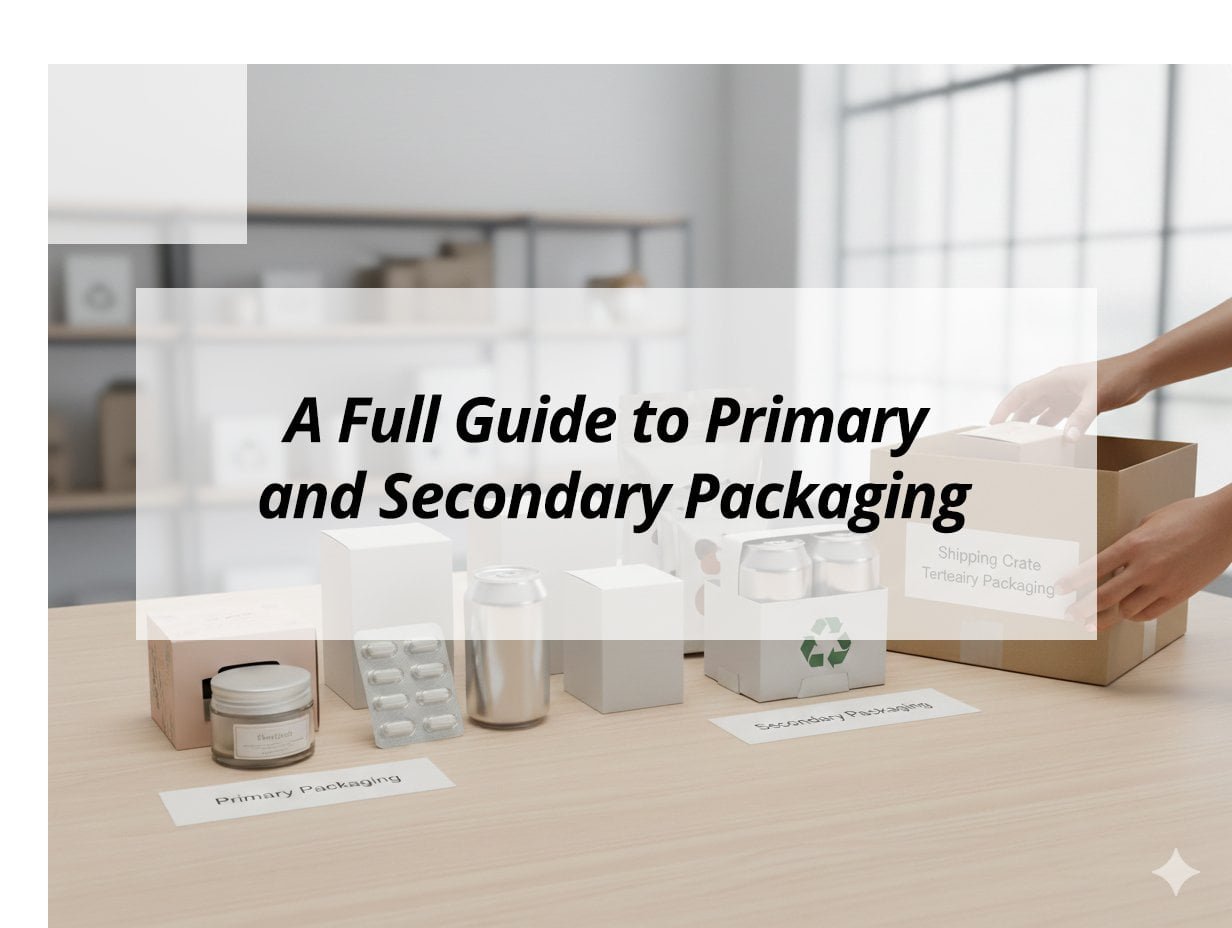
Confused about different packaging types? Understanding primary and secondary packaging is key for product success. This guide will clarify these terms.
Primary packaging directly holds and protects the product, ensuring its integrity and preservation. Secondary packaging then groups these primary units, providing additional protection during transit and supporting brand presentation for consumers.
Packaging is more than just a box. It protects, informs, and sells. From the moment a product is made until it reaches the customer, packaging plays a big role. This article will explore the different types and their importance.
What is primary and secondary packaging?
Do you know the difference between primary and secondary packaging? These terms are often confused. Understanding them is crucial for product design. It also helps with logistics.
Primary packaging is the material that first covers the product. It is in direct contact. Secondary packaging bundles primary packages. It offers extra protection. It also helps with branding and display.
Primary packaging1 forms the initial layer around a product. For instance, a tube designed for lipstick is primary packaging. Its primary function is to safeguard the product. This includes protecting it from physical harm. It also prevents contamination. This layer is essential for maintaining product integrity. Secondary packaging2 then encloses these primary packages. An example is a paperboard box holding several lipstick tubes. This box provides an additional layer of protection. It also groups multiple primary packages. This facilitates easier handling. It is also important for transportation.
Primary Packaging: The First Layer
Primary packaging is fundamental. It directly interacts with the product contents.
- Protection: It keeps the product safe from physical damage. It also guards against external factors. This includes light, air, and moisture.
- Containment: It effectively holds the product. This prevents leaks or spills. This is particularly important for liquid or semi-liquid products.
- Information: It often carries essential product information. This includes ingredients and usage instructions.
- User Experience: This is the part of the package the customer first encounters. It influences their initial perception of the product.
Secondary Packaging: Beyond the First Layer
Secondary packaging serves distinct purposes. It does not come into direct contact with the product.
- Grouping: It combines multiple primary packages. This streamlines handling. It also assists with retail presentation.
- Protection: It provides an additional layer of protection during transit. This shields the primary packaging from potential damage.
- Branding: It offers more surface area for branding elements and marketing messages. This enhances visual appeal on shelves.
- Logistics: It simplifies shipping and storage processes. It makes inventory management more efficient for businesses.
| Aspect | Primary Packaging | Secondary Packaging |
|---|---|---|
| Contact | Direct contact with product | No direct contact with product |
| Purpose | Protects, preserves, contains | Groups, protects primary packages, branding |
| Examples | Lipstick tube, cream jar | Cardboard box, shrink wrap |
| Consumer Role | Touched directly by consumer | Removed before product use |
Both primary and secondary packaging are critical for product security during delivery. They also contribute to successful market placement.
What are the 7 types of packaging with examples?
Are you aware of the many forms packaging can take? Beyond primary and secondary, diverse types exist. Knowing these helps in selecting suitable packaging solutions.
The 7 types of packaging include primary, secondary, tertiary, consumer, industrial, flexible, and rigid packaging. Each serves specific functions. They range from direct product containment to large-scale shipping.
Packaging encompasses a wide range of materials and applications. Categorizing packaging helps clarify its various roles based on function, material, or intended use. This classification aids businesses in organizing products for storage, transport, and retail. It also influences how products are presented to consumers. Different packaging types are chosen to meet varied product and market requirements. This includes robust solutions for industrial use and aesthetically focused options for consumer goods.
Understanding the Seven Categories
These categories define different packaging roles.
- Primary Packaging: This is the initial layer in direct contact with the product.
- Example: A bottle containing shampoo.
- Secondary Packaging: This bundles primary packages. It adds protection and branding.
- Example: A carton holding a single perfume bottle.
- Tertiary Packaging: This is designed for bulk handling and shipping. It consolidates multiple secondary packages.
- Example: A large corrugated box containing several cases of product.
- Consumer Packaging: This targets the end-user. It prioritizes appeal and convenience.
- Example: A decorative box for a gift set of cosmetics.
- Industrial Packaging: This is used for business-to-business shipping of large quantities. Its focus is protection and efficiency.
- Example: Large drums for bulk chemicals.
- Flexible Packaging: This utilizes pliable materials. It includes items like pouches and bags.
- Example: A resealable pouch for a face mask.
- Rigid Packaging: This uses firm materials. It offers strong, structural protection.
- Example: A glass jar for face cream.
Choosing the Right Type
Selecting the correct packaging type involves several considerations.
- Product Form: Liquids, powders, or solids each require specific containment.
- Protection Needs: Fragile or sensitive items necessitate stronger packaging solutions.
- Shipping Requirements: Long-distance or complex logistics demand robust tertiary packaging.
- Marketing Objectives: Consumer packaging often needs to be visually compelling to attract buyers.
| Packaging Type | Main Purpose | Material Examples |
|---|---|---|
| Primary | Product contact, protection | Glass, plastic, aluminum |
| Secondary | Grouping, branding | Cardboard, shrink wrap |
| Tertiary | Bulk transport, storage | Wood pallets, stretch film |
| Consumer | End-user appeal, convenience | Paperboard, specialty plastics |
| Industrial | B2B transport, heavy duty | Steel drums, large crates |
| Flexible | Lightweight, adaptable | Films, foils, pouches |
| Rigid | Strong protection, fixed shape | Glass, hard plastics, metal cans |
The selection of packaging type is a strategic decision influencing product safety, logistics, and market presence.
What are the 3 P's of packaging?
Have you heard about the 3 P's of packaging? These principles are vital for effective packaging. They guide design and function.
The 3 P's of packaging are Protection, Preservation, and Presentation. These three elements work together. They ensure the product reaches the consumer safely. They also make it appealing.
The 3 P's framework simplifies the overarching goals of packaging. It ensures that all critical aspects are addressed in packaging design and implementation. Protection refers to shielding the product from physical harm. It also involves guarding against environmental factors. Preservation focuses on maintaining the product's quality over time. This includes its freshness, efficacy, and intended characteristics. Presentation addresses the aesthetic appeal of the product. It aims to attract customers and convey brand value. For cosmetic products, all three P's are exceptionally important. A container for lotion must protect the formula. It must preserve its active ingredients. It must also be visually appealing on a retail shelf.
Protection: Guarding the Product
Protection is the fundamental function of packaging.
- Physical Protection: This includes cushioning against impacts. It also means resisting punctures or abrasions during handling and transport.
- Environmental Protection: This shields against damaging external elements. These include light exposure, temperature fluctuations, moisture, and oxygen ingress.
- Security: It provides resistance against tampering. This ensures product integrity and safety for the end-user.
Preservation: Maintaining Quality
Preservation ensures the product's longevity and effectiveness.
- Freshness: Packaging materials can create effective barriers. These barriers prevent spoilage and degradation of contents. This is crucial for perishable or sensitive products.
- Potency: It helps maintain the effectiveness of active ingredients. This ensures that the product performs as intended throughout its shelf life.
- Shelf Life: Appropriate preservation methods extend a product's usable period. This minimizes waste and enhances consumer satisfaction.
Presentation: Attracting the Consumer
Presentation focuses on the visual and informational aspects of packaging.
- Brand Image: Packaging serves as a tangible representation of a brand's identity. It helps build recognition and foster customer loyalty.
- Information: It communicates essential product details. This includes usage instructions, key benefits, and necessary safety warnings.
- Appeal: An attractive and well-designed package captures consumer attention. It influences purchasing decisions. Elements like colors, typography, and imagery are key.
| The 3 P's | Key Objective | Impact on Product/Consumer |
|---|---|---|
| Protection | Prevent damage and contamination | Product arrives intact and safe |
| Preservation | Maintain quality and freshness | Product remains effective and usable for longer |
| Presentation | Attract and inform consumers | Enhances brand value, encourages purchase |
Consideration of these 3 P's is integral to successful packaging development. It ensures a comprehensive approach to product delivery.
What are the FDA regulations for secondary packaging?
Are you aware of the regulations for secondary packaging, particularly from the FDA? Regulatory compliance is crucial. It ensures consumer safety and product accuracy.
The FDA does not directly regulate secondary packaging for cosmetics as strictly as primary packaging. However, secondary packaging must not present false or misleading information. It must also include necessary details, such as ingredient lists, if the primary packaging is too small.
The FDA (Food and Drug Administration) primarily focuses on the safety and efficacy of products themselves. For cosmetics, its main regulatory concern is direct product contact. This falls under primary packaging. Secondary packaging, such as an outer box, does not directly touch the cosmetic. Thus, it is subject to different regulatory considerations. The key principle for secondary packaging under FDA guidance is truthfulness. It must not contain false or deceptive claims. It also serves to convey information that may not fit on the primary container. This ensures consumers receive all vital product details.
Key Aspects of FDA Guidance
Even without direct regulation, secondary packaging fulfills important roles under FDA guidance.
- Absence of Misleading Information: All claims made on secondary packaging must be accurate and substantiated. For example, any sun protection factor (SPF) claim must be verifiable.
- Required Information Conveyance: If the immediate container (primary packaging) is too small, the secondary packaging must display:
- A complete list of ingredients.
- The net quantity of contents.
- The name and business address of the manufacturer or distributor.
- Any necessary cautionary statements or warnings.
- Labeling Integrity: All displayed information must be clear, legible, and durably affixed. It should not be easily removed or obscured.
- Container Safety: Although not in direct contact, the secondary package must not indirectly compromise the primary package. It should not cause any chemical migration or adverse interactions.
Compliance and Best Practices
Adhering to regulatory guidelines is essential for cosmetic brands.
- Accuracy: Rigorously verify all textual and visual content. Ensure it is correct and avoids exaggeration.
- Clarity: Employ clear fonts, appropriate sizing, and sufficient contrast. This makes information accessible and readable.
- Consistency: Information presented on secondary packaging should align with details on primary packaging. It should also match overall product claims.
- Material Safety: Ensure that secondary packaging materials are safe. They should not negatively react with the primary container or contribute to product degradation.
| FDA Focus Area | Application to Secondary Packaging | Example |
|---|---|---|
| Truthfulness | All claims must be accurate | "Hypoallergenic" claim must be verifiable |
| Information | Essential data if primary packaging is small | Full ingredient list on outer box |
| Safety | Must not indirectly harm product | Non-reactive packaging material |
| Legibility | Text must be clear and easy to read | Clear font size for warnings |
Ensuring that both primary and secondary packaging adhere to relevant industry standards helps businesses maintain compliance and build consumer trust.
My Insights: Comprehensive Guide to Primary and Secondary Packaging
Struggling to understand packaging types? Learn the crucial roles of primary and secondary packaging in protecting products and enhancing brand value.
Primary packaging directly contains and protects products, often employing bottles, tubes, or jars. Secondary packaging groups these items for easier handling and transport, utilizing boxes and cartons to enhance branding and logistics efficiency.
Understanding the Roles of Primary and Secondary Packaging
Core Definitions:
-
Primary Packaging:
- The immediate layer in contact with the product, ensuring its safety and integrity.
- Examples include plastic bottles, glass jars, and metal cans.
-
Secondary Packaging:
- The outer layer grouping primary packs for transport and retail.
- Includes corrugated boxes, shrink wraps, and display trays.
Key Differences:
| Dimension | Primary Packaging | Secondary Packaging |
|---|---|---|
| Product Contact | Direct (e.g., bottle, pouch) | No direct contact; surrounds primary packs |
| Main Purpose | Protects product quality and usability | Facilitates storage, transport, and retail display |
| Typical Materials | Glass, plastic, metal, paperboard | Corrugated board, cartons, shrink film |
Functional Roles:
- Primary Packaging: Ensures barrier properties and meets regulatory requirements, enhancing consumer experience through visual appeal and functionality.
- Secondary Packaging: Optimizes distribution efficiency and enhances shelf visibility, supporting logistics and promotional efforts.
Understanding these packaging dynamics helps businesses choose materials and designs that align with product needs and sustainability goals.
Conclusion
Primary packaging directly holds the product for protection and preservation. Secondary packaging groups these items, offering added protection and branding. Both are critical for product integrity and market success.