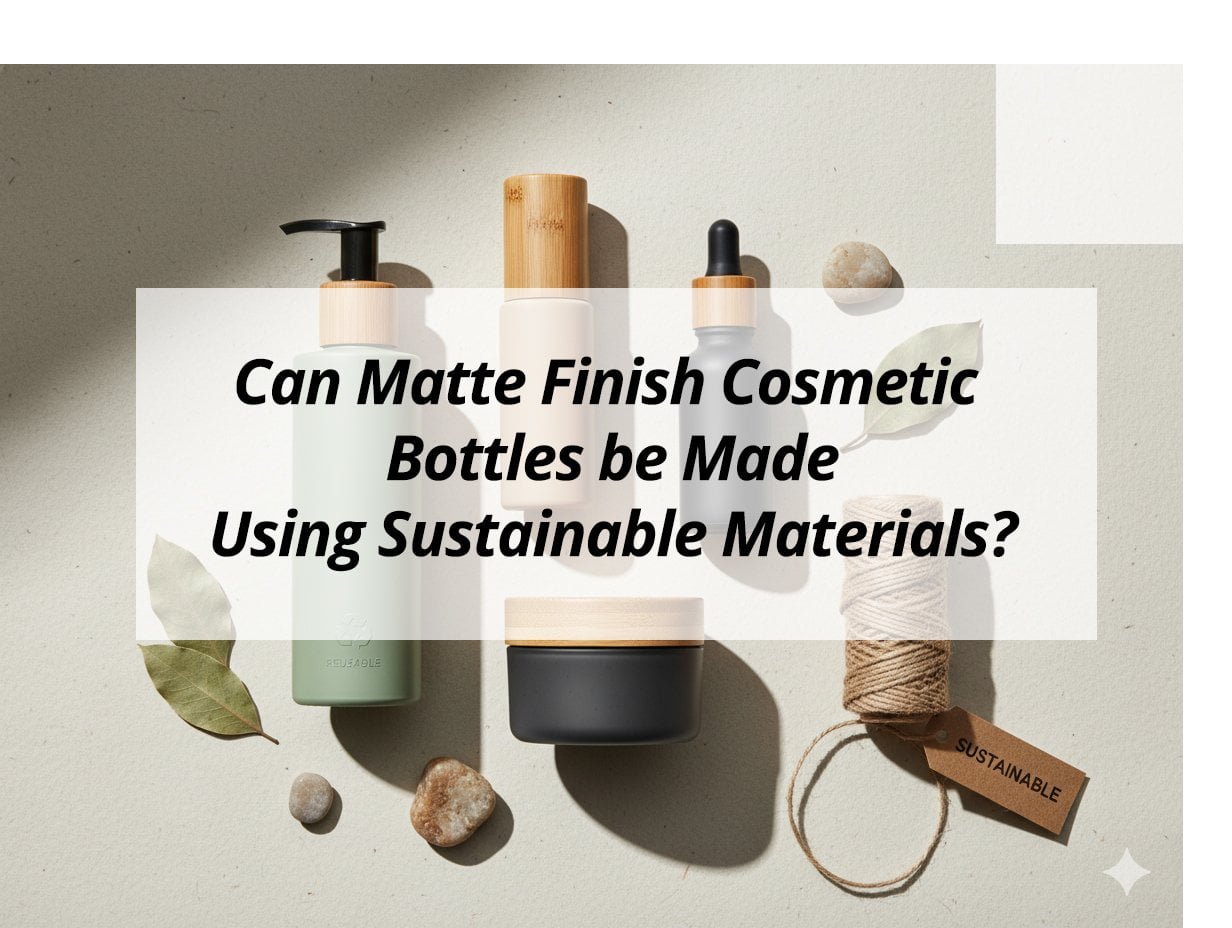
Cosmetic brands seek sustainable, elegant packaging. Advanced materials now deliver matte finishes combining visual sophistication with environmental responsibility.
Yes, cosmetic bottles with a matte finish can be produced using sustainable materials. This is accomplished through the use of materials such as Post-Consumer Recycled (PCR) plastics, bio-based polymers, glass, and aluminum. These materials are often coupled with eco-friendly coatings or surface treatments that impart the desired matte appearance without compromising environmental objectives.
Cosmetic brands embrace sustainable packaging, driven by eco-conscious consumers and regulations demanding lower environmental impact throughout product lifecycles.
What is the most eco-friendly packaging for cosmetics?
Determining the single "most" eco-friendly packaging1 for cosmetics involves evaluating various factors, including recyclability, recycled content, renewability, and energy consumption during production. The optimal choice often depends on the specific product requirements and the desired environmental benefits.
The most eco-friendly packaging for cosmetics typically involves materials that feature high recyclability, significant recycled content, or are sourced from renewable resources, thereby minimizing their environmental footprint. Glass, aluminum, and certain types of PCR plastics are frequently highlighted as leading options due to their capacity to reduce waste, conserve virgin resources, and support circular economy principles.
The emphasis in sustainable packaging development is on materials that offer clear environmental advantages. For instance, utilizing PCR plastic for a shampoo bottle or a soap bottle directly contributes to waste reduction by repurposing existing plastic. This approach supports brands in marketing their products with verifiable environmental claims.
How are eco-friendly packaging materials evaluated?
The assessment of environmentally friendly packaging materials involves a comprehensive approach. Multiple criteria are considered to understand the total environmental profile of a material.
- Life Cycle Assessment (LCA): This method evaluates the environmental impact of a product from raw material extraction through manufacturing, distribution, use, and disposal.
- Material Origin: Consideration is given to whether materials are derived from recycled sources (e.g., PCR) or renewable resources (e.g., plants).
- Production Energy Demand: The energy required for material processing and packaging manufacturing is a key factor, with lower energy use being preferable.
- End-of-Life Options: The ease of recycling, potential for reuse, or biodegradability of the packaging are critical for minimizing waste.
| Material Category | Environmental Advantage | Potential Limitation | Common Applications |
|---|---|---|---|
| PCR Plastics2 | Reduces reliance on virgin plastics, often recyclable | Recyclability can be complex with mixed polymers | Lotions, creams, shampoo bottle |
| Glass | Infinitely recyclable, inert, premium feel | Heavier, fragile, high energy for initial melt | Serums, high-end creams, some soap bottle |
| Aluminum | Highly recyclable, lightweight, good barrier | Energy-intensive primary production | Sprays, tubes, compacts |
| Bio-based Plastics3 | Sourced from renewable plant matter | May require specific industrial composting | Specialized films, some flexible packaging |
Achieving a matte finish on sustainable materials
A matte finish can be successfully applied to these sustainable materials. Techniques include surface treatments, specialized coatings, or direct molding. For example, PCR plastic can be molded to achieve a matte texture directly, or a low-VOC (Volatile Organic Compound) matte coating can be applied. This ensures that aesthetic preferences can be met without compromising sustainability goals.
Which packaging material is considered most environmentally friendly?
When focusing on the "most" environmentally friendly packaging material, emphasis is typically placed on those that excel in circular economy models. This includes materials that can be continuously recycled or reused without significant loss of quality, thereby preventing them from becoming waste.
Glass and aluminum are frequently cited as the most environmentally friendly packaging materials due to their ability to be recycled indefinitely without degradation, coupled with their high potential for incorporating recycled content. However, Post-Consumer Recycled (PCR) plastics also represent a highly environmentally friendly option, particularly when they effectively displace the need for virgin plastic in high-volume products like a shampoo bottle or soap bottle.
The value of materials with an extended lifecycle is increasingly recognized within the industry. The goal is to minimize waste generation and support a sustainable resource loop.
Why glass and aluminum are often top contenders
Glass and aluminum are highly valued for their recyclability characteristics.
- Glass: It can be recycled repeatedly without any loss in purity or quality, allowing for a true bottle-to-bottle recycling loop. Its inert nature also makes it suitable for various cosmetic formulations.
- Aluminum: This material is also infinitely recyclable and lightweight, which contributes to reduced transportation emissions and costs. It offers excellent barrier properties, protecting product integrity.
The role of PCR plastics
PCR plastics hold significant importance in the shift towards sustainable packaging.
- Waste Diversion: Utilizing PCR plastic directly reduces the volume of plastic waste in landfills and oceans.
- Reduced Carbon Footprint: The production of PCR plastic often requires less energy compared to virgin plastic manufacturing, leading to lower greenhouse gas emissions.
- Material Adaptability: PCR plastic can be engineered for a wide array of packaging types, from small cosmetic jars to larger containers for eco friendly packaging for beauty products.
Balancing material attributes for optimal impact
The selection of sustainable packaging materials involves a careful balance of various factors, including material weight, cost, aesthetic requirements, and overall environmental footprint. For instance, while glass is highly recyclable, its weight can increase transportation-related emissions. PCR plastics are lighter but depend on robust recycling infrastructures.
- For premium products: Glass or aluminum may be chosen for their perceived value and infinite recyclability.
- For high-volume consumer goods: PCR plastic offers a practical balance of sustainability, cost-effectiveness, and functional performance, making it suitable for items such as a shampoo bottle.
Does L'Oréal use sustainable packaging?
Major global brands, such as L'Oréal, have made substantial commitments to advancing sustainable packaging practices4. Their initiatives often serve as benchmarks for the broader industry, demonstrating pathways for both innovation and responsibility.
Yes, L'Oréal has publicly established comprehensive goals for sustainable packaging, emphasizing strategies to increase the incorporation of recycled content (specifically PCR plastics), develop refillable and reusable packaging solutions, and explore bio-based and lightweight materials. These efforts aim to significantly reduce the environmental impact of their extensive range of cosmetic products.
The engagement of leading industry players like L'Oréal in sustainability efforts underscores the mainstream adoption of environmentally conscious practices. Their actions reflect a response to evolving consumer expectations for eco friendly packaging for beauty products.
How large brands implement sustainable packaging strategies
Large brands typically adopt multi-faceted approaches to sustainable packaging.
- Integration of Recycled Materials: L'Oréal targets substantial increases in the use of recycled or bio-based plastics in their packaging, including bottles for shampoo and other liquid products.
- Development of Refill Systems: The introduction of refillable packaging allows consumers to reuse primary containers, thereby reducing the consumption of new packaging materials.
- Lightweighting Initiatives: Reducing the mass of packaging materials minimizes resource consumption and lowers carbon emissions associated with transportation.
- Exploration of Bio-based Alternatives: Research and implementation of plastics derived from renewable plant sources are underway to decrease reliance on petrochemicals.
Implications for packaging manufacturers
For packaging manufacturers, these industry trends necessitate continuous innovation and adherence to high standards. This involves:
- Material Innovation: Researching and offering advanced sustainable materials and processing techniques.
- Quality Assurance: Ensuring that sustainable packaging solutions meet rigorous quality specifications, including aesthetic requirements like a matte finish.
- Certification and Transparency: Providing verifiable certifications and clear documentation for sustainable materials to build trust and support brand claims.
How to make environmentally friendly packaging?
Creating environmentally friendly packaging involves a holistic approach, encompassing material selection, design optimization, and manufacturing processes. It represents a continuous effort to minimize environmental impact throughout the packaging lifecycle.
To produce environmentally friendly packaging, prioritize materials that are recycled (e.g., PCR plastics for a shampoo bottle5), readily recyclable, or derived from renewable sources. Implement designs that reduce material usage, enable refillability or reusability, and optimize for efficient production. Additionally, ensure transparent sourcing, minimize waste in manufacturing, and provide clear consumer guidance for proper end-of-life disposal or recycling.
The objective is to integrate practical and sustainable solutions across all stages of packaging development. This involves making informed decisions that contribute to a positive environmental outcome.
Core principles for developing eco-friendly packaging
Several key areas are central to the creation of environmentally responsible packaging.
- Strategic Material Selection:
- Maximizing Recycled Content: Employing Post-Consumer Recycled (PCR) materials whenever feasible. Using PCR plastic for a soap bottle6, for example, directly diverts waste from landfills.
- Ensuring Recyclability: Designing packaging that is compatible with existing recycling infrastructures. This often means avoiding complex multi-material constructions.
- Considering Renewable Resources: Investigating and utilizing materials derived from sustainably managed plant sources.
- Adopting Mono-material Design: Packaging made from a single type of plastic (e.g., entirely PET or entirely PP) simplifies the recycling process significantly.
| Packaging Component | Preferred Eco-friendly Option | Environmental Benefit |
|---|---|---|
| Bottles/Jars | PCR PET, PCR PP, Glass, Aluminum | Reduced virgin material, high recyclability |
| Caps/Closures | PCR PP, designs made from a single type of plastic | Enhances overall package recyclability |
| Labels | Recycled paper, easily removable, or water-soluble labels | Facilitates material recovery |
| Pumps/Sprayers | Designs featuring fewer material types, refillable units | Reduces complex plastic waste |
Sustainable Design Methodologies
Design principles play a crucial role in enhancing environmental performance.
- Lightweighting: Reducing the amount of material used in packaging while maintaining functional integrity. Lighter packaging leads to less material consumption and lower transportation emissions.
- Design for Refill and Reuse: Developing packaging systems that allow consumers to easily refill or reuse containers. This is a significant factor in eco friendly packaging for beauty products7.
- Simplification of Components: Minimizing the number of separate parts in a package to improve manufacturing efficiency and ease of recycling.
Sustainable Production and Logistics
Environmental considerations also extend to manufacturing and supply chain processes.
- Energy Efficiency in Manufacturing: Implementing energy-saving technologies and practices in production facilities.
- Waste Reduction in Production: Minimizing material scrap and waste generation during the manufacturing and assembly stages.
- Logistics Optimization: Planning efficient transportation routes and maximizing packaging density to reduce fuel consumption and emissions.
By integrating these strategies, it is possible to develop environmentally friendly packaging solutions that also meet the aesthetic demands, such as a matte finish, of the cosmetic industry.
My Insights: Sustainable Materials for Matte Finish Cosmetic Bottles
Concerned about the environmental impact of cosmetic bottles? Learn how sustainable materials can achieve a matte finish.
Matte finish cosmetic bottles can be sustainably produced using recycled plastics, glass, bamboo, and plant-based resins. These materials offer eco-friendly options without sacrificing aesthetic appeal or functionality, appealing to eco-conscious consumers and complying with environmental regulations.
Exploring Sustainable Options for Matte Finish Bottles
Sustainable Material Choices:
- Recycled Plastics: Options like post-consumer resin (PCR) and HDPE allow for matte finishes without new plastic production.
- Biodegradable Options: Cornstarch, sugarcane-based plastics, and Sulapac materials support matte textures with lower carbon footprints.
- Natural Materials: Bamboo and recycled glass can naturally achieve matte finishes and are recyclable.
Techniques for Matte Effects:
- Spray Painting: Eco-friendly paints can create matte finishes on recycled or biodegradable materials.
- Coating Methods: Vacuum coating and oxidization provide matte textures while preserving UV protection and durability.
Benefits and Consumer Appeal:
- Eco-Conscious Design: Using sustainable materials cuts waste and aligns with regulations like EU plastic mandates.
- Enhanced Brand Image: These materials maintain quality while appealing to environmentally aware consumers.
| Material Type | Sustainability Benefit |
|---|---|
| Recycled Plastics | Reduces virgin plastic use and waste. |
| Biodegradable Plastics | Lowers carbon footprints and enhances biodegradability. |
| Natural Materials | Supports recycling and premium aesthetics. |
By integrating these sustainable materials, brands can create attractive, eco-friendly matte finish bottles that resonate with today's eco-conscious market.
Conclusion
Matte finish cosmetic bottles can be sustainably produced. This involves careful material selection, such as PCR plastics, glass, or aluminum, combined with optimized design. The approach allows for both sophisticated aesthetics and a reduced environmental footprint.
-
Explore innovative solutions in eco-friendly packaging that can help reduce environmental impact. ↩
-
Discover how PCR plastics contribute to sustainability in cosmetic packaging. ↩
-
Understand how bio-based plastics can reduce reliance on fossil fuels. ↩
-
Stay updated on innovative practices that brands are adopting for sustainability. ↩
-
Explore how PCR plastics can reduce waste and promote sustainability in shampoo packaging. ↩
-
Learn about the environmental impact of using PCR plastics in soap packaging and its benefits. ↩
-
Discover effective strategies for creating sustainable packaging solutions in beauty products. ↩