
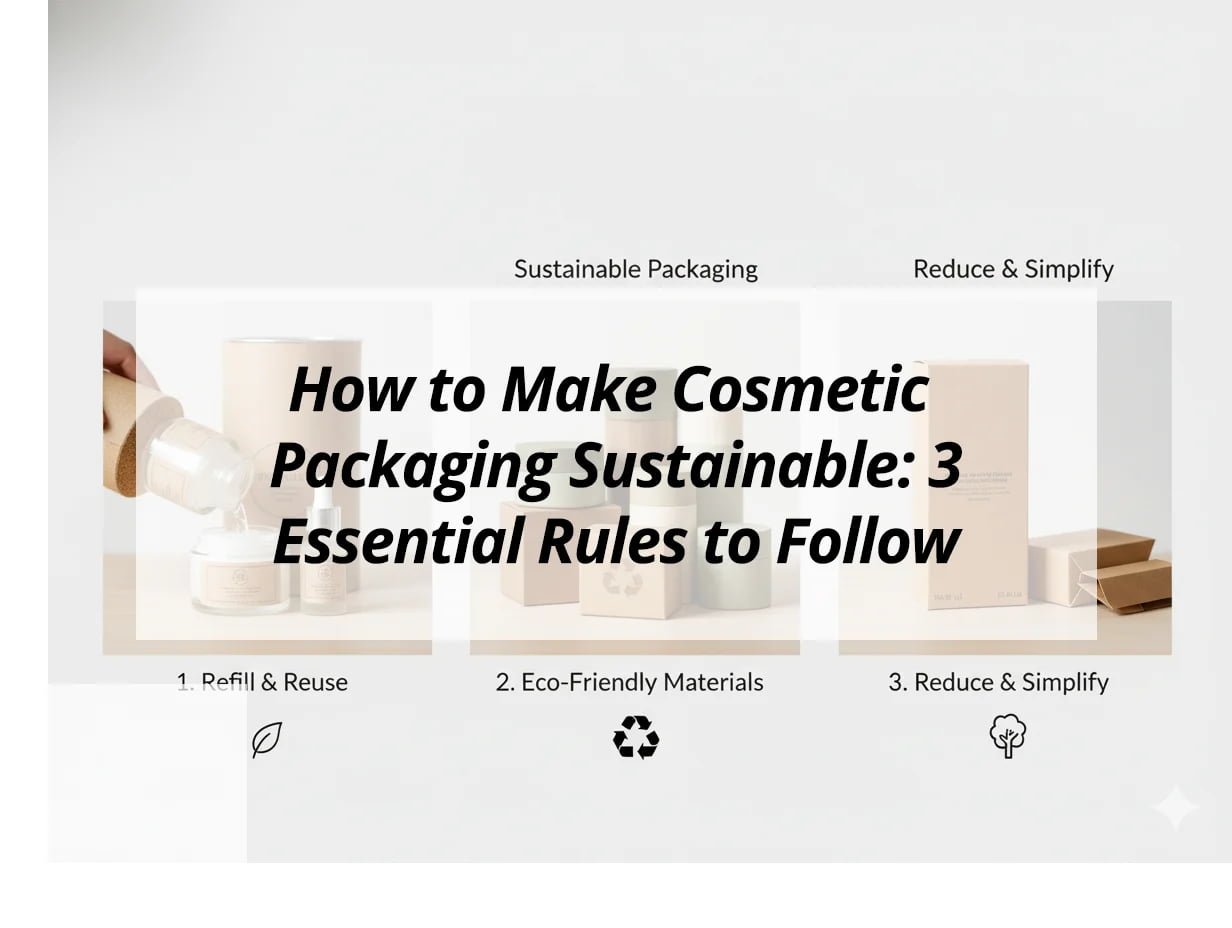
The cosmetic industry faces a big challenge. Brands want great packaging. They also need it to be good for the planet. How can we do both effectively?
To make cosmetic packaging sustainable, companies must focus on three essential rules: choosing eco-friendly materials, designing for circularity (like reuse or recycling), and educating consumers on proper disposal. These rules help reduce environmental impact from production to post-consumer life, creating truly responsible packaging solutions.
This guide will break down key concepts. It will show how to apply these rules. We will look at different strategies and principles. This helps ensure packaging choices support a greener future.
What are the 3 C's of packaging?
When thinking about packaging, people often talk about the 3 C's. What do these mean for us in cosmetics? It helps set a clear standard for quality and function.
The 3 C's of packaging typically refer to "Containment, Protection, and Convenience." For cosmetic packaging, this means the package must safely hold the product, shield it from damage and contamination, and be easy for consumers to use and handle. These factors are critical for product integrity and consumer satisfaction.
Understanding these fundamentals is the first step. Before we even think about sustainability, the packaging must do its basic job. If it fails here, nothing else matters.
Containment: Holding the Product Securely
The primary job of any package is to hold its contents. This is especially true for cosmetics.
- Purpose: To prevent leakage or spillage.
- Details: This includes liquids like lotions, creams, and powders.
- Importance: A good seal is crucial. It keeps the product inside.
- Material Choice: Different materials work better for different products.
- Example: Glass jars for thick creams, plastic tubes for lotions.
- Consideration: The material must not react with the cosmetic formula.
For instance, a lipstick tube must hold the solid lipstick firmly. A lip gloss tube must prevent the liquid from leaking out. These are simple but vital examples of containment.
Protection: Keeping the Product Safe and Fresh
Beyond holding, packaging must protect. Cosmetics need protection from many things.
- Physical Protection: Guards against bumps and drops.
- Details: This is important during shipping and daily use.
- Importance: Prevents breakage and product damage.
- Environmental Protection: Shields from light, air, and moisture.
- Example: Opaque bottles protect light-sensitive ingredients.
- Consideration: Airless pumps keep air out, maintaining product freshness.
When we talk about sustainable skincare packaging, effective protection also means preventing product waste. A damaged or spoiled product is not sustainable.
Convenience: Easy for the User
Packaging should be easy to use. Consumers expect a good experience.
- Usability: How easy is it to open, dispense, and close?
- Details: Think about pump bottles, twist-up mechanisms, or screw caps.
- Importance: A frustrating package leads to a bad user experience.
- Portability: Is it easy to carry or store?
- Example: Compact designs for travel, stable bases for vanity tables.
- Consideration: Weight and size play a role here.
A good eco friendly container for cosmetics is also a convenient one. If it is hard to use, people will not choose it, regardless of its green credentials.
How to make packaging more sustainable?
Many businesses want to improve their environmental impact. A key question arises: "How can we truly make packaging more sustainable?" This requires clear actions and choices.
To achieve more sustainable packaging, companies should prioritize using recycled or renewable materials, design for multiple uses or easy recycling, minimize overall material consumption, and optimize transport efficiency. These steps reduce resource depletion, lower carbon emissions, and decrease waste throughout the packaging's lifespan.
This involves looking at every stage of the packaging journey. From the very start of design to what happens after a consumer uses the product. Each stage offers a chance to make a difference.
Choosing Responsible Materials
The materials we use are fundamental. They set the groundwork for sustainability.
- Recycled Content: Using materials that have been used before.
- Example: Post-Consumer Recycled (PCR) plastic or recycled glass.
- Benefits: Reduces demand for new raw materials, lowers energy use in production.
- Renewable Resources: Materials from natural sources that can grow back.
- Example: Bamboo, paper, or bio-plastics made from corn or sugarcane.
- Benefits: Less reliance on fossil fuels, supports agricultural industries.
- Biodegradable/Compostable: Materials that break down naturally.
- Example: Some types of bioplastics.
- Consideration: Requires specific conditions to degrade properly; industrial composting might be needed.
For sustainable skincare packaging, selecting the right material is a big decision. It impacts the entire product lifecycle.
Designing for Circularity
Packaging should be part of a loop, not a one-way street to waste. This is circular design.
- Refillable Systems: Packaging meant to be refilled again and again.
- Mechanism: A durable outer component with replaceable inner cartridges or pouches.
- Benefits: Drastically cuts down on packaging waste.
- Reusable Packaging: Containers designed for consumers to reuse at home.
- Example: Jars or bottles that can be cleaned and refilled by the consumer with a new product.
- Benefits: Extends the life of the package, reduces frequent purchases.
- Recyclable Design: Making packaging easy for recycling facilities to process.
- Details: Using mono-materials (single type of plastic/glass), avoiding glues, clear labels.
- Importance: Increases the chance that the packaging will actually be recycled.
| Design Strategy | Description | Impact on Sustainability |
|---|---|---|
| Mono-material | Using a single type of plastic, glass, or metal for the entire package. | Simplifies sorting and reprocessing at recycling plants. |
| Modularity | Designing components that can be easily separated or replaced. | Supports refill systems and easier material separation for recycling. |
| Lightweighting | Reducing the amount of material used in the package without losing strength. | Lowers resource consumption and transportation emissions. |
These design choices are crucial for making eco friendly containers for cosmetics truly effective.
Minimizing and Optimizing
Less is often more in sustainable packaging. We look for ways to reduce and optimize.
- Reduce Excess Packaging: Remove unnecessary layers or components.
- Example: Eliminating outer cartons when not strictly needed for protection.
- Benefit: Saves materials and reduces waste at the consumer end.
- Optimize Size and Shape: Design packaging to fit products precisely.
- Detail: Maximizing units per shipping carton.
- Benefit: Reduces empty space, lowering transport costs and emissions.
These steps help create efficient packaging that is lighter on the planet.
What are the 5 R's of sustainable packaging?
The concept of the 5 R's gives a clear framework. It guides decisions towards more sustainable practices. What does this framework include? It helps businesses apply principles effectively.
The 5 R's of sustainable packaging are typically "Refuse, Reduce, Reuse, Recycle, and Rot (Compost)." This framework provides a hierarchical approach to minimizing environmental impact, encouraging us to first avoid unnecessary packaging, then use less, extend product life, process materials for new uses, and finally, return organic materials to the earth.
This hierarchy is important. It tells us which actions have the biggest impact. We should always try to move up the chain, starting with refusing and reducing.
Refuse: Say No to Unnecessary Packaging
The first and most impactful step is to avoid packaging altogether.
- Meaning: Do not use packaging that is not needed.
- Example: Rejecting excess plastic wrap or unnecessary boxes.
- Benefit: Prevents waste from being created in the first place.
- Business Application: Brands can question if a secondary package is truly essential.
- Consideration: Does this extra layer add value or just waste?
This is a powerful first step for any sustainable skincare packaging strategy.
Reduce: Use Less Material
If packaging is needed, use as little as possible.
- Meaning: Minimize the amount of material in each package.
- Example: Lightweighting bottles, using thinner films, optimizing designs.
- Benefit: Conserves resources and reduces the energy needed for production and transport.
- Practical Steps: Evaluate every component for material reduction potential.
- Detail: Can a cap be smaller? Can the walls of a jar be thinner?
Reducing material directly lowers the environmental footprint of eco friendly containers for cosmetics.
Reuse: Design for Multiple Uses
Design packaging to be used many times.
- Meaning: Create durable containers that consumers can refill or repurpose.
- Example: Refillable lotion bottles, glass jars that become storage containers.
- Benefit: Extends the lifespan of the packaging, significantly reducing waste.
- Business Model: Offer refill pouches or bulk options.
- Consideration: Encourage consumers to return or refill containers.
This strategy is gaining popularity and is a strong component of sustainable packaging.
Recycle: Turn Used Materials into New Products
When packaging cannot be reused, make sure it can be recycled.
- Meaning: Process used materials to create new products.
- Example: Plastic bottles become new plastic bottles, glass becomes new glass.
- Benefit: Saves raw materials and reduces landfill waste.
- Design Focus: Ensure packaging is easily recyclable.
- Details: Use widely accepted materials, avoid mixed materials, provide clear instructions.
Effective recycling is a cornerstone of circular economy models for packaging.
Rot (Compost): Return to the Earth
For organic materials, composting is the final step.
- Meaning: Allow organic packaging to break down into nutrient-rich soil.
- Example: Packaging made from certain bioplastics or plant-based materials.
- Benefit: Creates valuable compost, avoids landfills.
- Requirement: Often needs industrial composting facilities.
- Consideration: Not all "biodegradable" materials compost easily at home.
This option is for specific types of materials and products.
What are the 7 R's of sustainable packaging?
Building on the 5 R's, some expand the framework to the 7 R's. What additional principles are included? This offers an even more detailed approach to sustainability.
The 7 R's of sustainable packaging typically add "Rethink" and "Repair" to the existing "Refuse, Reduce, Reuse, Recycle, and Rot" framework. "Rethink" encourages fundamental re-evaluation of packaging needs and design, while "Repair" applies to durable goods that might be part of a packaging system. This expanded model provides a more comprehensive guide for achieving environmental responsibility.
These extra R's emphasize proactive thinking and extending the life of products and packaging even further. They highlight a holistic view of sustainability.
Rethink: Fundamental Re-evaluation
This R comes first in a sense. It means going back to the drawing board.
- Meaning: Question everything about the packaging.
- Example: Do we even need packaging for this product? Can the product itself be different?
- Benefit: Leads to truly innovative and impactful solutions.
- Application: It means challenging old assumptions.
- Consideration: Could we deliver this product in a completely new way?
Rethink is about innovating to avoid packaging problems from the start.
Repair: Extend Product Life (for packaging components)
This R applies more to durable goods. However, it can relate to packaging systems.
- Meaning: If a durable packaging component breaks, can it be fixed instead of thrown away?
- Example: A complex, high-value dispenser or pump might be designed for repair.
- Benefit: Avoids replacement and new material production.
- Relevance to Cosmetics: Less direct for single-use packaging.
- Consideration: More relevant for long-life primary packaging in refill systems.
While less common for everyday cosmetic packaging, repair adds to the circularity principle for more permanent parts.
The Original 5 R's (Revisited for Context)
The core 5 R's still form the backbone.
- Refuse: Avoid packaging entirely when possible.
- Reduce: Minimize material use if packaging is necessary.
- Reuse: Design packaging for multiple uses.
- Recycle: Ensure packaging can be processed into new materials.
- Rot (Compost): For organic materials, facilitate natural decomposition.
These principles remain essential guides for designing sustainable skincare packaging and eco friendly containers for cosmetics.
Holistic Approach to Sustainability
Using all R's gives a complete picture. It helps companies make the best decisions.
| R-Principle | Primary Focus | Goal |
|---|---|---|
| Rethink | Challenging fundamental assumptions about packaging. | Radical innovation and problem prevention. |
| Refuse | Avoiding unnecessary packaging. | Eliminating waste generation from the start. |
| Reduce | Minimizing material quantity in packaging. | Conserving resources and lowering production impacts. |
| Reuse | Designing for repeated use of packaging. | Extending package lifespan and reducing new material demand. |
| Repair | Fixing durable components rather than replacing them. | Maximizing utility of long-life packaging elements. |
| Recycle | Processing used materials into new ones. | Resource recovery and reduction of landfill waste. |
| Rot | Composting organic packaging materials. | Nutrient cycling and organic waste diversion. |
By applying these principles, businesses can build a truly comprehensive approach to sustainable packaging.
My Insights: Achieving Sustainable Cosmetic Packaging
Struggling with sustainable packaging choices? Discover the key rules to make your cosmetic packaging eco-friendly and appeal to green-conscious consumers.
Sustainable cosmetic packaging involves using recyclable materials, minimizing packaging size, and designing for end-of-life recyclability. Employing reusable solutions and eco-friendly inks further reduces environmental impact, aligning with consumer expectations for green products.
Essential Rules for Sustainable Cosmetic Packaging
Rule 1: Select Recyclable Materials
- Key Materials: Use glass, aluminum, and PCR plastics that integrate easily into recycling systems, promoting circular economies.
- Benefits: Reduce reliance on virgin resources and decrease carbon footprints.
Rule 2: Minimize and Lightweight Packaging
- Approach: Adopt minimalist designs, reduce material thickness, and explore refillable formats.
- Impact: Decrease waste, improve resource efficiency, and comply with regulations like Extended Producer Responsibility (EPR).
Rule 3: Design for End-of-Life
- Strategies: Incorporate biodegradable materials and clear recycling labels to ensure lifecycle sustainability.
- Consumer Engagement: Use symbols or QR codes to educate consumers on proper disposal methods.
| Rule | Key Actions | Benefits |
|---|---|---|
| Recyclable Materials | Use glass, aluminum, PCR plastics | Supports circular economies |
| Minimize Packaging | Lightweighting, minimalist design | Reduces waste and emissions |
| End-of-Life Design | Biodegradable options, clear labeling | Enhances recyclability and consumer support |
Implementing these strategies ensures your cosmetic packaging is both sustainable and aligned with contemporary consumer values.
Conclusion
Making cosmetic packaging sustainable involves more than just one action. It requires following rules like the 3 C's and applying principles like the 5 or 7 R's. By choosing smart materials, designing for circularity, and educating users, we can make packaging better for everyone.