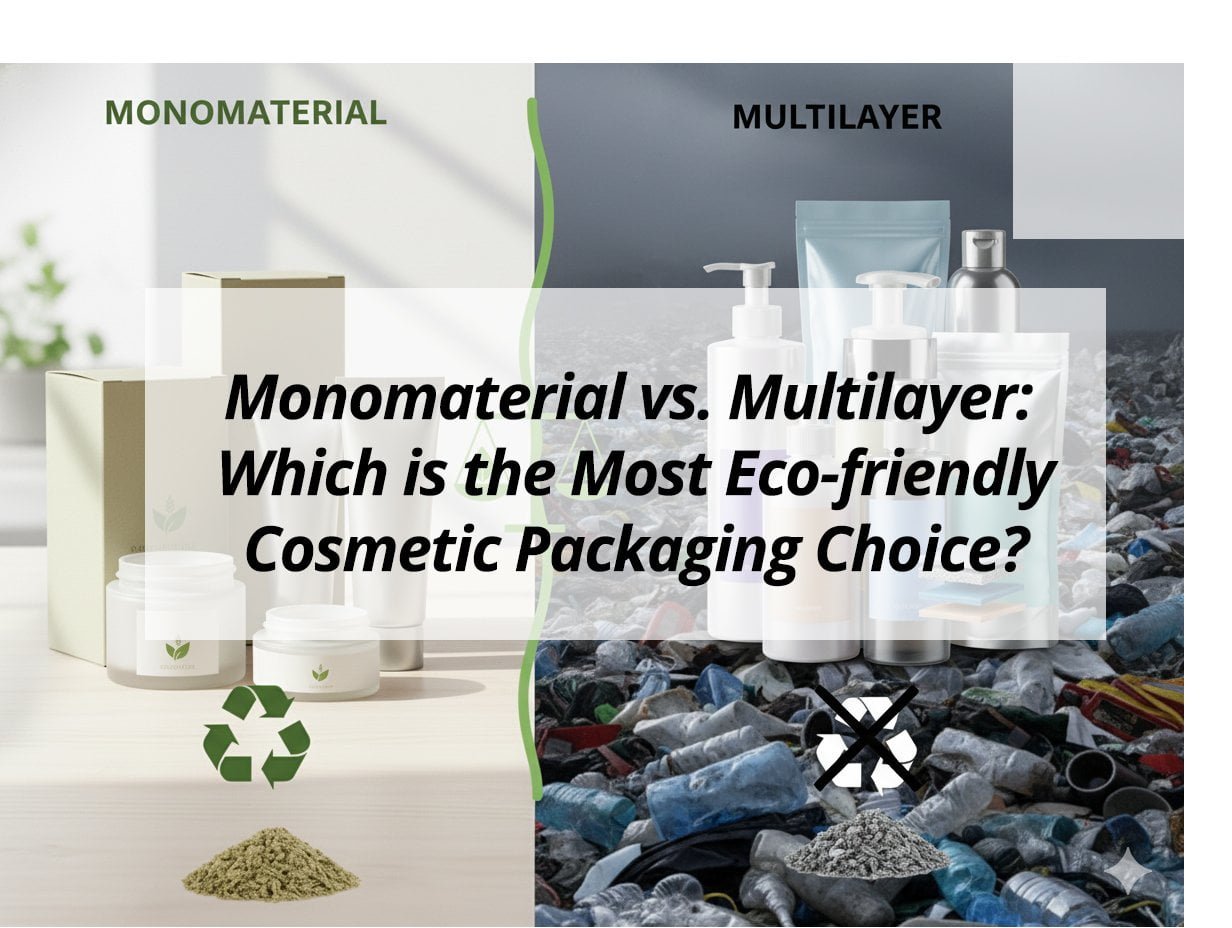
In a world increasingly focused on environmental impact, cosmetic brands face pressure to choose sustainable packaging. As consumers demand more eco-friendly options, the choice between monomaterial and multilayer packaging becomes critical.
The eco-friendliness of monomaterial versus multilayer packaging varies based on recyclability and lifecycle impacts. Monomaterial offers simplicity in recycling, while multilayer enhances product protection and longevity. Understanding each option's environmental benefits helps brands align with sustainability goals.
Selecting the right packaging affects both brand reputation and the planet. Exploring these options provides valuable insights into their respective advantages and challenges.
What type of packaging is most environmentally friendly?
Choosing environmentally friendly packaging requires careful consideration of material and design.
Monomaterial packaging is often considered more eco-friendly due to its recyclability. Using a single material simplifies the recycling process, reducing contamination risks. This supports a circular economy, lessening environmental burdens. However, its application depends on product needs and market demands.
While monomaterial solutions offer straightforward recycling, they may face limitations in performance. Understanding their benefits and drawbacks is essential for making informed choices.
Exploring Monomaterial Packaging
Monomaterials bring simplicity and recyclability but face trade-offs in versatility:
-
Recyclability: Employing one material increases ease of recycling, though it may require specific waste streams.
-
Design Simplicity1: Reduces sorting and waste management challenges by using homogenous materials.
-
Limitations: May lack certain protective qualities essential for preserving sensitive products.
Adopting monomaterials aligns with sustainability and operational simplicity but requires careful consideration of product compatibility.
What are the advantages of multilayer packaging?
Multilayer packaging offers significant benefits in terms of functionality and product protection.
Multilayer packaging excels at offering tailored protection and enhancing product longevity. With different layers serving specific purposes, it offers moisture barriers and UV protection, effectively extending shelf life. This makes it crucial for products needing robust preservation, balancing sustainability with practicality by reducing waste from spoilage.
The complexity of multilayer packages means they serve essential roles in maintaining product integrity, which supports a broader sustainability narrative.
Delving into Multilayer Benefits
Multilayer solutions are pivotal for certain cosmetic products requiring specialized protection:
-
Enhanced Protection2: Offers comprehensive security against moisture, oxygen, and other environmental factors, safeguarding product quality.
-
Shelf Life Extension3: Reduces product waste by maintaining its efficacy, which contributes positively to sustainability goals.
-
Functional Variability4: Combines materials like polymers and foils to meet specific needs, such as light blocking or aroma preservation.
| Benefit | Explanation |
|---|---|
| Barrier Performance | Superior defense against moisture, customized for sensitivity-specific products |
| Versatility | Different layers cater to precise functional needs |
| Application | Ideal for integrating robust preservation techniques into packaging |
What type of packaging material should be used for sustainability?
Selecting sustainable packaging materials requires foresight and consideration for their lifecycle impact.
Using recyclable and biodegradable materials supports sustainability in packaging. Materials like PET and PLA provide eco-friendly options, aiding in closed-loop systems. They offer the potential for either recycling or composting, aligning well with green initiatives and reducing environmental burdens associated with waste.
Deciding on sustainable materials involves identifying what complements product needs without compromising eco-responsibility.
Going Deeper into Sustainable Choices
Understanding sustainable material properties can optimize packaging strategies:
PET (Polyethylene Terephthalate)
-
Recyclability: Highly accepted and processed at recycling facilities worldwide.
-
Durability & Clarity: Offers strength without sacrificing aesthetic appeal, suitable for clear containers.
PLA (Polylactic Acid)
-
Biodegradability: Compostable, making it a valuable option for reducing landfill contributions.
-
Renewable Resource: Sourced from plant-based materials, promoting renewable resource utilization.
-
Trade-offs: While biodegradable, PLA may require industrial composting to degrade effectively.
| Material | Recyclability | Biodegradability | Suitability |
|---|---|---|---|
| PET | Very High | No | Bottles, containers |
| PLA | Moderate | Yes | Compostable alternatives |
What packaging is better for the environment than traditional packaging?
Embracing modern packaging innovations can significantly enhance environmental responsibility.
Eco-friendly alternatives5, including recyclable, biodegradable, and reusable packaging, surpass traditional packaging in reducing environmental impact. These choices decrease carbon footprints and improve resource efficiency, combining utility with sustainability, which is crucial for meeting global environmental standards.
Transitioning from conventional to sustainable packaging is essential in today's environmentally focused landscape.
Examining Eco-friendly Innovations
Modern packaging solutions offer alternatives vastly superior to traditional methods:
-
Recyclable Options: Facilitate material reuse and reduce the need for new raw inputs, exemplified by materials like aluminum and paper.
-
Biodegradable Solutions: Products naturally decompose post-use, minimizing landfill impact.
-
Reusable Designs: Encourage repeated use, such as refillable and modular containers, enhancing long-term sustainability.
Eco-friendly initiatives reflect a brand's dedication to sustainability, influencing consumer perceptions and encouraging environmentally conscious purchasing decisions.
My insights: Monomaterial vs. Multilayer Cosmetic Packaging
Concerned about the environmental impact of cosmetic packaging? Discover whether monomaterial or multilayer choices are most eco-friendly for your brand.
Monomaterial packaging is generally more eco-friendly due to easier recycling and support for a circular economy. Multilayer packaging6, while offering superior barrier properties, can be justified for products requiring enhanced protection to reduce waste.
Evaluating Eco-friendliness in Cosmetic Packaging
Monomaterial Packaging:
- Eco-benefits: Simplifies recycling processes, reducing contamination issues in streams. Easier to sort and process.
- Sustainability: Supports a circular economy; ideal for stable formulations with existing recycling infrastructure.
Multilayer Packaging:
- Barrier Properties: Offers better protection against oxygen, light, and moisture, extending product shelf life.
- Consideration: Suitable for sensitive formulas, reducing product waste; however, more resource-intensive and difficult to recycle.
Strategic Decision Guide:
- Choose Monomaterial for stable products in markets with recycling capabilities, focusing on simplicity and lower environmental footprint.
- Opt for Multilayer when high barrier protection is essential, ensuring minimized layer use and effective waste reduction strategies.
Comparison Table
| Criteria | Monomaterial | Multilayer |
|---|---|---|
| Recyclability | High | Low |
| Barrier Properties | Basic | Advanced |
| Environmental Impact | Lower | Higher, but justified by reduced waste |
| Application | Stable formulas | Sensitive, active-heavy formulas |
Monomaterial packaging is the eco-friendly baseline, while multilayer options should be reserved for specific needs, considering life-cycle impacts and recovery schemes.
Conclusion
Choosing between monomaterial and multilayer packaging hinges on evaluating recyclability, product protection, and overall environmental impact. Making informed decisions supports brand sustainability efforts.
-
Learn how simpler designs can enhance recycling processes and reduce waste management challenges. ↩
-
Explore how multilayer packaging safeguards products against environmental factors. ↩
-
Learn about the role of packaging in reducing product waste and maintaining efficacy. ↩
-
Understand how different materials in multilayer packaging cater to specific functional needs. ↩
-
Explore modern packaging innovations that significantly reduce environmental impact. ↩
-
Find out how multilayer packaging enhances product protection and extends shelf life. ↩