Creating the perfect PE skin care bottle involves a detailed production journey. Let's unpack this fascinating process and discover the essentials behind each step.
The production of PE skin care bottles begins with design, followed by material selection, molding, and finishing. This meticulous process ensures high-quality cosmetic packaging, meeting luxury skincare standards. Choosing reliable cosmetic bottle manufacturers is crucial for consistent excellence.
Understanding the nuances of the production process can help in making informed choices and appreciating the craftsmanship that goes into every bottle.
What is the production process of pet bottles?
Ever wondered how a simple PET bottle is transformed into a vital piece of skincare product packaging? Let's explore this intriguing journey.
The production of PET bottles starts with selecting high-grade cosmetic packaging materials1. Next, the preform molding process2 shapes the plastic into ready-to-blow containers. Finally, the bottles are cooled, trimmed, and inspected for quality assurance3.
Knowing each phase in crafting a PET bottle sheds light on the complexity and craftsmanship behind everyday cosmetic bottles, highlighting their significance in skincare packaging.
The PET Bottle Production Journey
-
Material Selection: High-quality plastics are essential. In China, cosmetic bottle suppliers emphasize durable, eco-friendly materials. These materials form the foundation, ensuring longevity and safety for cosmetic use.
-
Preform Molding: This step shapes the initial bottle form. It's here customization begins, tailoring the bottle to luxury skincare needs. The preforms are small but crucial components that will be blown into full-sized bottles.
-
Blowing Process: The preform is heated and blown into its final shape. This requires precision to achieve uniformity and strength. Different techniques can be applied depending on the design complexity.
-
Cooling and Trimming: Bottles are cooled to solidify their shape, then trimmed to remove excess material. This ensures each bottle's smooth finish and prepares it for subsequent labeling.
-
Quality Control: Each bottle undergoes stringent tests to ensure it meets cosmetic bottle manufacturers' standards. This step guarantees that the bottles can withstand transportation and consumer use without degradation.
Understanding these stages highlights why choosing a reliable supplier, like those in China, is essential for top-tier skincare product packaging.
How to manufacture skin care products?
Creating skincare products is an intricate process involving multiple stages. It's a blend of science, art, and meticulous attention to details.
Skincare product manufacturing involves formulation, testing, packaging planning, and production. Customized luxury skincare packaging enhances brand appeal. Each stage requires rigorous quality control to ensure the product's effectiveness and safety.
The journey to produce high-quality skincare products requires a deep understanding of consumer needs, combined with innovative formulation and design.
The Steps to Manufacture Quality Skincare Products
| Step | Description |
|---|---|
| Formulation | Developing formulas that meet market trends and consumer needs. Involves selecting active ingredients and preservatives. Ensures stability and targeted skin benefits. |
| Testing | Stability and dermatological testing ensure safety. Confirms performance and gathers feedback. Clinical trials might be needed for efficacy claims. |
| Packaging Design | Collaborating with manufacturers to create functional and attractive packaging. Packaging enhances appeal and aligns with brand identity. |
| Production and Filling | Full-scale production includes filling bottles and labeling. Automation and precision ensure consistency and efficiency. |
| Quality Assurance | Final checks align product and packaging with regulatory standards. Includes labeling correctness and sealing to prevent contamination. |
These components exemplify how in-depth and nuanced skincare product creation is, from inception to final delivery to consumers.
What is the process of making bottles?
Bottle manufacturing might seem straightforward, but it involves a precise sequence of steps to transform raw materials into beautiful containers.
Bottle making starts with melting raw materials to form the desired shape through molding. Precision and design customization are crucial, especially in luxury skincare packaging. The final product undergoes strict quality control measures to meet industry standards.
Delving into the bottle-making process enhances appreciation for the craftsmanship and technology required to create cosmetic packaging materials.
Key Stages in Bottle Making
| Stage | Description |
|---|---|
| Melting and Extrusion | Raw materials are melted and shaped into preforms, setting the basic structure. Advanced equipment is used for precision. |
| Molding | Precision molds form bottles into specific shapes and designs, allowing for brand differentiation and customizability. |
| Blowing and Cooling | Bottles are blown into final shape and cooled to retain structure and hardness. This ensures durability and design integrity. |
| Trimming and Finishing | Excess material is removed and decorative elements added. Custom features like embossing can enhance the brand image. |
| Quality Control | Critical inspections ensure adherence to standards, providing assurance of meeting cosmetic bottle suppliers' requirements. |
These phases demonstrate the blend of technology and artistry involved in creating bottles, especially when targeting the demanding skincare product packaging market.
What are the steps in the blowing process of a PET bottle?
The blowing process is a pivotal stage in PET bottle manufacturing, ensuring structural integrity and aesthetic appeal.
The blowing process involves heating the preform, inserting it into a mold, and applying air pressure. This expands the material into its final form. Precision is vital to produce durable, visually appealing bottles.
Understanding the blowing process sheds light on the intricacies of creating superior cosmetic packaging materials, emphasizing the importance of expertise in bottle production.
Detailed Blowing Process Steps
-
Heating: The preform is heated uniformly to reach optimal pliability. This step is essential for successful shaping. The even heat distribution ensures that the preform can stretch without breaking.
-
Mold Insertion: The heated preform is placed in a mold, crucial for determining the bottle's final size and design. Molds are designed to create specific bottle features like grooves or flat surfaces.
-
Air Pressure Application: Compressed air expands the preform within the mold, ensuring uniform thickness and strength. The pressure needs to be carefully controlled to avoid distortions.
-
Cooling: Rapid cooling solidifies the shape, maintaining the desired structural integrity. This is critical to preserving the exact dimensions and appearance.
-
Ejection and Inspection: The finished bottle is removed and inspected for any defects or inconsistencies. Any bottles that do not meet specifications are recycled or modified.
These steps highlight the precision and control involved in crafting cosmetic bottles, particularly in maintaining quality for skincare product packaging.
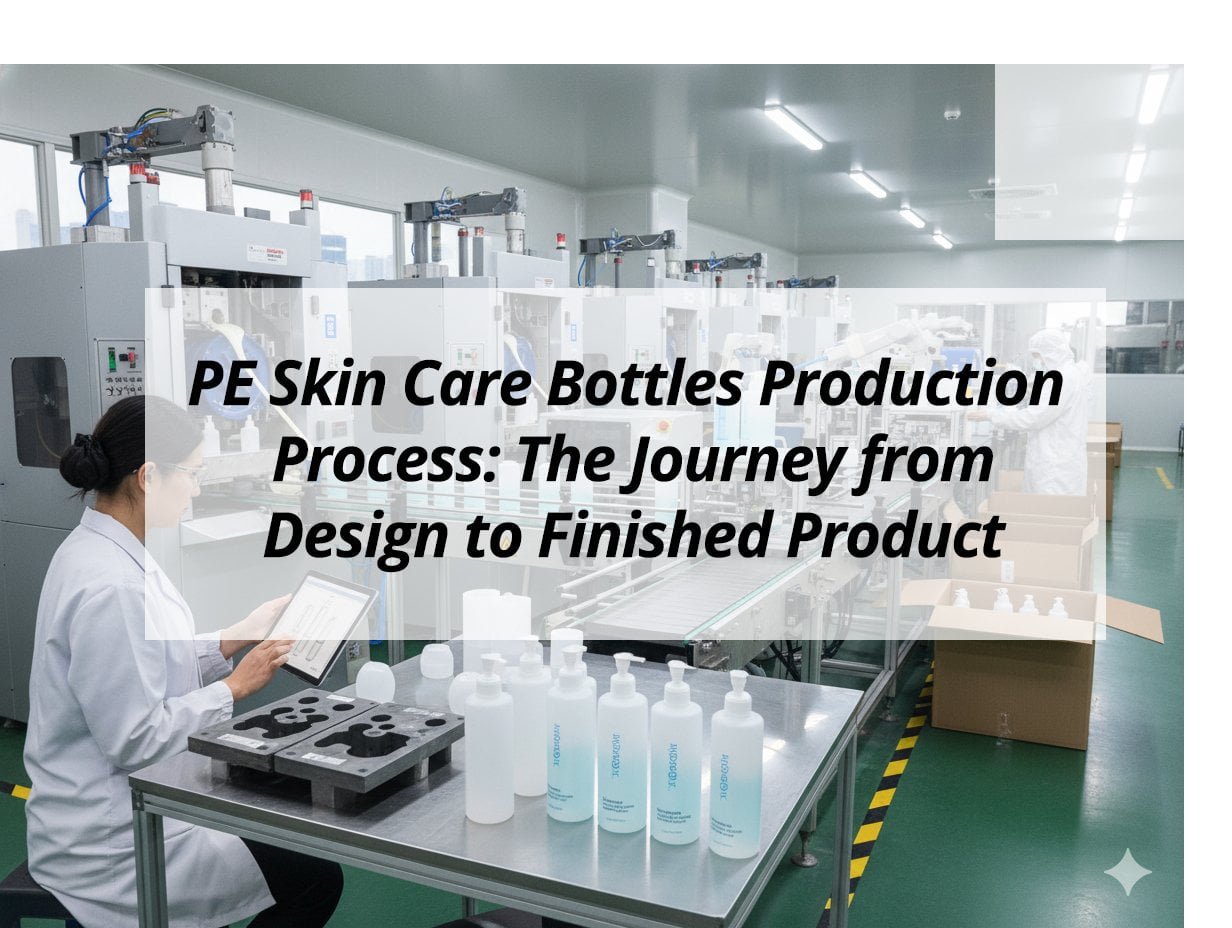
My insights: PE Skin Care Bottles Production Process: The Journey from Design to Finished Product
Confused about the production of PE skin care bottles? Discover the comprehensive process from design to distribution that ensures quality and efficiency.
The production of PE skin care bottles4 involves design, material selection, extrusion blow molding, and quality control. This process ensures durable, flexible bottles ideal for lotions, incorporating branding and sustainability elements throughout.
Understanding the PE Bottle Production Process
Design and Material Selection:
-
Design Phase: Utilize 3D modeling for optimal aesthetics and functionality. Steel molds ensure consistency.
-
Material Preparation: Choose high-density (HDPE) or low-density (LDPE) polyethylene for flexibility and compatibility with skincare products. Clean and dry pellets to ensure purity.
Core Manufacturing Steps:
-
Extrusion: Melt PE pellets at 180-240°C to create a parison through a controlled die.
-
Blow Molding: Inflate the parison in a mold to shape the bottle, then cool to solidify.
-
Trimming: Remove excess material and refine bottle necks for closures.
Finishing and Quality Control:
-
Surface Treatments: Add branding through silk screening or hot stamping.
-
Quality Checks: Perform leak, drop, and chemical compatibility tests. Include post-consumer recycled PE for sustainability.
Summary Table:
| Stage | Key Actions |
|---|---|
| Design | 3D modeling, steel mold creation |
| Material Prep | HDPE/LDPE selection, cleaning, drying |
| Manufacturing | Extrusion, blow molding, trimming |
| Finishing | Surface treatments, quality checks |
This structured process results in efficient production of high-quality, sustainable PE skin care bottles.
Conclusion
From design to completion, PE skin care bottles embody intricate craftsmanship and scientific precision, ensuring each product's quality and allure in the competitive cosmetic industry.
-
Discover various cosmetic packaging materials that enhance product safety and appeal, crucial for skincare brands. ↩
-
Learn about the preform molding process, a key step in creating durable and customized bottles for skincare. ↩
-
Find out how quality assurance ensures the safety and effectiveness of cosmetic packaging, vital for consumer trust. ↩
-
Discover the advantages of PE bottles, including their flexibility and sustainability for skincare products. ↩