
Do you ever wonder what makes your lipstick tube work so smoothly? Many people don't think about the design behind this everyday item. But a lot goes into making it functional.
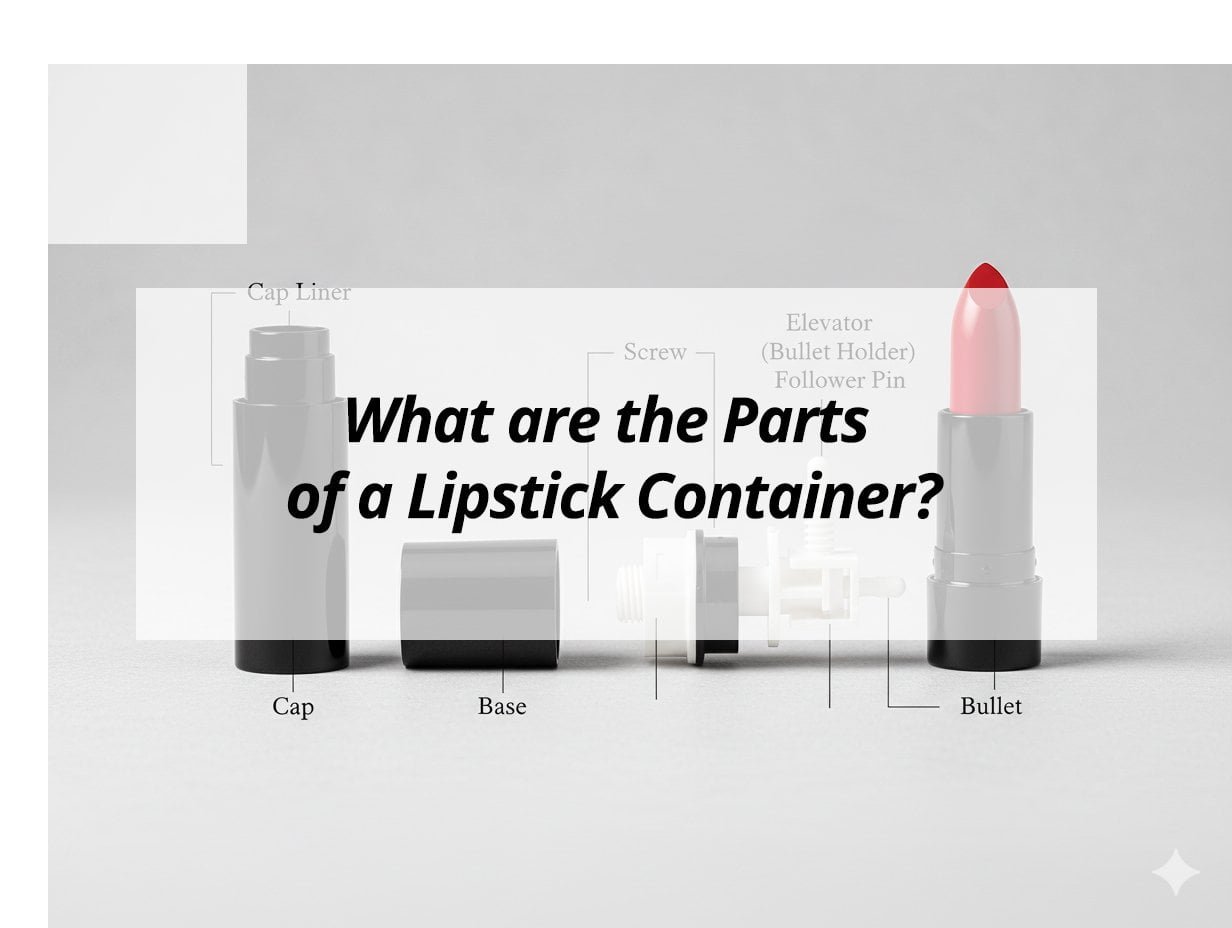
A standard lipstick container consists of several key components: the base, inner cup, spiral mechanism, barrel, and cap. These parts work together to protect the lipstick bullet, allow for smooth retraction and extension, and provide an appealing aesthetic for the cosmetic product.
Knowing the different parts helps you understand why some lipstick containers feel more luxurious or work better than others. It is all about the engineering and design.
What are the parts of a lipstick called?
Have you ever taken a closer look at a lipstick tube and wondered about its different pieces? Each part has a special name and job. They all work together to create a smooth experience.
The main parts of a lipstick container are the cap, barrel, spiral mechanism, inner cup (or bullet holder), and the base. Each component plays a vital role in protecting the lipstick bullet, ensuring its smooth application, and providing structural integrity to the entire assembly.
When I talk to clients about custom lipstick tubes, we discuss these parts in detail. For example, the inner cup's design is crucial for holding the lipstick firmly. A poorly designed inner cup can lead to the lipstick breaking or wobbling. This is a common issue we help brands solve.
Breaking down the main components
Each part of the lipstick container is important. They fit together like a puzzle.
- Cap: This is the outer cover. It protects the lipstick from damage and keeps it from drying out. It also prevents accidental marks on your bag.
- Barrel (or Shell): This is the main outer body of the lipstick tube. It provides the main structure and often carries the brand's design.
- Spiral Mechanism: This is inside the barrel. It has a spiral track. It allows the lipstick bullet to move up and down.
- Inner Cup (or Bullet Holder): This holds the lipstick bullet at the bottom. It connects to the spiral mechanism.
- Base: This is the very bottom part of the container. It usually rotates to make the spiral mechanism work.
| Part Name | Function | Material Examples |
|---|---|---|
| Cap | Protection, aesthetic appeal | PP, ABS, Aluminum, SAN |
| Barrel | Outer structure, design element | ABS, Aluminum, PETG, PMMA |
| Spiral Mechanism | Controls lipstick extension/retraction | PP, POM |
| Inner Cup | Holds lipstick bullet | PP, PE |
| Base | Bottom support, rotating mechanism activation | ABS, PP, Aluminum |
My thoughts on lipstick container components
I have seen many designs for these parts. The best ones use strong, precise materials. For instance, an aluminum cap feels heavy and luxurious. This makes the whole product feel more expensive. A smooth spiral mechanism ensures the lipstick glides up and down without sticking. These small details make a big difference in how a customer experiences the product.
What is the lipstick container called?
Do you ever wonder what the actual name for that tube holding your lipstick is? It's more than just a "tube." There are specific terms in the industry for it.
The container that holds lipstick is generally called a "lipstick tube" or "lipstick case." In professional cosmetic packaging terms, it can also be referred to as a "lipstick mechanism" or "lipstick component," depending on whether you are talking about the assembled unit or its individual parts.
When I speak with cosmetic brand buyers, we often use these terms. For example, a client might ask for a new design for a lipstick case. Or they might need a specific lipstick mechanism for a custom product. Using the right terms helps ensure clear communication.
Common names for lipstick containers
There are a few ways to refer to the lipstick container. Each name has a slightly different meaning.
- Lipstick Tube1: This is the most common and general term. It refers to the entire assembled unit.
- Lipstick Case2: This term is also very common. It emphasizes the outer housing that protects the lipstick. It often implies a more decorative or luxurious shell.
- Lipstick Mechanism3: This refers specifically to the internal parts that allow the lipstick to move up and down. It is the functional core of the container.
- Lipstick Component: This is a broader term. It can refer to any individual part of the lipstick container.
| Term | Focus | Usage Context |
|---|---|---|
| Lipstick Tube | Complete ready-to-fill container | General public, retail, common industry |
| Lipstick Case | Outer aesthetic housing, protective | Marketing, luxury brands, design focus |
| Lipstick Mechanism | Internal working parts | Engineering, manufacturing, technical |
| Lipstick Component | Any single part of the assembly | Sourcing, inventory, production planning |
My experience with lipstick container terminology
I recall a conversation with a new brand. They wanted to order "lipstick holders." I had to clarify if they meant the inner cups or the entire tubes. This showed me how important it is to use clear language. We always make sure to confirm exactly what parts of a lipstick they need. This ensures we deliver exactly what they expect for their custom cosmetic packaging.
What are the little balls on my lipstick?
Have you ever noticed tiny little balls, or sometimes specks, on your lipstick bullet? It can be surprising to see them. Many people wonder what they are.
The "little balls" or specks sometimes seen on lipstick are typically called "sweating" or "blooming." This phenomenon occurs when natural waxes or oils in the lipstick formula separate slightly and rise to the surface, especially due to temperature changes. It usually does not affect the product's quality or performance.
From my experience in manufacturing cosmetic packaging, I know that lipstick formulas are complex. They contain many ingredients. Changes in temperature during shipping or storage can cause these small reactions. We always advise our clients on how proper packaging can help minimize these occurrences.
Understanding lipstick "sweating" and "blooming"
This phenomenon is quite common. It is usually harmless.
- Sweating: This happens when oils separate from the wax. They form tiny droplets on the surface of the lipstick. It looks like the lipstick is "sweating."
- Blooming: This is when waxes migrate to the surface. It can create a fine, powdery, or sometimes grainy texture. It looks like a "bloom" on the lipstick.
| Phenomenon | Appearance | Primary Cause | Impact on Product |
|---|---|---|---|
| Sweating | Tiny oil droplets, shiny specks | Temperature fluctuations, humidity | None (usually) |
| Blooming | Fine white or gray powdery film | Wax separation, temperature changes | None (usually) |
| Causes | Incompatible ingredients, improper cooling | Manufacturing issues, storage | Can vary |
My insights on lipstick formula issues
I have seen countless lipstick formulas go through our production process. Sometimes, a brand will experiment with new natural ingredients. These can be more prone to sweating or blooming if not handled correctly. We emphasize using high-quality inner cups that maintain a stable environment for the lipstick bullet. This helps to reduce these surface changes. It is an important part of ensuring superior quality for the final product.
How does a lipstick container work?
Have you ever thought about the clever engineering inside a lipstick tube that allows it to extend and retract so smoothly? It's a simple action we take for granted.
A lipstick container works through a precisely engineered spiral mechanism. When the base is rotated, a pin or ridge on the inner cup follows a helical track within the barrel, causing the lipstick bullet to move up or down without wobbling. This design ensures controlled application and protection of the product.
Understanding this mechanism is key to designing effective lipstick packaging. We ensure that our spiral mechanisms are precise. This provides a consistent and satisfying user experience. A well-made mechanism prevents jamming or premature wear.
The mechanics of lipstick extension
The operation of a lipstick container relies on a few moving parts working in harmony.
- Rotation of the Base: When you twist the base, it turns the inner cup.
- Spiral Track: The inner cup has a small protrusion. This fits into a spiral groove inside the barrel.
- Upward/Downward Motion: As the inner cup rotates along the spiral track, it is forced to move either up or down the barrel. This movement extends or retracts the lipstick bullet.
- Stability: The design ensures that the lipstick bullet remains stable and centered as it moves. This prevents it from rubbing against the sides of the container.
| Mechanism Part | Role in Operation | Importance |
|---|---|---|
| Base Rotation | Initiates movement of the inner cup | User control of lipstick position |
| Spiral Track | Guides the inner cup's vertical motion | Smooth, controlled extension/retraction |
| Inner Cup Pin | Engages with the spiral track | Translates rotational to linear movement |
| Barrel Casing | Provides the static helical groove | Structural support for the mechanism |
My perspective on lipstick mechanism design
I've supervised the production of millions of lipstick containers. The precision of the spiral mechanism is critical. If the tolerances are off even slightly, the lipstick can wobble, stick, or break. We use advanced injection moulding machines to ensure every component fits perfectly. This commitment to superior quality means the finished product performs flawlessly. It is what our clients expect when they order customised logo lipstick tubes from us.
My Insights: Understanding the Anatomy of a Lipstick Container
Curious about what makes up a lipstick container? Explore its intricate components and discover how they work together for functionality and style.
A lipstick container consists of the cap, base, and inner mechanism. The cap protects the lipstick, the base houses the mechanism, and the inner mechanism facilitates the extension and retraction of the lipstick bullet.
Exploring Lipstick Container Components
Main External Parts:
- Cap: Protects the lipstick from contamination and drying, often designed to be airtight.
- Base: Holds the mechanism and typically displays logos or decorative elements.
- Overshell: Offers aesthetic appeal and a smooth transition between cap and base.
Internal Mechanism:
- Inner Body/Cartridge: Houses the moving parts and guides the bullet.
- Cup/Bullet Holder: Holds the lipstick bullet and moves it up and down.
- Spiral/Screw Mechanism: Converts twisting motion into vertical movement.
Supporting Components:
| Component | Function |
|---|---|
| Beads/Bead Fork | Guides the cup smoothly and controls the twist. |
| Lubricating Oil | Ensures smooth twisting and reduces friction. |
| Gaskets/Seals | Enhance airtightness for certain formulas. |
Understanding these components helps appreciate the complexity behind a simple-looking lipstick container. Each part plays a crucial role in ensuring functionality, protection, and user experience, providing a seamless blend of design and engineering.
Conclusion
A lipstick container is a clever assembly of parts. The cap, barrel, inner cup, and spiral mechanism work together. They protect the lipstick and allow for smooth use.