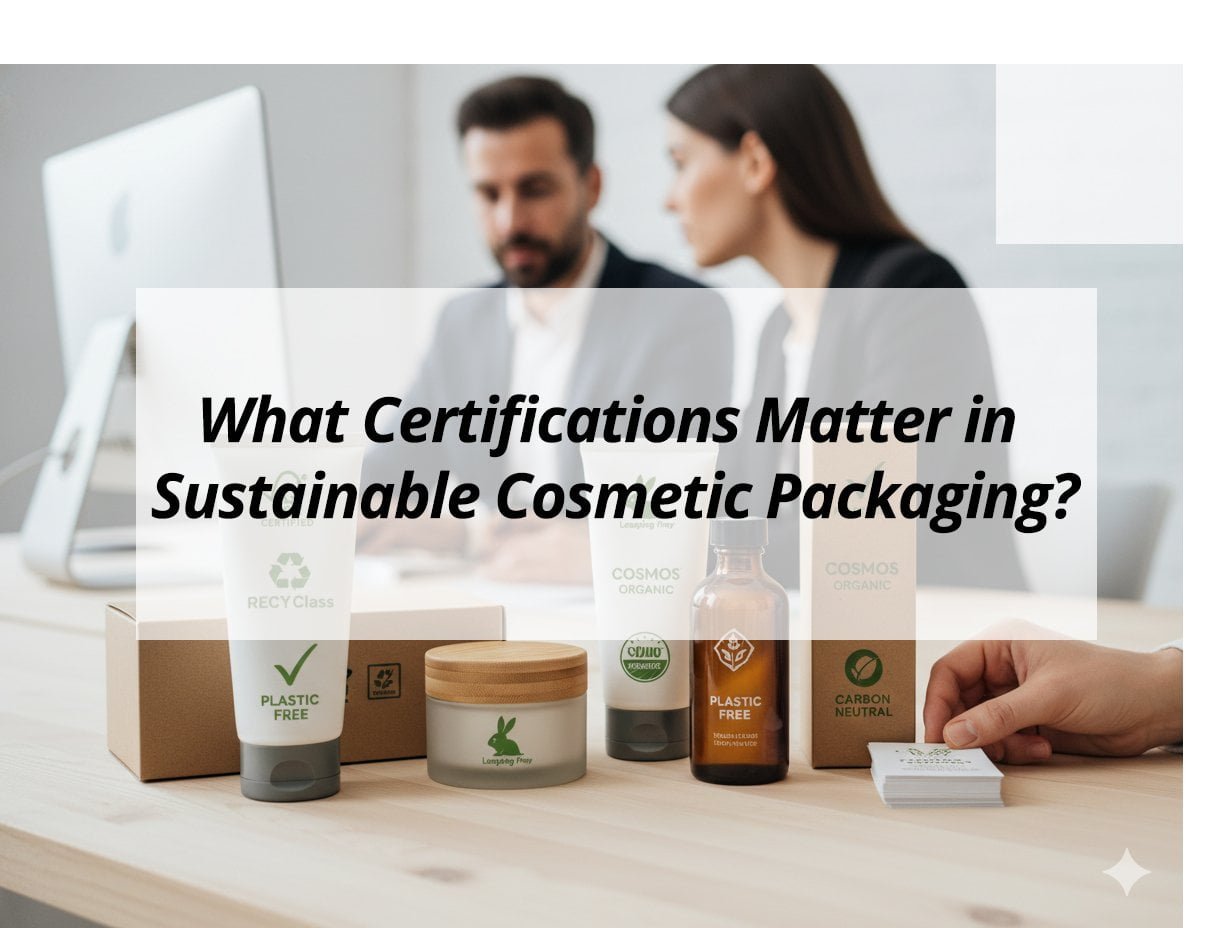
Are you a brand buyer sourcing sustainable cosmetic packaging? It is hard to know which claims are real. Certifications help ensure environmental responsibility.
In sustainable cosmetic packaging, key certifications like FSC, Ecocert, Cradle to Cradle, and ISO 14001 matter. They verify claims related to responsibly sourced materials, ethical manufacturing, and recyclability. Understanding these certifications helps ensure your cosmetic packaging products meet environmental standards. This builds consumer trust.
I have seen many brands struggle with greenwashing. They want to be genuinely sustainable. Certifications provide third-party proof. They help you make informed decisions in a complex market.
What Are the Top Sustainability Certifications?
Do you feel overwhelmed by all the "green" labels? It is hard to know which certifications truly mean something. Not all are equally rigorous.
The top sustainability certifications1 in cosmetic packaging include FSC for responsible forestry, Ecocert/COSMOS for natural and organic standards, Cradle to Cradle for circularity, and ISO 14001 for environmental management systems. Other important ones are marine biodegradability labels and plastic recycling certifications. These labels provide credible proof of environmental claims2 for cosmetic packaging products.
I often advise clients on this. For example, if a brand uses paperboard for packaging, FSC certification is essential. It means the wood came from responsibly managed forests. This helps ensure real environmental action.
Key Certifications and Their Focus
These certifications cover different aspects of sustainability.
- FSC (Forest Stewardship Council):
- Focus: Responsible forest management.
- What it means: Wood and paper products come from forests managed in an environmentally sound, socially beneficial, and economically viable way.
- Relevance to Packaging: Important for paperboard boxes, labels, and wooden components of cosmetic packaging products.
- Ecocert / COSMOS Organic & Natural:
- Focus: Organic and natural cosmetics, including packaging materials.
- What it means: Strict standards for ingredients, manufacturing, and packaging. Packaging should be minimal, recyclable, or from recycled content.
- Relevance to Packaging: For brands making natural/organic claims, the packaging must also meet specific environmental criteria.
- Cradle to Cradle Certified®:
- Focus: Circular economy principles. Products and materials are designed for continuous reuse.
- What it means: Assesses products across five quality categories: material health, material reutilization, renewable energy and carbon management, water stewardship, and social fairness.
- Relevance to Packaging: For highly innovative and truly circular cosmetic packaging products.
- ISO 14001 (Environmental Management System):
- Focus: A company's overall environmental management system.
- What it means: The company has systems in place to manage its environmental impact. It is not a product certification.
- Relevance to Packaging: Shows a supplier's commitment to environmental practices in their manufacturing of cosmetic packaging products.
- Plastic Recycling Certifications (e.g., APR, RecyClass):
- Focus: Recyclability of plastic packaging.
- What it means: Verifies that plastic packaging is compatible with existing recycling streams.
- Relevance to Packaging: Crucial for plastic cosmetic packaging products, especially PCR and monomaterial designs.
Why Certifications Matter
Certifications provide transparency and trust.
- Credibility: They offer third-party verification of environmental claims.
- Risk Reduction: They help avoid greenwashing accusations.
- Consumer Trust: Eco-conscious consumers look for certified products.
- Supply Chain Assurance: They ensure suppliers adhere to specific standards.
| Certification | Primary Focus | What it Verifies for Packaging | Example Use in Cosmetic Packaging Products |
|---|---|---|---|
| FSC | Responsible forestry | Paper/wood components sourced sustainably. | Outer cartons, paper labels, wooden caps. |
| Ecocert/COSMOS | Natural/Organic cosmetics | Packaging meets minimal impact criteria (recyclable, recycled content). | Glass jars, PCR plastic bottles for organic creams. |
| Cradle to Cradle | Circularity, material health | Materials are safe and designed for reuse/recycling in closed loops. | Innovative, fully circular packaging designs. |
| ISO 14001 | Environmental management | Manufacturer has an effective environmental system. | Supplier's overall operational practices. |
| APR / RecyClass | Plastic recyclability | Plastic packaging is compatible with recycling infrastructure. | PET bottles, PP cosmetic tubes. |
| OK Compost HOME/Industrial | Biodegradability/Compostability | Packaging will break down in specified environments. | Bioplastic films, specific compostable tubes. |
When you choose cosmetic packaging products, look for suppliers with these relevant certifications. They are a sign of genuine commitment to sustainability.
What Are the 5 R's of Sustainable Packaging?
Do you want to make your packaging more sustainable? The "5 R's" provide a simple framework. They guide decisions for environmentally friendly packaging.
The 5 R's of sustainable packaging are Rethink, Reduce, Reuse, Recycle, and Renew. This framework prioritizes minimizing waste and environmental impact at every stage of packaging design and lifecycle. It helps brands create more responsible cosmetic packaging products by focusing on systemic improvements rather than just end-of-life solutions.
I use this framework often. It helps break down complex sustainability goals into clear actions. For example, before choosing a material, "Rethink" if packaging is even needed. Then, "Reduce" its size. This structured approach is very effective.
Understanding Each "R"
Each "R" represents a step in making packaging more sustainable.
- Rethink:
- Meaning: Question the fundamental need for packaging. Can the product be delivered differently? Can the design be radically improved?
- Action: Challenge existing packaging norms. Innovate for truly sustainable solutions.
- Example: Switching from a multi-component jar to a simple monomaterial cosmetic tube.
- Reduce:
- Meaning: Minimize the amount of packaging material used.
- Action: Use lighter materials. Design smaller packaging. Eliminate unnecessary layers.
- Example: Lightweighting a glass bottle, making plastic cosmetic tubes thinner.
- Reuse:
- Meaning: Design packaging to be refilled or repurposed multiple times.
- Action: Create durable, refillable containers. Offer refill options to consumers.
- Example: Skincare bottles with interchangeable inner cartridges, or sturdy jars for other uses.
- Recycle:
- Meaning: Use materials that can be processed and made into new products after use.
- Action: Choose widely recyclable materials (like PET, HDPE, aluminum, glass). Design for monomaterial.
- Example: Ensuring all plastic cosmetic packaging products are #1, #2, or #5 plastics.
- Renew:
- Meaning: Use materials from renewable sources.
- Action: Incorporate bioplastics, bamboo, or FSC-certified paper.
- Example: Caps made from bamboo, cosmetic tubes using sugarcane-based bioplastic.
| The 5 R's | Priority Level | Action for Cosmetic Packaging Products | Examples |
|---|---|---|---|
| Rethink | Highest | Fundamental redesign, challenge packaging necessity. | Solid shampoo bars (no bottle), minimalist design. |
| Reduce | High | Minimize material use, lightweighting, right-sizing. | Thinner walled jars, smaller tubes, less secondary packaging. |
| Reuse | High | Design for multiple uses, implement refill systems. | Refillable lipstick tubes, skincare bottles with cartridges. |
| Recycle | Medium | Choose widely accepted recyclable materials, monomaterial design. | PET bottles, PP cosmetic tubes, glass jars. |
| Renew | Medium | Incorporate materials from renewable resources. | Bioplastic caps, FSC-certified paper boxes. |
When you select cosmetic packaging products, apply the 5 R's framework. It guides you to comprehensive sustainable solutions.
What is BRC Certification for Packaging?
Are you a packaging manufacturer or buyer? You might have heard of BRC certification. It is important for safety and quality.
BRC certification for packaging is a global standard for packaging materials. It ensures suppliers produce safe, legal, and high-quality packaging. This certification covers hygiene, product safety, and operational standards. For cosmetic packaging products, BRCGS Packaging Materials certification assures brands that their packaging meets rigorous safety and quality benchmarks, protecting both the product and the consumer.
I work with many factories in China. BRC certification is a big deal for them. It shows their commitment to quality and safety. It is especially important for packaging that touches sensitive products, like cosmetics. It gives peace of mind to buyers.
Focus of BRCGS Global Standard for Packaging Materials
BRCGS (Brand Reputation Compliance Global Standards) is a leading global safety and quality certification program.
- Scope: It applies to manufacturers of all types of packaging materials. This includes plastic, paper, glass, and metal.
- Key Areas: The standard covers:
- Senior management commitment.
- Hazard and risk management systems.
- Product safety and quality management.
- Site standards (layout, hygiene, pest control).
- Process control (manufacturing, storage).
- Personnel (training, protective clothing).
- Global Recognition: BRCGS is recognized by retailers and brand owners worldwide. It is a benchmark for supplier approval.
Why BRC Certification Matters for Cosmetic Packaging
BRC certification offers significant benefits for cosmetic packaging products.
- Product Safety: Ensures the packaging itself will not contaminate the cosmetic product. This is crucial for consumer health.
- Legal Compliance: Helps manufacturers meet legal obligations regarding packaging safety.
- Quality Assurance: Demonstrates that the packaging is produced to high-quality standards. This reduces defects.
- Supply Chain Confidence: Brands can trust BRC-certified suppliers more. It simplifies supplier audits.
- Risk Mitigation: Reduces risks of product recalls due to packaging faults.
| BRCGS Standard Section | Relevance to Cosmetic Packaging Products | Benefit for Brands and Consumers |
|---|---|---|
| Senior Management | Ensures leadership commitment to quality and safety in packaging production. | Guarantees a culture of safety from the top down. |
| Hazard & Risk Management | Identifies and controls potential hazards (e.g., contamination, defects). | Minimizes risks of unsafe or faulty cosmetic packaging products. |
| Product Safety & Quality | Implements robust systems for consistent product quality and safety. | Ensures packaging performs as expected, protecting product integrity. |
| Site Standards | Governs hygiene, pest control, and environment of manufacturing facility. | Prevents external contamination during packaging production. |
| Process Control | Manages manufacturing steps, storage, and distribution. | Leads to consistent, reliable cosmetic packaging products. |
| Personnel | Training and hygiene of staff involved in packaging production. | Reduces human error and ensures clean handling. |
When you choose suppliers for cosmetic packaging products, prioritize those with BRCGS Packaging Materials certification. It is a mark of high standards and reliability.
What Is a Certification to Look For When Choosing Eco-Friendly Products?
Are you looking for certified eco-friendly cosmetic products? It can be hard to spot genuine green claims. Certifications help you choose wisely.
When choosing eco-friendly products, look for certifications like Ecocert/COSMOS for natural ingredients, FSC for sustainable paper/wood packaging, and Cradle to Cradle for circular design. Also, consider labels for plastic recycling (APR, RecyClass) or biodegradability. These certifications provide independent verification of environmental claims for cosmetic packaging products and formulations.
I know that consumers want real proof of sustainability. They are wary of empty claims. Certifications offer that proof. They help you buy products that truly align with your values.
Top Certifications for Eco-Friendly Products
These certifications cover various aspects of "eco-friendly."
- Ecocert / COSMOS Organic & Natural:
- What it Certifies: Both the product formula and its packaging. For packaging, it emphasizes minimal environmental impact, recyclability, and use of recycled materials.
- Why it Matters: A trusted standard for natural and organic cosmetics globally.
- FSC (Forest Stewardship Council):
- What it Certifies: Paper, cardboard, and wooden components of packaging. It guarantees responsible sourcing.
- Why it Matters: Ensures no deforestation or unethical forestry practices for your cosmetic packaging products.
- Cradle to Cradle Certified®:
- What it Certifies: The entire product, including packaging, is designed for a circular economy. It covers material health and reutilization.
- Why it Matters: Represents the highest standard for truly sustainable design.
- Global Recycled Standard (GRS) / Recycled Claim Standard (RCS):
- What it Certifies: The presence and percentage of recycled material (pre-consumer and post-consumer) in a product or packaging.
- Why it Matters: Provides transparent verification of recycled content, combating greenwashing.
- Compostability Certifications (e.g., TÜV Austria OK Compost HOME/Industrial):
- What it Certifies: Packaging will biodegrade under specific composting conditions.
- Why it Matters: Offers an alternative end-of-life solution to traditional recycling or landfill.
How to Use Certifications When Buying
Look for these logos on the packaging.
- Check the Label: Certifications are usually displayed prominently.
- Understand the Scope: Some certifications apply to the formula, some to the packaging, and some to both.
- Prioritize Your Values: If recycled content is key, look for GRS. If overall product sustainability is key, look for Ecocert.
| Certification / Label | Environmental Aspect Certified | Benefit for Eco-Friendly Cosmetic Packaging Products |
|---|---|---|
| Ecocert/COSMOS | Organic/Natural formula & sustainable packaging criteria. | Assures holistic environmental responsibility. |
| FSC | Responsible sourcing of paper/wood packaging. | Guarantees forest protection. |
| Cradle to Cradle | Product/packaging designed for circularity, material safety. | Represents highest standard for sustainable design. |
| GRS/RCS | Verified recycled content in materials. | Confirms use of post-consumer recycled materials. |
| OK Compost | Biodegradability in home or industrial compost. | Offers responsible end-of-life option for packaging. |
| Vegan/Cruelty-Free | Ethical product (though not directly packaging sustainability). | Appeals to ethical consumers. |
When you choose cosmetic packaging products, use these certifications as your guide. They help ensure your products are genuinely eco-friendly.
My Insights: Essential Certifications for Sustainable Cosmetic Packaging
Confused about which certifications ensure truly sustainable packaging? Discover what matters to verify eco-friendly practices in the cosmetics industry.
Certifications like FSC ensure responsibly sourced materials, while Cradle to Cradle verifies lifecycle sustainability. ISO 14001 focuses on environmental management, and Ecocert certifies organic packaging. These certifications not only build consumer trust but also ensure compliance with sustainability standards.
Understanding the Importance of Certifications in Sustainable Packaging
Key Certifications:
-
FSC (Forest Stewardship Council): Ensures sustainable sourcing of paper and wood, promoting biodiversity and community rights.
-
Cradle to Cradle (C2C): Focuses on material health, renewability, and circularity for recyclable or biodegradable designs.
-
Global Recycled Standard (GRS): Verifies the recycled content in packaging, distinguishing between pre- and post-consumer materials.
Cosmetics-Specific Options:
-
ECOCERT: Evaluates eco-friendly packaging alongside natural ingredients for ethical production.
-
COSMOS: Sets standards for organic cosmetics, including sustainable packaging.
-
ISCC PLUS: Certifies materials like recycled PET for performance in beauty packaging.
Why They Matter:
Certifications provide transparency against greenwashing, ensuring rigorous audits for recyclability and compostability. Brands use them to meet regulatory needs and consumer demands for eco-friendly products. Understanding these certifications helps distinguish genuine sustainable practices from mere claims.
Brands leading in sustainable cosmetic packaging3 design prioritize these certifications, advancing both environmental and social responsibilities.
Conclusion
Sustainable cosmetic packaging needs certifications. FSC, Ecocert, Cradle to Cradle, and BRCGS are important. The 5 R's guide eco-friendly choices. Look for these to ensure real sustainability.