
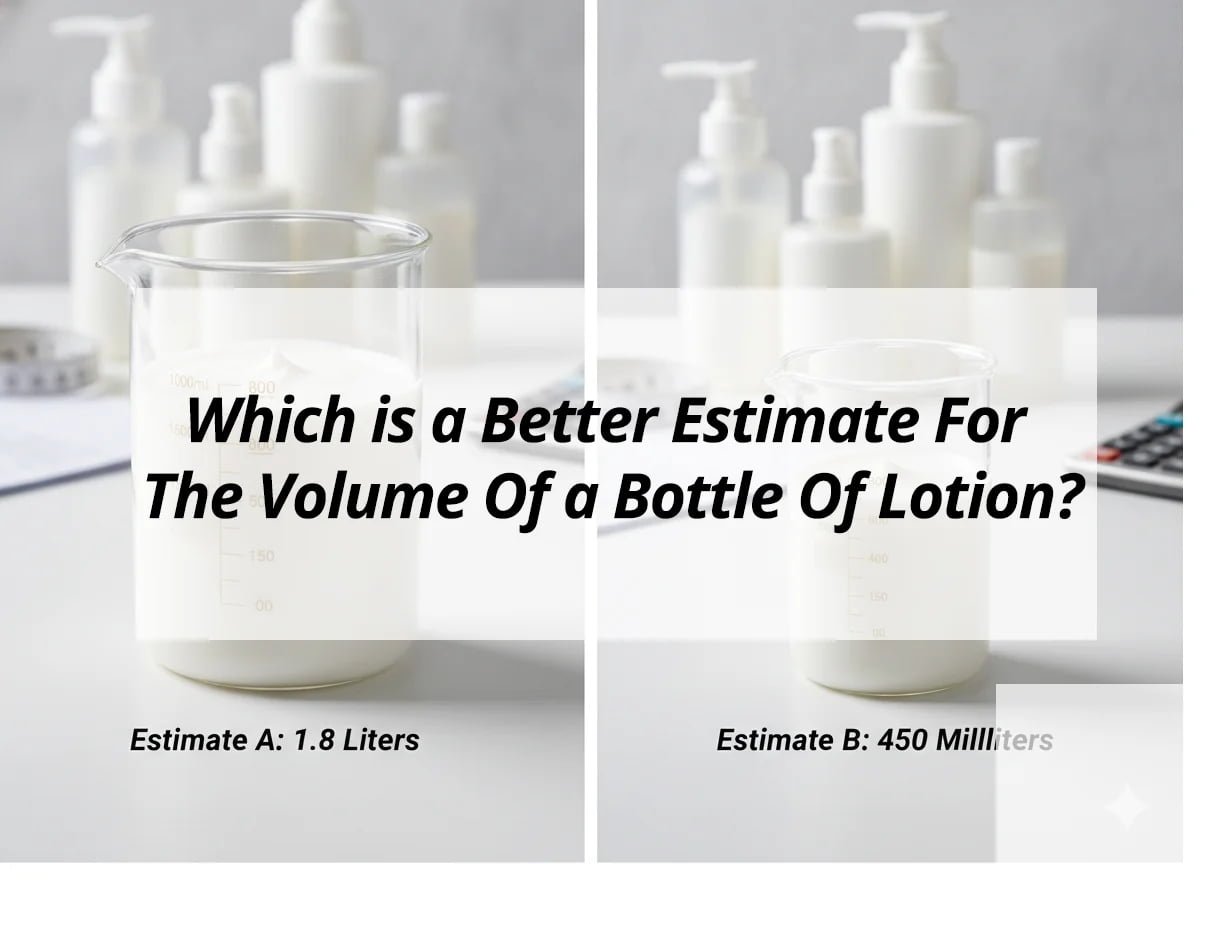
Accurately estimating the volume of lotion bottles is a common challenge for buyers. Inaccurate estimates can lead to issues with inventory, production, and overall costs.
The most effective estimate for a bottle of lotion's volume depends on the bottle's design and dimensions. Typical cosmetic bottles often hold between 50ml and 500ml. A reliable estimate can be achieved by referencing labeled capacities or by applying geometric formulas based on internal measurements.
Achieving precise volume estimation is essential for efficient inventory management and streamlined production planning. This guide details practical methods for accurate estimations, which can lead to significant operational savings.
What is the volume of a bottle of lotion?
Understanding the volume of a lotion bottle is fundamental. It is more than just a numerical value; it provides crucial information for packaging selection and product allocation.
The volume of a bottle of lotion represents the total space the liquid occupies within the container, commonly measured in milliliters (ml) or fluid ounces (fl oz). This measurement indicates the exact quantity of product a bottle can contain when filled to its intended capacity.
Knowing the precise volume assists in selecting appropriate packaging and ensures accurate product labeling. This precision is vital for compliance and consumer information.
Why is Lotion Bottle Volume Important?
The importance of lotion bottle volume extends across several key operational areas. Firstly, it supports product formulation by guiding the quantity of lotion to be produced for each batch. Secondly, it plays a critical role in cost management, ensuring that bottle sizes align with product volumes to minimize waste. Thirdly, volume directly impacts shipping logistics, as larger volumes typically correlate with heavier and more expensive shipments. Finally, accurate volume contributes to customer satisfaction, as consumers expect the product quantity to match packaging size.
Consider these aspects:
- Production Planning: Accurate volume data enables factories to forecast raw material needs and schedule production runs effectively.
- Regulatory Compliance: Product labeling laws in many regions require precise volume declarations, making accurate measurement essential for legal adherence.
- Packaging Design: The appropriate bottle volume influences the overall design, impacting how a product is perceived in the market.
Experience in packaging supply shows the critical nature of these details. For example, verifying a client's volume requirements against their chosen packaging prevents discrepancies in product fill and avoids potential production delays. Such attention to detail in volume estimation is a core aspect of successful packaging solutions.
| Aspect | Significance |
|---|---|
| Product Formulation | Ensures correct product ratios and prevents under or over-filling during manufacturing. |
| Cost Control | Optimizes material usage and reduces expenditure on packaging components. |
| Shipping Logistics | Influences freight costs and efficiency by determining package weight and dimensions. |
| Customer Satisfaction | Meets consumer expectations regarding product quantity and perceived value. |
| Regulatory Adherence | Guarantees compliance with labeling laws and market standards for volume declaration. |
| Market Competitiveness | Offers suitably sized packaging options that align with consumer preferences and market trends. |
What is the best estimate for a bottle of lotion?
Determining the most accurate volume estimate for lotion bottles can be challenging. A reliable estimation method helps prevent future complications in supply chain and product delivery.
The best estimate for a lotion bottle's volume is typically derived from its labeled capacity. For bottles without clear labeling or for new designs, a precise estimate is achieved by measuring the internal dimensions and applying standard geometric formulas.
A dependable method for volume estimation is invaluable. It facilitates informed decisions regarding packaging choices and product specifications.
How Can a Good Estimate Be Made?
Developing a precise estimate for bottle volume involves several practical approaches. The most straightforward method is to consult the product label, where volume is usually stated in milliliters (ml) or fluid ounces (fl oz). If a label is absent or if a new bottle design is being considered, alternative methods become necessary.
One practical approach is visual comparison. This involves comparing the bottle's physical size to common items with known volumes, such as standard beverage cans (e.g., 330ml) or water bottles (e.g., 500ml). While this method offers a quick, rough estimate, it lacks the precision required for critical applications like packaging procurement.
For greater accuracy, measuring the bottle's internal dimensions is key. For cylindrical bottles, measure the internal height and the internal radius (half of the diameter) of the base. The formula for volume is then: Volume = π × radius² × height. For bottles that are rectangular or square, measure the internal length, width, and height. The volume is calculated as: Volume = length × width × height. It is crucial to measure internal dimensions to reflect the true liquid capacity, rather than external dimensions which would include the material thickness.
Packaging suppliers often assist clients with this process. When a custom bottle design is proposed, detailed drawings allow for the exact volume calculation. This ensures that the client's product will fit correctly, preventing errors and unnecessary costs in manufacturing.
| Method | Description | Accuracy | Best For |
|---|---|---|---|
| Check Labeled Capacity | Refer to the volume indicated on the product's label. | Very High | Existing products with clear volume labels. |
| Visual Comparison | Assess bottle size relative to common items of known volume. | Low-Medium | Initial, approximate volume checks. |
| Geometric Calculation | Measure internal dimensions and apply specific geometric volume formulas. | High | New packaging designs or unmarked containers. |
| Water Displacement | Fill the bottle with water and transfer to a graduated measuring container. | Very High | Physical prototypes for direct measurement. |
Which is a better estimate for the volume of a bottle of glue?
When estimating volume, a bottle of glue presents different considerations compared to a bottle of lotion, primarily due to differing product applications. Understanding these distinctions is crucial for accurate procurement.
The most reliable estimate for the volume of a bottle of glue, similar to lotion, is its stated capacity on the label. However, glue bottles are typically smaller, designed for targeted application, resulting in much lower volumes, usually in the range of 10ml to 100ml. The methodology for estimation remains consistent, but the expected volume range varies significantly.
Recognizing these differences ensures that appropriate packaging is selected for each product type, minimizing common packaging errors.
Are Glue and Lotion Bottles Estimated Differently?
The fundamental principles for estimating the volume of glue and lotion bottles are not different. Both rely on examining labels, performing visual comparisons, or applying geometric formulas. However, a significant distinction lies in their typical volume ranges. Lotion bottles generally have larger capacities because lotions are often applied in greater quantities. Conversely, glue bottles are usually smaller, reflecting the smaller amounts of glue used per application.
The intended use of each product dictates its typical packaging size. Lotions are frequently dispensed from larger containers with pumps or squeeze tops for broader application on skin. This often necessitates volumes ranging from 200ml to 500ml. Glues, on the other hand, are used for precise, small-scale tasks and typically come in smaller containers, often 20ml to 50ml, equipped with fine nozzles or brush applicators. This difference in application directly influences the expected volume and packaging design.
For instance, when sourcing packaging for different products, the term "bottle" for a cosmetic item implies a distinct volume range and dispenser type compared to a "bottle" for an adhesive. Even if both containers are cylindrical, the specific requirements for capacity, material compatibility, and closure mechanisms will vary. A glue container might require a chemically resistant plastic and a precision tip, whereas a lotion bottle would use a more common cosmetic-grade material with a pump.
While the estimation tools are the same, practical experience with product categories greatly aids in narrowing down the expected volume range. This contextual understanding helps in guiding packaging decisions effectively. The ultimate purpose of the product drives the appropriate volume and packaging characteristics.
Key Differences in Bottle Characteristics:
- Typical Volume Range: Lotion bottles generally feature higher capacities (e.g., 50ml-500ml), while glue bottles typically have lower capacities (e.g., 5ml-100ml).
- Dispenser Mechanisms: Lotion bottles often incorporate pumps, sprayers, or flip-top caps. Glue bottles frequently utilize fine nozzles or integrated brush applicators.
- Material Specifications: Certain glues may require specialized plastics for chemical compatibility, whereas lotion bottles generally use standard cosmetic-grade plastics.
- Target Market and Design: Lotion packaging is tailored for personal care markets, emphasizing aesthetics. Glue packaging is functional, designed for craft, repair, or industrial sectors.
How to calculate volume in a bottle?
Accurately determining the volume a bottle can hold is crucial to avoid errors in product formulation and packaging. A systematic approach to volume calculation ensures precision.
To calculate the volume of a bottle, first identify its primary geometric shape, such as a cylinder or cuboid. Next, accurately measure the bottle's internal dimensions, including height, radius, length, or width. Finally, apply the corresponding mathematical formula to these measurements to ascertain the precise liquid capacity.
This methodical process ensures high accuracy, a fundamental requirement for professionals involved in packaging development and product management.
Step-by-Step Volume Calculation
Calculating bottle volume precisely is a fundamental step in packaging. Miscalculations can lead to inefficiencies and increased costs. Here is a structured approach to ensure accuracy.
1. Identify the Bottle's Geometric Shape
Begin by recognizing the basic shape of the bottle. Most cosmetic packaging falls into common geometric forms or combinations thereof.
- Cylinder: Characterized by a round base and straight sides (e.g., many serum or toner bottles).
- Rectangular Prism (Cuboid): Features a square or rectangular base with straight sides (e.g., some foundation or body wash bottles).
- Sphere or Hemisphere: A complete or half-spherical shape (less common for primary bottle bodies, more for jars or caps).
- Irregular Shapes: For highly customized designs, the bottle may need to be broken down into simpler geometric components for calculation.
2. Measure Internal Dimensions Accurately
The most critical step is to measure the internal dimensions of the bottle. Using external measurements will result in an overestimated volume due to the thickness of the container material.
For a Cylinder:
- Height (h): Measure from the inside bottom of the bottle up to the intended fill line, or just below the neck constriction.
- Radius (r): Measure the internal diameter across the base and divide this value by two.
For a Rectangular Prism: - Length (l): Measure the internal length of the bottle's base.
- Width (w): Measure the internal width of the bottle's base.
- Height (h): Measure from the inside bottom to the intended fill line.
3. Apply the Correct Mathematical Formula
Once the internal dimensions are recorded, use the appropriate formula for the identified shape.
- Cylinder: Volume = π × r² × h (where π ≈ 3.14159)
- Rectangular Prism: Volume = l × w × h
For example, consider a cylindrical lotion bottle with an internal diameter of 4 cm, yielding a radius of 2 cm. If the internal height to the fill line is 10 cm:
Volume = 3.14159 × (2 cm)² × 10 cm
Volume = 3.14159 × 4 cm² × 10 cm
Volume = 125.66 cm³
Given that 1 cm³ equals 1 ml, the precise internal volume is 125.66 ml. This calculation informs the labeling of the bottle, typically as 125ml or 130ml, ensuring accuracy for distribution.
4. Consider the Fill Level and Headspace
It is important to note that bottles are typically not filled to their absolute maximum capacity. A small amount of "headspace" is deliberately left between the product surface and the cap. This space accommodates potential product expansion due to temperature changes and prevents spillage upon opening. When providing volume specifications, this headspace is factored in; for instance, a bottle designated for 100ml of product might actually have a total internal volume slightly greater than 100ml to allow for this necessary buffer.
Useful Units and Conversions:
| Unit | Equivalence (approx.) |
|---|---|
| 1 milliliter (ml) | 1 cubic centimeter (cm³) |
| 1 liter (L) | 1000 ml |
| 1 fluid ounce (fl oz) | 29.57 ml (US fluid ounce) or 28.41 ml (Imperial fluid ounce) |
This table assists in converting calculated volumes into standard units for labeling and international trade.
My Insights: A Better Estimate for the Volume of a Bottle of Lotion
Confused about how much lotion your bottle holds? Discover the typical volumes for common lotion bottles.
A better estimate for the volume of a standard bottle of lotion is around 15 fluid ounces. Most consumer bottles range from 200ml to 500ml, aligning with everyday use and typical household sizes.
Understanding Lotion Bottle Sizes
Volume Breakdown
- Common Sizes: Most household lotion bottles fall between 200ml and 500ml (7–17 fluid ounces).
- Smaller Variants: Travel sizes often hold 50ml (about 1.7 fluid ounces), while sample sizes range from 10ml to 15ml.
- Larger Options: Professional or bulk-use bottles can be 750ml to 1L (25–33 fluid ounces).
| Bottle Type | Typical Volume |
|---|---|
| Travel Size | ~50ml (1.7 oz) |
| Standard Household | 200ml-500ml (7–17 oz) |
| Professional/Salon | 750ml-1L (25–33 oz) |
By understanding these sizes, you can choose the right bottle for your needs, whether for personal use, travel, or professional settings. This ensures you select a practical volume without underestimating or overestimating.
Conclusion
Accurately estimating lotion bottle volume is crucial for packaging buyers. Utilizing methods like label checks, comparative sizing, and geometric calculations ensures precision. This systematic approach supports efficient production and optimal product delivery.