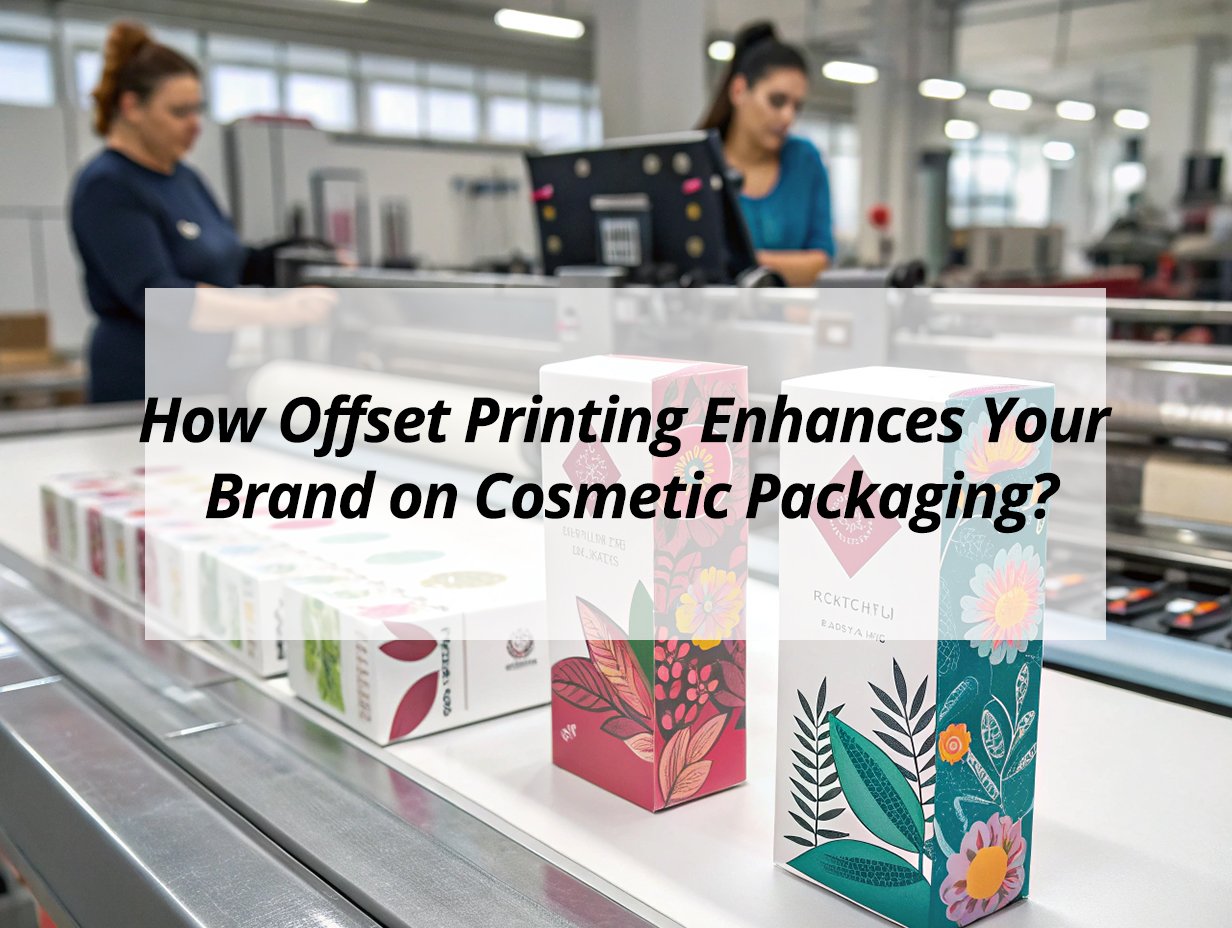
Great cosmetic formulas can lose shelf impact when packaging colors look inconsistent, small text becomes unclear, or complex brand artwork cannot be reproduced accurately.
Offset printing enhances cosmetic packaging by producing sharp typography, detailed multicolor graphics, smooth gradients, precise patterns, and consistent brand colors across large production runs. It is especially effective for cosmetic tubes and cylindrical packaging where brands need complex artwork, strong SKU differentiation, repeatable visual identity, and efficient high-volume decoration.
Offset printing turns the packaging surface into a larger branding canvas. The best result comes from matching artwork, colors, tube material, ink, surface treatment, curing, durability, production quantity, and recyclability goals.
What Is Offset Printing in Cosmetic Packaging and How Does It Work?
Offset printing is a high-speed decoration process that transfers artwork indirectly from printing plates onto cosmetic packaging instead of pushing ink directly through a stencil.
In cosmetic packaging, offset printing transfers ink from prepared printing plates to an intermediate transfer surface and then onto the tube or container. Multiple printing stations can apply different colors with precise registration. This process is well suited to detailed graphics, fine text, halftones, gradients, patterns, and multicolor artwork on round cosmetic tubes.
1. The Artwork Is Separated Into Colors
The process begins with digital artwork.
Depending on the design, the file may use:
- CMYK;
- spot colors;
- Pantone-style brand colors;
- halftones;
- gradients.
Each color needs to be controlled during printing.
Older conventional tube offset systems often use several individual spot-color stations.
More advanced systems can combine process and spot colors.
Polytype's current Prime Offset technology, for example, combines CMYK plus four additional spot colors to reproduce detailed graphics, gradients, fine typography, and brand-critical colors.
This gives cosmetic brands more design freedom than traditional limited-color printing.
2. Printing Plates Carry the Artwork
Each printing plate contains part of the image.
The printing system transfers ink from the plate through an intermediate roller or blanket and then onto the package.
This indirect transfer is the origin of the term offset.
The method allows the manufacturer to reproduce fine detail repeatedly.
It can work particularly well for round cosmetic tubes, where the package rotates during the decoration process.
SR Packaging describes offset tube decoration as capable of producing halftones and gradients with precise multicolor artwork in a single production sequence.
3. Registration Keeps Colors Aligned
If a design uses several colors, each color needs to appear in exactly the right place.
This is called registration.
Poor registration can create:
- blurred logos;
- color shadows;
- uneven outlines;
- unreadable fine text.
Registration matters strongly when artwork contains:
- small typography;
- fine lines;
- geometric patterns;
- several overlapping colors.
Modern offset systems are built around stable registration so thousands of tubes can maintain the same artwork position.
4. The Ink Must Cure Correctly
Printing is not complete when the ink touches the tube.
The ink still needs to dry or cure.
UV-curable inks are widely used in packaging because they can cure quickly.
Specialized UV offset inks are available for non-absorbent substrates such as pretreated PE and PP, although ink suppliers recommend adhesion testing on the final material.
This is important because cosmetic tubes do not absorb ink like paper.
The printing system needs to create adhesion on a plastic surface.
Why Is Offset Printing Effective for Cosmetic Brand Design?
Cosmetic packaging often needs more visual information than a simple logo. Offset printing lets brands use complex artwork while maintaining a clean industrial finish.
Offset printing strengthens cosmetic branding by reproducing multiple colors, gradients, fine typography, illustrations, patterns, and repeated brand elements with high consistency. It allows cosmetic tubes to communicate product function, ingredients, shade families, fragrance variants, and visual identity directly on the package while maintaining a smooth professional surface.
1. It Supports More Detailed Artwork
Silk screen is excellent for strong logos and simple solid colors.
Offset becomes more useful when artwork includes:
- botanical illustrations;
- detailed patterns;
- fine background graphics;
- small typography;
- multicolor design;
- gradual color transitions.
For example, a skincare tube could use:
soft beige background + green botanical illustration + gradient accent + dark brand typography
instead of relying on only one or two solid printed colors.
Current cosmetic tube manufacturers specifically position offset printing for colorful artwork, gradients, patterns, and detailed designs.
2. Gradients Create More Visual Depth
A gradient can move smoothly from:
- pink to orange;
- dark blue to pale blue;
- green to transparent;
- one shade of beige to another.
These transitions can make packaging feel:
- softer;
- more modern;
- more expressive.
Offset printing handles halftones and tonal variation better than conventional silk screen.
This creates more freedom for modern beauty branding.
3. Small Text Can Stay Sharp
Beauty packaging often contains a large amount of information.
A tube may need:
- product name;
- key ingredients;
- capacity;
- instructions;
- claims;
- regulatory information.
Fine typography needs accurate printing.
Polytype's latest offset platform specifically emphasizes the ability to maintain sharp small fonts while producing gradients and detailed artwork.
This is valuable because poor typography immediately makes cosmetic packaging look less professional.
4. Offset Helps Build Product Families
Imagine a skincare range containing:
- cleanser;
- toner;
- serum;
- moisturizer;
- sunscreen.
The brand wants every product to look connected.
Offset printing can keep the same:
- logo;
- typography;
- visual pattern;
- background structure.
Then each SKU can use a different color.
| Product | Main Offset Color |
|---|---|
| Cleanser | Soft blue |
| Toner | Pale green |
| Serum | Dusty pink |
| Moisturizer | Beige |
| Sunscreen | Warm yellow |
The package family stays consistent while customers can identify each product quickly.
5. Direct Printing Creates a Clean Surface
Offset printing places the artwork directly onto the packaging.
There is no separate label edge.
This can create a cleaner look for:
- skincare;
- sunscreen;
- hand cream;
- foundation;
- hair treatments.
It can also reduce some of the visual complexity created by a large label.
However, brands still need to review the ink and packaging structure from a recycling perspective.
Direct printing is not automatically environmentally superior.
How Does Offset Printing Compare With Silk Screen, Hot Stamping, and Digital Printing?
Each decoration technology solves a different visual problem. Brands get better results when they select the printing method according to artwork rather than using one method for every package.
Offset printing is strongest for detailed multicolor artwork, gradients, patterns, and high-volume tube production. Silk screen is better for opaque solid colors and tactile ink. Hot stamping creates reflective metallic accents, while digital printing offers artwork flexibility and can be useful for shorter runs or frequent design changes. Hybrid decoration can combine several methods.
Offset Printing vs Silk Screen Printing
Silk screen pushes ink directly through a mesh stencil.
This creates relatively thick ink coverage.
It works well for:
- bold logos;
- high-opacity white;
- simple text;
- solid Pantone colors.
Offset ink usually feels flatter.
A 2026 tube-decoration comparison describes offset as smooth and suited to complex multicolor patterns and gradients, while silk screen creates more tactile ink and stronger solid-color coverage.
The decision can therefore be simple:
complex artwork → offset
bold solid logo → silk screen
Offset Printing vs Hot Stamping
Hot stamping transfers foil rather than conventional colored ink.
It is ideal for:
- gold logos;
- silver borders;
- rose-gold accents;
- holographic details.
Offset printing cannot reproduce the same true reflective foil effect.
But hot stamping is not ideal for photographic images or large multicolor illustrations.
A package can combine both:
four-color offset artwork + gold hot stamped logo
This creates detail and luxury in the same design.
Offset Printing vs Digital Printing
Digital printing removes some conventional plate requirements.
It can be useful when a brand needs:
- lower quantities;
- many artwork changes;
- personalization;
- several short-run SKUs.
Offset can become more efficient when volumes increase.
Modern offset technology is also moving toward faster changeovers, narrowing part of the traditional flexibility gap between conventional and digital decoration.
Decoration Comparison
| Method | Strongest Use | Main Limitation |
|---|---|---|
| Offset | Detailed multicolor artwork | Setup and color control |
| Silk screen | Opaque solid colors | Less suitable for smooth gradients |
| Hot stamping | Metallic accents | Limited for complex imagery |
| Digital | Short runs and variable artwork | Economics vary with volume |
| Label | Maximum artwork flexibility | Adds another component |
| Metallization | Full metallic surface | Not for detailed printed graphics |
The strongest cosmetic package may combine two methods instead of forcing one process to do everything.
How Does Offset Printing Improve Brand Consistency Across Large Production Runs?
A beauty brand needs the 100,000th tube to look like the approved sample, not just the first ten tubes shown during development.
Offset printing can improve brand consistency by using controlled plates, ink formulas, machine settings, registration, curing, and approved color references across repeated production. Once the process is stabilized, it can reproduce the same graphics efficiently across high-volume cosmetic tube orders, making it useful for brands that need consistent shelf appearance across many SKUs.
1. Brand Colors Need Repeatability
Many brands rely on one recognizable color.
Examples might include:
- a specific green;
- signature pink;
- clinical blue;
- warm orange.
Small color changes can make production batches look inconsistent on retail shelves.
Manufacturers can control offset printing with:
- approved ink formulations;
- physical color references;
- machine settings;
- golden samples.
Meliora Packaging, for example, promotes multi-color offset decoration with controlled color matching and precise registration for cosmetic tubes.
2. High Volume Makes Consistency More Important
One imperfect tube is a small problem.
A color error across 100,000 tubes is expensive.
Potential costs include:
- reprinting;
- rejected packaging;
- delayed filling;
- wasted formula;
- missed launches.
Brands should therefore define quality before production.
3. Use a Golden Sample
The final approved tube should represent:
- tube color;
- print colors;
- artwork size;
- print position;
- opacity;
- gloss;
- registration.
Both brand and supplier should keep matching references.
Future orders can then be checked against the same standard.
4. Lock Artwork Versions
Beauty brands often change:
- ingredients;
- product claims;
- addresses;
- regulatory text.
File control matters.
The purchase order should identify:
- artwork file name;
- revision number;
- printing specification;
- color references.
This prevents an old file from returning to production.
5. Review Multiple SKUs Together
If a product family has 12 SKUs, I would not approve each design completely independently.
I would line them up together.
Then compare:
- logo size;
- typography;
- spacing;
- color relationship;
- print height.
This helps create stronger shelf consistency.
What Should Brands Test Before Approving Offset-Printed Cosmetic Packaging?
Perfect digital artwork does not guarantee perfect packaging. Printing must survive manufacturing, filling, shipping, retail handling, and repeated consumer contact.
Before approving offset-printed cosmetic packaging, brands should test ink adhesion, curing, abrasion, scratching, water, oil, alcohol or formula exposure, color accuracy, registration, and transport durability. Testing should use the final tube material, PCR level, surface treatment, coating, ink, artwork, and production process rather than a visually similar sample.
1. Check Surface Treatment
PE and PP can have relatively low surface energy.
The ink may not adhere reliably without treatment.
Common treatments include:
- corona;
- flame.
Industry sources describe corona treatment as an important preparation step for offset printing on cosmetic tubes, while UV ink suppliers recommend pretreated PE and PP and an adhesion pretest.
A supplier should verify the treatment level before printing.
2. Test Ink Adhesion
Check whether ink:
- peels;
- flakes;
- transfers;
- scratches away.
Do this after the ink is fully cured.
The exact test method should be agreed between the supplier and brand.
3. Test Cosmetic Formula Exposure
A sunscreen tube may come into contact with:
- sunscreen oils;
- water;
- sweat.
A hand cream tube may remain covered in product residue.
A cleanser tube may stay in a wet bathroom.
The printed surface should be tested according to actual use.
4. Test Flexing
Cosmetic squeeze tubes are repeatedly compressed.
This creates another challenge.
Ink must remain stable as the tube wall flexes.
Check for:
- cracking;
- separation;
- loss of detail.
The test should include repeated use rather than only inspecting a brand-new tube.
5. Check Registration
Multi-color artwork should remain aligned.
Pay particular attention to:
- small text;
- thin borders;
- outlines;
- geometric patterns.
Brands should define an acceptable registration tolerance before mass production.
6. Review the Filled Package
For translucent or lightly colored tubes, the formula can influence final appearance.
I would review:
empty tube + filled tube
before final approval.
Offset Printing QC Checklist
| Test | What It Checks |
|---|---|
| Color check | Brand consistency |
| Registration | Alignment between colors |
| Adhesion | Ink bonding |
| Abrasion | Handling durability |
| Flex test | Performance during squeezing |
| Water test | Bathroom use |
| Formula exposure | Chemical resistance |
| Scratch test | Surface durability |
| Artwork check | Correct revision |
| Golden sample | Repeat-production standard |
Decoration should be treated as a manufacturing specification, not only a graphic-design decision.
Can Offset Printing Work With Sustainable Cosmetic Packaging?
Offset printing can be used on PCR and recycling-focused cosmetic tubes, but sustainability depends on the full packaging structure and the type and quantity of ink used.
Offset printing can support sustainable cosmetic packaging when it is applied to lightweight, PCR, or recycling-compatible tube structures using inks and coverage suited to the target recycling stream. Brands should evaluate direct printing together with the main resin, ink chemistry, printed area, barrier layer, closure, and decoration rather than assuming direct printing automatically improves recyclability.
1. Offset Can Work on PCR Tubes
Neopac currently offers a recycled cosmetic tube using PE and up to 73% PCR material, with offset printing among its available decoration options.
This demonstrates that recycled-content packaging does not require brands to abandon sophisticated printing.
However, PCR may change:
- base color;
- surface appearance;
- print perception.
The final PCR tube should therefore be used for color approval.
2. Offset Can Work on Recycling-Focused PE Structures
Neopac's current Polyfoil MMB tube uses a PE-focused structure and lists offset printing, silk screen printing, and hot foil stamping as decoration options. The company reports APR and RecyClass recycling-related assessments for specific configurations.
Again, the complete package matters.
The printing method alone does not determine recyclability.
3. Printing Inks Are a Recycling Variable
The EU PPWR explicitly includes inks and lacquers / printing / coding among parameters relevant to design for recycling.
The regulation notes that some inks can affect washing systems, recycled-material transparency, or recycling quality.
This means brands should ask printing suppliers:
- What ink system is used?
- How much surface is printed?
- Is the design assessed against the target recycling stream?
- Is an alternative ink or lower coverage possible?
4. 2026 Recycling Guidance Is Becoming More Detailed
RecyClass updated its Design for Recycling guidelines in March 2026, including new guidance based on testing of printing inks for HDPE, PP, PE, PET, and other packaging streams.
A March 2026 RecyClass technical review also specifically investigated the effect of direct UV-curable printing ink levels on colored HDPE rigid packaging.
The practical message is simple:
“Direct printed” does not automatically mean recycling-compatible.
Use current guidance for the exact material.
5. PPWR Increases Attention to Decoration
The EU PPWR generally began applying from August 12, 2026 and requires packaging to move toward recyclability while minimizing unnecessary packaging weight and volume. It also recognizes inks and coatings as relevant design features.
This makes decoration part of sustainable packaging engineering.
Brands should not design the tube first and think about inks only at the end.
My insights: How Offset Printing Enhances Your Brand on Cosmetic Packaging
Offset printing creates the most brand value when packaging artwork needs more than a simple logo. Its strength is turning a cosmetic tube into a consistent multicolor visual system that can scale.
Offset printing enhances cosmetic branding by combining detailed artwork, smooth gradients, fine typography, multiple colors, and repeatable production on one packaging surface. I would choose it for complex tube graphics and large SKU families, then use silk screen or hot stamping only where stronger opacity, texture, or metallic emphasis adds clear brand value.
1. Start With the Artwork
I would decide the decoration method only after seeing the design.
If the artwork contains:
- complex gradients;
- illustrations;
- many colors;
- detailed patterns;
offset is a strong starting point.
If it only contains:
one large white logo
silk screen may be simpler.
2. Use Offset for Product Families
Offset printing becomes particularly useful when the brand has many SKUs.
I would create one common visual system and change:
- accent color;
- illustration;
- product name.
This makes the range feel connected.
3. Protect the Core Brand Color
If one color defines the brand, I would not rely only on CMYK interpretation.
I would discuss a dedicated spot color where the equipment allows it.
Modern offset systems that combine process colors with spot colors are especially useful for this reason.
4. Do Not Add Colors Without a Purpose
More printing stations create more design freedom.
That does not mean every tube needs eight colors.
I would ask:
Does this extra color improve recognition, product understanding, or shelf impact?
If not, remove it.
Simpler artwork can improve:
- cost;
- registration;
- repeatability.
5. Use Hybrid Decoration Strategically
A premium tube might use:
offset gradient + silk screen logo + gold hot stamp
This can look excellent.
But three processes also increase:
- setup;
- sampling;
- registration risk;
- cost.
I would use each decoration only for a specific visual function.
6. Approve the Real Tube Material
A white PE tube and a PCR PE tube may not create identical color results.
I would print samples on:
- final resin;
- final wall structure;
- final tube color.
This is particularly important for PCR packaging.
7. Test the Tube After Squeezing
Cosmetic tubes are flexible objects.
I would perform repeated squeezing before final print approval.
The artwork should remain:
- readable;
- attached;
- visually consistent.
8. Keep Sustainability in the Artwork Discussion
If a design needs nearly 100% heavy ink coverage, I would ask whether the same branding could work with less.
Reducing coverage can potentially:
- simplify decoration;
- reduce ink use;
- support recycling considerations.
Current PPWR and RecyClass work makes printing chemistry and coverage increasingly relevant to design-for-recycling decisions.
9. Compare Offset With Digital at the Real Order Quantity
For a small test launch, digital printing may deserve comparison.
For stable higher-volume production, offset may become more commercially efficient.
I would compare:
- setup cost;
- unit cost;
- MOQ;
- artwork changes;
- color consistency;
- lead time.
The best printing technology is not always the most technically advanced one.
It is the process that fits the commercial order.
10. Use an Offset Printing Approval Checklist
Before mass production, I would confirm:
- Final tube material confirmed
- PCR percentage confirmed where relevant
- Final tube color approved
- Surface treatment confirmed
- Artwork revision locked
- CMYK and spot colors defined
- Brand colors physically approved
- Gradient quality checked
- Small typography checked
- Registration tolerance approved
- Ink system confirmed
- UV or other curing process confirmed
- Adhesion tested
- Flex resistance tested
- Abrasion tested
- Water exposure tested
- Formula exposure tested where relevant
- Recycling impact reviewed
- Golden sample retained
- Repeat-production specifications locked
Offset printing is most valuable when it makes brand identity easier to recognize at scale. The goal is not simply to print more colors. It is to reproduce the right colors, details, typography, and visual hierarchy consistently on every cosmetic package.
Conclusion
Offset printing strengthens cosmetic branding through detailed multicolor artwork, gradients, sharp typography, and repeatable production when brands control materials, ink, registration, durability, and recyclability.