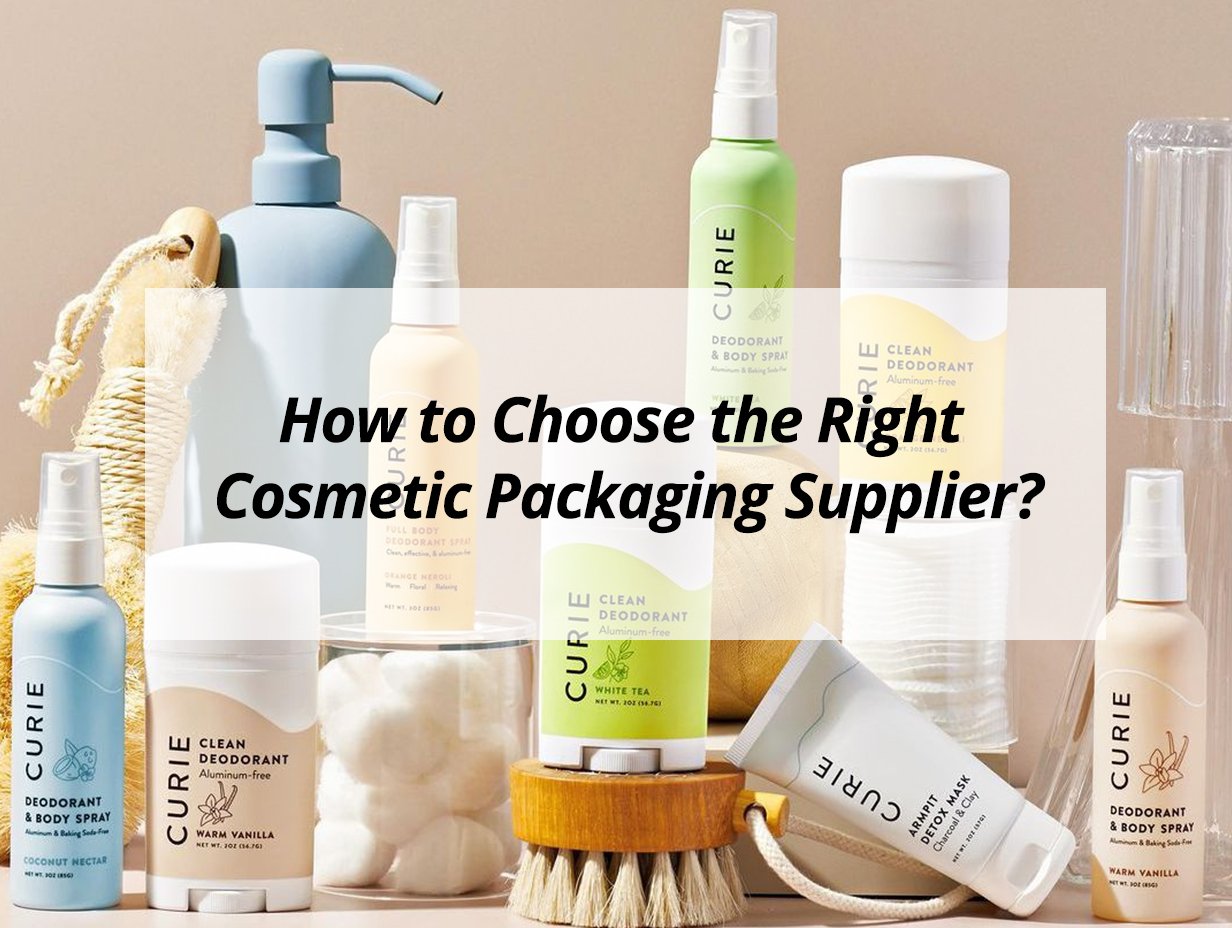
The wrong packaging supplier can create leaking products, inconsistent colors, missed launches, unexpected costs, and quality problems that appear only after mass production.
To choose the right cosmetic packaging supplier, compare product expertise, formula compatibility, physical sample quality, manufacturing capability, QC, customization, MOQ, total cost, certificates, lead time, communication, and repeat-order reliability. The right supplier should prove its claims with samples, specifications, testing, documentation, and consistent production rather than relying on catalog images or low prices.
Cosmetic packaging suppliers should be compared by total project value, not unit price alone. The right partner should protect the formula, support the brand, control quality, and deliver consistently.
What Should You Look for in a Cosmetic Packaging Supplier?
A large catalog does not prove that a supplier understands your product. The first question should be whether its real capabilities match your packaging requirements.
Look for a cosmetic packaging supplier with relevant product experience, suitable materials, technical knowledge, reliable manufacturing, strong quality control, physical samples, realistic customization, and clear production support. The supplier should understand how the package interacts with the formula, filling process, decoration, shipping conditions, customer use, and target-market requirements.
1. Match the Supplier to the Product Category
Cosmetic packaging covers many different technologies.
A supplier may specialize in:
- lipstick tubes;
- mascara tubes;
- lip gloss packaging;
- airless bottles;
- lotion pumps;
- cream jars;
- cosmetic tubes;
- glass bottles;
- compacts;
- fragrance packaging.
These products require different technical knowledge.
A strong airless-bottle manufacturer may not be the strongest compact supplier. A company with excellent glass capabilities may not have deep knowledge of mascara wipers and brushes.
Current supplier guides consistently recommend checking category-specific experience before making commercial comparisons.
2. Understand the Supplier Business Model
Not every good supplier must own every production machine.
There are several sourcing models.
| Supplier Type | Main Advantage | Possible Limitation |
|---|---|---|
| Direct manufacturer | Better process control and customization | Often higher MOQ |
| Distributor | Broad stock range and smaller quantities | Less control over manufacturing |
| Trading company | Can combine several product categories | Factory transparency needs checking |
| Full-service supplier | Manages packaging, decoration, testing, and logistics | Service costs may be higher |
| Specialist manufacturer | Strong technical depth in one category | Narrower product range |
The correct choice depends on the project.
A new brand using stock packaging may benefit from a distributor. A large brand developing a custom airless bottle may need direct manufacturer involvement.
3. Check Material Knowledge
A supplier should clearly identify materials such as:
- PP;
- PE;
- HDPE;
- PET;
- PETG;
- ABS;
- glass;
- aluminum;
- PCR plastic.
The supplier should also explain limitations.
For example, clear PET, PP, aluminum, PCR resin, and glass create different cost, decoration, shipping, formula-protection, and recycling considerations.
Avoid vague descriptions such as:
- environmental plastic;
- premium plastic;
- eco material;
- high-grade acrylic.
Ask for the actual material specification.
4. Check Future Capability
The supplier should fit today's project and ideally support future products.
A skincare brand may start with one serum and later add:
- cream;
- toner;
- eye product;
- cleanser;
- sunscreen.
A makeup brand may expand from lipstick into:
- lip gloss;
- mascara;
- foundation;
- compact packaging.
A supplier with relevant adjacent technologies can reduce future sourcing complexity.
How Can You Verify Cosmetic Packaging Quality Before Mass Production?
Supplier quality should be verified through physical products and controlled testing. A quotation and company presentation cannot prove how packaging will perform after filling.
Verify cosmetic packaging quality by testing production-representative samples with the real formula. Check dimensions, leakage, closure fit, pump output, dispensing, compatibility, decoration, color, drop resistance, and transportation. Approve a golden sample, define acceptable defects, and require documented QC checkpoints before releasing mass production.
1. Request Physical Samples
A website photograph can hide:
- scratches;
- weak hinges;
- loose caps;
- uneven molding;
- poor pump feel;
- incorrect color;
- thin walls;
- printing defects.
Physical samples reveal these issues.
Supplier-selection guides published in 2026 also identify unwillingness to provide samples as a sourcing warning sign.
2. Test the Final Formula
Empty packaging tests are not enough.
Compatibility testing should use:
final formula + final container + final closure + final dispensing system
Recent technical guidance describes compatibility testing as observation of the real formula in the intended packaging under defined storage and temperature conditions.
Cosmetic formulas may contain:
- oils;
- surfactants;
- alcohol;
- fragrance;
- essential oils;
- acids;
- pigments;
- solvents.
These can affect plastics, seals, coatings, labels, pumps, and metal parts.
Brands should check:
- leakage;
- swelling;
- cracking;
- corrosion;
- discoloration;
- evaporation;
- odor changes;
- pump function;
- closure performance.
FDA also notes that cosmetics can become contaminated when packaging does not adequately protect the product. Companies remain responsible for cosmetic product safety.
3. Approve a Golden Sample
The final approved physical sample should define:
- color;
- gloss;
- dimensions;
- logo position;
- decoration;
- pump;
- closure;
- material;
- assembly.
Both buyer and supplier should keep matching samples.
Mass production can then be compared against a real standard.
4. Define QC Before Production
“Good quality” is not measurable.
The supplier and buyer should agree on defects before the order starts.
Possible categories include:
Critical
- leakage;
- broken mechanism;
- contamination;
- wrong material.
Major
- printing in the wrong position;
- loose closure;
- serious scratches;
- incorrect color.
Minor
- small molding marks;
- minor cosmetic variation in hidden areas.
A professional supplier should be able to explain its inspection flow.
5. Check the Whole Packaging System
Do not test only the visible container.
Check:
| Packaging Type | Important Functional Checks |
|---|---|
| Airless bottle | Pump output, priming, piston movement |
| Cream jar | Cap fit, liner, leakage |
| Lip gloss tube | Wiper, applicator, neck seal |
| Mascara | Brush loading, wiper, evaporation |
| Lipstick | Twist mechanism, cup retention |
| Lotion bottle | Pump output, dip tube, leakage |
| Cosmetic tube | Seal strength, cap fit, product evacuation |
The package is only successful when every component works together.
How Should You Compare MOQ, Pricing, and Lead Times Between Suppliers?
A low quotation can become expensive when it includes the wrong MOQ, missing decoration costs, long development times, or unexpected tooling charges.
Compare cosmetic packaging suppliers using the same specification, quantity, materials, components, decoration, testing, and shipping assumptions. Review MOQ by component, total project cost, tooling, sampling, production capacity, and full delivery timeline. The best commercial supplier should fit both the first launch and realistic future order volumes.
1. Ask What the MOQ Actually Covers
MOQ can apply separately to:
- stock bottle;
- custom color;
- cap;
- pump;
- printing;
- coating;
- hot stamping;
- carton;
- custom mold.
A supplier may advertise an MOQ of 3,000 units but require 10,000 units for a custom color or specialized decoration.
Supplier guides note that stock products usually offer lower development risk, while custom molds and processes require larger commitments.
2. Compare the Same BOM
A useful RFQ should define a clear bill of materials.
For example:
- 50 ml PP airless bottle;
- PP cap;
- 0.25 ml pump output;
- custom beige color;
- one-color silk screen;
- 10,000 pieces;
- individual protective packing.
Every supplier should quote that same requirement.
Recent buyer guidance specifically recommends freezing the product function, formula-contact system, commercial scope, and evidence requirements before quotations are compared.
3. Calculate Total Cost
Compare more than the unit price.
| Cost Area | Supplier A | Supplier B | Supplier C |
|---|---|---|---|
| Packaging unit | |||
| Decoration | |||
| Tooling | |||
| Samples | |||
| Testing | |||
| Assembly | |||
| Inspection | |||
| Export packing | |||
| Freight | |||
| Total landed cost |
Also consider the cost of packaging failure.
Poor quality can create:
- production downtime;
- formula loss;
- rejected goods;
- repacking;
- emergency freight;
- delayed launches.
Saving a few cents per package may not be valuable when those risks increase.
4. Ask for the Full Timeline
Do not ask only:
“What is your production lead time?”
Ask for:
sample → color approval → mold → decoration approval → production → QC → packing → shipment
Custom mold development can add significant time before mass production even begins.
The supplier should also explain current capacity.
A promised 30-day lead time is only useful if the production line can actually accept the order.
What Certifications and Documents Should a Cosmetic Packaging Supplier Provide?
Certificates can support supplier evaluation, but buyers should verify what they actually cover instead of treating every certificate as proof of product quality.
A cosmetic packaging supplier should provide material specifications, technical drawings, approved samples, QC records, relevant management-system certificates, sustainability documentation, and testing information required by the project. Buyers should verify company names, certificate numbers, validity, factory scope, materials, and product coverage before relying on any supplier claim.
1. Review Quality-System Evidence
ISO 9001 is commonly used when evaluating supplier quality systems.
As of August 29, 2026, ISO lists the new ISO 9001 edition as still under publication with publication expected in September 2026. ISO 9001:2015 therefore remains the published edition while certified companies prepare for transition.
An ISO certificate does not prove that one particular bottle is defect-free.
It provides evidence about the supplier's management system.
The package still needs:
- inspection;
- specifications;
- functional testing;
- physical approval.
2. Verify Sustainability Documentation
When a supplier claims:
- PCR;
- FSC;
- recyclable;
- refillable;
- reduced material;
ask for specific evidence.
For FSC paper packaging, FSC's public certificate search can verify an organization's certificate status, dates, location, and product scope.
Do not accept an FSC logo on a PDF as enough evidence.
3. Verify Environmental Claims
For products sold in the U.S., FTC guidance warns against broad, unqualified claims such as “green” or “eco-friendly.” Recycled-content claims should identify the actual percentage when the package contains only partial recycled content.
A supplier should therefore provide specific information such as:
- 30% PCR PET;
- 50% PCR PP;
- FSC-certified paperboard;
- refillable jar with replaceable cartridge.
Specific data is more useful than sustainability slogans.
4. Protect Label Space
The packaging supplier should also understand that decoration cannot consume all available label space.
For cosmetics sold in the U.S., FDA requires cosmetic labels to include specified information such as product identity and net quantity, along with other required information depending on the panel and product.
This matters for small formats such as:
- lipstick;
- mascara;
- lip gloss;
- mini bottles.
The packaging design must leave enough usable space.
5. Build a Complete Supplier File
A useful approval file can include:
- company details;
- material specification;
- 2D drawing;
- component BOM;
- artwork;
- color standard;
- golden sample;
- certificates;
- compatibility results;
- QC standards;
- packing specification;
- approved production timeline.
This file reduces confusion during repeat orders.
My insights: How to Choose the Right Cosmetic Packaging Supplier?
Choosing the right supplier should not start with “Who has the lowest price?” It should start with “What does this packaging need to do correctly?”
The right cosmetic packaging supplier combines product-specific expertise, formula compatibility, production capability, reliable samples, measurable QC, transparent MOQ and total cost, verified documentation, realistic lead times, clear communication, and repeat-order discipline. A strong supplier reduces risk before production instead of asking the buyer to discover problems after thousands of packages have already been manufactured.
1. Start With the Packaging Brief
I would define the project before contacting suppliers.
The brief should include:
- formula type;
- viscosity;
- capacity;
- product category;
- target quantity;
- material;
- pump or closure;
- decoration;
- target cost;
- market;
- launch date;
- sustainability goal.
Better input creates more comparable quotations.
2. Do Not Treat Every Supplier Model the Same
A direct factory can be the right choice for large customized projects.
A stock distributor may be better for a small launch.
A full-service supplier may be valuable when the buyer needs one partner to coordinate:
- primary packaging;
- decoration;
- cartons;
- testing;
- logistics.
The best model depends on the project.
3. Use Samples to Test Both Packaging and Supplier
The sample should test packaging quality.
The sampling process should test the supplier.
I would observe:
- response speed;
- technical answers;
- drawings;
- specification accuracy;
- problem solving;
- willingness to explain limitations.
Poor communication before receiving an order is a major warning sign.
4. Compare Evidence Instead of Promises
Instead of asking:
“Is your quality good?”
ask for:
- production sample;
- QC flow;
- dimensional drawing;
- material data;
- test report;
- certificate;
- inspection record.
Evidence makes supplier comparison much easier.
5. Use a Weighted Supplier Scorecard
| Evaluation Factor | Suggested Weight |
|---|---|
| Product-category experience | 15% |
| Sample quality | 15% |
| Formula compatibility support | 15% |
| Quality control | 15% |
| Manufacturing capability | 10% |
| MOQ and total cost | 10% |
| Customization | 5% |
| Documentation | 5% |
| Communication | 5% |
| Lead time and repeatability | 5% |
I would not automatically select the supplier with the highest score in one category.
I would look for balance.
6. Calculate the Cost of Failure
A $0.40 package from a reliable supplier may be cheaper than a $0.32 package that causes:
- 5% leakage;
- decoration rejects;
- missed filling schedules;
- replacement production;
- emergency air shipment.
Cosmetic packaging sourcing should therefore focus on total risk-adjusted cost.
7. Check Whether the Supplier Can Repeat the Package
A good sample is only the beginning.
The supplier should be able to repeat:
- resin;
- color;
- dimensions;
- pump;
- decoration;
- closure;
- packaging quality.
Repeat orders should reference approved drawings, component codes, artwork versions, and golden samples.
8. Require Change Control
Suppliers sometimes need to change:
- resin source;
- pigment;
- pump component;
- mold;
- subcontractor;
- decoration factory.
A strong supplier should notify the buyer before making a change that can affect approved packaging.
This is especially important for long-term skincare and makeup products.
9. Select a Supplier for the Next Three Orders
I would not choose a packaging supplier only for the first PO.
I would ask:
- Can it support higher volume?
- Can it reproduce the color?
- Can it provide replacement components?
- Can it add another capacity?
- Can it support additional product categories?
- Will the same documents still be available?
That creates a more useful long-term sourcing decision.
10. Use a Final Approval Checklist
Before placing a mass-production order, I would confirm:
- Product category experience verified
- Supplier business model understood
- Exact material confirmed
- Physical samples approved
- Final formula compatibility tested
- Functional tests completed
- Golden sample retained
- Decoration approved
- MOQ confirmed by process
- Total project cost calculated
- Tooling ownership confirmed
- QC standards documented
- Certificates verified
- Production capacity reviewed
- Full lead time confirmed
- Export packing approved
- Repeat-order specifications locked
- Change-control process agreed
The best cosmetic packaging supplier does more than sell a container. The supplier helps turn an approved concept into repeatable production without adding unnecessary quality, cost, compliance, or delivery risk.
Conclusion
Choose a cosmetic packaging supplier by verifying product fit, samples, formula compatibility, QC, total cost, documentation, communication, delivery, and repeat-production reliability.