Traditional cosmetic bottles can force customers to discard an entire premium package after the formula runs out. That adds waste and makes repeat purchasing less efficient.
A replaceable inner bottle airless pump bottle is a refillable cosmetic container with a reusable outer case and a removable product-filled cartridge. Its airless dispensing system limits routine air contact with the formula, while the replacement design lets customers keep selected outer components. It combines product protection, convenience, and potential packaging savings.
I see this format as an important option for skincare brands, especially when products are purchased repeatedly. But the real advantage depends on how the cartridge, pump, sealing system, and refill supply work together. I would evaluate the engineering before relying on the word “sustainable.”
What Is a Replaceable Inner Bottle Airless Pump Bottle?
A refillable bottle may look identical to a standard airless bottle. The key difference is hidden inside, where the product-contact container is designed to be removed.
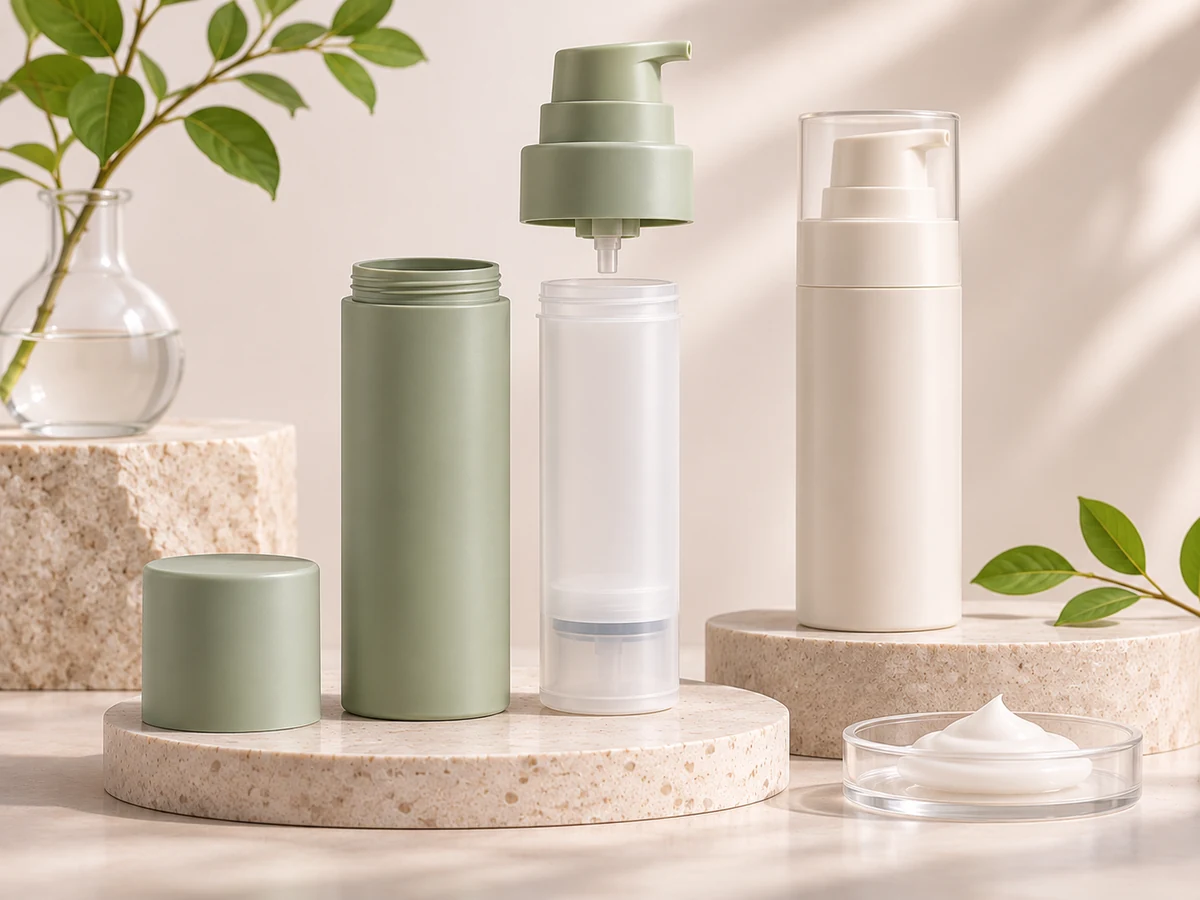
A replaceable inner bottle airless pump bottle usually includes an outer shell, an airless dispensing assembly, and a matching removable inner bottle. Once the product is used, the customer replaces the specified refill unit rather than buying another complete package. The parts that remain in use depend on the bottle model.
Understanding the Main Components
I divide the packaging into the parts customers keep and the parts they replace. A durable outer case can carry the brand's color, texture, logo, and premium finish. The inner cartridge holds the cosmetic formula and may include the piston that moves as product is dispensed. The actuator, cap, and pump are retained in some designs. Other designs replace part of the dispensing assembly with every cartridge.
This distinction matters. I would never assume that every refillable airless bottle has a reusable pump, or that every cartridge is sold as a ready-to-use sealed unit. A supplier's technical drawing should show exactly where the refill separates from the original pack.
| Component | Typical Function | Reused or Replaced? |
|---|---|---|
| Outer shell | Provides appearance, grip, and structural support | Usually reused |
| Inner bottle or cartridge | Holds the skincare formula | Replaced |
| Piston or flexible liner | Helps move the formula without routine air replacement | Often part of the refill; model-dependent |
| Pump and actuator | Controls dispensing | Model-dependent |
| Cap and decorative parts | Protects the actuator and supports branding | Usually reused, if designed for it |
It Is Not the Same as a Normal Refillable Bottle
In a simple refillable lotion bottle, a user may unscrew the pump and pour in more product. A replaceable-inner design uses a matching cartridge instead. This can simplify handling and reduce direct contact with the formula, but it does not automatically make the system sterile.
The word airless describes the dispensing mechanism. The word replaceable describes how the product supply is renewed. A traditional airless bottle may have no approved refill procedure at all. I would confirm both features separately before approving a purchase.
How Does a Replaceable Inner Bottle Airless Pump Bottle Work?
Refillable airless packaging only delivers a good experience if the pump operates reliably and the new cartridge locks into position without leakage or confusion.
Most airless bottles dispense product through a piston or collapsible liner rather than a conventional dip tube. In a replaceable-inner system, the user removes an empty cartridge and installs a matching filled cartridge. The assembly is then secured and, when required, primed before use. Exact steps vary by design.
What Happens When the Pump Is Pressed?
I find it helpful to separate product movement from the refill operation. In a piston-based design, pressing the actuator moves a measured amount of formula through the pump. As product leaves, a piston advances inside the product chamber. Air may enter beneath the piston, but the construction is intended to keep that air away from the formula during normal dispensing.
Some airless packages use a flexible inner pouch instead. The pouch contracts as the contents are dispensed. Both approaches reduce the need for outside air to replace the discharged product. Neither guarantees complete oxygen exclusion, perfect preservation, or suitability for every formula.
The formulation still needs stability and compatibility testing. A thick cream, light lotion, and fluid serum can require different pump valves, dose settings, and filling methods. I would test the actual product rather than relying only on a supplier's water-based demonstration.
How Is the Empty Inner Bottle Replaced?
The customer might twist the base, press a release button, or unlock a retaining ring. After removing the old cartridge, the customer installs the correct replacement and checks that it is fully seated. Depending on the model, the pump stays on the outer bottle or comes with the new refill.
I would ask a supplier to demonstrate this sequence with production-intent samples, not just a rendering. The cartridge should fit without excessive force, attach securely, and avoid exposing the product unnecessarily. Instructions should explain how to identify an empty unit, replace it safely, and dispose of the old components according to local guidance.
The cartridge is not universal. Even bottles labeled 30 ml or 50 ml can use different diameters, sealing surfaces, piston positions, and locking features. A buyer should use the exact approved refill part number. Swapping formulas in a retained pump also needs a documented hygiene and compatibility assessment.
Why Is Replaceable Inner Bottle Airless Packaging a Game-Changer for Cosmetics?
Cosmetic brands want premium presentation, repeat purchases, and less unnecessary packaging. A well-designed cartridge system can address all three, but the benefits are not automatic.
Replaceable-inner airless packaging can combine controlled dispensing with repeated use of an attractive outer shell. It may reduce the material purchased and discarded for each later refill, improve the convenience of repeat purchases, and support a consistent brand experience. The environmental and financial gains depend on real consumer reuse.
Product Protection and More Consistent Dispensing
I see product protection as the first reason to consider this format. A closed dispensing path can reduce routine handling and exposure to external air compared with frequently opening a jar. It can be useful for certain serums, moisturizers, and treatment products, provided their formulas pass compatibility and stability tests.
A metered pump can also help consumers apply a more repeatable amount. However, I would check dose variation, priming, residual product, and pump function from the first press to the last. A premium container loses its value if the actuator blocks, the piston jams, or too much formula remains inside.
Refill Convenience and Brand Retention
A customer who keeps the attractive outer bottle has a practical reason to buy the matching refill. I would make the refill easy to recognize, easy to order, and easy to insert. A subscription or repeat-purchase program may help if customers use the product regularly, but the refill must remain available.
Research published by the Sustainable Packaging Coalition in 2026 emphasizes convenience, simplicity, and availability in skincare refill adoption. This supports a practical point: a refill system is only useful when people actually use it.
Packaging Material and Commercial Trade-Offs
A refill cartridge can require less material than a complete new pack, especially if the outer shell is substantial. Still, I would compare the mass and materials of the original pack plus several refills against repeated purchases of a standard bottle. Refill cartons, transport, breakage, and actual reuse rates should be part of that assessment.
| Business Factor | Possible Advantage | Important Limitation |
|---|---|---|
| Packaging waste | Fewer outer bottles discarded | Requires repeated refill purchases |
| Premium branding | Decorative outer case remains in use | Initial pack may cost more |
| Repeat sales | Matching refill supports repurchase | Long-term cartridge availability is essential |
| Product protection | Airless dosing reduces routine air exchange | Formula-specific validation remains necessary |
| Production economics | Less outer decoration on later units | Additional tooling, assembly, and inventory may be needed |
I would describe the format as a potential sustainability and cost improvement, not a guaranteed reduction in carbon emissions or overall price. Claims should follow measured evidence and the conditions in which the packaging is used.
How Should Cosmetic Brands Choose and Test Replaceable Airless Pump Bottles?
The best-looking refillable package can still fail on a filling line or in a customer's hands. Selecting the right design requires more than choosing a capacity.
Cosmetic brands should confirm material composition, formula compatibility, pump performance, refill fit, filling procedures, and replacement-part supply before mass production. They should also review total packaging cost, decoration durability, recycling claims, and requirements in the destination market. Approved samples and documented test results are more reliable than marketing descriptions.
Choose the Materials and Structure Carefully
I would begin with the formula and product positioning. Common options may include PP or PE inner components, with PP, PET, or other plastics used for external parts depending on the design. A premium outer shell can be opaque, clear, matte, or decorated, but the product-contact materials must be suitable for the formula.
Material selection should not be based on resin names alone. Pumps may contain springs, elastomers, valves, and multiple polymers. I would request the component bill of materials and ask which pieces can be separated after use. A mono-material claim should be verified for the actual assembly rather than inferred from the outer bottle.
For brands selling into Europe, I would include the EU Packaging and Packaging Waste Regulation in the compliance review. It began applying on 12 August 2026, but individual provisions have different implementation dates. A refillable design does not automatically demonstrate compliance with every requirement.
Test the Complete Filled Package
I would approve the package only after checking the production-intent assembly with the intended formula. The test plan should cover pump priming and output, leakage after shipping simulation, compatibility over the product's shelf life, cartridge locking strength, and dispensing across expected storage conditions.
A practical refill test also matters. Users should be able to remove and install the inner bottle without breaking the housing or touching exposed product-contact parts. Where the pump is reused, the manufacturer should define its intended service life and the cleaning or hygiene precautions required, if any.
| Supplier Question | Why It Matters |
|---|---|
| Which components are reused and which are replaced? | Defines the actual refill system |
| Is the refill supplied filled and sealed? | Affects filling, hygiene, and consumer instructions |
| What is the exact refill part number? | Prevents mismatched reorders |
| What formulas and viscosities have been tested? | Reduces dispensing and compatibility risk |
| What are the MOQ, tooling cost, and lead time for both units? | Supports realistic launch planning |
| What test data supports sustainability claims? | Helps avoid unsupported environmental statements |
I would also ask whether suppliers can provide matching refills throughout the expected life of the product line. A beautiful reusable outer bottle becomes a stranded asset if its cartridge is discontinued after one season.
My Insights: What Is a Replaceable Inner Bottle Airless Pump Bottle and Why Is It a Game-Changer for Cosmetics
Brands often focus on how refillable packaging looks, but a weak cartridge connection or unreliable pump can undo its promised value.
I believe a replaceable inner bottle airless pump bottle is most valuable when it makes repeat use practical while protecting the cosmetic formula. The reusable outer bottle supports long-term branding, and the cartridge can reduce repeated material use. Its success depends on compatible parts, reliable dispensing, simple replacement, and proven consumer adoption.
Why I Would Evaluate the Refill System Before the Outer Design
My first question would not be whether the bottle looks luxurious. I would ask whether a customer can buy the correct refill after several months and install it without damaging the pump or exposing the formula. If the answer is uncertain, the product is not ready for a refill-based business model.
I also think brands should compare the total cost across the first purchase and later refills. A high-quality outer case may cost more initially, but the refill may require fewer decorated components. The actual business case depends on tooling, filling operations, order volumes, and how many times customers reuse the case. I would model more than one scenario instead of promising automatic savings.
| My Priority | What I Would Check |
|---|---|
| Formula integrity | Real-product stability and compatibility results |
| Refill reliability | Secure fit and repeatable replacement |
| Pump durability | Function after the intended number of refills |
| Sustainability | Component weights, recyclability, and realistic reuse |
| Supply continuity | Refills available under a stable approved specification |
I would treat sustainability as an outcome to measure, not a label to print on the bottle. The packaging has to survive transport, work with the formula, and remain easy to use. Its refill parts must also be available at a price customers accept.
For me, the real game-changing feature is not simply a removable inner bottle. It is the combination of a dependable airless dispenser and a refill system that customers can use again and again. That creates a stronger foundation for product quality, customer trust, and responsible packaging decisions.
Conclusion
Replaceable-inner airless bottles can improve cosmetic dispensing and support reuse, but their value depends on tested compatibility, reliable refills, and a realistic lifecycle assessment.