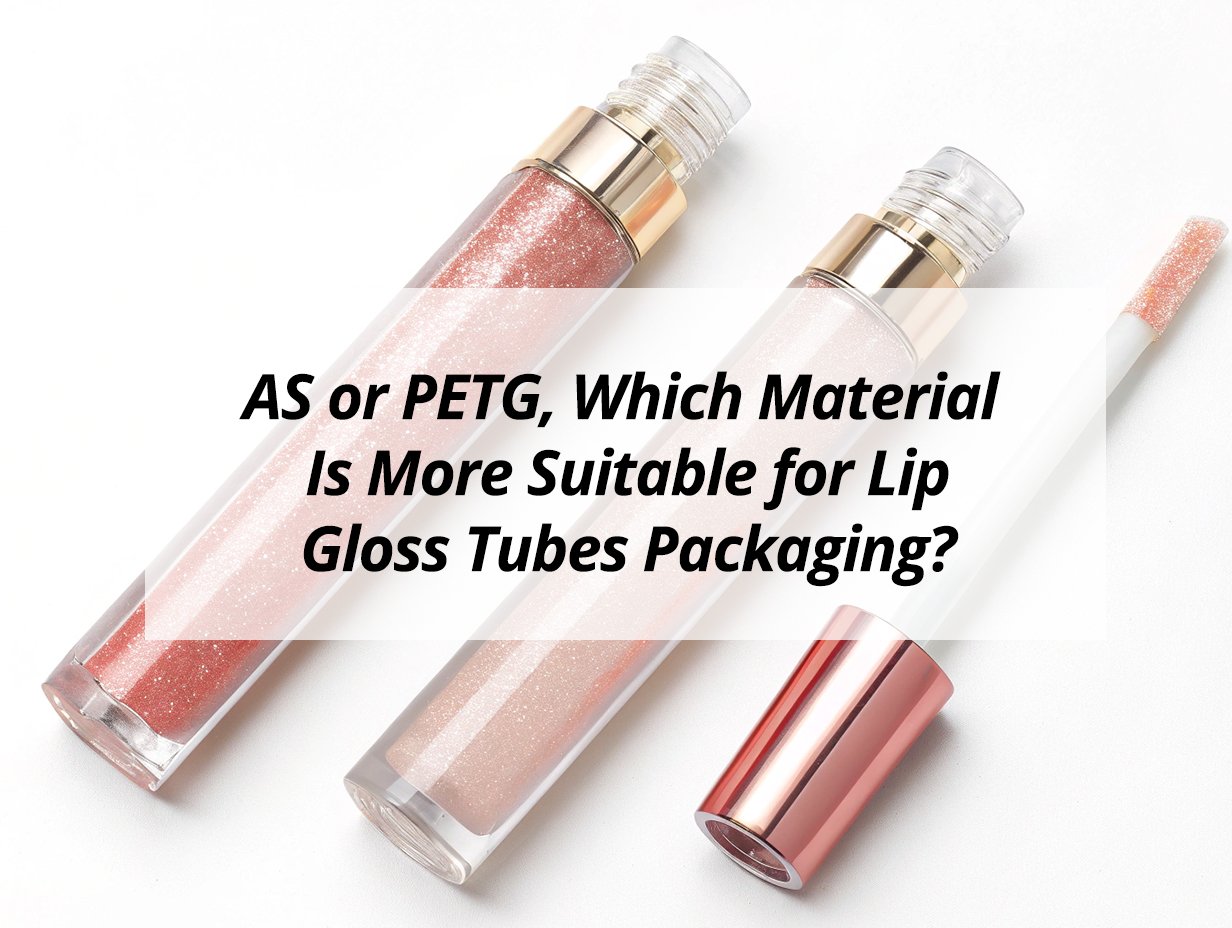
AS and PETG can both create clear lip gloss packaging, but differences in toughness, rigidity, chemical compatibility, cost, and recycling behavior can affect the final product.
PETG is generally more suitable for premium lip gloss tubes when high clarity, impact resistance, chemical compatibility, and thick-wall glass-like appearance are priorities. AS/SAN can be a practical alternative when rigidity, surface hardness, transparency, and cost control matter more. The final choice should always be confirmed through formula compatibility and drop testing.
I would not select either resin only from a catalog. Lip gloss packaging must be evaluated as a complete bottle, wiper, wand, applicator, cap, decoration, and formula system.
What Are the Main Differences Between AS and PETG Lip Gloss Tubes?
Both materials can look crystal clear on a product page, but their mechanical behavior and typical roles in cosmetic packaging are different.
AS, also known as SAN, is a stiff transparent styrenic plastic with high surface quality and dimensional stability. PETG is a transparent copolyester known for toughness, chemical resistance, and thick-wall design capability. AS favors rigidity and a crisp hard feel, while PETG generally performs better when impact resistance and premium durability matter.
1. What Exactly Is AS?
In cosmetic packaging, AS commonly refers to styrene-acrylonitrile, also called SAN.
The styrene component helps provide:
- clarity;
- stiffness;
- processability.
The acrylonitrile component improves:
- chemical resistance;
- heat resistance;
- dimensional performance.
EPA reference material describes SAN as inherently transparent with good hardness, rigidity, dimensional stability, gloss, and chemical resistance.
INEOS Styrolution also offers commercial SAN grades with:
- transparency;
- high surface quality;
- chemical resistance;
- heat resistance.
One of its Luran SAN grades specifically lists cosmetic packaging as an application.
This makes AS useful where brands want a clear, hard, well-defined molded component.
2. What Is PETG?
PETG means polyethylene terephthalate glycol-modified.
It belongs to the copolyester family.
PETG is widely used for premium cosmetic packaging because it can provide:
- excellent clarity;
- high gloss;
- thick walls;
- toughness;
- good chemical resistance;
- complex shapes.
Eastman's cosmetic copolyester portfolio emphasizes glass-like clarity, chemical resistance, shatter resistance, durability, and thick-wall molding capability.
That combination makes PETG particularly attractive when the lip gloss formula itself needs to remain visible.
3. PETG Is Common in Current Lip Gloss Bottles
Current Aptar lip gloss packaging shows how these materials are actually used commercially.
For several formats, Aptar lists:
PETG bottle + POM rod + ABS/AS cap
rather than using AS as the entire formula-contact package.
This is useful because it shows that AS and PETG are not always competing for the same component.
A manufacturer can select:
- PETG for transparent bottle walls;
- AS/ABS for a rigid cap;
- POM for the rod;
- another polymer for the wiper.
Basic AS vs PETG Comparison
| Property | AS / SAN | PETG |
|---|---|---|
| Transparency | Very high | Very high |
| Surface rigidity | High | Moderate to high |
| Toughness | Lower | Higher |
| Impact resistance | Lower | Higher |
| Thick-wall luxury appearance | Good | Excellent |
| Chemical resistance | Good, grade dependent | Generally strong |
| Surface hardness | Strong | Good |
| Dimensional stiffness | Strong | Good |
| Drop resistance | More design-sensitive | Stronger starting point |
| Cost | Often lower | Usually higher |
| Common lip gloss role | Rigid parts, caps, selected bottles | Premium transparent bottles |
Neither column should replace testing.
The exact resin grade and package geometry still matter.
Is PETG More Durable and Chemically Resistant Than AS for Lip Gloss Packaging?
For most lip gloss projects where drop performance and challenging formulations matter, PETG generally provides the more forgiving mechanical profile.
PETG usually offers better toughness and impact resistance than AS, making it attractive for handbags, e-commerce shipping, and thick-wall premium lip gloss packaging. Both materials can offer useful chemical resistance, but PETG is often selected for broader formula compatibility. Actual gloss, lip oil, plumping, fragrance, and solvent systems should still undergo filled-package testing.
1. Toughness Is One of PETG's Main Advantages
A lip gloss package experiences real abuse.
It may be:
- dropped on a bathroom floor;
- carried in a handbag;
- shipped through e-commerce;
- exposed to changing temperatures.
A highly rigid package can look premium but still be vulnerable to cracking after impact.
Eastman describes cosmetic copolyesters as having:
- toughness;
- impact resistance;
- shatter resistance;
- chemical resistance.
Current packaging comparisons also position PETG as less brittle than AS for lip gloss applications.
I would therefore give PETG an advantage for products where consumers are likely to carry the tube frequently.
2. AS Has Strong Rigidity
PETG's impact advantage does not make AS a poor material.
AS provides strong stiffness.
This can create:
- crisp edges;
- rigid walls;
- stable geometry;
- hard surface feel.
INEOS describes its SAN portfolio around transparency, stiffness, chemical resistance, heat resistance, and dimensional stability.
That can be useful for:
- square packaging;
- rigid caps;
- decorative shells;
- products that need dimensional precision.
3. Formula Chemistry Matters
Lip gloss formulas can include:
- mineral oils;
- ester oils;
- synthetic emollients;
- silicones;
- fragrance;
- pigments;
- plumping ingredients;
- botanical oils.
One material can perform well with a standard gloss and poorly with another aggressive formulation.
This is why I would avoid statements such as:
“PETG is compatible with every lip gloss.”
or:
“AS is safe for all oils.”
Those claims are too broad.
4. Use the Actual Formula
The correct test is:
final resin + final molded bottle + final formula + final wiper + final cap
Then evaluate over time.
Look for:
- cracking;
- crazing;
- swelling;
- color change;
- clouding;
- leakage;
- odor;
- deformation.
For a plumping gloss, lip oil, or formula containing aggressive fragrance or volatile ingredients, I would normally begin testing with PETG because its toughness and chemical-performance profile provides a stronger starting point.
5. Test the Neck Area Carefully
The bottle wall is not the only risk.
Stress can concentrate around:
- neck;
- wiper seat;
- threads;
- square corners.
A chemically compatible material can still crack if the molded part contains excessive internal stress.
Supplier quality therefore matters as much as resin selection.
Which Material Is Better for Lip Gloss Tube Cost, Clarity, and Decoration?
AS can offer an economical route to rigid transparent packaging, while PETG usually justifies its premium through toughness, thick-wall appearance, and design flexibility.
AS is often attractive when brands need clear rigid packaging while controlling material cost. PETG generally costs more but supports premium thick-wall designs, strong toughness, and high clarity. Both can support cosmetic decoration, but brands should compare finished-package cost—including molding, cap, applicator, printing, metallization, assembly, and rejects—not resin price alone.
1. Both Materials Can Look Clear
Transparency alone should not decide the project.
AS can provide excellent clarity and surface quality.
PETG can also create exceptional clarity and gloss, especially in thick-wall cosmetic packaging.
From a distance, consumers may not know which plastic they are seeing.
The difference becomes more visible through:
- wall thickness;
- hand feel;
- impact behavior;
- molding quality;
- decoration.
2. PETG Works Well for Thick-Wall Luxury Designs
One reason brands choose PETG is the ability to imitate some of the visual weight of glass.
A thick PETG wall can create:
- strong transparency;
- optical depth;
- substantial appearance.
Eastman specifically highlights the ability of cosmetic copolyesters to mold thick parts while maintaining clarity and premium aesthetics.
This works well for:
- luxury lip oils;
- premium gloss;
- prestige makeup collections.
3. AS Can Create Crisp Rigid Geometry
AS can work particularly well for:
- square caps;
- geometric shells;
- sharp-looking transparent parts.
Its stiffness helps maintain well-defined geometry.
For a highly structured square tube where extreme drop resistance is less important, AS may provide a practical balance.
4. Decoration Options Are Broad
A current PETG lip gloss platform from Aptar supports decoration including:
- resin coloring;
- hot stamping;
- UV metallization;
- spraying;
- anodizing;
- laser engraving;
- pad printing;
- digital printing;
- screen printing;
- film transfer.
AS-based components can also support many common decorative processes depending on grade and surface preparation.
However, I would always test:
- coating adhesion;
- screen ink;
- hot stamping;
- metallization;
- alcohol resistance.
5. Compare Finished Cost
Material price is only one cost.
A complete lip gloss package includes:
- bottle;
- cap;
- rod;
- wiper;
- applicator;
- decoration;
- assembly.
Current supplier cost analysis notes that resin can represent only one part of the final packaging economics, while tooling and other components can be more significant.
This means PETG being more expensive does not automatically mean the finished package will be dramatically more expensive.
Commercial Comparison
| Requirement | AS | PETG |
|---|---|---|
| Budget control | ★★★★★ | ★★★ |
| Premium thick-wall look | ★★★★ | ★★★★★ |
| Clear formula display | ★★★★★ | ★★★★★ |
| Rigid feel | ★★★★★ | ★★★★ |
| Drop resistance | ★★★ | ★★★★★ |
| Complex premium shapes | ★★★★ | ★★★★★ |
| E-commerce durability | ★★★ | ★★★★★ |
| Standard stable formula | ★★★★★ | ★★★★★ |
| More demanding formula | Test carefully | Stronger starting point |
| Premium brand positioning | ★★★★ | ★★★★★ |
These scores are editorial guidance, not standardized material ratings.
Is AS or PETG More Sustainable for Cosmetic Packaging?
Neither material should automatically be called sustainable. PETG and AS both require a package-level recycling assessment, and PETG should not be confused with standard PET.
Neither AS nor PETG is automatically the more sustainable choice. The decision should consider material weight, number of components, recycled content, durability, manufacturing waste, local collection, and realistic recycling routes. PETG offers strong durability but conventional PETG can interfere with standard PET bottle recycling, so brands should not market it as ordinary recyclable PET.
1. PETG Is Not the Same as PET
This distinction is critical.
PET and PETG share part of their chemistry and naming.
But they do not behave identically in recycling.
RecyClass's design guidance identifies PETG as a non-compatible material in conventional PET bottle structures because it can affect recycled PET quality.
This means a supplier should not simply say:
“PETG is PET, so it goes into the PET recycling stream.”
That statement needs much more qualification.
2. AS Also Needs a Real Recovery Route
AS/SAN is a useful engineering plastic.
But its transparency and technical properties do not automatically give it an established household recycling route.
I would therefore ask:
- Is AS collected in the target market?
- Is the package too small for sorting?
- What other components are attached?
- Can the cap or bottle be separated?
Without those answers, “recyclable AS” can remain only a technical material claim.
3. Lip Gloss Packaging Is Small and Complex
A typical package may contain:
PETG + AS + ABS + POM + wiper material + flocked applicator
Aptar's commercial products illustrate this type of mixed-material structure.
That complexity matters more than whether the bottle itself is clear.
Small format also creates another recycling challenge because the complete tube may be difficult to capture during sorting.
4. Durability Can Still Have Sustainability Value
PETG's durability can reduce:
- breakage;
- rejects;
- damaged shipments.
For refillable or durable outer packaging, toughness can also support longer use.
Eastman positions durable copolyesters for reusable and refillable cosmetic applications where long-term integrity matters.
However, durability should not be confused with recyclability.
They are two different environmental attributes.
5. Consider PET-Recycling-Compatible Alternatives
Material technology is evolving.
Eastman's newer Cristal One grades, for example, are designed to provide premium cosmetic clarity and toughness while remaining compatible with the PET recycling stream.
This creates a third option for new development:
Do I need conventional AS or PETG, or should I evaluate a newer PET-stream-compatible specialty resin?
For sustainability-led projects, that can be a valuable question.
When Should You Choose AS for Lip Gloss Packaging?
AS remains useful when rigidity, clarity, surface quality, and cost are stronger priorities than maximum impact performance.
Choose AS/SAN when you need a clear, rigid, dimensionally stable cosmetic component for a conventional formula and want to control packaging cost. AS can work well for caps, shells, and selected bottles, but brands should pay extra attention to drop resistance, internal molding stress, and formula compatibility before mass production.
AS can make sense for:
- standard lip gloss;
- stable formulas;
- rigid square packaging;
- cost-conscious projects;
- transparent decorative parts;
- caps and shells.
I would consider AS when the package needs to feel:
- hard;
- crisp;
- highly structured.
AS May Be a Better Choice If:
- the formula is already validated with AS;
- the supplier has an existing proven mold;
- drop requirements are moderate;
- cost matters strongly;
- rigidity matters more than toughness.
The strongest reason to choose AS is often not that it is “better.”
It is that it may be good enough for the exact application at a more attractive commercial cost.
When Should You Choose PETG for Lip Gloss Packaging?
PETG becomes more attractive when the product needs premium transparency combined with greater toughness and broader performance margins.
Choose PETG when the lip gloss package needs high clarity, thick-wall luxury appearance, stronger impact resistance, demanding transport performance, or greater formula-compatibility flexibility. PETG is particularly attractive for premium gloss, lip oil, e-commerce, travel products, and packaging expected to survive frequent handbag use.
PETG Is Strong for Premium Lip Gloss
I would prioritize PETG for:
- prestige lip gloss;
- lip oil;
- shimmer gloss;
- thick-wall packaging;
- heavy-looking transparent designs.
Current Aptar commercial platforms use PETG extensively for transparent lip gloss bottles.
This is a strong real-world signal that PETG remains important in premium color-cosmetic packaging.
PETG Is Useful for E-Commerce
Online retail increases the importance of:
- drop resistance;
- shipping vibration;
- temperature changes.
PETG's toughness can reduce the risk of package cracking.
For a brand shipping individual lip gloss products directly to customers, I would give this mechanical advantage significant weight.
PETG Supports Formula Visibility
Like AS, PETG can clearly display:
- shimmer;
- pigment;
- transparency;
- formula texture.
But PETG combines that visibility with a tougher material profile.
That can justify the additional cost for higher-priced products.
My insights: AS or PETG, Which Material Is More Suitable for Lip Gloss Tubes Packaging
If I were choosing between only AS and PETG for a new lip gloss bottle, I would normally start development with PETG and use AS where rigidity or cost creates a clear advantage.
PETG is generally the stronger all-around choice for premium lip gloss tubes because it combines crystal clarity with toughness, impact resistance, chemical performance, and thick-wall design flexibility. AS remains useful for rigid, clear, cost-conscious components. Neither material should be approved without filled-formula, drop, leakage, decoration, and production testing.
1. Start With the Formula
I would first ask what will actually be filled.
Is it:
- traditional sticky gloss;
- lip oil;
- plumping gloss;
- liquid lipstick;
- volatile formula?
For a more demanding oil-rich or active formula, I would usually begin with PETG testing.
2. Decide Whether You Need Rigidity or Toughness
This distinction makes the comparison easier.
AS = rigidity
PETG = toughness
That is simplified, but useful.
If the brand wants a sharp square component with a hard feel, AS can work well.
If the package needs to survive repeated dropping, PETG gets the advantage.
3. Test Filled Tubes, Not Resin Chips
A resin sample tells me very little about the final customer experience.
I would test:
actual molded bottle + actual gloss + actual wiper + actual cap
The package is a system.
4. Perform a Drop Comparison
I would produce samples in both materials using comparable structures.
Then test:
- room-temperature drops;
- multiple orientations;
- shipping simulation.
Pay particular attention to:
- corners;
- neck;
- base.
A slightly cheaper material loses its cost advantage if breakage increases.
5. Compare Appearance After Filling
Both materials can look clear.
But the final appearance may differ after:
- filling;
- decoration;
- storage.
I would compare:
- gloss;
- optical distortion;
- color;
- wall appearance;
- scratches.
6. Compare the Same Package Cost
Do not compare resin prices alone.
Ask the supplier to quote the same:
- capacity;
- cap;
- wiper;
- applicator;
- decoration;
- quantity.
Then compare the finished unit.
7. Consider Decoration Early
If the design needs:
- hot stamping;
- metallization;
- screen printing;
- spraying;
I would produce decorated samples before material approval.
Decoration adhesion may affect the final choice.
8. Do Not Use Recyclability as a Shortcut
I would not choose PETG simply because someone says:
“PETG is recyclable.”
Current European design-for-recycling guidance shows why that statement needs qualification. Conventional PETG is not equivalent to PET in the PET bottle stream.
I would also not call AS sustainable without a realistic collection route.
9. Consider a Third Material for Sustainability-Led Projects
If strong PET-stream recyclability is a central packaging objective, I would also investigate:
- PET;
- newer PET-compatible specialty cosmetic resins.
Eastman's Cristal One family demonstrates that premium clarity, toughness, thick-wall capability, recycled content, and PET-stream compatibility can increasingly be combined in newer material systems.
This does not make it the automatic answer.
It means AS vs PETG does not need to be the only comparison.
10. Use a Final AS vs PETG Selection Checklist
Before approving the lip gloss package, I would confirm:
- AS/SAN grade identified
- PETG grade identified
- Final formula tested
- Oil resistance checked
- Stress cracking reviewed
- Tube clarity compared
- Thick-wall appearance compared
- Drop resistance tested
- Neck strength tested
- Leakage tested
- Wiper compatibility confirmed
- Applicator performance checked
- Decoration tested
- Scratch resistance reviewed
- MOQ compared
- Complete package cost compared
- Recycling route reviewed
- Sustainability claims qualified
- Golden sample approved
- Mass-production specification locked
For most new mid-premium and premium lip gloss projects, PETG would be my first material to test because it offers a stronger balance between transparency, toughness, chemical performance, and visual quality.
AS remains a practical material when the formula is stable, the structure is proven, rigidity is valuable, and cost needs tighter control.
Conclusion
Choose PETG for premium clarity, toughness, and broader performance margins; choose AS for rigid, clear, cost-conscious packaging when formula compatibility and drop performance are already proven.