I often face curved bottles, domed jars, and sculpted caps in cosmetic packaging. Flat printing methods struggle. I want quality, durability and cost-control.
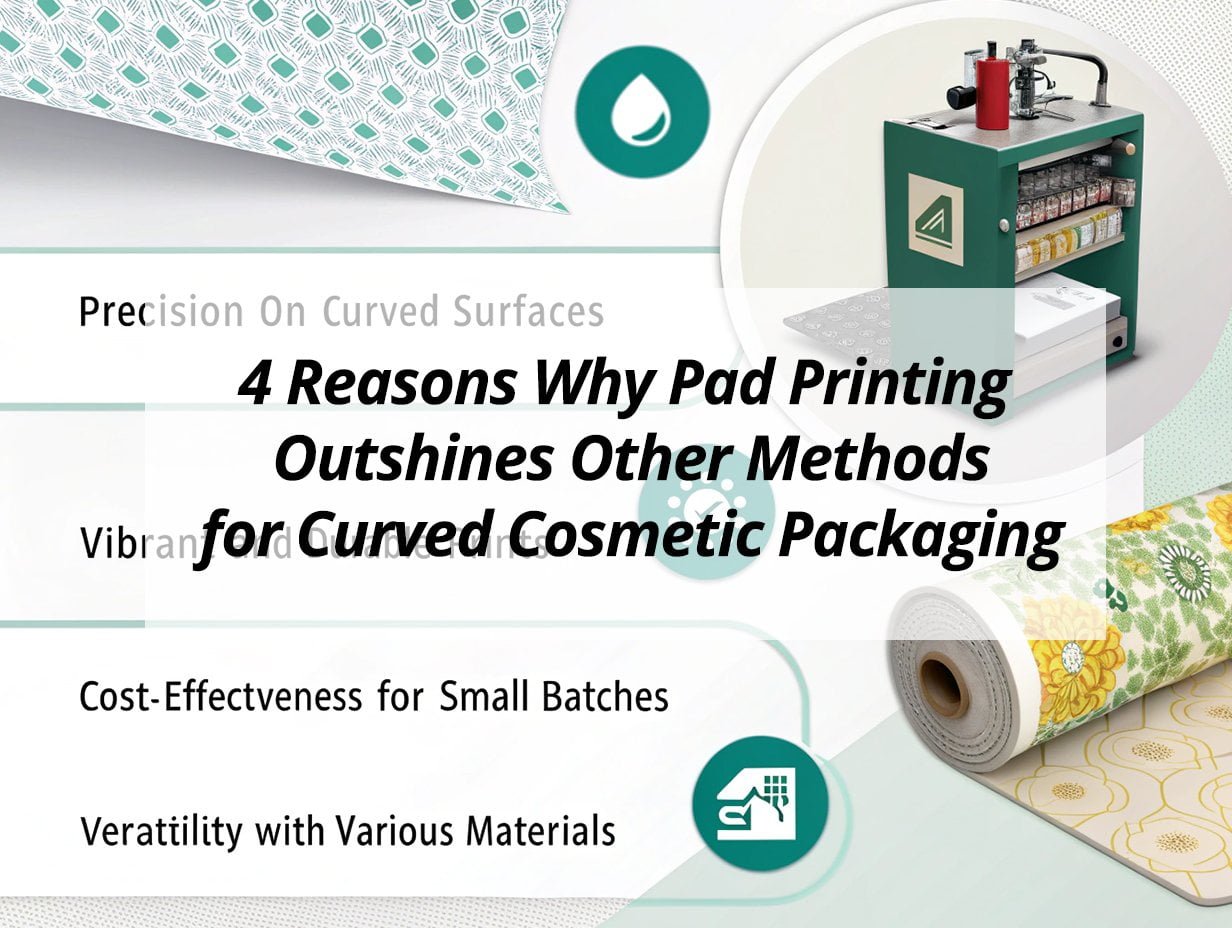
Pad printing offers precise design transfer on curved or irregular surfaces, strong adhesion on plastics/metals/glass, excellent detail reproduction, and cost-efficient runs for complex geometries.
I will unpack four major reasons I pick pad printing when dealing with curved cosmetic containers.
What are the advantages of pad printing?
My first reason centres on surface adaptability1 and detail. Pad printing excels where other methods fail.
Pad printing uses a flexible silicone pad that conforms to curved, recessed or odd-shaped surfaces; it deposits ink precisely even on domes, cylinders, concave shapes, and textured finishes.
In my work, I often see containers with deep curves or embossed logos. I choose pad printing because it handles those without distortion.
Adaptability, detail, adhesion, cost-effectiveness2
Surface adaptability & flexible pad
The core of pad printing is a silicone pad that picks up ink from an etched plate (cliché) and then transfers it to the substrate. Because the pad is flexible it conforms to irregular shapes. On curved cosmetic bottles3, domed lids or sculpted jars, this matters a lot. Other methods like screen printing expect a flatter surface and may miss edges or produce uneven ink laydown. With pad printing I can print on recesses, undercuts and curved areas with consistent quality.
Fine detail reproduction
Pad printing can reproduce very fine lines and small text even on curved parts. Cosmetic brands often demand small ingredient lists or fine decorative patterns around curved lids. The precise registration capability of pad printing allows multi-color jobs in one operation or with tight alignment. This produces branding that looks premium. I have used pad printing for logos with very thin outlines and the result matched I expected.
Adhesion & durable finishes
Cosmetic parts suffer handling, abrasion, exposure to creams and oils, and retail wear. The inks used in pad printing adhere strongly to plastics, glass, metals and coatings. UV-curable or solvent inks may be used. The durability means the print stays looking sharp, without peeling or fading. I specify pad printing when durability matters more than purely low cost.
Cost-effectiveness for complex geometry
When I work with curved or specialty containers, using pad printing is often cheaper than trying to adapt other methods. Because the pad system handles odd shapes, I avoid expensive mold changes or special treatments. The setup cost for pad printing (cliché + pad) is moderate and suits both small and large batches. That makes it economical for premium and limited edition runs on complex containers.
Pad printing strengths overview
| Advantage | Why it matters for curved packaging | Application note |
|---|---|---|
| Surface adaptability | Handles curves, recesses, odd geometry | Sculpted jars, curved bottles |
| Detail reproduction | Fine logos, small text on rounds | Luxury cosmetics branding |
| Adhesion & durability | Withstands oils, handling, wear | Made for retail display & usage |
| Cost-efficiency | Less expensive for complex shapes than alternatives | Good for limited edition or curved SKUs |
When geometry is complex I default to pad printing. It balances quality, durability, and cost in ways other printing methods can’t easily match.
Which printing type is best for printing on plastic bags?
Plastic bags are common for cosmetic samples, pouches, sachets or refill packs. I look for methods suited to flexible substrates.
For plastic bags I often choose either flexographic printing for very large runs or digital/rotogravure for smaller runs; pad printing is less common but can be used when the bag has molded or uneven surface features.
In my sourcing I consider substrate type, run size, surface geometry, and finish when selecting method.
Substrate factors, printing methods comparison
Substrate and product demands
Plastic bags for cosmetics may be flat, heat-sealed pouches or multi-layer laminates. They often require barrier properties, laminate structures, and smooth surfaces to print. The surface is less irregular than curved jars, so printing method focus shifts to cost per unit, ink adhesion, and finish quality.
Method comparison
- Flexography: Good for high-volume, flat pouches. Lower setup cost for very large runs.
- Rotogravure: Also high-volume, excellent image quality on flexible materials but high setup.
- Digital printing: Ideal for short runs, customizations, small batch print-on-demand. Works well on flat flexible bags.
- Pad printing: Works when the bag has molded textures, embossments or irregular surfaces where other methods struggle.
Practical decision guide
| Run size & surface | Best method | Why |
|---|---|---|
| Very large flat pouches | Flexo/rotogravure | Low cost per unit, suitable for flat surfaces |
| Small to medium flat bags or custom prints | Digital printing | Low setup, fast turnaround |
| Bags with embossed/irregular surfaces | Pad printing | Conforms to uneven surface, excellent for niche shapes |
When I advise clients, I map the bag geometry first. If bag is simple flat, digital or flexo wins. If bag has 3D features or molded shape, pad printing becomes a strong candidate though less common for bags.
What is the principle of pad printing?
Understanding how pad printing works helps in deciding when to use it. I always explain this to my production team.
Pad printing transfers ink from an etched plate (cliché) using a flexible pad. The pad picks up ink from recesses in the plate, then deposits it on the substrate—especially helpful for curves and irregular geometry.
I walk through the steps so that packaging design and engineering teams understand its fit.
Process steps, materials, registration, and constraints
Key process steps
- A plate (cliché) is etched with the image to print.
- Ink is applied and excess wiped, leaving ink in recesses.
- A silicone pad presses onto the plate, picks up ink.
- The pad then presses onto the container surface and transfers the ink.
- The ink dries/curates (UV or solvent based depending on ink).
This sequence allows print on surfaces that are not flat.
Materials and specifics
- The pad material: silicone offers flexibility and resilience. It deforms to match substrate shape without distorting the image much.
- The ink: Must be compatible with substrate and bond well (e.g., plastic, metal, glass). UV-curable inks or special metallic inks are often used in premium cosmetics4.
- The plate: Must be precisely etched to handle fine detail.
- Registration: Multi-color pad printing requires precise alignment between colors successive layers. That is more complex but achievable.
Constraints and design considerations
- Pad printing works best for limited colors (though multi-color is possible). For full photographic images on large flat surfaces digital or offset may be easier.
- The substrate must be fixed in the fixture so the pad can press reliably. Containers must be stable under pad pressure.
- The print area is typically smaller due to movement of pad and reach. Very large flat panels may not be ideal.
- Setup cost exists (plate, pad, fixture) so for extremely small runs with many designs the cost per design may rise.
Pad printing process overview
| Element | Role in process | Key design note |
|---|---|---|
| Plate (cliché) | Holds the image to transfer | Fine etching allows detail |
| Ink reservoir | Supplies ink into plate recesses | Must match substrate |
| Silicone pad | Picks ink and transfers it | Shape must match surface |
| Substrate fixture | Holds container steady | Critical for repeatability |
| Cure/dry step | Fixes ink on surface | Match ink type and substrate |
I often emphasize to buyers: "If your container is sculpted or curved, design it for pad printing early." That saves cost and avoids last-minute compromises.
What is the difference between pad printing and digital printing?
I find many clients confuse pad printing and digital printing. They ask which is “better.” The answer is: it depends on geometry, run size, substrate, cost and finish.
Pad printing handles curved and complex containers with strong adhesion on odd surfaces. Digital printing excels at flat or nearly flat surfaces, variable data, small runs and rapid design changes—but may struggle on deep curves or recesses.
I compare both so my clients choose wisely.
Side-by-side comparison, strengths, run size, geometry
Strengths of pad printing vs digital
Pad printing: Ideal for 3D shapes, curved surfaces, metals, plastics, and glass. Excellent ink adhesion and durability. Works on recessed areas and handles multi-color registration.
Digital printing: Ideal for complex graphics, small fonts, gradients, personalization, variable data, flat substrates like cartons, sleeves, boxes. Fast turnarounds, minimal plates needed.
Run size & cost implications
Pad printing: Setup cost (plate, pad, fixture) but good cost per unit for curved geometry especially in medium to large runs. For very small runs the setup may dominate cost.
Digital printing: Minimal setup. Low cost for short runs. Cost per unit remains reasonable even at small volumes. Personalized units are cost-effective.
Geometry & substrate compatibility
Pad printing: Works on curved, recessed, domed shapes, irregular surfaces. Substrate can be plastic, metal, glass.
Digital printing: Works best on flat or gently curved surfaces. Substrate types vary (paper, plastic, film) but extreme curvature may give print distortion or challenge ink adhesion.
Pad vs digital printing comparison
| Factor | Pad Printing | Digital Printing |
|---|---|---|
| Surface geometry | Excellent for curves & recesses | Best for flat or slightly curved |
| Setup cost | Moderate (plate + pad) | Low (no plate) |
| Run size efficiency | Medium to large | Small to medium |
| Personalization | Possible but less common | Excellent (variable data) |
| Graphics complexity | Good, but fewer gradients | Superb for gradients, photographic graphics |
| Substrate adhesion on odd surfaces | Strong | May need special treatments or struggle |
In my cosmetic packaging sourcing, if the container is curved or has sculpted geometry I lean pad printing. If the design is mostly flat and needs personalization or rapid change I lean digital. Sometimes I combine: digital for flat carton sleeve + pad printing for the curved tube.
My Insights: The Reasons Why Pad Printing Excels in Curved Cosmetic Packaging
Struggling with printing on curved surfaces? Discover how pad printing transforms your cosmetic packaging with precision and efficiency.
Pad printing is ideal for curved cosmetic packaging due to its adaptability to complex surfaces, high precision, material versatility, and cost-effectiveness, especially for smaller production runs.
Pad Printing Advantages
Versatile Surfaces and Precision
- Conforms to Curves: The silicone pad adapts to curved and irregular surfaces, ensuring consistent ink transfer without specialized fixtures.
- Fine Detailing: Reproduces intricate designs with sharp edges, maintaining brand integrity on small or sculpted items.
Material and Cost Efficiency
- Broad Compatibility: Works on plastics, glass, and metals, allowing seamless transitions between different packaging materials without retooling.
- Economical for Small Runs: Offers low setup costs and rapid changeovers, perfect for limited editions or regional variants.
| Advantage | Benefit |
|---|---|
| Versatile Surfaces | Consistent ink transfer on curves |
| High Precision | Captures intricate designs and logos |
| Material Versatility | Compatible with various materials |
| Cost-Effectiveness | Low setup costs for small-to-mid runs |
Pad printing delivers durable, precise, and aesthetically pleasing results, making it a top choice for brands focused on quality and creativity.
Conclusion
I choose pad printing when containers are curved, textured, or complex—because it delivers strong adhesion, high precision, and cost-efficiency for geometry that other methods struggle with.
-
Explore how surface adaptability enhances printing on various shapes, ensuring quality and precision. ↩
-
Explore the cost benefits of pad printing for complex geometries compared to other printing methods. ↩
-
Discover why pad printing is ideal for curved surfaces, ensuring high-quality branding on cosmetic products. ↩
-
Learn about the printing techniques that enhance the branding of premium cosmetics. ↩