
Do you struggle to get all the product out of your cosmetic bottles? This issue leads to wasted product. It means you do not use everything you paid for. This is a common packaging challenge.
Airless pump bottles function differently from standard pumps. They use a vacuum system. This system pushes the product upward without letting air enter the bottle. This design maintains product freshness. It also ensures nearly complete product usage. This benefits both product integrity and cost-efficiency.
Cosmetic packaging choices are important for brand buyers and manufacturers. They look for solutions that protect products. They also want packaging that performs well for end-users. Airless pump bottles offer a solution that meets these requirements effectively.
What Are the Benefits of Airless Pump Bottles?
Are you concerned about product degradation1? Many cosmetic formulas lose effectiveness when exposed to air. Traditional packaging can accelerate this process. This results in a shorter shelf life for products.
Airless pump bottles provide several benefits. They shield products from air and external contamination. This extends the product's shelf life. They also ensure almost all product is dispensed from the container. This reduces waste. These features make them ideal for preserving sensitive or valuable cosmetic formulations.
Consider a high-performance serum. If it comes in a jar, each opening exposes it to oxygen. This can break down active ingredients. An airless bottle keeps the product sealed. This maintains its quality from the first use to the last. This difference is critical for product stability.
Key Advantages of Airless Packaging
Airless pump bottles offer clear advantages. They ensure product integrity. They also improve user experience.
| Benefit | Explanation | Impact on Product |
|---|---|---|
| Product Preservation | Airless pumps prevent air entry. This stops oxidation. It also blocks contamination from external elements. | Sensitive ingredients, like vitamins, retain their potency longer. Product efficacy is maintained. |
| Maximized Usage | The vacuum mechanism pushes all product upwards. This allows nearly 100% of the contents to be dispensed. | Eliminates product waste. Consumers experience full value from their purchase. |
| Enhanced Hygiene | No air or direct finger contact occurs within the product chamber. This reduces bacterial growth risk. | Products remain cleaner and safer for application. Important for sensitive formulas. |
| Precise Dosing | Airless pumps deliver a consistent, measured amount of product with each press. | Users get the correct dosage every time. This helps control usage and extends product life. |
| Versatility | Airless systems are compatible with a wide range of product viscosities. This includes creams and thin liquids. | Suitable for diverse cosmetic products. Offers flexible packaging solutions. |
Why Businesses Choose Airless Systems
Businesses in cosmetic packaging value superior quality. They seek packaging that enhances product performance. Airless pump bottles address common issues like product spoilage and waste. They are a preferred choice for companies focused on product stability and customer satisfaction. The choice of airless packaging reflects a commitment to advanced product care.
Are Airless Pump Bottles Better?
Does the performance of airless pump bottles2 truly surpass other packaging types? This is a frequent inquiry. Buyers need to understand the value proposition. They evaluate if the benefits justify the investment.
Yes, airless pump bottles are generally superior. They provide advanced protection for cosmetic formulas compared to traditional pumps or jars. This leads to extended product freshness and activity. They also minimize product waste. This makes them a more hygienic and economically sound choice for both brands and consumers. They deliver a better dispensing experience.
Consider a scenario where a new skincare product launches. If it uses standard packaging, customer feedback might include concerns about product efficacy over time. Switching to airless cosmetic bottles often resolves such issues. The sealed environment preserves the formula. This maintains product performance throughout its use.
Airless vs. Traditional Packaging
The contrast between airless and traditional packaging impacts product longevity and user satisfaction.
- Protection Level: Airless bottles offer a complete seal. Traditional pumps, even with caps, allow some air exposure. Jars fully expose the product each time they are opened.
- Shelf Life: Products housed in airless bottles typically have a longer shelf life. This is due to the lack of oxygen exposure, which can degrade ingredients.
- User Experience: Airless bottles offer clean and effortless dispensing. They eliminate the need to scoop product or shake bottles to access contents.
- Product Integrity: Delicate formulations with active ingredients, such as antioxidants, require strict protection. Airless packaging effectively provides this safeguard.
Considering Glass Airless Pump Bottles
Some manufacturers opt for glass airless pump bottles3. These combine airless technology with the premium aesthetics of glass. Glass offers excellent barrier properties and a sophisticated appearance. For brands targeting high-end markets, glass airless cosmetic bottles are a compelling option. They elevate brand perception and provide optimal product protection.
| Feature | Airless Pump Bottles (Plastic) | Glass Airless Pump Bottles | Traditional Pumps/Jars |
|---|---|---|---|
| Material Feel | Lightweight, durable | Premium, substantial, elegant | Varies (plastic, glass) |
| Barrier Quality | Excellent | Superior | Good to Poor |
| Cost | Moderate | Higher | Low to Moderate |
| Fragility | Low | High | Low to Moderate |
| Recyclability | Often (check specific plastic) | High | Varies |
For businesses seeking a balance of quality and cost, plastic airless options offer robust performance at competitive price points. These meet diverse manufacturing needs effectively.
How Do Airless Pump Bottles Work?
Have you ever considered the precise mechanism inside an airless pump bottle? While appearing simple, it involves intricate engineering. Understanding its function clarifies why these bottles are highly effective.
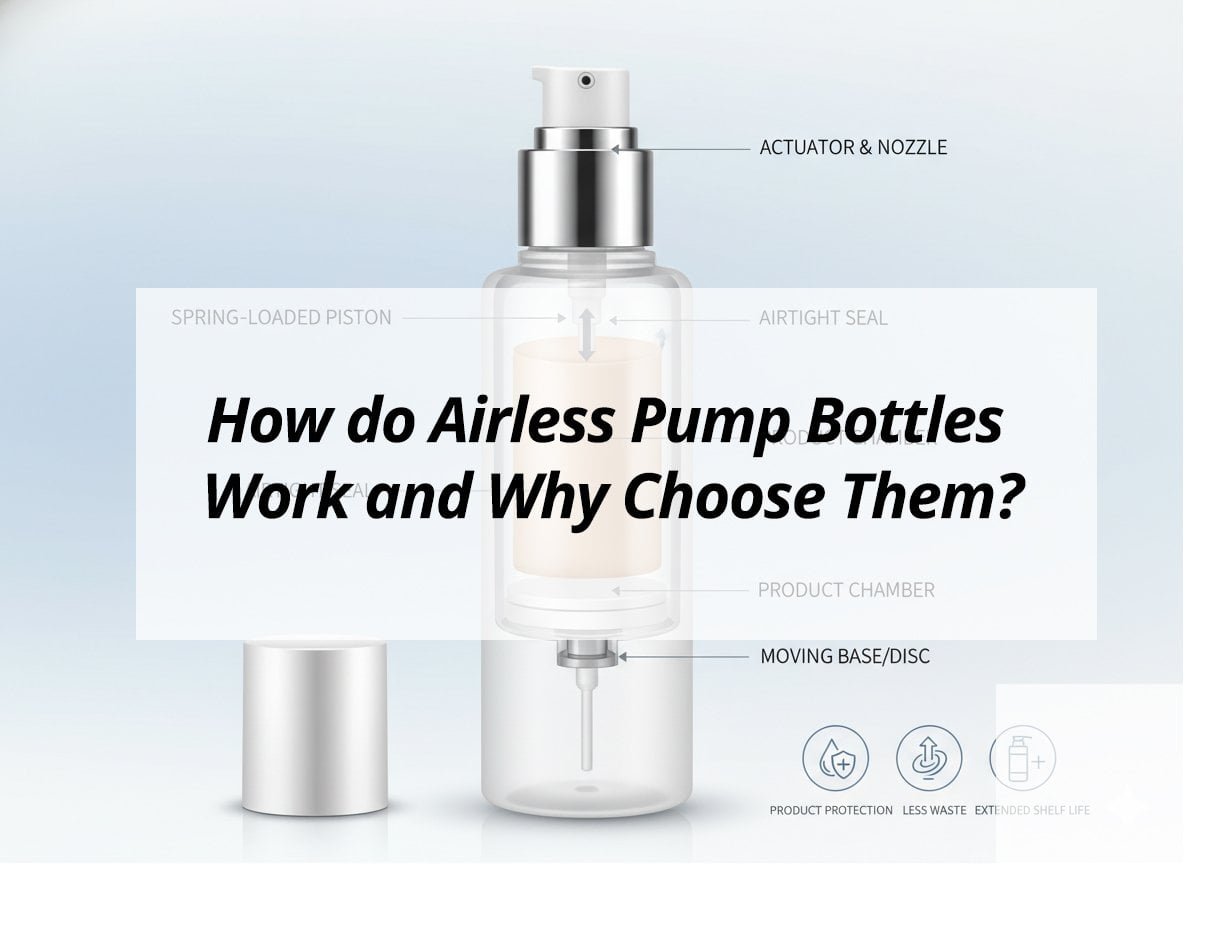
Airless pump bottles operate with a piston system. When the pump is pressed, a disc or piston at the bottle's base rises. This movement generates a vacuum. This vacuum draws the product upward without a dip tube. This design keeps air out of the product chamber. It also ensures precise and efficient product dispensing.
When a customer asks, "Airless pump bottles how it works?" they often assume a complex or fragile system. Explaining the piston mechanism demystifies it. If an "airless pump bottle not working," it often means it needs to be primed. Once primed, the vacuum system functions as intended. This simple fix helps ensure continuous product flow.
The Piston and Vacuum System
The fundamental design of an airless pump bottle relies on its unique internal structure.
- No Dip Tube: A key distinction from conventional pumps is the absence of a straw-like dip tube.
- Rising Piston: A movable disc or piston is positioned at the bottom of the bottle's inner chamber.
- Vacuum Creation: Pressing the pump head generates pressure. This pressure causes the piston to ascend. The product above the piston moves upward.
- Product Dispensing: The product is then expelled through the nozzle.
- Air Exclusion: No ambient air enters the bottle. This ensures the product remains isolated from external elements.
Steps in the Airless Process
The operational steps highlight the system's efficiency.
- Actuator Press: The user depresses the pump actuator.
- Piston Ascent: This action causes the internal piston to move upward within the bottle.
- Product Movement: The product is forced upwards by the rising piston.
- Dispensing: Product exits via the pump nozzle.
- Vacuum Seal: As the piston ascends, it maintains a consistent vacuum seal. This prevents air intrusion.
| Component | Function | Importance |
|---|---|---|
| Actuator | The component pressed by the user. | Initiates the product dispensing cycle. |
| Pump Head | Houses the mechanism for pressure generation. | Regulates the volume of product released per pump. |
| Piston | Moves vertically within the bottle. | Facilitates product expulsion and maintains the airless barrier. |
| Outer Bottle | Provides structural integrity and aesthetic presentation. | Encapsulates the internal components and holds the product. |
| Inner Pouch | (Specific designs) Collapses as product is used. | An alternative to a piston system, also maintains an airless state. Relevant for "Airless pump bottle how to refill" designs. |
When manufacturing airless pump bottles wholesale, precision is paramount. The piston's movement must be smooth and consistent. This ensures reliable product delivery and a dependable user experience.
What Is the Difference Between an Airless Pump and a Regular Pump?
When comparing different cosmetic packaging, how do you differentiate between pump types? Though visually similar, their operational mechanisms vary significantly. These variations directly influence product quality.
The primary distinction lies in air management. A regular pump uses a dip tube to draw product up, allowing air to replace dispensed volume. An airless pump, conversely, lacks a dip tube. It employs a rising piston to push product upwards. This prevents air from entering the bottle. This design offers superior product protection from oxidation and contamination. It also enables near-total product evacuation.
Customers often inquire, "What is the difference between an airless pump and a regular pump?" Demonstrating the internal mechanisms clarifies this. Showing a regular pump's dip tube and an airless pump's piston quickly illustrates the functional advantages of the latter. This understanding helps in selecting suitable airless cosmetic bottles for specific product needs.
Key Functional Differences
Here is a detailed comparison of their operational distinctions:
- Dispensing Mechanism:
- Regular Pump: Utilizes a long dip tube reaching the bottle's base. Product is siphoned up this tube. Air concurrently enters through a vent to equalize pressure.
- Airless Pump: Features no dip tube. A piston at the bottle's bottom moves upward. It directly pushes the product to the pump head. No air enters the product chamber.
- Air Exposure:
- Regular Pump: Product is exposed to ambient air with each pump. Air also occupies space above the product. This increases the risk of oxidation and microbial growth.
- Airless Pump: The product remains consistently sealed from external air. This preserves its freshness and active properties.
- Product Evacuation:
- Regular Pump: Often leaves a notable amount of product within the bottle. The dip tube cannot reach all contents.
- Airless Pump: Facilitates nearly 100% product usage. The piston expels almost every last drop.
- Formula Compatibility:
- Regular Pump: Suitable for less sensitive formulations.
- Airless Pump: Ideal for delicate, natural, or high-value formulas due to superior protection.
Impact on Product Quality and Shelf Life
These functional differences have a direct impact on product quality and longevity.
| Feature | Regular Pump Bottle | Airless Pump Bottle |
|---|---|---|
| Air Exposure | High (product exposed with each pump) | None (product always sealed) |
| Contamination | Higher risk (airborne bacteria, direct contact) | Very low risk (no air, no direct touch) |
| Oxidation | High likelihood (especially for active ingredients) | Negligible (ingredients maintain stability longer) |
| Product Waste | Moderate to High (product left in bottle) | Very Low (nearly 100% product usage) |
| Shelf Life | Shorter, product degradation can be accelerated | Longer, product potency and freshness are sustained |
| Cost | Generally lower | Generally higher (due to advanced mechanism) |
Choosing the correct pump type is critical for product success. Airless pump bottles enhance the value proposition of cosmetic products. Sourcing airless pump bottles wholesale ensures access to these advanced packaging solutions.
Are Airless Pump Bottles Refillable?
A common question is, "Are airless pump bottles refillable?" The answer depends on the specific design. Some airless designs feature removable inner chambers. This allows for convenient replacement or refilling. Other designs are hermetically sealed units. These are not intended for refilling. When considering "Airless pump bottle how to refill," it is important to verify the product's construction. Certain airless cosmetic bottles are specifically engineered for refillability. This supports sustainability efforts.
My Insights: How Airless Pump Bottles Revolutionize Skincare Packaging
Tired of wasted products and degraded formulas? Airless pump bottles offer a solution with consistent dosing and product preservation.
Airless pump bottles use vacuum technology to protect products from air and contamination. They maintain formula integrity, reduce waste, and enhance shelf life, making them ideal for sensitive formulations and premium packaging experiences.
Why Choose Airless Pump Bottles?
How They Work:
Airless pump bottles utilize a piston or diaphragm system at the bottom of the bottle. Pressing the pump creates a vacuum that pushes product upward while preventing air from entering.
Key Benefits:
- Extended Shelf Life: By minimizing oxygen exposure, actives like vitamin C and retinol remain potent, extending the product's shelf life.
- Reduced Contamination: The sealed environment limits contact with fingers and air, reducing microbial risks.
- Less Product Waste: Nearly all contents can be dispensed, avoiding leftovers at the bottom.
- Controlled Dosing: Each pump delivers a consistent amount, ideal for products with high-value ingredients.
- Reduced Preservatives: The protective environment allows for fewer preservatives, appealing to clean beauty standards.
Ideal Uses:
Airless bottles are perfect for products with oxygen-sensitive actives, natural formulas seeking minimal preservatives, luxury skincare, and treatments requiring precise dosing.
Brands focusing on innovation and sustainability can leverage airless technology to enhance product quality and customer experience, contributing to a premium, eco-friendly impression in the market.
Conclusion
Airless pump bottles offer significant advantages over traditional packaging. They protect products from air and contamination, preserving freshness and efficacy. They also maximize product usage by minimizing waste. These features make them a superior choice for cosmetic packaging.