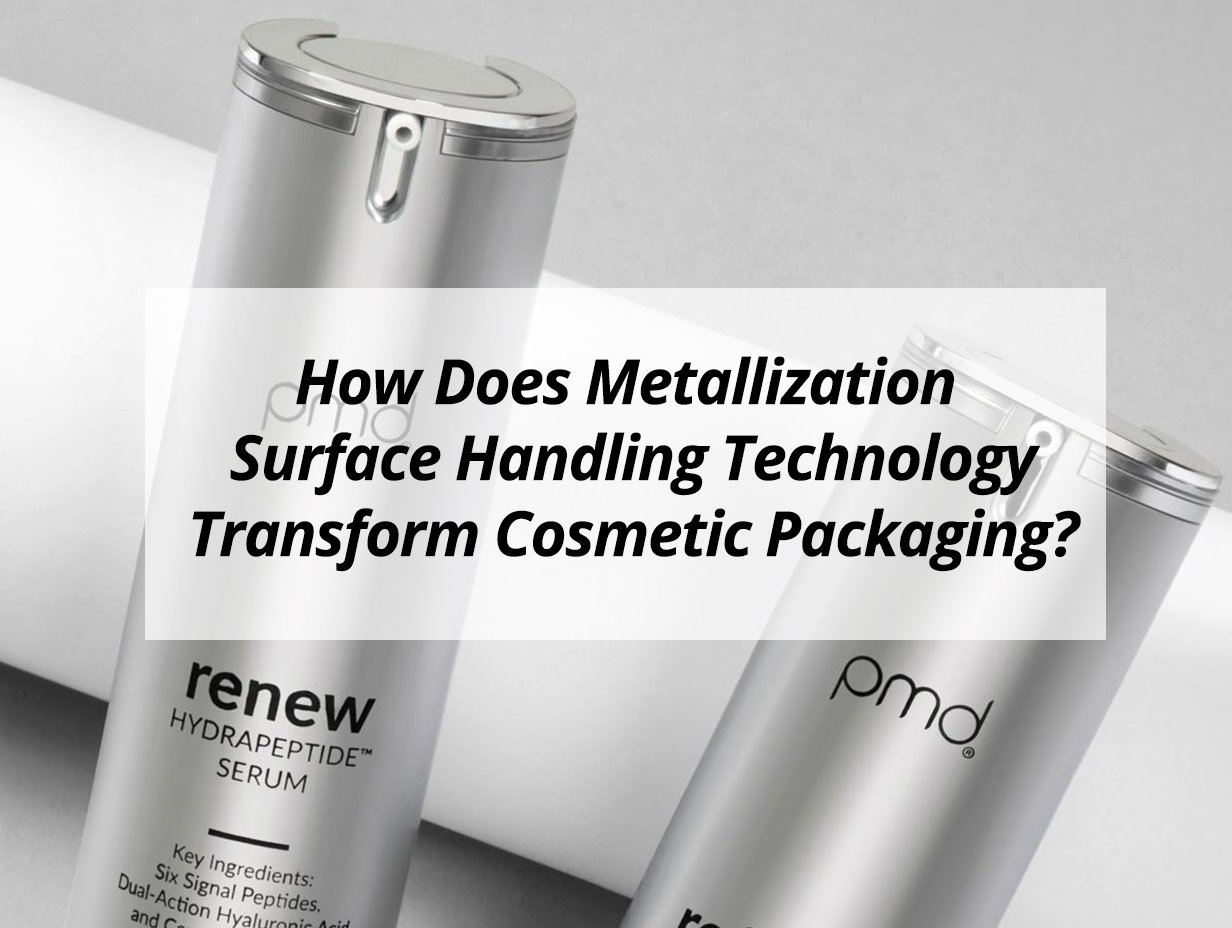
Plain plastic packaging can perform well but lack premium visual impact. Metallization adds a reflective metal-like surface that can change how customers perceive the entire product.
Metallization surface handling technology transforms cosmetic packaging by depositing an ultra-thin metallic layer onto plastic, glass, or other suitable components. Vacuum metallization can create chrome, silver, gold, rose-gold, satin, and tinted effects while maintaining lightweight structures. It improves visual differentiation, premium perception, and design flexibility when coatings, materials, durability, and recyclability are properly controlled.
Metallization can make cosmetic packaging look like polished metal without changing the complete container to metal. Successful results depend on substrate quality, coating layers, geometry, color, durability, production consistency, cost, and recycling design.
What Is Metallization Technology in Cosmetic Packaging and How Does It Work?
Metallization is not metallic paint. Vacuum metallization creates a real thin metal layer on the surface of a packaging component.
Cosmetic packaging metallization commonly uses physical vapor deposition inside a vacuum chamber. A prepared component receives a base coat, metal such as aluminum is vaporized and deposited as an ultra-thin film, and a protective top coat is added afterward. The complete coating system determines the final color, gloss, adhesion, durability, and visual effect.
1. Surface Preparation Comes First
The packaging component must be clean before metallization.
Problems such as:
- dust;
- mold-release residue;
- fingerprints;
- scratches;
- oil;
- molding marks;
can reduce coating quality.
Metallization creates a very reflective surface. This means small defects can become easier to see.
A matte plastic component may hide a slight molding line.
The same component with a mirror-chrome finish may make that line more obvious.
This is why surface preparation is part of the decoration process rather than a minor cleaning step.
2. A Base Coat Creates a Better Surface
A primer or UV base coat is commonly applied before the metallic layer.
The base coat can help:
- improve adhesion;
- smooth the surface;
- create uniform gloss;
- reduce visible substrate defects;
- prepare the component for metal deposition.
Industry process descriptions identify the primer or base coat as an important stage before vacuum deposition.
The base coat can influence the final appearance.
A mirror finish needs a very smooth surface.
A softer satin effect may use a different coating approach.
3. Metal Is Deposited Inside a Vacuum Chamber
The prepared components enter a vacuum chamber.
In common evaporation systems, aluminum is heated until it vaporizes.
The metal vapor travels through the chamber and deposits onto the exposed packaging surfaces.
PVD equipment used for cosmetics can also use other decorative targets and processes, depending on the desired finish.
The deposited film is extremely thin.
One 2026 PVD technology guide describes typical vacuum-deposited cosmetic metallic films at roughly 70–100 nanometers.
This is why a plastic lipstick shell can look metallic without becoming a heavy solid-metal part.
4. A Top Coat Protects the Finish
The metal layer alone is delicate.
A protective coating is usually applied afterward.
The top coat can help protect against:
- scratches;
- rubbing;
- humidity;
- minor chemical contact;
- handling.
UV top coatings are widely used in premium cosmetic-packaging systems for this purpose.
The top coat can also change the final appearance.
It may produce:
- high gloss;
- matte metal;
- champagne gold;
- rose gold;
- colored chrome;
- tinted metallic;
- iridescent effects.
Typical Metallization Structure
| Layer | Main Purpose |
|---|---|
| Packaging substrate | Provides shape and structural strength |
| Surface preparation | Removes contaminants and improves consistency |
| Base coat | Smooths surface and supports adhesion |
| Metallic film | Creates reflective metal effect |
| Protective top coat | Protects finish and controls final color/gloss |
The visual result therefore comes from the complete coating system rather than from the metal layer alone.
Why Does Vacuum Metallization Make Cosmetic Packaging Look More Premium?
Metallic surfaces reflect surrounding light, creating visual movement and depth that conventional solid-color plastic cannot reproduce in the same way.
Vacuum metallization makes cosmetic packaging look more premium because it creates smooth, highly reflective metal-like surfaces while keeping the component lightweight. Brands can use chrome, gold, rose gold, satin, tinted, and iridescent finishes to highlight caps, collars, lipstick cases, compacts, jars, and other visible components without manufacturing them entirely from metal.
1. Reflection Creates Strong Shelf Impact
A silver plastic cap and a chrome-metallized cap do not look the same.
Pigmented plastic mainly reflects light from its outer surface.
A metallized finish creates a more mirror-like reflection.
As the package moves, the highlights move too.
This can make a cosmetic package more noticeable:
- on retail shelves;
- in product photography;
- in social media videos;
- under beauty-store lighting.
The finish can make a simple molded component feel more visually complex.
2. Metallization Can Simulate Solid Metal
Cosmetic brands often want the look of:
- polished aluminum;
- chrome;
- gold;
- rose gold;
- brushed metal.
Using actual metal for every component can change:
- weight;
- cost;
- tooling;
- assembly;
- recycling;
- closure design.
Vacuum metallization offers another route.
A lightweight plastic component can retain its molding and functional advantages while gaining a metallic appearance.
Current cosmetic-decoration guides describe vacuum metallization as a standard approach when brands want a broad metallic look without using the weight or cost of a full metal component.
3. One Packaging Shape Can Support Several Brand Stories
The same molded component can potentially create different looks through coating.
For example:
| Metallized Finish | Possible Visual Direction |
|---|---|
| Bright chrome | Modern, technical, futuristic |
| Champagne gold | Refined premium beauty |
| Rose gold | Soft luxury and color cosmetics |
| Dark metallic | Masculine or high-performance |
| Satin silver | Quiet luxury |
| Iridescent | Trend-led and expressive |
| Tinted chrome | Strong brand differentiation |
This helps brands create product families without changing every mold.
4. Metallization Can Create Visual Hierarchy
Brands do not need to metallize the entire package.
They can use metallic treatment on:
- a cap;
- pump collar;
- lipstick shell;
- compact frame;
- jar lid.
The main bottle or jar can remain:
- clear;
- matte;
- soft-touch;
- colored;
- frosted.
For example:
matte ivory jar + champagne-gold metallized cap
can create stronger contrast than making every component gold.
5. Premium Appearance Still Needs Durability
A beautiful metallized package can lose value quickly if it scratches.
High-touch components need particular attention.
Examples include:
- lipstick tubes;
- compact cases;
- mascara tubes;
- fragrance caps.
These parts may be handled many times during the product's life.
Premium metallization systems therefore combine surface appearance with base coats and protective top coats designed for repeated use.
The finish should feel premium after several weeks of use, not only when the customer first opens the carton.
Which Cosmetic Packaging Materials and Components Work Best With Metallization?
Metallization is most useful on packaging surfaces that can accept the required base coat and top coat while maintaining dimensional and functional stability.
Vacuum metallization is widely used on suitable plastic and glass cosmetic components, including lipstick cases, mascara tubes, compact cases, jar caps, perfume caps, bottles, and decorative shells. Material selection should consider coating adhesion, temperature resistance, molding quality, geometry, chemical exposure, and whether the metallized component affects closure or recycling performance.
1. ABS Components
ABS is common in decorative cosmetic packaging.
It can be used for:
- lipstick shells;
- compact cases;
- caps;
- decorative collars.
Its rigidity and surface quality can support premium decoration.
However, the complete coating system still needs testing for:
- adhesion;
- chemical exposure;
- scratching;
- heat;
- production consistency.
2. PP Components
PP is common because it is lightweight and widely used in:
- caps;
- jars;
- lipstick mechanisms;
- airless systems;
- makeup packaging.
Metallizing PP can create additional technical and recycling considerations.
Surface pretreatment or suitable base coats may be needed to support reliable coating.
The supplier should test the actual resin and molding conditions rather than assuming one PP component behaves like another.
3. PET and Other Clear Plastics
PET-based components can combine transparent areas with metallic decoration.
This can support designs such as:
- clear bottle + metallic cap;
- transparent outer wall + metallized internal component.
Brands should control:
- coating adhesion;
- heat exposure;
- clarity;
- dimensional stability.
4. Glass Components
PVD and coating systems can also decorate suitable glass components.
Applications can include:
- perfume bottles;
- skincare jars;
- caps or decorative glass surfaces.
One current PVD decorator describes metallization capabilities for both plastic and glass cosmetic bottles, jars, and closures.
Glass brings its own challenges.
The coating must survive:
- handling;
- decoration;
- filling;
- transport;
- possible fragrance or alcohol exposure.
5. Components With High Visual Value Work Best
I would usually consider metallization first for components that strongly affect appearance.
Examples include:
- lipstick outer shells;
- compact lids;
- perfume caps;
- pump collars;
- mascara caps;
- jar lids;
- decorative rings.
Using metallization on every hidden internal part rarely creates the same branding value.
Component Selection Table
| Cosmetic Component | Metallization Value | Main Risk |
|---|---|---|
| Lipstick shell | Very high | Scratching from frequent handling |
| Compact case | Very high | Abrasion and fingerprints |
| Perfume cap | Very high | Chemical exposure and scratches |
| Jar lid | High | Hand contact and thread wear |
| Pump collar | High | Assembly scratches |
| Mascara tube | High | Bag abrasion |
| Hidden internal part | Low | Added cost without visual value |
| Thread or sealing surface | Usually avoid | May affect tolerances or function |
The metallic process should not interfere with:
- sealing;
- threads;
- snap fits;
- pump seats;
- hinges.
Decorative surfaces and functional surfaces should therefore be defined separately.
What Should Brands Test Before Approving Metallized Cosmetic Packaging?
Metallized packaging should be tested as a complete decorated component. A perfect showroom sample does not prove that mass production will survive filling, transport, and daily use.
Before approving metallized cosmetic packaging, brands should test coating adhesion, scratching, rubbing, color, gloss, chemical resistance, formula exposure, temperature, geometry coverage, assembly damage, transport, and batch consistency. The approved sample should use the final resin, base coat, metallic layer, top coat, color, geometry, and mass-production process.
1. Test Adhesion
The coating system should remain bonded to the underlying package.
Possible failure may appear as:
- peeling;
- flaking;
- cracking;
- blistering.
Brands should test the completed coating stack.
Testing only the base coat does not prove that the final metallized system performs correctly.
2. Test Abrasion and Scratching
This is critical for high-touch beauty products.
A metallized lipstick may contact:
- keys;
- phones;
- handbags;
- makeup brushes.
A metallized compact may rub against other objects every day.
The top coat should protect the metallic finish against realistic handling.
3. Test Chemical Contact
Cosmetic packaging may come into contact with:
- fragrance;
- alcohol;
- foundation;
- cream;
- sunscreen;
- oil;
- cleaning products.
The brand should test the likely exposure for the actual product.
A metallized perfume cap may need stronger chemical-resistance review than a secondary carton decoration.
4. Test Assembly
Decoration can be damaged before the package reaches the consumer.
Assembly may create:
- scratches;
- clamp marks;
- pressure marks;
- friction.
For example, a metallized pump collar may be scratched while being assembled onto the bottle.
Testing should therefore include the full assembly line.
5. Test Geometry Coverage
Vacuum deposition requires the vapor to reach visible areas of the component.
Complex shapes can create:
- shadow areas;
- inconsistent thickness;
- uneven reflection.
PVD system design therefore considers part geometry, fixtures, rotation, metal source, and required productivity.
The brand should inspect:
- corners;
- shoulders;
- recessed areas;
- edges;
- curved surfaces.
6. Control Color and Gloss
Gold is not one color.
Neither is silver.
Brands should define whether they want:
- yellow gold;
- champagne gold;
- pale gold;
- rose gold;
- bright chrome;
- satin silver.
The final reference should be a physical sample, not only a digital rendering.
7. Retain a Golden Sample
The golden sample should lock:
- substrate;
- metallic shade;
- gloss;
- top coat;
- surface quality;
- coverage;
- acceptable defects.
Both buyer and supplier should retain matching samples.
This is especially important for repeat orders.
How Does Metallization Compare With Hot Stamping and Electroplating?
Metallization, hot stamping, and electroplating can all create metallic-looking cosmetic packaging, but they use different technologies and solve different design problems.
Vacuum metallization is best for broad, continuous metallic surfaces. Hot stamping transfers foil to selected logos or decorative areas. Electroplating creates a different deposited-metal structure and can provide a robust metallic appearance but may introduce greater process and recyclability complexity. Brands should choose by coverage, substrate, geometry, durability, cost, and end-of-life goals.
Vacuum Metallization vs Hot Stamping
Hot stamping normally decorates selected areas.
It works well for:
- logos;
- lines;
- borders;
- product names.
Vacuum metallization works better when the brand wants:
- an entire cap;
- a complete shell;
- a large continuous metallic surface.
A lipstick can even use both:
metallized shell + hot stamped logo
The processes should not be confused.
Vacuum Metallization vs Electroplating
Electroplating deposits metal through an electrochemical process.
Vacuum metallization deposits an extremely thin metallic film through PVD.
Modern cosmetic PVD system suppliers position vacuum metallization as an alternative to conventional electroplating for decorative applications because it can create thin metallic films across plastic and glass parts.
From a recycling perspective, the distinction can matter.
A 2025 cosmetics-plastic recycling guide from FEBEA and ELIPSO identifies metallization and electroplating as features that can create sorting challenges, while noting different behavior depending on the structure and recycling stream.
Decoration Comparison
| Process | Best Use | Coverage |
|---|---|---|
| Vacuum metallization | Metal-like shell or surface | Large or full component |
| Hot stamping | Metallic logo or accent | Localized |
| Electroplating | Robust decorative metallic layer | Broad surface |
| Metallic ink | Printed metallic graphic | Localized |
| Solid metal shell | True metal component | Structural component |
The right technology depends on what the package actually needs.
How Does Metallization Affect Sustainable Cosmetic Packaging?
A metallic appearance should not automatically be treated as either sustainable or unrecyclable. The complete decorated package needs evidence.
Metallization can affect plastic packaging sorting and recycling, but its impact depends on the base resin, coating structure, metallic area, component weight, geometry, and target recycling stream. Brands should use design-for-recycling guidance and testing rather than relying on generic claims about metallic decoration.
1. Metallization Can Affect Sorting
Recycling facilities need to identify packaging correctly.
Metallic decoration can influence:
- optical detection;
- material identification;
- sorting behavior.
RecyClass reported in 2026 that metallized decorations were one of the packaging features evaluated in its sorting research and updated Design for Recycling work.
Its current roadmap also shows further metallized-decoration testing for HDPE and PP container sorting behavior.
This means guidance can continue changing as more test data becomes available.
2. Tested Metallized Packaging Can Still Perform Well
A useful example comes from Albéa's (Re)Flex metallized HDPE tube.
RecyClass reports that the tested tube achieved 94% sorting efficiency into the HDPE rigid stream and was considered compatible with the European colored HDPE recycling stream under specified conditions.
This is important.
It shows that the word metallized alone does not answer the recyclability question.
The complete package needs to be assessed.
3. Do Not Turn One Test Into a Universal Claim
A tested HDPE tube does not prove that:
- a metallized PP compact;
- ABS lipstick case;
- PET bottle;
- mixed-material pump;
will behave the same way.
RecyClass's methodology emphasizes standardized testing and design-for-recycling assessment for the relevant packaging stream.
Its online self-assessment tool also states that a tool result alone cannot be used as a recyclability claim; third-party certification is required for such claims under its program.
4. PPWR Makes Design Review More Important
The EU Packaging and Packaging Waste Regulation now applies across the EU on a phased basis from August 12, 2026.
The European Commission says the framework is intended to reduce packaging waste, strengthen circularity, increase secondary-material use, and move packaging toward recyclability.
This makes decoration decisions part of a wider packaging-design discussion.
Brands should ask:
- Is full metallization necessary?
- Can only the cap be metallized?
- Can the main bottle remain easier to sort?
- Does the supplier have recyclability test evidence?
- Can the same visual impact be achieved with less decorated area?
The most sustainable visual design may not be the one with the least metallic appearance.
It may be the one that creates the desired branding effect using less decoration and a better-tested material structure.
My insights: How Does Metallization Surface Handling Technology Transform Cosmetic Packaging
Metallization transforms cosmetic packaging most successfully when brands use it to create focused premium value instead of treating every component as a surface that needs metallic decoration.
Metallization surface handling technology can transform lightweight cosmetic components into polished, metal-like packaging while preserving the basic structure of the underlying material. Its real value comes from combining premium aesthetics with controlled coating layers, durable top coats, suitable component geometry, repeatable production, strategic decoration coverage, and evidence-based recyclability decisions.
1. Metallization Should Solve a Design Problem
I would first ask:
Why does this component need to look metallic?
Possible answers include:
- increase premium perception;
- highlight the cap;
- create shelf contrast;
- connect several SKUs;
- simulate metal without additional weight.
If there is no clear answer, metallization may simply add cost.
2. Metallize High-Impact Components First
The strongest value often comes from small but highly visible parts.
For example:
- fragrance cap;
- pump collar;
- jar lid;
- lipstick shell;
- compact frame.
A clear bottle with one metallic collar may create more visual balance than a completely metallized bottle.
3. Design the Complete Coating Stack
I would not approve “silver metallization” as one vague specification.
The project should define:
substrate → preparation → base coat → metallic layer → top coat
Each layer influences the final package.
If the top coat changes, the gloss or gold tone may also change.
4. Do Not Use Digital Color Alone
Chrome, champagne gold, and rose gold are difficult to evaluate accurately from a screen.
I would approve:
- actual molded component;
- final metallization;
- final top coat;
- final lighting conditions.
A physical golden sample should become the reference.
5. Test High-Touch Products More Aggressively
Metallized lipstick and compacts need stronger abrasion review than components that customers rarely touch.
I would increase testing for:
- bag friction;
- repeated opening;
- fingernail scratching;
- oil;
- hand cream;
- sunscreen.
The product's real use environment should determine the test plan.
6. Compare Metallization With Actual Metal
If the brand wants a metal look, I would compare:
| Factor | Metallized Plastic | Solid Metal Component |
|---|---|---|
| Weight | Lower | Higher |
| Appearance | Can closely simulate metal | True metal |
| Structural material | Plastic underneath | Metal |
| Molding flexibility | High | Different manufacturing process |
| Denting | Usually lower | Can dent depending on structure |
| Cost | Often attractive for decorative parts | Can be higher |
| Recycling | Needs decoration assessment | Depends on complete component design |
The right answer depends on the product and price point.
7. Compare Metallization With Hot Stamping
If the design needs only a gold logo, I would probably test hot stamping first.
If the entire cap needs chrome, metallization becomes more logical.
This prevents using a full-surface process for a small decoration problem.
8. Control Functional Areas
I would avoid unnecessary metallization on:
- threads;
- sealing surfaces;
- snap features;
- pump-contact areas.
These areas need dimensional consistency more than decoration.
Keep premium finishing focused on visible surfaces.
9. Review Recyclability Before Locking the Design
Metallization should be reviewed while the package is still editable.
I would ask the supplier for:
- base resin;
- coating structure;
- metallized area;
- component weight;
- recycling assessment;
- testing evidence.
This is easier before the artwork and molds are finalized.
10. Use a Metallization Approval Checklist
Before mass production, I would confirm:
- Final substrate confirmed
- Surface preparation defined
- Base coat approved
- Metallization process confirmed
- Metallic shade approved
- Top coat approved
- Gloss level approved
- Geometry coverage checked
- Threads and functional surfaces protected
- Adhesion tested
- Scratch resistance tested
- Abrasion tested
- Formula or chemical exposure tested
- Assembly damage checked
- Transport testing completed
- Golden sample retained
- Color tolerance documented
- Defect standards documented
- Recycling impact reviewed
- Mass-production specification locked
Metallization is most powerful when the metallic finish looks intentional, survives real customer use, remains stable across production batches, and fits the package's material and end-of-life strategy.
Conclusion
Metallization transforms cosmetic packaging through lightweight metal-like finishes, premium reflection, and flexible colors, but success depends on coating quality, durability, geometry, production control, and recyclability testing.