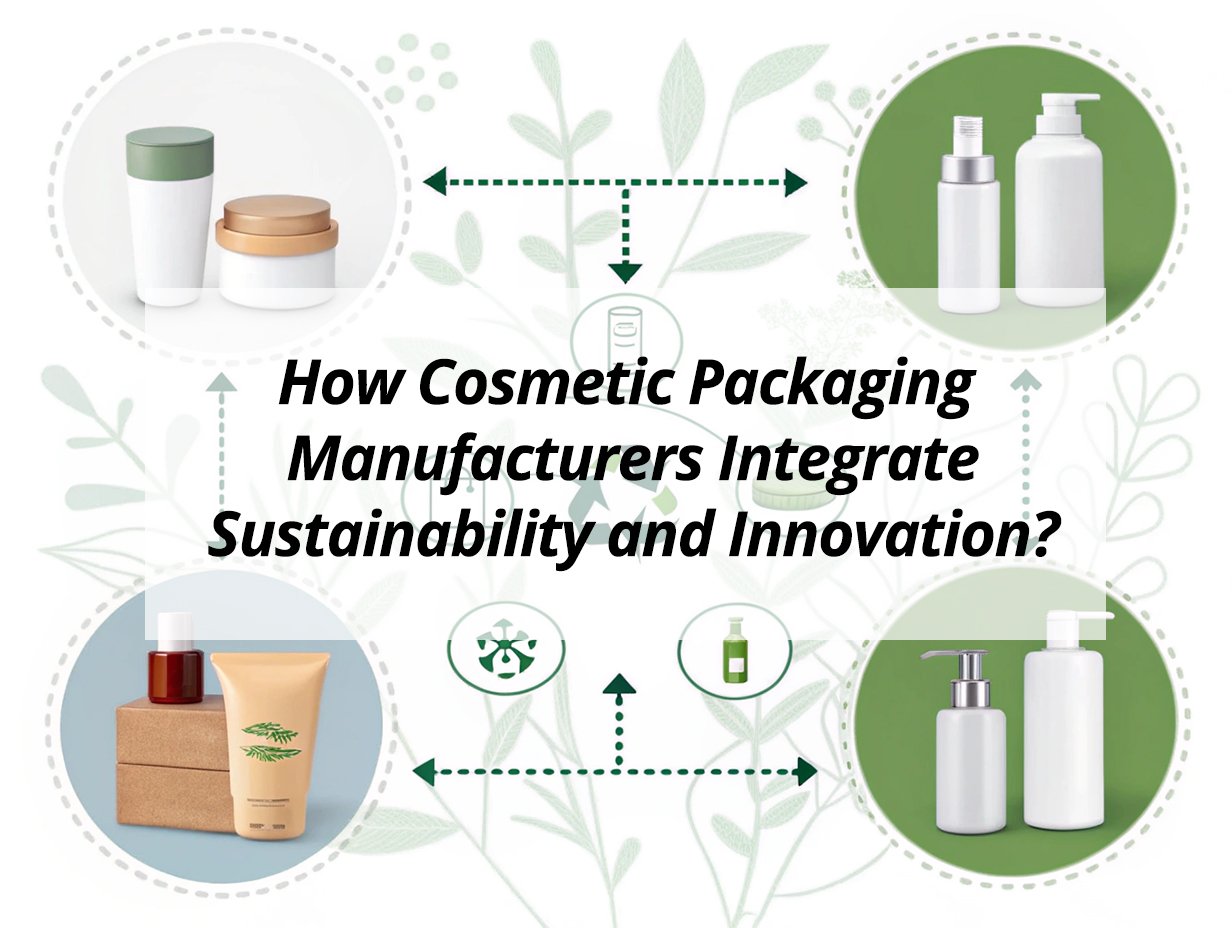
Cosmetic packaging manufacturers now face a difficult challenge: reduce environmental impact while still delivering formula protection, premium design, accurate dispensing, convenience, and reliable mass production.
Cosmetic packaging manufacturers integrate sustainability and innovation by reducing material, increasing recycled content, simplifying structures, developing mono-material pumps and containers, engineering refill systems, improving formula protection, and designing for recycling. The strongest solutions combine environmental improvement with manufacturing efficiency, functionality, aesthetics, consumer convenience, and measurable performance rather than treating sustainability as a separate feature.
Modern sustainable packaging development is becoming a system-design process. Materials, pumps, refills, decoration, recyclability, product protection, regulations, manufacturing, and customer experience increasingly need to work together from the beginning.
What Sustainable Materials Are Cosmetic Packaging Manufacturers Using?
Manufacturers are not replacing every traditional package with one new “green” material. They are selecting different materials according to formula, structure, recycling systems, manufacturing requirements, and environmental goals.
Cosmetic packaging manufacturers increasingly use PCR PET, PCR PP, PCR PE, mono-material PP and PE structures, lightweight glass, aluminum, responsibly sourced paper, and reduced-material hybrid systems. Material selection depends on formula protection, recycling compatibility, manufacturing, decoration, weight, cost, and availability, so no single material is the most sustainable choice for every cosmetic product.
1. PCR Reduces Virgin Plastic Demand
Post-consumer recycled plastic is one of the most visible changes in cosmetic packaging.
Manufacturers can offer:
- PCR PET bottles;
- PCR PP jars;
- PCR PE tubes;
- PCR caps;
- recycled-content outer components.
Amcor's 2026 beauty portfolio highlights post-consumer recycled plastic alongside refillable, reusable, and recycling-focused packaging.
APC Packaging also develops refillable PP packaging that can incorporate substantial PCR content in selected configurations.
However, PCR creates engineering challenges.
Manufacturers need to control:
- color variation;
- odor;
- specks;
- transparency;
- mechanical strength;
- shrinkage;
- decoration;
- dimensional consistency.
This means innovation is not simply:
replace virgin plastic with PCR
It is:
introduce PCR while keeping the package commercially reliable.
2. Mono-Material Structures Reduce Complexity
Traditional cosmetic packaging can contain many materials.
An airless bottle may include:
- PP;
- PE;
- PET;
- metal spring;
- elastomer valve;
- glass ball.
A lipstick mechanism may combine:
- ABS;
- PP;
- POM;
- aluminum;
- steel.
Manufacturers are redesigning these structures around fewer material families.
HCP's Harmony lipstick, for example, uses an all-PP mono-material construction together with a refillable mechanism.
Quadpack's ShapeUp Stick also uses mono-material PP, refillability, and recycled-content options.
The objective is to make complex cosmetic mechanisms easier to manage at end of life without losing functionality.
3. PE Is Expanding Into Advanced Packaging
PE is already important in cosmetic tubes.
Manufacturers are now pushing it into more complex systems.
Neopac presented its NeoDose Solo system at Paris Packaging Week 2026. The structure combines a mono-PE airless pump with a high-barrier PE-focused tube designed for the PE recycling stream.
This development is important because traditional high-performance packaging often needs multiple materials.
Innovation is increasingly about achieving:
barrier + dispensing + recyclability
within a simpler structure.
4. Paper Can Reduce Selected Plastic Components
Paper is also being explored where its properties make sense.
Lumson's XPAPER system uses an FSC paper outer bottle around an airless pouch system. Lumson states that its 50 ml paper outer shell weighs 50% less than a comparable PET outer bottle in its analysis.
However, paper is not automatically a replacement for the formula-contact package.
Sensitive formulas may still need:
- inner pouches;
- barriers;
- pumps;
- plastic closures.
The manufacturer therefore needs to design the complete structure, not simply replace an outer plastic wall with paper.
Material Innovation Overview
| Material Strategy | Main Benefit | Main Engineering Challenge |
|---|---|---|
| PCR PET | Reduces virgin PET | Color and clarity |
| PCR PP | Reduces virgin PP | Appearance and consistency |
| Mono-material PP | Simplifies rigid components | Mechanism engineering |
| Mono-material PE | Strong tube potential | Barrier and dispensing |
| Lightweight glass | Reduces material weight | Breakage and freight |
| Aluminum | Premium + recycling value | Cost and mixed structures |
| FSC paper | Reduces selected plastic | Moisture/barrier limitations |
| Refill cartridge | Reduces repeated full packs | Consumer reuse behavior |
Manufacturers increasingly choose materials according to the complete package rather than sustainability slogans.
How Do Manufacturers Combine Refillability, Recyclability, and Product Protection?
Refillable and recyclable packaging can create new problems if the redesign weakens formula protection, hygiene, dispensing, or convenience.
Manufacturers combine refillability, recyclability, and product protection by designing durable outer packs, lightweight replacement cartridges, simplified material structures, secure seals, controlled dispensing, and formula-protective airless systems. A successful refill should use less packaging while remaining hygienic, easy to replace, compatible with the formula, and durable enough for repeated consumer use.
1. Airless Packaging Shows the Engineering Challenge
Airless packaging is valuable because it can protect formulas from:
- excessive air exposure;
- contamination;
- oxidation;
- repeated finger contact.
Traditional airless systems can be mechanically complex.
Modern manufacturers are redesigning them.
Aptar's Sol airless platform uses recycle-ready PP, a metal-free pathway, and offers PCR resin options.
Its Macro airless system uses an all-plastic pump and reports a 90% product evacuation rate, showing how material simplification can be combined with dispensing performance.
That is a useful example of integrated innovation.
The manufacturer is addressing:
- formula protection;
- product evacuation;
- material structure;
- recycling;
- consumer use.
at the same time.
2. Refill Systems Need Durable Engineering
A refillable package has two different parts:
durable component + replaceable component
The durable part may include:
- premium outer bottle;
- compact case;
- lipstick shell;
- actuator.
The refill should ideally contain less material.
Aptar's Gaia system uses a reloadable airless architecture where the refill does not contain the pump. The company designed the replacement unit for easier recycling while the main outer structure stays in use.
Aptar's 2026 Clarins project illustrates the material-saving opportunity. The company reports that each reload reduced packaging material impact by 73% compared with the previous package through reductions in metal, plastic, and cardboard.
The important point is not the word refillable.
It is the measurable reduction created by repeated use.
3. Makeup Mechanisms Are Becoming Refillable
Refill innovation is expanding beyond skincare.
HCP has developed:
- refillable lipstick;
- refillable cushion packaging;
- refillable compact systems.
Its Harmony PP Airtight Refill Slimstick combines mono-material PP construction with refillability while retaining an airtight closure designed to protect the formula.
This shows how innovation can connect three objectives:
- formula protection;
- reuse;
- recyclability.
4. Refill Must Remain Easy
An environmentally improved package can fail commercially if the consumer cannot understand it.
Manufacturers therefore need to engineer:
- intuitive removal;
- secure insertion;
- clear click feedback;
- leak prevention;
- hygiene;
- cartridge compatibility.
APC Packaging's refillable airless design uses a push-button release system to simplify replacement of the inner cartridge.
This is an important form of innovation because consumer behavior determines whether the environmental benefit actually happens.
5. Product Waste Matters Too
Packaging sustainability is not only about the grams of packaging.
If a redesigned package leaves more cosmetic formula unused, part of the environmental benefit can be lost.
Manufacturers therefore increasingly consider:
- product evacuation;
- pump output;
- residual formula;
- controlled dosage.
Airless packaging can support this by helping consumers access more of the product.
Sustainable engineering should therefore measure both:
packaging waste + product waste
rather than optimizing only one.
How Is Technology Improving Sustainable Cosmetic Packaging?
Manufacturing innovation is making it possible to simplify packaging without giving up many of the functions that previously required complex multi-material structures.
Technology is improving sustainable cosmetic packaging through all-plastic pumps, advanced airless systems, high-barrier mono-material tubes, refill mechanisms, precision lightweighting, PCR processing, improved decoration, digital prototyping, and recyclability testing. These tools help manufacturers reduce material complexity while maintaining formula protection, dispensing performance, premium aesthetics, and mass-production reliability.
1. All-Plastic Pumps Remove Traditional Metal Components
A conventional pump often uses a metal spring.
That creates functional reliability but adds another material.
New designs are moving the spring function into plastic.
Aptar's Macro uses an all-plastic pump, while other manufacturers are also developing mono-material or metal-free dispensing technologies.
The challenge is maintaining:
- spring force;
- dosage;
- priming;
- recovery;
- leakage resistance;
- cycle life.
The innovation is therefore mechanical, not simply cosmetic.
2. High-Barrier Mono-Material Structures Are Improving
Sensitive cosmetic formulas may need protection from:
- oxygen;
- moisture;
- light;
- evaporation.
Historically, high barriers often required multilayer structures.
Neopac's 2026 mono-PE airless solution shows how manufacturers are trying to provide high barrier performance while remaining compatible with the PE recycling stream.
This type of development is likely to become more important because beauty brands do not want to choose between:
recyclability or product protection
They increasingly expect both.
3. Manufacturers Are Lightweighting More Precisely
Older packaging designs often created luxury through:
- thick walls;
- heavy bases;
- oversized caps;
- double-wall jars.
Manufacturers can now use:
- simulation;
- optimized rib structures;
- improved molding;
- better resin distribution;
to remove material without making the container feel weak.
The goal is:
less material, same function
rather than simply producing the thinnest possible wall.
4. Digital Development Reduces Physical Iterations
Modern development can involve:
- 3D CAD;
- virtual rendering;
- mold-flow analysis;
- tolerance simulation;
- rapid prototyping.
These tools allow manufacturers to test structure earlier.
A team can evaluate:
- refill removal;
- cap fit;
- actuator movement;
- hinge geometry;
- component thickness;
before committing to final molds.
This can reduce development waste and shorten the innovation cycle.
5. Sustainability Is Being Integrated With Decoration
Brands still want beauty packaging to look premium.
A sustainable PP lipstick cannot succeed only because it uses one resin.
It may still need:
- strong color;
- logo printing;
- hot stamping;
- metallization;
- tactile finish.
Neopac's mono-material airless system still supports colored actuators, hot-foiled collars, and premium decoration.
Quadpack's mono-material ShapeUp Stick is also positioned around both sustainable performance and customizable beauty design.
Innovation therefore means keeping branding flexibility inside a simpler packaging system.
How Are Regulations Changing Sustainable Packaging Innovation?
Packaging regulation is turning sustainability from an optional design direction into a technical requirement that manufacturers increasingly need to anticipate during product development.
Regulations are pushing cosmetic packaging manufacturers toward recyclability, material minimization, recycled plastic content, better documentation, and circular design. The EU PPWR began applying from August 12, 2026 and introduces recyclability performance requirements, packaging minimization rules, and future minimum recycled-content levels for plastic packaging, influencing designs being developed years before the deadlines.
1. PPWR Changes the Development Brief
The European Commission confirmed that PPWR began applying across the EU on a phased basis from August 12, 2026. It is designed to reduce packaging waste, improve circularity, increase recycled-plastic use, and require packaging to become recyclable.
For manufacturers, this changes the customer's questions.
Brands increasingly need to ask:
- How many materials are in this package?
- What is the package weight?
- Can it enter a recycling stream?
- Can PCR be added?
- Can the package be lighter?
- Can components be separated?
Innovation therefore becomes linked directly to compliance planning.
2. Recyclability Will Become More Measurable
PPWR establishes recyclability performance grades from 2030 and stronger requirements later in the following decade.
This means manufacturers need more than statements such as:
designed for recycling
They will increasingly need data about:
- resin;
- component weights;
- labels;
- closures;
- decorations;
- recyclability performance.
This encourages more technical packaging development.
3. Recycled Content Is Becoming a Design Requirement
Article 7 of PPWR sets future recycled-content requirements for plastic packaging.
From the applicable 2030 timing, the regulation specifies:
- 30% recycled content for contact-sensitive PET packaging;
- 10% for contact-sensitive packaging made mainly from other plastics;
subject to the detailed provisions, exceptions, calculation rules, and implementing acts.
Cosmetic manufacturers therefore need to prepare PCR-capable packaging before these dates arrive.
A mold developed today may still be producing packaging in 2030.
4. Packaging Minimization Challenges Traditional Luxury
PPWR also requires packaging weight and volume to be minimized while maintaining functionality.
That puts pressure on design strategies based mainly on:
- thick false bottoms;
- oversized dimensions;
- excessive material.
Premium cosmetic packaging will increasingly need to communicate value through:
- precision;
- mechanism quality;
- surface finish;
- refillability;
- ergonomics;
- design;
rather than material quantity alone.
What Should Beauty Brands Look for in Sustainable Packaging Innovation?
A supplier calling a package innovative or sustainable does not prove that it creates a meaningful environmental improvement.
Beauty brands should evaluate sustainable packaging innovation through measurable material reduction, recycled-content evidence, formula compatibility, recyclability, refill performance, product evacuation, manufacturing stability, decoration, cost, and consumer convenience. The best innovation should solve a real packaging problem and remain practical at commercial scale rather than exist only as a concept sample.
1. Ask What Has Actually Improved
Instead of asking:
“Is this sustainable packaging?”
ask:
- How many grams were removed?
- What percentage is PCR?
- Which material was eliminated?
- How many refill cycles are expected?
- What recycling stream is targeted?
- Was recyclability tested?
These questions produce measurable answers.
2. Check Whether It Can Be Mass Produced
Innovation needs commercial reality.
A beautiful prototype is not enough.
A packaging manufacturer should be able to explain:
- mold stability;
- production rate;
- material supply;
- decoration;
- assembly;
- QC;
- MOQ;
- repeat production.
APC Packaging describes innovation as needing to be replicable, economical, and able to satisfy a real market need.
That is a useful standard.
3. Test Formula Performance
Sustainable redesign cannot compromise the cosmetic formula.
Brands should test:
- leakage;
- oxidation;
- evaporation;
- pump output;
- formula compatibility;
- color change;
- product evacuation.
A recyclable package that damages an expensive serum is not a successful sustainability solution.
4. Evaluate Refill Honestly
Refillable packaging should be compared against repeated full packages.
For example:
Conventional system
5 complete jars
versus:
Refillable system
1 durable jar + 4 lightweight refills
The second design should use meaningfully less total material.
5. Evaluate the Consumer Experience
Consumers should not need engineering knowledge to use sustainable packaging.
Check:
- Is the refill obvious?
- Does it click into place?
- Can customers find replacement units?
- Is the package hygienic?
- Is disposal understandable?
Technology should reduce friction, not create it.
Sustainable Innovation Scorecard
| Evaluation Area | What to Measure |
|---|---|
| Material reduction | Grams removed |
| PCR | Verified recycled-content percentage |
| Mono-material | Number of material families |
| Refill | Material saved per refill |
| Recyclability | Target recycling stream |
| Formula protection | Stability and compatibility results |
| Evacuation | Residual formula |
| Durability | Drop and cycle performance |
| Decoration | Brand quality and recycling impact |
| Cost | Commercial scalability |
| Consumer use | Ease of refill/disposal |
| Documentation | Supplier evidence |
This approach helps separate meaningful innovation from environmental marketing.
My insights: How Cosmetic Packaging Manufacturers Integrate Sustainability and Innovation
Sustainability and innovation are becoming the same packaging-development problem. Manufacturers can no longer optimize material, function, beauty, recycling, and cost as completely separate decisions.
Cosmetic packaging manufacturers integrate sustainability and innovation most effectively by engineering the entire packaging system together. Material reduction provides the foundation, PCR reduces virgin-resin demand, mono-material engineering simplifies recovery, refill extends package life, airless technology protects formulas, and better manufacturing data makes environmental improvements measurable and repeatable at commercial scale.
1. Start With Reduction
I would make material reduction the first question.
Before changing materials, ask:
- Can the package be lighter?
- Can one component disappear?
- Can the double wall become single wall?
- Can the cap be smaller?
Reduction often creates the most direct improvement.
2. Simplify Before Adding PCR
A highly complex package made with 30% PCR can still contain:
- metal;
- silicone;
- several polymers;
- oversized decoration.
I would first simplify the structure.
Then add recycled content.
This creates a stronger system.
3. Make Innovation Solve Two Problems at Once
The strongest innovations usually solve several problems.
For example:
full-plastic pump
can support both:
- dispensing;
- material simplification.
refillable airless
can support:
- formula protection;
- reuse.
mono-PE barrier tube
can support:
- formula protection;
- recycling compatibility.
That is more valuable than adding one isolated sustainability feature.
4. Treat Formula Protection as Sustainability
If packaging extends formula life or improves evacuation, that can reduce product waste.
I would therefore include:
- oxidation;
- hygiene;
- dosage;
- evacuation;
inside sustainability discussions.
The formula often contains more value and resources than the package around it.
5. Design Refills Around Repeat Behavior
A refill only creates its expected benefit when customers use it.
I would make the refill:
- easy to remove;
- easy to install;
- easy to purchase;
- clearly cheaper or materially smaller.
The system should encourage repeated use naturally.
6. Keep Premium Design
Sustainable packaging does not need to look inexpensive.
Manufacturers can use:
- shape;
- precise mechanisms;
- controlled color;
- texture;
- selective decoration;
- elegant typography;
to create premium value without adding unnecessary weight.
Luxury should increasingly mean better design, not simply more material.
7. Design for Future Regulations
A packaging mold can remain in use for many years.
I would therefore review:
- PPWR;
- PCR targets;
- recyclability;
- packaging weight;
before finalizing a new design.
Waiting until 2030 to redesign a package developed in 2026 can create unnecessary cost.
8. Require Evidence
I would ask manufacturers for:
- component weights;
- material breakdown;
- PCR documentation;
- recyclability information;
- refill comparison;
- test reports.
A sustainability icon in a catalog is not enough.
9. Measure the Whole System
A package should be evaluated across:
materials → manufacturing → filling → transport → consumer use → refill → disposal
One improvement can create a problem elsewhere.
For example:
- lighter wall may increase breakage;
- heavy refill case may require too many cycles;
- complex metallization may affect recycling;
- high PCR may reduce formula compatibility.
The complete system matters.
10. Use a Sustainability and Innovation Checklist
Before approving a new packaging concept, I would confirm:
- Packaging weight optimized
- Unnecessary components removed
- Main materials identified
- Mono-material opportunities reviewed
- PCR options tested
- Formula compatibility verified
- Airless or dispensing performance tested
- Product evacuation measured
- Refill material reduction calculated
- Refill durability tested
- Consumer replacement process tested
- Decoration reviewed
- Target recycling stream identified
- Component separation reviewed
- Supplier sustainability evidence collected
- PPWR requirements reviewed where relevant
- MOQ and cost commercially realistic
- Mass-production capability confirmed
- Golden sample approved
- Repeat-production specifications locked
The future of cosmetic packaging will not come from one perfect sustainable material. It will come from manufacturers engineering better systems that protect formulas, use fewer resources, support circularity, and still give beauty brands the performance and design consumers expect.
Conclusion
Cosmetic packaging manufacturers integrate sustainability and innovation through reduction, PCR, mono-material design, refill systems, advanced dispensing, better recyclability, and engineering that protects both formulas and resources.