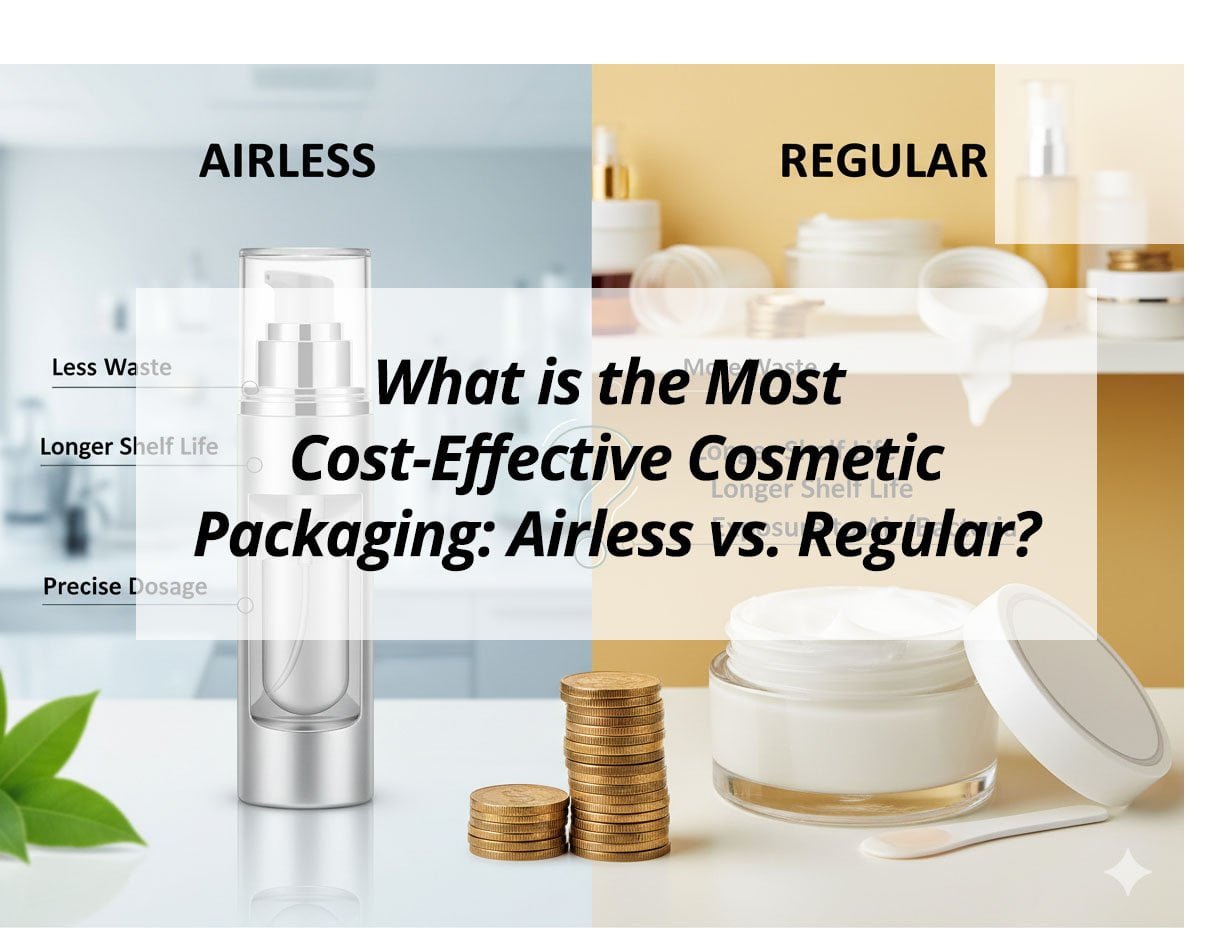
Companies often seek to optimize costs for cosmetic packaging. Balancing quality and budget is a key challenge. This analysis explores the cost factors. It compares airless and regular packaging options.
Selecting the most cost-effective cosmetic packaging requires a comprehensive evaluation. Regular packaging often presents lower initial investment. Airless packaging provides advantages in product preservation and waste reduction. These benefits can lead to long-term value. The optimal choice depends on specific product needs and brand objectives.
The perception of cost-effectiveness extends beyond the purchase price. Issues such as product spoilage or customer dissatisfaction can arise from inadequate packaging. Therefore, a holistic view of packaging performance and its impact on product integrity and market reception is essential.
What is the most cost-effective packaging?
Determining the most cost-effective packaging involves more than just unit price. It includes evaluating product protection, shelf life, and user experience. Businesses must consider these elements to make an informed decision.
Cost-effective packaging balances initial expenditure with functional benefits. Standard packaging, such as basic jars or bottles, typically has a lower per-unit cost. Airless packaging, despite a higher initial price, extends product shelf life. It also minimizes waste. This makes it more economical for sensitive or high-value formulations over time.
Early experiences in packaging procurement often highlight the distinction between cheap and truly cost-effective. Relying solely on the lowest price can lead to hidden expenses. For instance, packaging that fails to protect formulations from oxidation can result in product degradation. This leads to customer complaints and potential recalls. Such incidents underscore the importance of packaging performance. A slightly higher initial investment in packaging that offers superior protection can prevent significant losses. These losses include damaged goods and harm to brand reputation. Factors such as a packaging's ability to maintain product stability, enhance dispensing, and minimize residue contribute to its overall value. This is particularly relevant for formulations containing delicate or active ingredients.
Factors Defining Cost-Effectiveness
Cost-effectiveness is determined by several critical factors. These factors include:
- Product Protection:
- Protection from air exposure.
- Barrier against light degradation.
- Prevention of microbial contamination.
- Shelf Life Extension:
- Ability to maintain product freshness.
- Reduction in product returns due to spoilage.
- Dispensing Efficiency:
- Ease of product access for the consumer.
- Minimization of product residue within the container.
- Brand Perception:
- Aesthetics and perceived quality of the packaging.
- Alignment with the brand's premium or value positioning.
- Sustainability Aspects:
- Recyclability of materials.
- Environmental impact, which can influence consumer choice.
| Feature | Regular Packaging (e.g., standard jar) | Airless Packaging (e.g., airless pump bottle) |
|---|---|---|
| Initial Unit Cost | Lower | Higher |
| Product Integrity | Moderate (vulnerable to air exposure) | High (excellent protection from oxidation) |
| Product Shelf Life | Shorter for sensitive formulations | Extended for sensitive formulations |
| Product Evacuation | Can leave significant residue | Minimizes residue, dispenses nearly all product |
| Hygiene Level | Potential for user contamination | Enhanced hygiene due to no direct contact |
| Suitability | Stable, less reactive formulas | Sensitive, active, high-value formulations |
Strategic selection of packaging considers both upfront costs and long-term performance.
How much does makeup packaging cost?
The cost of makeup packaging is highly variable. It is influenced by numerous factors. Understanding these cost drivers is essential for budget planning and procurement.
Makeup packaging costs vary significantly. Basic plastic containers or tubes can be less than $0.50 per unit. More elaborate airless systems or custom glass components can range from $1 to over $5 per unit. Key factors influencing cost include material, design complexity, manufacturing volume, and decorative finishes.
The cost of packaging is often a complex calculation. A client's request for a highly customized compact, mirroring luxury designs, illustrates this. Custom mold creation alone represented a substantial upfront investment. The subsequent unit cost was elevated due to the intricate design and specialized materials. This experience highlights that design choices directly correlate with manufacturing expenses. Material selection is a primary cost driver. Plastics are generally less expensive than glass or metal. Within plastics, types like PET often cost less than acrylic. Customization, such as specific printing methods or surface treatments, adds to the unit cost. Furthermore, production volume significantly impacts pricing. Higher order quantities typically result in lower per-unit costs, whereas smaller runs incur higher individual unit prices due to less efficient amortization of setup costs.
Key Drivers of Packaging Cost
Several factors are pivotal in determining packaging costs. These include:
- Material Specification:
- Types of plastic (e.g., PP, PET, ABS, Acrylic).
- Use of glass, aluminum, or other metals.
- Inclusion of recycled content or bio-based materials.
- Design and Engineering:
- Complexity of the container's shape.
- Number of individual components requiring assembly.
- Investment in custom molds for unique designs.
- Decoration Techniques:
- Methods like screen printing, hot stamping, offset printing.
- Special finishes such as metallization, UV coatings, soft-touch effects.
- The number of colors and passes required.
- Production Volume:
- Impact of Minimum Order Quantities (MOQs) on unit price.
- Economies of scale for larger production runs.
- Ancillary Components:
- Inclusion of pumps, sprayers, droppers, spatulas, brushes.
- Each component adds to the overall cost.
| Component / Factor | Typical Cost Impact (per unit) | Explanatory Notes |
|---|---|---|
| Standard Plastic Jar | $0.25 - $0.90 | Varies with size, plastic type (e.g., PP, PET) |
| Glass Bottle | $0.70 - $2.50 | Higher perceived value, increased weight for shipping |
| Airless Pump Bottle | $1.20 - $4.50+ | Complex mechanism, multi-part construction |
| Custom Mold Fee | $800 - $8,000+ (one-time cost) | Spread across total production volume; high initial outlay |
| Decoration (e.g., Screen Print) | $0.04 - $0.25 per color/pass | Multiple colors or processes increase cost |
| Minimum Order Quantity (MOQ) | Unit price decreases as MOQ increases | Reflects setup costs and material efficiencies |
Comprehensive understanding of these cost drivers is crucial for effective budget management.
Do airless pumps waste less product?
The issue of product residue and waste in packaging is a common concern for consumers. Airless pump technology addresses this directly. Its efficacy in product evacuation is a key advantage.
Airless pumps demonstrably reduce product waste compared to conventional packaging with dip tubes or jars. Their design utilizes a vacuum-powered piston. This mechanism progressively pushes the product upward. It ensures nearly complete dispensing of the contents. This maximizes product utility for the consumer.
Conventional dispensing methods often leave a significant portion of the product adhering to the container walls or below the reach of a dip tube. This leads to consumer frustration and perceived financial loss. For example, standard lotion bottles frequently require shaking, inverting, or repeated pumping to access residual product, often without full success. Airless systems operate differently. They do not rely on a dip tube. Instead, an internal disc or piston elevates the product as it is dispensed. This creates a vacuum seal. It keeps the product densely packed. This design allows for evacuation rates exceeding 95%. For high-value cosmetic formulations, this efficiency is a considerable benefit. It ensures consumers fully utilize the product they purchased. This enhances customer satisfaction and reinforces brand value. Products packaged in airless containers consistently receive positive feedback regarding their superior product evacuation.
How Airless Pumps Minimize Waste
The design principles of airless pumps contribute to minimal product waste:
- Dip Tube Absence:
- Eliminates the common issue of product retention below the dip tube's reach.
- Allows for access to all product, regardless of viscosity.
- Piston Mechanism:
- An internal piston or disc lifts the product from the container's base.
- This ensures consistent and near-total product evacuation.
- Controlled Dosing:
- Each pump dispenses a precise, consistent amount of product.
- Helps prevent over-application and extends product life.
- Sealed Environment:
- Maintains a vacuum seal, preventing air re-entry.
- Protects sensitive formulations from oxidation and degradation.
| Packaging Type | Product Evacuation Rate (Approx.) | Key Advantage for Waste Reduction |
|---|---|---|
| Standard Pump Bottle | 70-85% | Product remains on walls, below dip tube, and in pump |
| Cosmetic Jar | 80-90% | Product can dry out or be difficult to scoop entirely |
| Squeeze Tube | 85-95% | Difficult to fully empty without cutting the tube |
| Airless Pump Bottle | 95-99% | Piston ensures near-complete evacuation, minimal residue |
The use of airless pumps offers clear advantages in maximizing product utilization. This benefits both consumers and brands.
What is the formula for packaging cost?
Accurately calculating total packaging expenses is critical for financial planning. Understanding the components of this cost provides greater budgetary control.
The comprehensive formula for packaging cost per unit is: (Raw Material Cost + Manufacturing Cost + Decoration Cost + Assembly Cost + Freight & Logistics Cost + Supplier's Margin + Amortized One-Time Costs) / Total Units. This formula accounts for all direct and indirect expenses. It ensures a complete financial overview of packaging. One-time costs, such as mold fees, are spread across the projected total production volume.
Calculating packaging costs involves more than a single line item. One project highlighted the importance of including all incidental costs. An omission in accounting for the assembly of a complex cap, though minor per unit, accumulated into a significant unforeseen expense over a large production run. This emphasizes the need for a detailed cost breakdown. Raw material cost is often the largest component, varying by material type (plastic, glass, metal). Manufacturing costs cover labor, machine time, and factory overhead. Decoration, encompassing printing and specialized finishes, adds to the unit price. If packaging involves multiple parts, assembly costs must be included. Freight and logistics, covering shipping, customs, and insurance, are also essential. Finally, the manufacturer's profit margin is integrated into the quoted price. For custom packaging, initial mold or tooling fees are one-time investments. These are amortized, meaning their cost is distributed across the total number of units produced over the mold's lifespan.
Components of Total Packaging Cost
A detailed breakdown of packaging cost components includes:
- Raw Material Cost:
- Price of primary materials (resins, glass, metals).
- Directly proportional to the weight and type of material used.
- Manufacturing Cost:
- Labor expenses for production processes.
- Machine operation time and energy consumption.
- Factory overhead attributed to each unit.
- Decoration Cost:
- Expenses for inks, foils, coatings, and specialized materials.
- Labor and machine costs for applying decorative elements.
- Assembly Cost:
- Cost associated with combining multiple packaging components.
- E.g., inserting pumps into bottles, attaching special caps.
- Freight & Logistics Cost:
- Transportation expenses from manufacturer to final destination.
- Import duties, taxes, and customs clearance fees.
- Insurance coverage during transit.
- Supplier's Margin:
- The profit component added by the packaging manufacturer.
- Negotiable based on volume and relationship.
- Amortized One-Time Costs:
- Costs for custom molds, tooling, or unique design development.
- These are divided by the total projected units produced.
| Cost Category | Description | Illustrative Unit Cost (Example) |
|---|---|---|
| Raw Material Cost | Price of materials for one unit | $0.20 (e.g., for standard plastic) |
| Manufacturing Cost | Labor and machine time per unit | $0.12 |
| Decoration Cost | Printing, finishes applied per unit | $0.08 (e.g., for a single-color print) |
| Assembly Cost | Cost to combine parts for one unit | $0.04 (e.g., for pump insertion) |
| Freight & Logistics | Shipping and associated fees per unit | $0.07 |
| Supplier's Margin | Manufacturer's profit allocated per unit | $0.10 |
| Amortized Mold Fee | (Total mold fee / Total units) | $0.03 (e.g., $3000 mold for 100,000 units) |
| Total Unit Cost | Sum of all components | $0.64 per unit (example total) |
A thorough understanding of this cost formula empowers businesses to manage their packaging budget effectively and make strategic sourcing decisions.
My Insights: Evaluating Cost-Effective Cosmetic Packaging: Airless vs. Regular
Wondering which packaging is more cost-effective: airless or regular? Discover what suits your product's formula and budget best.
Airless packaging offers superior protection from contamination and waste, ideal for sensitive formulas. Regular packaging is more affordable but requires preservatives due to air exposure. Choice relies on product needs and cost.
Cost-Effectiveness Analysis of Airless vs. Regular Packaging
Cost and Performance Factors
| Factor | Airless Packaging | Regular Packaging |
|---|---|---|
| Unit Price | $1.50–$4.00+ per unit | $0.40–$1.50 per unit |
| Mechanism Complexity | Advanced pump system | Simple tube/jar/squeeze |
| Formula Protection | Superior, minimizing oxidation | Moderate, relies on more preservatives |
| Waste Reduction | High, nearly complete dispensing | Low, typically more leftover waste |
| Brand Value | Premium positioning | Mass-market positioning |
-
Price vs. Protection: Regular packaging is cost-effective for products like cleansers or lotions that are less sensitive to oxidation, focusing more on affordability in high-volume sales.
-
Airless Advantages: Investing in airless packaging benefits products with sensitive actives like vitamin C, or brands aiming for a premium image. Despite higher costs, they reduce waste and extend shelf life.
-
Decision Guide: If your product includes unstable ingredients or seeks upscale positioning, airless may justify the cost. For everyday products with less sensitivity to air, regular packaging maintains cost-effectiveness.
Understanding these aspects helps balance budgetary constraints with product requirements and brand positioning when selecting between airless and regular cosmetic packaging.
Conclusion
Making informed decisions about cosmetic packaging is crucial for brand success. By comprehensively comparing airless and regular packaging options. By understanding the diverse factors that influence packaging costs. And by recognizing the significant product waste reduction offered by airless pumps, businesses can optimize their investment. This ensures both cost-effectiveness and enhanced product integrity.