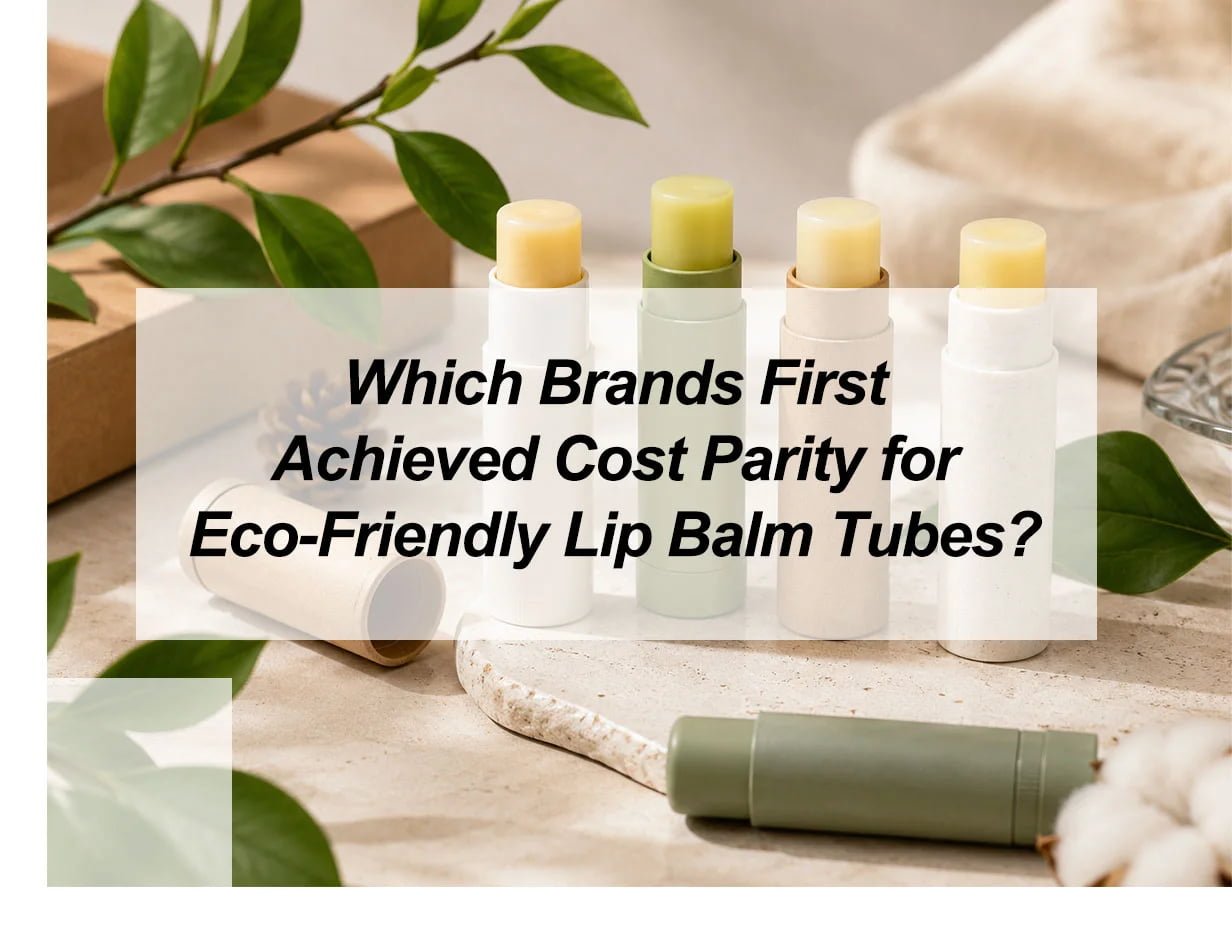
Many lip balm brands want cleaner packaging, but cost blocks action. A small tube looks simple, yet the price gap can stop a launch.
No public evidence clearly proves that one brand was the first to achieve full cost parity for eco-friendly lip balm tubes. Early leaders include Poppy & Pout, Eco Lips, Burt’s Bees, and Sunniemade, but cost parity usually depends on order volume, material type, supplier scale, and whether the tube uses a standard design.
This question matters because buyers do not only want a greener tube. They want a tube that fills well, protects the formula, looks good on shelf, and does not damage margin. In my view, the real answer is not only about one brand. It is about the point where sustainable lip balm packaging becomes practical for normal commercial use.
Which Brands Moved Early Into Eco-Friendly Lip Balm Tubes?
Early eco-friendly lip balm packaging did not begin with perfect cost parity. It began with brands that were willing to test paper, plant fiber, and recyclable formats before the market was fully ready.
Poppy & Pout is one of the clearest early examples because it says its lip balms have been packaged in recyclable cardboard tubes since 2014. Eco Lips became important later with Plant Pod, a 100% plant-based, plastic-free lip balm tube designed to work like a regular tube. Burt’s Bees also entered paper tube lip balm at a mass-market level. Sunniemade pushed the format further with a paper squeeze tube.
The Early Brand Pattern
| Brand | Packaging Direction | Why It Matters |
|---|---|---|
| Poppy & Pout | Recyclable cardboard tubes | Early commercial use of paperboard lip balm packaging |
| Eco Lips | Plant-based plastic-free Plant Pod | Strong functional claim because it works like a regular tube |
| Burt’s Bees | Paper lip balm tubes | More mainstream retail visibility |
| Sunniemade | Paper squeeze tube | Better user experience than many push-up paper tubes |
These brands did not all prove cost parity in public. That point is important. A brand can use eco-friendly lip balm tubes and still pay more than plastic. A brand can also reach practical cost parity internally without publishing the exact packaging cost. Most brands do not disclose their supplier quotes, mold costs, scrap rates, filling loss, or freight impact. So I would not say one brand “first achieved cost parity” unless there is a clear public cost statement.
Why “First” Is Hard To Prove
Cost parity is not one number. It changes by country, order size, tube diameter, paper thickness, decoration method, label material, and assembly process. A small handmade brand may pay a high price for paper tubes. A large brand may get a better price because it orders more units and uses a standard tube. A contract manufacturer may also reduce cost if it fills the same tube format for many clients.
So the better question is this: which brands helped make eco-friendly lip balm tubes commercially believable? On that point, Poppy & Pout, Eco Lips, Burt’s Bees, and Sunniemade are all useful examples.
Are Cardboard Lip Balm Tubes Really Eco-Friendly?
Cardboard lip balm tubes can be eco-friendly, but only when the full structure supports the claim. The tube must avoid hidden plastic layers, hard-to-recycle adhesives, and coatings that make disposal unclear.
A cardboard tube is not automatically sustainable. The best versions use responsibly sourced paper, simple decoration, safe adhesives, and a design that keeps the balm stable through normal use. The worst versions look green but still include mixed materials that are hard to separate.
What Makes A Paper Tube More Trustworthy?
| Factor | Better Choice | Risky Choice |
|---|---|---|
| Main material | Paperboard or plant fiber | Mixed plastic-paper laminate |
| Coating | Minimal or clearly disclosed | Unknown waterproof coating |
| Label | Paper label or direct print | Plastic film label |
| Adhesive | Natural or recyclable-compatible adhesive | PVC or hidden plastic glue |
| Use experience | Smooth push-up or squeeze function | Disk slip, cracking, weak cap fit |
In lip balm, packaging must do more than hold the product. Lip balm contains oils, waxes, butters, and sometimes flavor oils. These ingredients can stain paper, soften weak structures, or affect the push-up mechanism. This is why some paper tubes perform well and others feel cheap.
The Consumer Experience Problem
Many consumers like the idea of cardboard tubes, but they may not like the feel. A plastic twist-up tube is familiar. A paper push-up tube needs more care. If the user pushes too much product out, it can be hard to push it back cleanly. If the tube gets wet in a bag or bathroom, the experience may feel worse than plastic.
This is why newer formats matter. A paper squeeze tube or a plant-based tube that works like plastic can reduce friction. For a brand, this is the real path toward adoption. The tube must not ask the customer to accept a worse product just because the packaging is greener.
Why Are Sustainable Lip Balm Tubes More Expensive Than Plastic Tubes?
Sustainable lip balm tubes are often more expensive because materials, production scale, tooling, testing, and quality control are not as mature as conventional plastic tubes.
Plastic lip balm tubes are cheap because the supply chain is large, stable, and highly standardized. Eco-friendly tubes often use newer materials and smaller production runs. That means the cost per unit can rise before the brand even fills the balm.
Main Cost Drivers
| Cost Driver | Why It Raises Price |
|---|---|
| Material sourcing | Certified paper, PCR, or plant fiber may cost more |
| Smaller production runs | Lower volume means weaker pricing power |
| Filling compatibility | Paper and plant-based tubes need more testing |
| Decoration limits | Some eco materials are harder to print or label |
| Scrap rate | Newer formats may create more waste during filling |
| Freight impact | Bulkier paper structures can affect shipping cost |
Cost parity becomes easier when brands stop treating sustainable packaging as a custom luxury feature. A standard paper tube, standard cap size, and simple label can be far cheaper than a fully custom eco tube with special colors, embossing, and complex finishing.
The Hidden Cost Question
Many buyers compare only the empty tube price. That is not enough. A cheaper eco tube can become expensive if it slows filling speed, leaks oil, dents during transport, or creates complaints. A slightly more expensive tube can be cheaper in real business terms if it runs smoothly and protects the product.
This is why I look at landed cost, not only unit cost. Landed cost includes tube price, MOQ, decoration, filling loss, shipping, storage, breakage, inspection, and after-sale problems. When a brand studies all of these points, cost parity becomes a practical business target instead of a marketing phrase.
How Can Lip Balm Brands Reach Cost Parity With Eco-Friendly Tubes?
Lip balm brands can reach cost parity by using standard tube formats, increasing order volume, choosing materials that match the formula, and working with suppliers that already produce eco-friendly packaging at scale.
Cost parity is not only about asking for a lower price. It is about removing waste from the full packaging system. A brand should reduce custom parts, shorten the development cycle, and avoid packaging that needs special handling.
Practical Cost Parity Checklist
| Action | Cost Impact |
|---|---|
| Use standard tube sizes | Reduces mold and setup cost |
| Avoid too many colors | Lowers printing and inventory risk |
| Order by forecast | Improves supplier pricing |
| Test formula early | Prevents failed production runs |
| Use one tube across several SKUs | Increases volume per component |
| Choose local or efficient freight routes | Reduces landed cost |
| Keep decoration simple | Cuts labor and material waste |
Why Volume Changes Everything
A small brand may buy 1,000 to 5,000 paper tubes and feel that eco packaging is too expensive. A larger brand may buy 50,000 or 100,000 units and see a much smaller gap. The material did not change. The pricing structure changed.
This is why some brands may have reached internal cost parity earlier than the public knows. They may have used private supplier agreements, large order commitments, or simplified packaging designs. But without public data, it is safer to say that the market reached practical parity in stages, not through one single brand event.
What Buyers Should Ask Suppliers
A buyer should ask direct questions before choosing an eco-friendly lip balm tube:
- What is the price difference at 5,000, 20,000, 50,000, and 100,000 units?
- Does the tube work with oil-heavy formulas?
- Can the tube pass transport and drop testing?
- Is the label also plastic-free or recyclable?
- What is the real lead time during peak season?
- Can the same tube be used for several flavors or formulas?
These questions help buyers see whether the supplier can support real production, not only a nice sample.
Which Brands First Achieved Cost Parity for Eco-Friendly Lip Balm Tubes?
No verified public source clearly names one brand as the first to achieve cost parity for eco-friendly lip balm tubes. The most accurate answer is that early practical leaders include Poppy & Pout, Eco Lips, Burt’s Bees, and Sunniemade, while true cost parity depends on scale and supply chain design.
This is the key insight behind the whole topic. A brand may be first in paper tubes. Another brand may be first in plant-based function. Another may be first in mainstream retail exposure. But “first to cost parity” is a different claim. It needs cost proof.
A More Useful Ranking
| Question | Strong Example |
|---|---|
| Who used cardboard tubes early? | Poppy & Pout |
| Who promoted a plant-based plastic-free tube? | Eco Lips |
| Who helped normalize paper tubes in mainstream retail? | Burt’s Bees |
| Who improved paper tube usability with squeeze design? | Sunniemade |
| Who clearly proved first cost parity? | No single public winner is confirmed |
My View On The Real Answer
I would not write that one brand first achieved cost parity unless the brand published packaging cost data. That would be risky and easy to challenge. A more objective answer is this: cost parity for eco-friendly lip balm tubes appears to be a supply-chain milestone, not a single-brand trophy.
The first brands that likely came close were the ones that used simple structures, accepted standard sizes, ordered enough volume, and built their product story around the packaging. Poppy & Pout proved that cardboard could be part of a brand identity. Eco Lips proved that a plant-based tube could act more like a normal tube. Burt’s Bees gave paper tubes more mainstream visibility. Sunniemade showed that usability can still improve.
For buyers, the lesson is clear. Do not only ask, “Which brand was first?” Ask, “Which packaging route can reach cost parity for my order size, formula, market, and margin?” That question leads to better sourcing decisions.
My insights: Which Brands First Achieved Cost Parity for Eco-Friendly Lip Balm Tubes
Eco-friendly lip balm tubes are no longer only a branding choice. They are becoming a cost, sourcing, and production decision for beauty brands.
The brands that first came close to cost parity were not necessarily the brands with the loudest sustainability claims. They were the brands that used standard eco-friendly tube formats, ordered at larger volumes, reduced custom decoration, and worked with suppliers that could repeat production at scale.
The Real Meaning Of Cost Parity
Cost parity does not always mean that an eco-friendly lip balm tube has the exact same unit price as a plastic tube. In real sourcing, it means the full packaging cost becomes acceptable when the brand considers tube price, filling speed, defect rate, shipping cost, shelf appeal, and customer trust.
For lip balm brands, this is important because the tube is a small component with a big influence. A cheap plastic tube may cost less at first, but it may not support a clean beauty story. A paper or plant-based tube may cost more at first, but it can help the product look more natural, more premium, and more aligned with customer values.
| Cost Factor | Plastic Tube | Eco-Friendly Tube | Cost Parity Impact |
|---|---|---|---|
| Unit price | Usually lower | Often higher at small volume | Gap narrows with volume |
| Mold cost | Mature and common | Lower if standard tube is used | Standard design helps |
| Filling speed | Very stable | Depends on material | Testing reduces risk |
| Decoration | Easy and cheap | May need simpler printing | Simple design lowers cost |
| Brand value | Functional | Stronger sustainability story | Can support higher retail price |
| Shipping | Compact and light | May be bulkier | Needs carton planning |
Which Brands Came Close First?
Poppy & Pout is one of the early brands connected with recyclable cardboard lip balm tubes. Eco Lips is another important example because its Plant Pod format focused on a plastic-free, plant-based tube that still worked like a regular lip balm tube. Burt’s Bees helped make paper tube lip balm more visible to mainstream buyers. Sunniemade showed that paper-based lip balm packaging could also improve usability through a squeeze-style format.
These brands are important, but there is no clear public proof that one of them was the first to achieve full cost parity. Most brands do not publish their packaging costs, supplier quotes, filling costs, or production loss rates. Because of this, it is more objective to say that cost parity happened gradually through better supplier scale and smarter packaging design.
Why The First Winner Is Hard To Name
A brand may reach cost parity in one production run but lose it in another. The result changes when the order quantity changes. It also changes when the formula is oily, the cap fit needs improvement, the tube needs custom printing, or the shipment route becomes more expensive.
This is why I see cost parity as a supply chain milestone, not a single brand trophy. The most practical winners are the brands that make eco-friendly lip balm tubes easy to source, easy to fill, easy to ship, and easy for customers to use.
The Practical Insight For Buyers
A buyer should not only ask, “Which brand achieved cost parity first?” A better question is, “Which eco-friendly lip balm tube can reach cost parity for my order size, formula, decoration needs, and target retail price?”
That question leads to a more useful answer. Paperboard tubes can work well for natural and handmade-style brands. Plant-based tubes can work well for brands that need a familiar twist-up experience. PCR or mono-material tubes can work well for brands that want a lower-risk switch from plastic. Each option has a different path to cost parity.
| Packaging Route | Best Fit | Main Advantage | Main Risk |
|---|---|---|---|
| Paperboard push-up tube | Natural lip balm brands | Strong eco image | User experience may feel different |
| Plant-based tube | Clean beauty brands | Familiar function | Material cost may stay higher |
| PCR plastic tube | Mass-market brands | Easier transition | Sustainability story may feel weaker |
| Mono-material recyclable tube | Scalable brands | Better recycling logic | Needs clear recycling instructions |
| Paper squeeze tube | Differentiated brands | Better usability | Supplier options may be limited |
The clearest insight is this: the first brands to approach cost parity were likely not defined by one public announcement. They were defined by practical choices. They used simple structures, avoided over-customization, ordered enough volume, and selected suppliers that could make eco-friendly tubes repeatedly without too much waste.
Conclusion
No single brand is publicly proven as first. Cost parity comes from scale, simple design, reliable materials, and practical supplier execution.