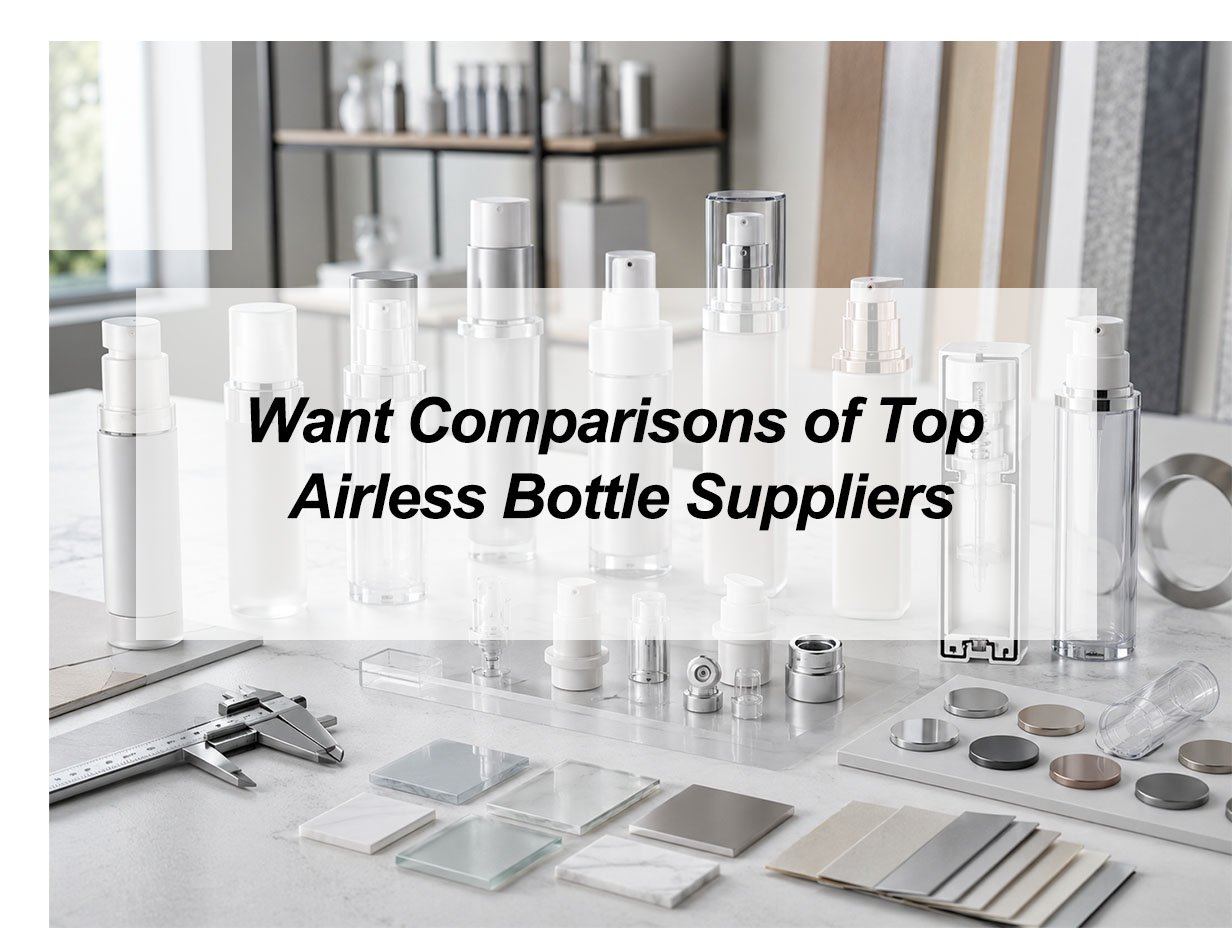
Choosing an airless bottle supplier can feel risky. Many suppliers look similar online, but pump quality, material choices, MOQ, lead time, and support can be very different.
Top airless bottle suppliers differ by technology, market position, sustainability options, decoration ability, and project flexibility. Aptar, Lumson, Silgan, APC Packaging, Quadpack, HCP Packaging, Yonwoo, Baralan, Amcor, and Berlin Packaging/Raepak each fit different buyer needs. The best choice depends on formula type, brand level, order volume, refill goals, and quality control requirements.
I would not choose an airless bottle supplier only by catalog photos. I would compare the pump system, formula protection, material structure, decoration options, recyclability, sample support, MOQ, mold cost, testing process, and export experience. Airless packaging is technical packaging. A beautiful bottle can still fail if the pump output is unstable, the piston does not move smoothly, or the formula cannot pass compatibility testing.
What Should Buyers Compare Before Choosing an Airless Bottle Supplier?
A cheap airless bottle can become expensive if it leaks, dispenses poorly, or delays a product launch. The first comparison should always be technical.
Buyers should compare airless bottle suppliers by pump performance, formula compatibility, evacuation rate, material type, refill options, decoration quality, MOQ, lead time, testing support, and document reliability. Price matters, but it should not be the only factor. A weak pump or unstable supplier can damage both the product and the brand.
I Start With the Formula, Not the Bottle Shape
When I compare suppliers, I begin with the formula. A light serum, thick cream, sunscreen, foundation, eye cream, and gel lotion may not use the same pump system. Some formulas are sensitive to air. Some are sensitive to metal parts. Some need strong dosage control. Some need a soft actuation feel because the product is used every day.
Airless bottle suppliers are not equal here. Some companies are stronger in pump engineering. Some are stronger in luxury glass. Some are stronger in sustainable plastic systems. Some are better for standard stock packaging. Some are more flexible for small and medium brands.
Key Comparison Table
| Comparison Point | Why It Matters | What I Would Ask |
|---|---|---|
| Pump output | Different formulas need different dosage levels | What is the pump dosage per stroke? |
| Formula compatibility | Some formulas react with materials or pump parts | Can you support compatibility testing? |
| Evacuation rate | Higher evacuation reduces product waste | What percentage of product can be dispensed? |
| Material structure | Mono-material, PCR, PP, PET, glass, and aluminum affect cost and recycling | What are all components made from? |
| Refill design | Refill systems only work if they are easy to use | Can customers replace the refill cleanly? |
| Decoration | Surface finishing affects brand image and recyclability | What decoration methods are stable for this material? |
| MOQ | MOQ decides whether the supplier fits the project scale | What is the MOQ for stock and custom colors? |
| Lead time | Delays can affect filling and launch windows | What is the realistic production lead time? |
| Testing | Airless packaging needs more testing than simple bottles | Do you test leakage, drop, vacuum, and pump life? |
| Documents | Export buyers need real documents, not vague claims | Can certificates and reports be verified? |
My First Buyer Rule
I would never approve an airless bottle only after seeing a photo. I would request samples, test the pump with the real formula, check the filling method, and review the decoration sample under normal light. I would also test the bottle after shipping movement. Airless packaging may look fine at first, but problems can appear after storage, temperature change, or repeated use.
The strongest suppliers usually explain limits clearly. They do not only say “yes.” They tell me which formula is risky, which decoration may peel, which material may not support a claim, and which pump is better for the product. That type of honesty is valuable.
Which Top Airless Bottle Suppliers Are Best for Different Buyer Needs?
The best supplier is not the same for every brand. A luxury skincare brand, a dermocosmetic brand, and a startup private-label brand may need different partners.
Aptar is strong for global performance and recyclable airless systems. Lumson and Baralan are strong for luxury glass airless. Silgan and Yonwoo are strong in pump engineering. APC Packaging is useful for refillable and PCR projects. Quadpack and HCP Packaging are strong for beauty-focused design, decoration, and complete packaging support.
Supplier Comparison Overview
| Supplier | Best For | Main Strength | Watch Before Ordering |
|---|---|---|---|
| Aptar Beauty | Premium skincare, dermocosmetics, global brands | Strong airless technology, recyclable systems, PCR options, broad product range | MOQ, project structure, and pricing may fit larger or premium projects better |
| Lumson | Luxury skincare, refillable glass airless | Glass airless, pouch technology, premium refill systems | Better for high-end projects than low-cost mass lines |
| Silgan Dispensing | Brands needing advanced pump engineering | Dispensing systems, precise dosing, formula protection, airless pump innovation | Confirm full-pack bottle options and decoration support |
| APC Packaging | Sustainable custom airless, refillable projects, US-market brands | All-PP airless, PCR options, refillable systems, custom support | Confirm tooling cost, MOQ, and custom lead time |
| Quadpack | Sustainable beauty brands and mid-to-premium projects | Global cosmetic packaging support, airless expertise, decoration and design | Confirm production region and item-specific lead time |
| HCP Packaging | Skincare and complexion brands needing decoration | Affinity Airless range, premium finishes, accurate dosage | Public range focuses on selected sizes |
| Yonwoo | Korean airless pump technology and skincare packaging | Long airless pump experience and strong IP base | Confirm communication, export process, MOQ, and customization details |
| Baralan | Prestige glass airless packaging | Italian glass packaging and luxury airless-in-glass systems | Glass cost, weight, and breakage testing need attention |
| Amcor / Berry | Large-scale beauty and personal care programs | Large packaging group, material science, new airless innovation | Confirm regional availability and exact beauty airless format |
| Berlin Packaging / Raepak | Stock sourcing and broader packaging options | Broad beauty packaging sourcing, pumps, dispensers, airless bottles | Verify original manufacturer and long-term supply stability |
My Practical Ranking by Project Type
| Buyer Need | Suppliers I Would Compare First |
|---|---|
| Safest global airless choice | Aptar Beauty, Silgan Dispensing |
| Luxury glass airless | Lumson, Baralan |
| Refillable airless | Lumson, APC Packaging, Aptar Beauty |
| Mono-material or PCR airless | Aptar Beauty, APC Packaging, Silgan Dispensing |
| Strong pump engineering | Silgan Dispensing, Yonwoo, Aptar Beauty |
| Premium decoration | HCP Packaging, Lumson, Quadpack |
| Flexible sourcing support | APC Packaging, Quadpack, Berlin Packaging/Raepak |
| Large global program | Aptar Beauty, Silgan, Amcor, Quadpack |
I would use this table as a shortlist, not as a final decision. A supplier can be excellent in one airless category and less suitable in another. For example, a luxury glass supplier may not be the best choice for a low-cost 100ml lotion. A pump specialist may not offer the exact outer bottle design a brand wants. A flexible supplier may offer strong customization, but the buyer still needs to test the pump carefully.
The best process is to select three to five suppliers, request samples with the real formula, ask for a clear quotation, compare decoration options, check testing documents, and confirm production timing. I would also ask whether the supplier can keep the same component quality for repeat orders. Consistency matters more than one perfect sample.
How Do Airless Bottle Suppliers Differ by Technology, Material, and Sustainability?
Many suppliers talk about sustainability, but the details are not the same. A refillable glass bottle, an all-PP airless bottle, and a PCR airless bottle solve different problems.
Airless bottle suppliers differ through pump design, piston or pouch systems, metal-free pathways, mono-material structures, PCR content, glass refill systems, and recyclability claims. A buyer should not treat all sustainable airless packaging as equal. Each solution has different cost, recycling, formula, and user-experience trade-offs.
Aptar: Strong Recyclability and Airless System Range
Aptar is a strong option when a buyer needs proven airless technology and sustainability direction. Its Future Airless PET combines a PET bottle-in-bottle system with a polyethylene pump, and the bottle-in-bottle can be made fully from rPET while the metal-free pump can contain PCR. Aptar also lists airless systems such as Mezzo and Micro, with options related to recyclability, PCR, organic/natural cosmetic standards, and multiple capacities.
For a dermocosmetic or premium skincare project, I would put Aptar on the shortlist because the company has strong dispensing know-how. I would still confirm MOQ, lead time, sample availability, and regional production before making a final decision.
Lumson and Baralan: Luxury Glass and Airless Experience
Lumson is strong when the brand wants premium airless packaging with a luxury feeling. Its XTAG refillable airless glass system uses pouch technology and comes in 15ml and 30ml sizes. This type of packaging fits high-value skincare, eye care, and prestige formulas. Baralan also focuses on premium glass packaging and airless-in-glass systems, so I would compare it when glass quality and luxury positioning matter.
The trade-off is cost and operational complexity. Glass airless can look beautiful, but it needs careful filling tests, drop tests, logistics planning, and weight calculation. I would not choose glass only because it looks premium. I would choose it when the product price and brand story can support it.
APC, Silgan, and HCP: Practical Performance Options
APC Packaging is useful when buyers want refillable and PCR options with more project flexibility. Its refillable airless system can use high PP PCR content by package weight and is available in 30ml and 50ml versions. Its AWP all-PP airless series can also use PP PCR.
Silgan is strong in dispensing engineering. Its DNA 35ERA airless system is positioned around formula protection, smooth actuation, polyolefin stream recyclability, and strong product evacuation. HCP Packaging is strong for beauty packaging decoration and selected airless bottle formats. Its Affinity Airless range is available in 15/20ml, 30ml, and 50ml sizes and focuses on sensitive skincare protection, accurate dosage, product evacuation, and decoration options.
Technology Comparison
| Technology Direction | Best Supplier Examples | Best Use |
|---|---|---|
| PET recyclable airless | Aptar | Premium skincare, larger sustainability programs |
| Glass airless with refill | Lumson, Baralan | Luxury skincare and prestige product lines |
| All-PP airless | APC Packaging, Silgan | Brands seeking simpler material structures |
| Pump engineering | Silgan, Yonwoo, Aptar | Sensitive formulas and high-use products |
| Decoration-focused airless | HCP Packaging, Quadpack, Lumson | Beauty brands needing strong shelf appeal |
| Flexible refillable system | APC Packaging, Lumson | Brands building repeat purchase and lower-waste stories |
My view is simple. Sustainability must be matched with real use. If customers will not buy refills, a refill system may not reduce much waste. If a package is technically recyclable but not accepted in the target market, the claim becomes weak. If PCR affects color, strength, or decoration, the buyer must accept that trade-off early. Good suppliers explain these points before production starts.
My insights: What Questions Should Buyers Ask Before Placing an Airless Bottle Order
A supplier comparison is useful, but the final order still depends on detailed questions. Many sourcing problems happen because buyers do not ask enough before paying the deposit.
Before placing an airless bottle order, buyers should ask about pump output, material composition, formula testing, leakage testing, decoration stability, MOQ, lead time, mold ownership, certificate authenticity, and after-sales responsibility. A clear question list reduces risk and helps buyers compare suppliers in a fair way.
My Airless Bottle Supplier Question List
| Question | Why I Ask It |
|---|---|
| What formula types has this pump already been used for? | Past use can show whether the system fits similar products |
| What is the exact pump output? | Dosage affects product experience and customer satisfaction |
| What is the evacuation rate? | Poor evacuation leaves product inside and creates complaints |
| Is the pump metal-free? | Some formulas and recycling goals may require this |
| What are the bottle, piston, pump, spring, cap, and overcap materials? | Full material details matter for compatibility and claims |
| Can this item use PCR? | PCR can support sustainability goals, but quality must be checked |
| Can this item be mono-material? | Mono-material structures can simplify recycling claims |
| What decoration methods are safe for this bottle? | Some finishes may scratch, peel, or affect recyclability |
| What is the MOQ for stock color, custom color, and private mold? | MOQ changes the real project cost |
| What tests are included before shipment? | Leakage, vacuum, pump, drop, and compatibility tests reduce risk |
| Can documents be verified? | Fake or weak documents can create export and brand risks |
| What happens if pumps fail after filling? | Responsibility must be discussed before production |
How I Would Make the Final Decision
I would first divide suppliers into three groups. The first group is high-performance global suppliers. This group includes Aptar, Silgan, Lumson, and Quadpack. I would use them when the project needs stronger engineering, premium image, and global support.
The second group is sustainability and customization suppliers. This group includes APC Packaging, HCP Packaging, and some specialized regional suppliers. I would use them when the project needs refillable designs, PCR, strong decoration, or flexible custom support.
The third group is stock and sourcing support suppliers. This can include Berlin Packaging/Raepak and qualified factories in China, Korea, Europe, or the US. I would use this group when speed, cost, or broad sourcing choice matters. However, I would inspect samples more carefully because the quality can vary by original manufacturer.
I would not let price decide everything. A lower unit price can be good, but only if the pump is stable and the supplier can repeat quality. If a supplier gives unclear answers about material, testing, or certificates, I would slow down. Airless packaging carries more risk than a simple jar or bottle.
The best airless bottle supplier is the one that matches the formula, protects the product, supports the launch schedule, and communicates clearly. That supplier may not always be the most famous one. It is the one that can prove performance before mass production.
Conclusion
Top airless bottle suppliers should be compared by performance, sustainability, decoration, flexibility, and risk control. The right supplier depends on the formula and launch plan.