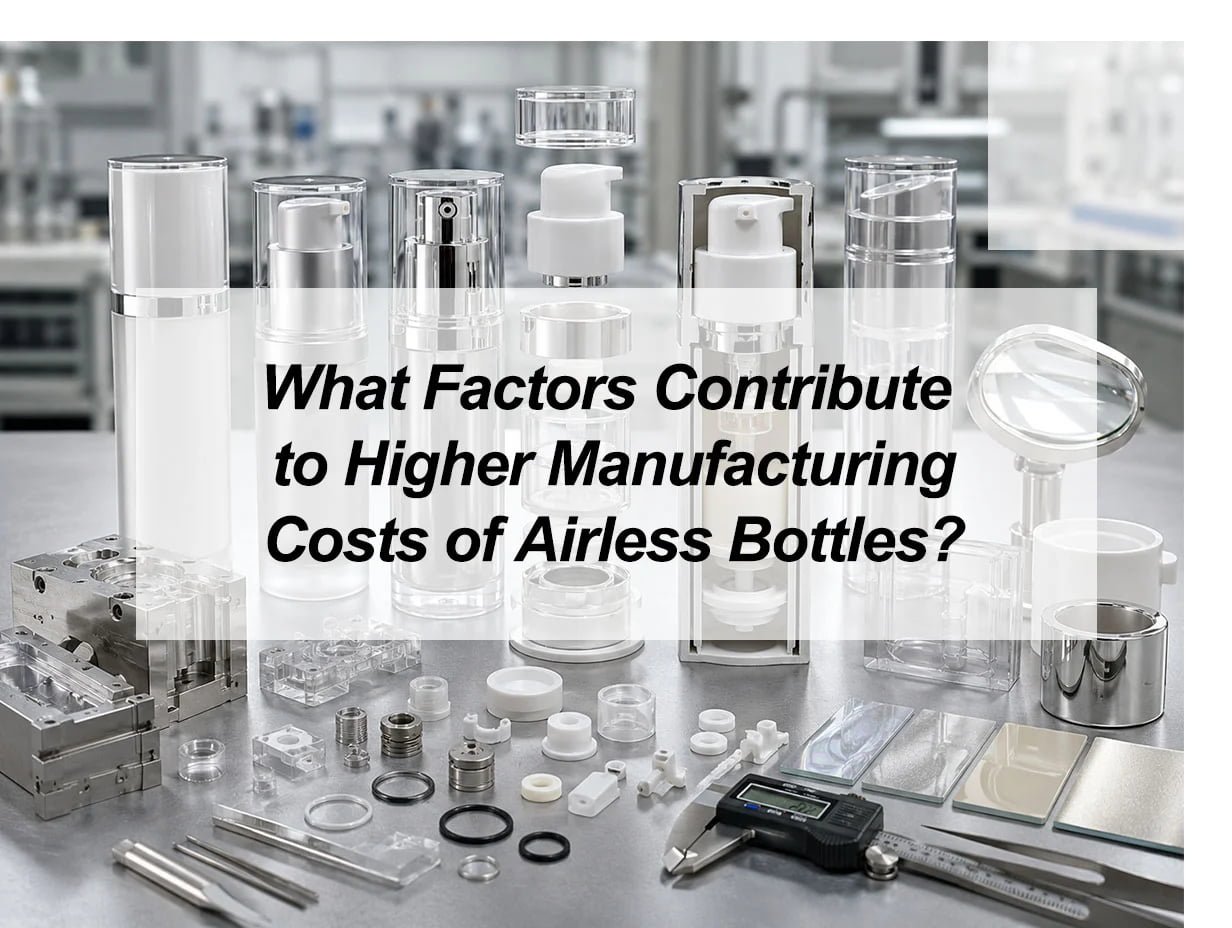
Airless bottles look simple from the outside. But inside, they need tighter engineering, more parts, more testing, and better control than standard cosmetic bottles.
The main factors that contribute to higher manufacturing costs of airless bottles are complex pump structures, precision molds, piston or pouch systems, stricter sealing requirements, material quality, decoration processes, refillable designs, formula compatibility testing, and higher quality control standards. These costs are higher because airless bottles must protect formulas while dispensing product smoothly and consistently.
I do not see airless bottles as only a packaging style. I see them as a small dispensing system. That is why the cost is different from a basic bottle, jar, or tube. A normal bottle mainly stores product. An airless bottle stores product, protects it from air exposure, controls dosage, supports a vacuum effect, and helps the user dispense more of the formula. This extra function creates extra cost.
Why Are Airless Bottles More Expensive Than Traditional Bottles?
Many buyers compare an airless bottle with a normal pump bottle and only look at the outer shape. That can lead to a wrong cost expectation.
Airless bottles are more expensive than traditional bottles because they need a pump engine, piston or pouch structure, airtight sealing, precise component matching, and extra assembly work. A traditional bottle can use a simpler dip tube pump, while an airless bottle must create pressure and movement inside the container without allowing air to flow back into the product.
Airless Bottles Are Functional Systems
A traditional bottle usually has a bottle body, cap, pump, dip tube, and sometimes an overcap. The structure is easier to mold and assemble. The pump pulls product through the dip tube, and air can often enter the bottle as product is used.
An airless bottle is more complex. It may use a piston at the bottom or an inner pouch inside the bottle. When the user presses the pump, the piston moves upward or the pouch collapses. This movement pushes the formula toward the pump without allowing normal air exchange inside the product chamber. The bottle must keep this movement smooth and controlled.
This structure adds cost because every part must work together. The pump must match the formula. The piston must match the bottle wall. The sealing area must be accurate. The actuator must feel smooth. The bottle must not leak during shipping or storage.
Traditional Bottle vs Airless Bottle
| Cost Area | Traditional Bottle | Airless Bottle |
|---|---|---|
| Main function | Store and dispense product | Store, protect, and dispense product with airless action |
| Internal structure | Usually simple dip tube system | Piston, pouch, or vacuum-style system |
| Mold precision | Moderate | Higher precision needed |
| Assembly steps | Fewer | More |
| Testing needs | Basic leakage and appearance checks | Leakage, pump output, vacuum, piston movement, and evacuation checks |
| Formula protection | Lower to moderate | Higher |
| Unit cost | Usually lower | Usually higher |
The Cost Comes From Risk Control
I think the biggest cost difference comes from risk control. Airless packaging is often used for active skincare, premium lotion, eye cream, sunscreen, foundation, and sensitive formulas. These products usually need better protection and more stable dispensing. If the pump fails, the whole product experience fails.
A simple bottle failure may mean a loose cap or small leakage problem. An airless bottle failure can mean no dispensing, uneven dosage, trapped product, pump blocking, weak vacuum, or customer complaints after launch. So the supplier must invest more in tooling, testing, assembly, and inspection.
This is why airless bottles usually fit mid-range and premium products better than very low-cost product lines. The buyer pays more, but the package can protect the formula better, support a cleaner user experience, and make the product feel more advanced.
How Do Mold Precision and Component Design Increase Airless Bottle Costs?
The outer shape of an airless bottle may look clean and simple. The hidden cost is often inside the mold and component tolerance.
Mold precision increases airless bottle costs because the pump, piston, bottle wall, shoulder, actuator, and sealing parts must match with tight tolerances. If one part is slightly inaccurate, the bottle may leak, lose vacuum, dispense unevenly, or leave product trapped inside. Precision engineering takes more tooling time, testing, and production control.
Precision Matters More Than Appearance
When I look at an airless bottle sample, I do not only check whether it looks good. I check whether the piston moves evenly, whether the pump returns smoothly, whether the actuator feels stable, and whether the bottle dispenses after repeated pressing. These small details depend on mold accuracy.
The inner wall of the bottle must be smooth enough for the piston to move. The piston lip must seal well enough to maintain pressure. The pump chamber must deliver a stable output. The neck and collar must close tightly. The actuator must press down and return without sticking. These requirements make the mold more demanding than a simple cosmetic bottle mold.
Main Cost Drivers in Component Design
| Component | Why It Adds Cost |
|---|---|
| Pump engine | It controls dosage, suction, return force, and dispensing feel |
| Piston | It must seal tightly but still move smoothly |
| Inner pouch | It needs material compatibility and collapse control |
| Bottle wall | It needs smoothness, strength, and accurate inner dimensions |
| Actuator | It affects comfort, appearance, and dosage control |
| Collar and shoulder | They support sealing and assembly stability |
| Cap or overcap | It protects the actuator and adds brand appearance |
| Refill cartridge | It adds extra mold, locking design, and user testing |
Small Errors Can Create Big Problems
A small dimensional error can create a big functional problem. If the piston is too tight, it may not move smoothly. If it is too loose, it may lose sealing performance. If the pump output is not stable, the user may get too much or too little product. If the bottle wall is not smooth enough, product evacuation may be poor.
This is why the mold cost and sampling process are higher. The supplier may need several mold trials before mass production is stable. Custom airless bottles cost even more because the supplier cannot rely only on an existing mold. Custom shapes, custom capacities, special caps, and unique actuators all increase engineering work.
I would tell buyers to be careful with very low-priced custom airless offers. If the supplier cuts too much cost from tooling or inspection, the problem may appear after filling. At that stage, the loss is much higher than the money saved on packaging.
How Do Materials and Sustainability Requirements Affect Airless Bottle Costs?
Material cost is not only about plastic price. For airless bottles, material choice affects pump performance, formula safety, decoration quality, recycling claims, and brand positioning.
Materials increase airless bottle manufacturing costs because suppliers may need high-quality PP, PET, PCR plastic, glass, aluminum, or special barrier structures. Sustainable options such as mono-material designs, PCR content, refillable systems, and metal-free pumps can also increase development cost because they require testing, stable sourcing, and careful component matching.
Better Materials Are Often Needed
Airless bottles often contain skincare formulas with active ingredients. These formulas can include vitamin C, retinol, peptides, acids, sunscreen filters, botanical extracts, and preservative-light systems. The packaging material must protect the product and avoid unwanted reactions. This can require better plastic grades, stronger testing, and more careful supplier control.
PP and PET are common choices. PP is often used for pumps, pistons, caps, and some airless bottle systems. PET can be useful for clear or premium-looking bottles. Glass is often used for luxury skincare. Aluminum may be used for premium or special positioning. Each material changes the cost structure.
PCR materials can also increase complexity. PCR content may support sustainability goals, but it can affect color, surface finish, smell, strength, and processing stability. The supplier needs to control batch consistency. This adds work.
Sustainability Options and Cost Impact
| Sustainability Direction | Why It Can Cost More |
|---|---|
| PCR plastic | Material supply and color consistency can be harder to control |
| Mono-material design | The pump and bottle must be redesigned to reduce mixed materials |
| Metal-free pump | It may require different spring or actuator engineering |
| Refillable airless | Extra cartridge, locking structure, and user testing are needed |
| Glass airless | Higher material cost, more weight, and more breakage control |
| Lightweight design | Wall thickness must be reduced without hurting strength |
| Recyclable decoration | Coating, label, and finish choices must be more controlled |
Refillable Systems Add More Than One Cost Layer
Refillable airless packaging can look attractive, but it is not automatically cheaper. It usually needs a durable outer bottle, replaceable inner cartridge, locking mechanism, and easy refill operation. The outer pack must survive repeated use. The refill must be clean and simple. The mechanism must not feel weak.
This means more parts, more molds, more assembly steps, and more user testing. The first production cost can be higher than a single-use package. The value may appear over repeat purchases, not in the first unit cost.
I believe sustainable airless packaging should be evaluated with total logic. A PCR airless bottle may be suitable for one brand. A refillable glass airless bottle may suit another. An all-PP airless bottle may work better for a third brand. The best choice depends on formula, price point, market, recycling system, and customer behavior.
How Do Decoration, MOQ, and Quality Control Add to the Final Cost?
Some buyers think the bottle structure is the only reason airless bottles cost more. But the final cost often grows during decoration, sampling, inspection, and order planning.
Decoration, MOQ, and quality control add to airless bottle costs because premium finishes need extra processes, custom colors require setup, low order quantities spread tooling costs across fewer units, and airless bottles need stricter tests before shipment. The final cost depends on both the technical structure and the buyer’s customization requirements.
Decoration Can Change the Price Quickly
Airless bottles are often used for premium skincare, so buyers usually request better decoration. This may include spraying, matte coating, UV coating, metallization, hot stamping, silk-screen printing, gradient color, anodized parts, soft-touch finish, or custom caps.
Each process adds cost. It also adds risk. A matte coating can scratch. A sprayed color can vary by batch. A metallic finish can show defects. Hot stamping must align correctly. Printing must survive handling. When the decoration standard is high, the rejection rate can rise. The supplier must spend more time checking appearance.
MOQ and Customization Cost
MOQ has a strong effect on unit cost. If a buyer orders a low quantity, the supplier still needs to prepare material, adjust machines, match color, test decoration, and arrange assembly. These setup costs are spread across fewer bottles, so the unit price becomes higher.
Custom airless projects cost more than stock items. A stock mold can reduce cost and sampling time. A private mold gives a unique shape but adds tooling cost, mold trial cost, design risk, and longer lead time.
| Cost Factor | Why It Raises Unit Cost |
|---|---|
| Custom color | Requires color matching and batch control |
| Custom mold | Requires tooling, trial molds, and engineering work |
| Low MOQ | Setup costs are spread across fewer units |
| Premium finish | Adds process steps and inspection needs |
| Multiple decoration methods | Increases handling and defect risk |
| Special cap or actuator | Adds mold and assembly complexity |
| Strict AQL standard | Requires more inspection time |
| Export packaging | Adds carton strength, protection, and documentation |
Quality Control Is Not Optional
Airless bottles need more testing than simple bottles. A good supplier may test leakage, vacuum performance, pump output, piston movement, product evacuation, drop resistance, cap fitting, and decoration stability. For important projects, formula compatibility testing is also needed.
This quality control costs money, but it prevents bigger losses. If a pump fails after filling, the buyer may lose the packaging cost, formula cost, filling cost, labor cost, shipping cost, and launch timing. That is why I see testing as a necessary part of the cost, not an extra service.
I would rather pay a fair price for stable airless packaging than choose the cheapest supplier and face problems after production. The right question is not only “Why is this bottle expensive?” The better question is “Which cost protects my product, and which cost is only decoration?”
My insights: What Factors Contribute to Higher Manufacturing Costs of Airless Bottles
Airless bottles cost more because they are not simple containers. They are small dispensing systems that need precision, protection, and stable performance.
The higher manufacturing cost of airless bottles comes from complex pump engineering, precision molds, piston or pouch systems, airtight sealing, premium materials, refillable structures, decoration processes, formula compatibility testing, and stricter quality control. These costs rise because airless bottles must protect sensitive formulas while delivering smooth, clean, and consistent dispensing.
The Real Cost Comes From Function, Not Just Appearance
When I compare airless bottles with traditional cosmetic bottles, I do not only look at the outside shape. A standard bottle mainly stores product. An airless bottle must store product, protect it from air exposure, control dosage, reduce contamination risk, and help users dispense more of the formula. This extra function requires more parts and tighter production control.
The pump must work smoothly. The piston or pouch must move correctly. The bottle wall must be accurate. The sealing area must prevent leakage. The actuator must feel stable when pressed. These details may look small, but they all affect the final cost.
| Cost Factor | Why It Raises Manufacturing Cost |
|---|---|
| Pump mechanism | It needs stable dosage, smooth actuation, and reliable return force |
| Piston or pouch system | It creates the airless effect and must move or collapse correctly |
| Precision molds | Inner dimensions must be accurate to prevent leakage or pump failure |
| Airtight sealing | The package must protect sensitive formulas from air exposure |
| Premium materials | PP, PET, PCR, glass, or aluminum must match formula and brand needs |
| Refillable design | Extra cartridges, locking structures, and user testing are required |
| Decoration process | Spraying, hot stamping, matte coating, and metallization add steps |
| Quality control | Leakage, vacuum, pump output, drop, and compatibility tests are needed |
In my view, the higher cost is reasonable when the product has real value to protect. Airless bottles are suitable for active skincare, eye cream, serum, foundation, sunscreen, and premium lotion. These products often need cleaner dispensing and better formula protection. A cheaper bottle may reduce packaging cost at first, but it can create bigger losses if the pump fails after filling. So the real question is not only why airless bottles cost more. The better question is whether the extra cost protects the formula, improves the user experience, and supports the product’s market position.
Conclusion
Airless bottles cost more because they combine packaging, pump engineering, formula protection, decoration, and testing. The higher cost is justified when performance protects the product value.