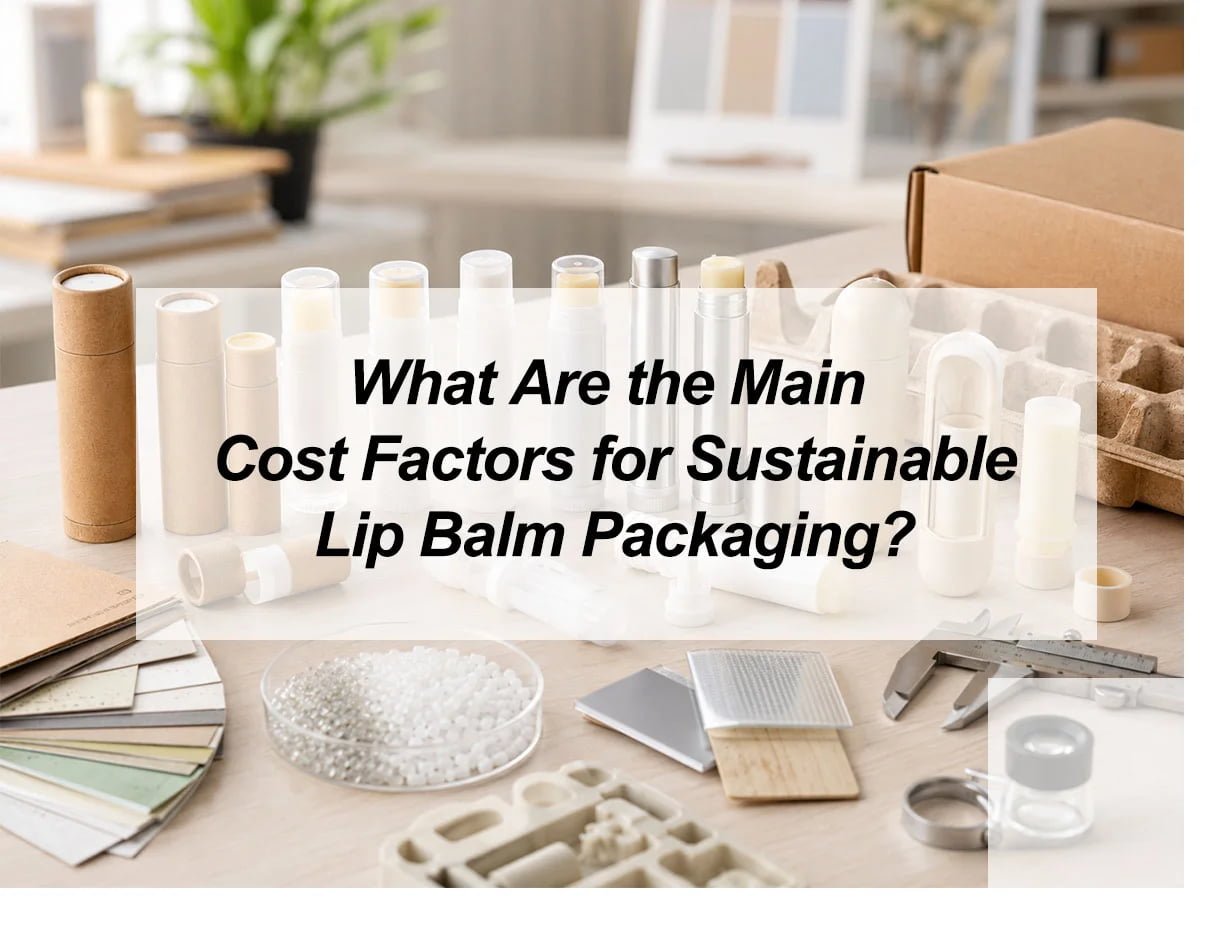
Sustainable lip balm packaging seems easy to choose. Then the details appear: material price, oil resistance, decoration, MOQ, testing, and shipping cost.
The main cost factors for sustainable lip balm packaging are material selection, structure complexity, barrier performance, tooling, MOQ, decoration, refill design, certification, quality testing, and logistics. Paper tubes, PCR plastic tubes, aluminum tubes, mono-material tubes, and refillable cases each have different cost logic. The best choice depends on formula, brand level, order size, and sustainability goal.
I would not compare sustainable lip balm packaging by unit price alone. Lip balm packaging is small, but it touches the formula, the user’s lips, the brand image, and the sustainability claim. A cheap tube can become expensive if it stains, cracks, melts, jams, leaks, or does not match the formula. A higher-cost tube can be worth it when it protects the balm, supports the brand story, and reduces sourcing risk.
Why Does Material Choice Affect Sustainable Lip Balm Packaging Cost?
Many buyers start by asking for “eco-friendly lip balm tubes.” That request sounds clear, but it can mean paper tubes, PCR plastic, aluminum, refillable cases, bio-based plastic, or mono-material packaging.
Material choice affects sustainable lip balm packaging cost because each material has different raw material pricing, processing needs, decoration limits, barrier performance, and recycling value. Paperboard, PCR plastic, aluminum, and refillable materials can all support sustainability, but they do not cost the same or solve the same packaging problem.
Paper Tubes Are Not Just Paper
Paper lip balm tubes often look simple. But a good paper tube needs more than rolled cardboard. The tube must hold its shape. It must push product smoothly. It must resist oil migration from the balm. It must not deform too easily in a bag or pocket. It must also look clean after printing.
That means paper tubes may need thicker board, better glue, tighter rolling, a liner, coating, or a more careful edge finish. These details raise cost. If the paper tube is too cheap, the customer may feel friction when pushing the balm up. The tube may also stain if the formula is oily.
PCR Plastic Has a Different Cost Logic
PCR plastic can reduce virgin plastic use, but it can be harder to control than standard plastic. The color may vary. The smell may need checking. The strength may change by batch. The surface may not always match a premium beauty look. Suppliers need better sourcing and material control, so the cost can rise.
PCR is useful when the brand wants a familiar lip balm tube shape with a lower virgin plastic story. It can fit mass-market and mid-range lip care. But buyers should confirm the PCR percentage, material grade, color stability, and whether the supplier can repeat the same quality across orders.
Aluminum Feels Premium, But It Has Trade-Offs
Aluminum lip balm packaging can feel modern, durable, and recyclable. It can also support a premium look. But aluminum usually costs more than standard plastic. It may need special tooling, surface treatment, anodizing, printing, or inner components. It can also increase shipping weight compared with light plastic tubes.
| Material Option | Main Cost Driver | Best Fit |
|---|---|---|
| Paperboard tube | Board quality, liner, coating, printing, oil resistance | Plastic-free or natural-positioned brands |
| PCR plastic tube | PCR supply, color control, testing, processing stability | Brands wanting lower virgin plastic use |
| Aluminum tube or case | Metal cost, tooling, surface treatment, weight | Premium lip care and refillable concepts |
| Bio-based plastic | Material price, certification, performance testing | Brands needing a plastic-like function with renewable input |
| Mono-material plastic | Design adjustment and component simplification | Brands focused on recyclability claims |
| Refillable case | Durable outer case, cartridge fit, user testing | Premium or loyalty-driven lip balm lines |
I usually compare materials by total project logic. A paper tube may support a strong sustainability story, but it must survive the balm formula. A PCR tube may be practical, but it must look clean. Aluminum may be premium, but it must fit the brand price. A refillable case may reduce waste over time, but customers must want to buy refills.
How Do Structure, Tooling, and MOQ Increase Lip Balm Packaging Cost?
The shape of lip balm packaging looks small, but the structure can be more complicated than buyers expect. A small tube still needs precise movement and reliable closure.
Structure, tooling, and MOQ increase lip balm packaging cost because push-up tubes, twist-up mechanisms, refill cartridges, custom caps, and special shapes need molds, machine setup, assembly control, and repeated testing. Low MOQ also raises unit cost because setup, printing, material preparation, and sampling costs are spread across fewer pieces.
Push-Up vs Twist-Up vs Refillable
A paper push-up tube is simple in concept, but it must push the balm smoothly. If the fit is too tight, the customer struggles. If it is too loose, the balm moves or falls. The inner diameter must match the fill weight and formula shrinkage.
A twist-up plastic tube needs a screw mechanism, base, inner cup, cap, and body. This adds components and assembly steps. A refillable lip balm case adds even more structure. It needs a durable outer case, refill insert, locking system, and easy replacement experience.
Tooling Matters Even for Small Packaging
Custom lip balm packaging may need new molds, dies, printing plates, cutting tools, or assembly fixtures. A simple stock tube keeps cost lower. A custom shape, custom diameter, magnetic cap, special refill cartridge, or unique applicator raises development cost.
MOQ also matters. If the buyer orders a small quantity, the supplier still needs to prepare materials, adjust machines, match colors, print samples, and check quality. These fixed costs do not disappear. They are just divided across fewer pieces.
| Structure Choice | Cost Impact |
|---|---|
| Stock paper push-up tube | Lower tooling cost, but limited custom shape options |
| Custom paper tube size | Higher setup cost and possible new tooling |
| Standard plastic twist-up tube | Stable cost and mature production |
| PCR plastic twist-up tube | Higher material control and testing cost |
| Aluminum case | Higher tooling and surface treatment cost |
| Refillable lip balm case | Higher design, mold, assembly, and user testing cost |
| Custom cap or shape | Higher mold cost and longer development time |
The Hidden Cost Is Development Time
I think many buyers underestimate development time. Sustainable packaging often needs more back-and-forth than normal packaging. The supplier may need to adjust paper thickness, printing, coating, cap tightness, or filling compatibility. If the balm formula is soft, oily, tinted, or heat-sensitive, testing becomes more important.
This is why the cheapest sample is not always the best choice. A supplier with better tooling and structure control may cost more, but it can reduce launch risk. For lip balm, the product is used many times and often carried in pockets, bags, cars, and warm places. The structure must work under real conditions.
Why Do Decoration, Certification, and Compliance Add Cost?
Sustainable lip balm packaging must look good and prove its claim. That means printing, finishing, certification, labeling, and documentation can become major cost areas.
Decoration, certification, and compliance add cost because sustainable lip balm packaging often needs FSC paper, recycled-content proof, compostability claims, clear recycling labels, safe inks, low-impact coatings, supplier documents, and export-ready packaging information. Premium finishes can also increase rejection rates and production steps.
Decoration Can Help or Hurt Sustainability
Decoration is not only a beauty choice. It can affect recyclability and sustainability claims. A paper tube with heavy lamination, metallic film, or plastic coating may look premium, but it can weaken the environmental story. A plastic tube with full-body labels or dark colors may be harder to recycle in some systems. A metal case with complex mixed-material inserts may be less simple than it appears.
Good decoration balances brand look and material logic. Simple printing, soy-based ink, water-based coating, embossing, debossing, and limited foil can work well for paper tubes. For plastic tubes, clean labels, lighter colors, and fewer mixed materials may support recycling communication.
Certification Costs Are Real
Sustainable claims need proof. If a brand wants to claim FSC paper, recycled content, compostability, or reduced plastic use, it may need documents from the supplier. These documents cost time and money. Some claims also need third-party testing or a chain-of-custody system.
I would not use broad claims like “100% eco-friendly” without proof. Buyers should ask what exactly is sustainable. Is it paper-based? Is it recyclable? Is it compostable only in industrial facilities? Is it made with PCR? Is the cap also sustainable? Is the ink safe? Is the glue compatible with the claim?
| Claim Type | Cost Behind the Claim |
|---|---|
| FSC paper | Certified paper sourcing and document control |
| PCR plastic | Recycled material sourcing and percentage verification |
| Compostable | Material testing and clear disposal instructions |
| Recyclable | Structure design and label clarity |
| Plastic-free | Material substitution and barrier testing |
| Refillable | Extra structure, refill SKU, and customer education |
| Low-waste | Design simplification and packaging reduction |
Compliance Is Becoming More Important
Sustainable packaging is under more review. Buyers selling into strict markets need clearer material information, recycling labels, and claim support. This raises cost because the supplier must provide more detail. It also reduces risk because vague green claims can create customer distrust.
For lip balm packaging, I would check product-contact safety, printing safety, material documents, and recycling or disposal claims. The package is small, but it still sits close to the formula and the customer’s mouth. That makes safety and documentation important.
How Do Testing, Logistics, and Total Project Risk Affect Final Cost?
The final cost of sustainable lip balm packaging is not only the quoted unit price. Testing, shipping, storage, damage rate, and customer complaints can change the real cost.
Testing, logistics, and project risk affect final cost because sustainable lip balm packaging must survive filling, heat, oil exposure, transport, storage, and daily use. Paper tubes, PCR plastic tubes, aluminum cases, and refillable packs each need different checks. A lower unit price is not helpful if the package fails after filling or shipping.
Lip Balm Formulas Create Special Testing Needs
Lip balm formulas often contain oils, waxes, butters, pigments, flavors, or active ingredients. These formulas can soften in heat, shrink after cooling, stain packaging, or leave residue. This is why packaging tests matter.
A paper tube should be checked for oil migration, push-up performance, staining, cap fit, and deformation. A PCR plastic tube should be checked for color stability, odor, strength, and compatibility. An aluminum case should be checked for denting, closure, inner component fit, and surface scratching. A refillable case should be checked for repeated opening and replacement.
Logistics Can Change the Best Choice
A lightweight paper tube may reduce shipping weight, but it can take more space if the walls are thick. Aluminum may be durable, but it can cost more to ship. Glass is usually not common for lip balm, but any heavy premium package increases freight and breakage risk. Plastic is light and efficient, but it may not support the brand’s sustainability goal.
| Risk Area | What to Test |
|---|---|
| Heat resistance | Does the balm leak, soften, or stain the package? |
| Oil resistance | Does the formula migrate into paper or labels? |
| Push-up function | Does the balm move smoothly without breaking? |
| Cap tightness | Does the cap stay on during transport and daily use? |
| Drop resistance | Does the package crack, dent, or deform? |
| Decoration durability | Does printing scratch, peel, or fade? |
| Storage stability | Does the package change after weeks of storage? |
| Refill usability | Can customers replace the refill easily and cleanly? |
Total Cost Is the Better Metric
I would compare sustainable lip balm packaging by total cost, not just unit cost. Total cost includes sample cost, mold cost, printing setup, certification, testing, production rejection, shipping, storage, and possible product loss.
A cheaper paper tube that stains after filling is not cheap. A beautiful aluminum case that exceeds the target retail price is not practical. A refillable case that customers do not reuse may not deliver its sustainability value. A PCR tube with unstable color may cause brand consistency problems.
The best packaging choice is the one that matches the product formula, price point, brand message, and sales channel. Sustainable packaging is not one material. It is a set of trade-offs. Buyers who understand those trade-offs can control cost better and build a stronger lip balm product.
My insights: What Are the Main Cost Factors for Sustainable Lip Balm Packaging
Sustainable lip balm packaging looks small and simple. But the cost changes fast when materials, structure, decoration, compliance, and user experience are considered together.
The main cost factors for sustainable lip balm packaging are material choice, tube structure, MOQ, mold or tooling, decoration method, barrier performance, refillable design, certification, testing, and logistics. Paper tubes, PCR plastic tubes, aluminum tubes, mono-material tubes, and refillable cases all have different cost drivers, so buyers should compare total project cost instead of only unit price.
Sustainable Lip Balm Packaging Costs More When It Must Do More
When I compare sustainable lip balm packaging, I do not only compare paper, plastic, aluminum, or refillable formats. I compare what the packaging must achieve. Lip balm is small, but the formula is often oily, waxy, heat-sensitive, and used directly on the lips. That means the package needs good push-up or twist-up function, clean contact, stable closure, and enough barrier protection.
A paper lip balm tube may look more eco-friendly, but it may need a liner, thicker paperboard, better glue, stronger edge finishing, and more moisture control. A PCR plastic tube may reduce virgin plastic use, but it may bring color variation, supply instability, or stricter material testing. An aluminum tube or case may feel premium and recyclable, but it may increase material cost, tooling cost, and shipping weight. A refillable lip balm case may reduce waste over repeat use, but it needs a stronger outer case, refill cartridge, tighter fit, and better user instructions.
| Cost Factor | Why It Raises Cost |
|---|---|
| Sustainable material | Paperboard, PCR, aluminum, bio-based plastic, or mono-material structures often cost more than standard virgin plastic |
| Barrier performance | Lip balm needs protection from oil migration, heat, moisture, and deformation |
| Tube mechanism | Push-up, twist-up, refillable, and custom shapes need different tooling and assembly |
| Decoration | Foil stamping, embossing, matte coating, labels, and color printing add cost |
| MOQ | Low quantity orders spread setup and printing cost across fewer units |
| Certification | FSC, recycled content, compostability, or supplier audits add verification cost |
| Testing | Heat resistance, leakage, formula compatibility, drop tests, and closure tests are needed |
| Logistics | Heavier or bulkier packaging increases freight and storage cost |
In my view, the real question is not only whether sustainable lip balm packaging is more expensive. The better question is which cost protects the product, supports the brand claim, and improves the customer experience.
Conclusion
Sustainable lip balm packaging costs depend on material, structure, decoration, proof, testing, and logistics. The best option balances sustainability with real product performance.