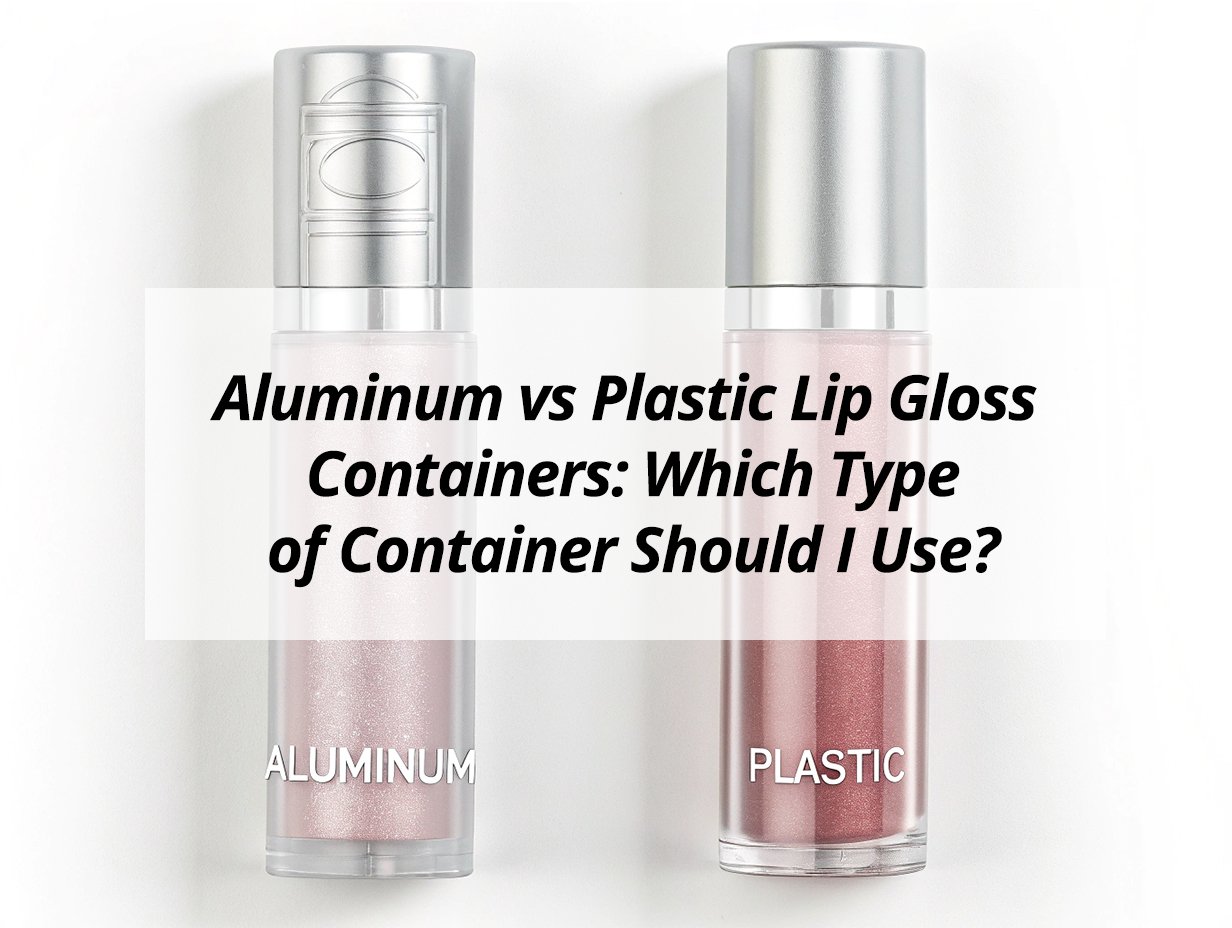
Choosing between aluminum and plastic affects more than appearance. The material changes cost, weight, formula visibility, decoration, consumer experience, shipping, sustainability, and production flexibility.
Choose plastic lip gloss containers when you need lower cost, low weight, formula visibility, broad shape options, and scalable production. Choose aluminum when premium metal feel, opacity, durability, or barrier performance is more important. For many premium products, a clear plastic bottle with an aluminum outer cap offers a practical middle ground.
The right choice depends on what the aluminum or plastic actually does in the complete pack. Buyers should compare the bottle, cap, wiper, applicator, formula, decoration, and recycling route together.
What Are the Main Differences Between Aluminum and Plastic Lip Gloss Containers?
The biggest mistake is comparing “aluminum” and “plastic” as if every lip gloss pack were made from only one material.
Plastic lip gloss packaging can use PET, PETG, PP, ABS, LDPE, and other polymers across the bottle, cap, rod, and wiper. Aluminum is commonly added as an outer cap, collar, or shell. Plastic favors transparency and molding flexibility, while aluminum adds metal feel, opacity, premium decoration, and strong barrier performance when used as the actual container wall.
1. Most Lip Gloss Packs Are Multi-Material Systems
A typical lip gloss package may include:
- bottle;
- wiper;
- cap;
- rod;
- doe-foot applicator;
- decorative shell.
Each component can use a different material.
Aptar's current lip gloss portfolio includes examples combining PETG with ABS, aluminum, PMMA, LDPE, and POM.
HCP also offers a PET bottle with:
- aluminum outer cap;
- LDPE wiper;
- POM rod;
- flocked or molded applicator.
This means a package that looks metallic may still be mainly plastic by weight.
2. Plastic Supports Formula Visibility
PET and PETG are popular because lip gloss is strongly connected to shade.
Consumers may want to see:
- nude color;
- pink tone;
- shimmer;
- glitter;
- clear lip oil;
- pigment density.
A clear package turns the formula itself into part of the branding.
Aptar describes its high-clarity PET and PETG lip gloss formats as designed specifically to showcase the formula.
Aluminum is opaque.
If the entire formula chamber is aluminum, consumers cannot see the shade directly.
3. Aluminum Creates a Different Touch
Aluminum can provide:
- cool touch;
- metallic sound;
- premium appearance;
- smooth anodized finish;
- higher perceived value.
HCP specifically markets aluminum cap options as providing a more luxurious feel or cool touch.
That sensory experience can support premium positioning.
Quick Comparison
| Feature | Plastic | Aluminum |
|---|---|---|
| Formula visibility | Excellent with clear PET/PETG | Opaque |
| Weight | Usually lower | Usually higher for comparable rigid parts |
| Cost | Usually lower | Usually higher |
| Shape flexibility | Very high | More limited by forming process |
| Premium tactile feel | Depends on finish | Strong |
| Barrier | Depends on resin/structure | Excellent when aluminum forms barrier |
| Decoration | Very flexible | Strong premium options |
| Impact behavior | Often resilient | Can dent depending on structure |
| Recycling | Depends on polymer and components | Strong intrinsic recyclability |
| Common lip gloss use | Bottle, cap, wiper, rod | Outer cap, collar, shell |
The final decision should therefore start with the role each material plays.
Which Material Is Better for Lip Gloss Packaging Cost, Weight, and Design?
Plastic normally has the advantage for cost, lightweight construction, transparent packaging, and molded design freedom, while aluminum performs strongly when premium appearance justifies extra material and processing.
Plastic is generally better for cost-sensitive and high-volume lip gloss because injection and blow molding support lightweight components, transparent walls, complex shapes, and extensive decoration. Aluminum is better when the product needs a true metal surface, cool tactile feel, premium positioning, anodized finishes, or a durable outer component that customers perceive as valuable.
1. Plastic Usually Supports Lower Cost
Plastic manufacturing is highly scalable.
Suppliers can produce stock formats in large volumes using:
- injection molding;
- injection blow molding;
- extrusion blow molding.
A beauty brand can often start with:
stock mold + custom color + logo
instead of developing new tooling.
This can reduce:
- development cost;
- lead time;
- MOQ pressure;
- sampling risk.
Aluminum outer components can add:
- metal forming;
- anodizing;
- polishing;
- additional assembly.
Those processes generally increase project cost.
The exact difference depends on:
- package size;
- quantity;
- aluminum thickness;
- finish;
- tooling;
- supplier.
2. Plastic Helps Reduce Shipping Weight
Empty cosmetic packaging occupies a large amount of shipping volume.
Weight still matters for:
- air freight;
- courier samples;
- warehouse handling;
- final product distribution.
Plastic has a natural advantage where lightweighting is the main goal.
However, brands should compare the actual component weights.
A very thin aluminum shell may not create a large difference from a thick luxury plastic cap.
3. Plastic Offers More Transparency Options
Clear PET and PETG can make:
- formula color;
- glitter;
- texture;
- fill level;
visible.
HCP's Fusion Sleek lip gloss uses a thick-wall one-piece PETG bottle designed for crystal-clear appearance and can then be paired with aluminum, paper, or plastic caps.
This is a useful design strategy because the bottle and cap solve different problems.
4. Aluminum Creates Premium Value Quickly
Changing one visible component can reposition the entire package.
For example:
clear PETG bottle + ABS cap
may feel modern and accessible.
The same bottle with:
clear PETG bottle + anodized aluminum cap
can look more premium without changing the formula-contact chamber.
HCP currently uses exactly this kind of selectable cap strategy across several lip gloss ranges.
5. Decoration Is Different
Plastic supports:
- resin coloring;
- spray coating;
- screen printing;
- hot stamping;
- metallization;
- digital printing.
Aluminum can support:
- anodizing;
- screen printing;
- laser engraving;
- coating;
- decorative finishing.
Aptar lists anodizing, metallization, spraying, hot stamping, screen printing, laser engraving, and other options on a lip gloss platform that combines PETG with an aluminum collar.
The better material therefore depends on the intended finish.
Which Material Provides Better Formula Protection?
Aluminum can provide extremely strong barrier performance, but only when the aluminum itself forms a meaningful barrier around the formula.
Aluminum provides an excellent barrier against light, oxygen, and moisture when it surrounds the product. Clear plastic lip gloss bottles sacrifice some of that opacity in exchange for formula visibility. However, many “aluminum” lip gloss packs use only an aluminum outer cap or shell, so the formula protection still depends mainly on the plastic bottle and closure system.
1. Aluminum Is an Excellent Barrier Material
The Aluminum Association identifies aluminum packaging as a complete barrier against:
- light;
- oxygen;
- moisture.
This is valuable for products sensitive to:
- oxidation;
- UV exposure;
- aroma loss.
However, this benefit must be interpreted correctly for lip gloss.
2. An Aluminum Cap Does Not Make the Bottle an Aluminum Barrier
Consider this structure:
- PET bottle;
- LDPE wiper;
- PP rod;
- aluminum outer cap.
The formula is still surrounded mainly by PET.
The aluminum cap improves:
- appearance;
- tactile feel;
- decoration.
It does not suddenly make the transparent PET wall opaque to light.
This distinction matters when making marketing claims.
3. Clear Plastic Can Be Commercially Valuable
Not every lip gloss needs complete light protection.
For many products, formula visibility may create more commercial value.
Examples include:
- clear lip oils;
- tinted gloss;
- glitter formulas;
- color-changing gloss;
- multi-shade collections.
The packaging should still go through formula compatibility testing.
4. The Closure System Matters Too
Barrier material alone does not prevent leakage or evaporation.
The complete system includes:
- neck;
- threads;
- wiper;
- rod;
- cap;
- applicator.
A premium aluminum cap cannot compensate for a badly designed wiper or neck seal.
Aptar emphasizes controlled application, integrated wipers, and leak-resistant construction as central features of its lip gloss packaging systems.
This is why formula protection should be evaluated at package level.
Is Aluminum or Plastic More Sustainable for Lip Gloss Packaging?
Neither material is automatically the sustainable winner. Aluminum has strong recycling properties, while simplified plastic packaging can be lightweight and compatible with established recycling streams.
Aluminum can be repeatedly recycled without losing its fundamental metallic properties, while plastic can reduce package weight and perform well when structures are simplified around compatible polymers. For lip gloss, sustainability depends on total material weight, recycled content, separability, package size, decoration, collection systems, and whether aluminum and plastic components can realistically reach the correct recycling streams.
1. Aluminum Has Strong Material Recycling Value
The Aluminum Association explains that aluminum can be melted and recycled repeatedly without the fundamental degradation that polymers experience during repeated conventional mechanical recycling.
This gives aluminum a strong circular-material story.
But there is a difference between:
recyclable material
and
a package that gets recycled
A tiny aluminum cap attached to:
- plastic threads;
- rod;
- wiper;
may not behave like a simple aluminum can.
2. Plastic Can Be Designed Better for Recycling
RecyClass recommends that plastic packaging be designed around the main polymer and that additional components remain compatible with the relevant recycling stream.
For PP and HDPE packaging, simplified structures and compatible polyolefin components can improve recycling potential.
For PET bottles, closures, labels, colors, and decorations also matter.
This creates an important design principle:
Do not judge plastic only by the word “plastic.” Judge the complete structure.
3. Hybrid Packaging Creates a Trade-Off
A PETG bottle plus aluminum cap may provide excellent aesthetics.
But now the system contains:
- plastic bottle;
- aluminum cap;
- plastic rod;
- LDPE/TPE wiper;
- flocked applicator.
The consumer may need to separate components for different recycling routes.
That may not happen in practice.
4. Package Size Matters
Lip gloss containers are relatively small.
Small packaging can create sorting and collection challenges even when the raw material itself is recyclable.
RecyClass explicitly treats packaging size and sortability as relevant design-for-recycling considerations.
This means brands should avoid broad claims such as:
“100% recyclable because it uses aluminum.”
Actual end-of-life performance depends on the complete design and local infrastructure.
5. EU Rules Increase the Importance of Design-for-Recycling
The EU PPWR generally applies from August 12, 2026. The regulation introduces a framework under which packaging will increasingly need to meet recyclability and circularity requirements, including recyclability performance criteria from 2030.
This makes simplified packaging increasingly important.
Sustainability Comparison
| Question | Aluminum | Plastic |
|---|---|---|
| Can material be recycled repeatedly? | Strong intrinsic advantage | Polymer quality can degrade |
| Lightweight potential | Good | Very strong |
| PCR availability | Recycled aluminum possible | PCR PET/PP/PE possible |
| Mono-material potential | Possible in selected designs | Possible with simplified design |
| Hybrid lip gloss complexity | Often still contains plastic | Can also contain several polymers |
| Collection | Depends on market and size | Depends on polymer, market and size |
| Best sustainability strategy | Reduce parts and enable recovery | Lightweight, simplify, add PCR where suitable |
The strongest package is not necessarily the package with the most expensive material.
It is the package that performs its function with fewer, better-designed components.
When Should a Beauty Brand Choose Aluminum Instead of Plastic Lip Gloss Packaging?
Aluminum becomes more attractive when premium experience, metal touch, opacity, durability, or distinctive decoration creates enough value to justify the added complexity and cost.
Choose aluminum when the lip gloss needs a premium metal feel, anodized decoration, opaque appearance, reusable outer component, or stronger barrier where aluminum actually surrounds the formula. Choose plastic when transparency, lightweighting, lower cost, complex molding, high volume, or broad color customization matters more. A hybrid design can combine both benefits.
Choose Plastic When You Need:
- visible formula color;
- lower unit cost;
- lower weight;
- high production volumes;
- complex molded shapes;
- broad stock options;
- easier shade launches;
- transparent walls.
Plastic is particularly practical for:
mass market + indie brands + trend-led lip gloss + lip oil + large shade ranges
Choose Aluminum When You Need:
- cool metal touch;
- premium positioning;
- anodized metallic finish;
- opaque design;
- durable decorative shell;
- luxury gifting experience;
- reusable outer case strategy.
Aluminum is particularly attractive for:
prestige makeup + luxury collections + limited editions + durable outer packaging
Choose Hybrid Packaging When You Need Both
A hybrid design may use:
clear PET/PETG bottle + aluminum outer cap
This provides:
- visible formula;
- established wiper system;
- lower bottle weight;
- premium cap;
- genuine metal touch.
Aptar and HCP currently offer lip gloss configurations using this type of material combination.
The trade-off is more material complexity.
Product Positioning Guide
| Product Strategy | Better Starting Option |
|---|---|
| Budget lip gloss | Plastic |
| High-volume retail gloss | Plastic |
| Clear lip oil | Clear PET/PETG |
| Shade-driven collection | Clear plastic |
| Luxury gloss | Aluminum accent or hybrid |
| Premium limited edition | Aluminum or hybrid |
| Lightweight travel product | Plastic |
| Strong metallic brand identity | Aluminum |
| Recyclability-first project | Simplified structure; assess full pack |
| Refillable luxury system | Durable aluminum outer pack may be useful |
The correct choice depends on what customers are paying for.
My insights: Aluminum vs Plastic Lip Gloss Containers: Which Type of Container Should I Use
The most useful comparison is not “aluminum versus plastic.” It is which material should perform each function inside the lip gloss package?
For most conventional lip gloss products, I would start with a plastic formula-contact bottle because transparency, weight, cost, molding flexibility, and proven wiper systems make it practical. I would add aluminum only when metal touch, premium positioning, durability, opacity, or a reusable outer component creates clear value that justifies the additional material and cost.
1. Start With Formula Visibility
I would first ask:
Does the customer need to see the lip gloss?
If yes, clear PET or PETG deserves strong consideration.
Formula visibility is especially useful for:
- lip oils;
- shimmer gloss;
- tinted gloss;
- transparent treatments.
If the package is completely opaque aluminum, the brand must communicate shade using:
- label;
- color code;
- window;
- secondary packaging.
2. Decide Whether Aluminum Is Functional or Decorative
This is one of the most important questions.
Is aluminum being used to:
protect the formula
or simply to:
make the cap feel premium?
If it is only the outer cap, I would describe it as a premium aluminum component rather than implying the complete pack has aluminum barrier performance.
3. Compare the Complete Component Structure
I would create a BOM before making a sustainability claim.
For example:
| Component | Hybrid Package |
|---|---|
| Bottle | PET |
| Wiper | LDPE |
| Rod | PP |
| Applicator | Flocked polymer |
| Outer cap | Aluminum |
This is more useful than calling the complete product an “aluminum tube.”
4. Use Plastic for Commercial Flexibility
For brands launching many SKUs, plastic can simplify:
- color changes;
- transparent formats;
- shape selection;
- stock molds;
- sampling;
- volume scaling.
This often makes it suitable for a first launch.
5. Use Aluminum Where Customers Touch the Package
If I want to add premium value without making the whole package metallic, I would focus aluminum on a high-touch component:
- cap;
- collar;
- outer shell.
Customers can immediately feel the material.
That gives aluminum more branding value per gram.
6. Do Not Ignore Dents and Surface Damage
Aluminum can feel premium, but thin aluminum components may:
- dent;
- scratch;
- show fingerprints.
Plastic can also scratch, but it behaves differently under impact.
I would test both options for:
- drop resistance;
- bag abrasion;
- scratching;
- assembly damage.
7. Compare Actual Cost, Not Material Reputation
I would ask suppliers to quote:
Option A: plastic cap
and
Option B: aluminum outer cap
using the same:
- bottle;
- wiper;
- rod;
- applicator;
- decoration area;
- quantity.
This makes the price difference meaningful.
8. Do Not Assume Aluminum Automatically Wins Sustainability
Aluminum has excellent material recycling characteristics.
Plastic can offer lower weight and simpler mono-material opportunities.
A hybrid package can gain premium value but add separation complexity.
I would compare:
- grams of aluminum;
- grams of plastic;
- number of polymers;
- PCR content;
- separability;
- actual local collection.
9. Consider a Premium Hybrid
For many premium lip gloss products, I see a strong commercial logic in:
clear plastic bottle + aluminum cap
The transparent bottle sells the formula.
The aluminum cap sells the premium experience.
Current HCP and Aptar packaging platforms show that this combination is already technically practical in commercial lip gloss systems.
It is not necessarily the best recycling structure, so sustainability still needs separate review.
10. Use a Final Material Selection Checklist
Before choosing aluminum or plastic, I would confirm:
- Formula compatibility tested
- Formula visibility requirement defined
- Target retail price confirmed
- Package weight compared
- Plastic resin confirmed
- Aluminum location confirmed
- Wiper material confirmed
- Rod and applicator confirmed
- Leakage tested
- Cap fit tested
- Drop testing completed
- Decoration tested
- Aluminum denting checked
- Plastic scratching checked
- MOQ compared
- Total cost compared
- Freight impact reviewed
- Recycling structure assessed
- PCR or recycled aluminum options reviewed
- Golden sample approved
For most mainstream lip gloss, plastic remains the practical starting point. For premium products, aluminum can create strong value when it is used strategically rather than simply added because metal sounds more sustainable or luxurious.
Conclusion
Choose plastic for transparency, cost, lightweighting, and flexibility; choose aluminum for premium touch and opacity, or combine both when formula visibility and luxury positioning matter equally.