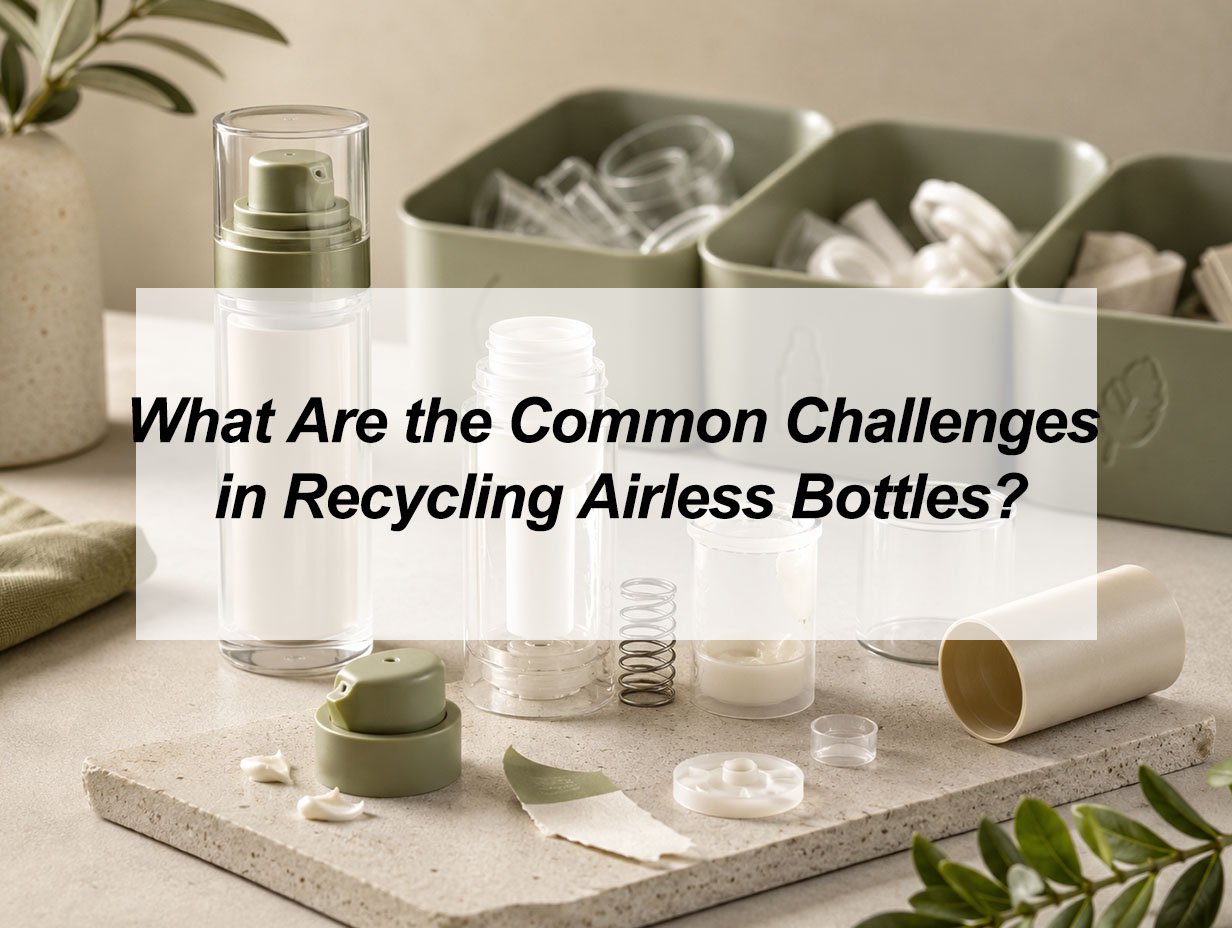
Recycling airless bottles is difficult because pumps, springs, labels, mixed plastics, small sizes, and leftover formula can stop packages from entering a usable recycling stream.
The main recycling challenges for airless bottles are their complex pump structures, mixed materials, metal or glass components, small dimensions, formula residue, dark colors, labels, coatings, and limited collection. Brands can improve recyclability by simplifying components, using mono-material systems, improving product evacuation, reducing decoration, and testing the complete package.
Airless bottle recycling depends on the complete packaging system. A recyclable bottle body is not enough when the pump, spring, piston, label, coating, and remaining formula disrupt sorting or material recovery.
Why Are Airless Bottles Difficult to Recycle?
Airless bottles protect formulas through precise multi-part systems. The same structure that improves dispensing can make sorting, separation, and recycling much harder.
Airless bottles are difficult to recycle because they often combine several plastics with metal springs, glass balls, silicone valves, labels, coatings, and product residue. Recycling facilities must identify the main material, separate incompatible components, clean the package, and create usable recycled resin. Every extra material or component can reduce recovery efficiency.
1. An Airless Bottle Is More Than One Bottle
A simple cosmetic bottle may contain a body, cap, and label. An airless bottle can contain many more parts:
- outer bottle;
- inner bottle or pouch;
- moving piston;
- pump housing;
- actuator;
- dip-free dispensing chamber;
- metal or plastic spring;
- glass or plastic ball;
- valve;
- gasket;
- overcap;
- label or coating.
These parts help create controlled dispensing. They may also protect sensitive formulas from routine air exposure. However, recycling systems do not judge the package only by its cosmetic performance. They judge whether it can be collected, identified, separated, washed, processed, and converted into useful recycled material.
APR explains that packaging design strongly affects recyclability. A component as small as a metal spring inside a dispenser can cause the package to become nonrecyclable.
2. The Main Resin May Be Unclear
An airless bottle may have a PP inner container and a PETG outer shell. The pump may contain PP, PE, silicone, metal, and glass. A cap may use ABS because it provides better rigidity and decoration.
This creates a difficult question: which recycling stream should receive the package?
| Airless Component | Possible Material |
|---|---|
| Bottle body | PP, PET, PE, PETG, acrylic |
| Inner pouch | PE, multilayer film |
| Piston | PP or PE |
| Pump housing | PP, PE, ABS |
| Spring | Steel or plastic |
| Ball | Glass, steel, or plastic |
| Valve | Silicone or thermoplastic elastomer |
| Outer shell | PETG, PMMA, ABS, aluminum |
| Decoration | Ink, foil, coating, label |
If the package contains too many incompatible materials, it may be removed during sorting or produce lower-quality recycled resin.
3. Consumers Cannot Solve Every Design Problem
Some brands expect customers to remove the pump, separate the cap, clean the bottle, and identify several plastic types. This is not a reliable recycling strategy.
Packaging should be evaluated in the condition in which consumers normally discard it. A design that is recyclable only after complex manual disassembly may perform poorly in real collection systems.
The better approach is to reduce the number of components, use compatible materials, and provide simple instructions only where separation is realistic.
How Do Pumps, Metal Springs, and Mixed Materials Affect Recycling?
The pump is often the hardest part of an airless bottle to recycle. It contains the precision components that make the packaging work.
Pumps, metal springs, glass balls, valves, and mixed polymers can affect sorting, density separation, recycled-resin quality, and final material recovery. A metal component may trigger sorting equipment, while an incompatible plastic may remain with the main resin and weaken it during extrusion. Full-plastic pumps can reduce these problems when independently tested.
1. Metal Components Can Cause Rejection
Metal springs give pumps reliable return force. Metal balls can support valve control. But these small parts may create major recycling problems.
APR guidance explains that some metal components can cause a package to be rejected by metal detectors or magnets. If the package is rejected, it can be directed into a waste stream instead of being recycled.
If metal does not trigger sorting equipment, it may still enter the washing and separation process. Metal pieces can sink with certain plastic flakes, damage equipment, or lower the quality of the final recycled material.
2. Different Plastics Behave Differently
Plastic recycling often uses density separation. Some resins float in water, while others sink. This can help separate a PET bottle from a polyolefin closure.
But mixed materials can still create problems:
- PP may contaminate an HDPE recycling stream when its proportion is too high.
- PVC can damage PET or HDPE recycling even in small amounts.
- PETG may behave differently from standard PET.
- ABS and acrylic may not follow the intended bottle recycling stream.
- silicone valves may require specific testing.
APR states that dispenser and pump materials should either remain compatible with the base resin or separate effectively during the recycling process.
3. Full-Plastic Pumps Are Improving
Mono-material and full-plastic pump systems are one of the strongest improvement directions. RecyClass recently approved an all-plastic pump whose spring and ball are made from plastic rather than conventionally used metal springs or glass balls. The approval identified these replacements as an improvement for recycling.
This does not mean every all-plastic pump is recyclable. The complete package still needs review.
| Pump Design | Recycling Risk |
|---|---|
| Steel spring and glass ball | High material complexity |
| Mixed PP, PE, ABS, and silicone | Needs compatibility testing |
| PP pump on PET bottle | May separate, but full design needs review |
| All-PP airless system | Stronger mono-material direction |
| Plastic spring and plastic ball | Removes common metal and glass barriers |
| Refillable outer pump | Can reduce repeated component production |
4. Recyclability Must Be Tested
A supplier statement such as “all plastic” is not enough. Brands should ask:
- Which plastic is used in every component?
- What percentage does each resin represent?
- Does the pump contain silicone?
- Does the package pass sorting tests?
- Does it pass washing and extrusion tests?
- Can the resulting recycled resin be used in a valuable application?
- Is the assessment valid in the target market?
A precise component map helps buyers understand whether a pump is truly simplified or only described with broad sustainability language.
Can Mono-Material and Refillable Airless Bottles Solve Recycling Problems?
Mono-material and refillable systems can improve circularity, but neither design guarantees collection, sorting, recycling, or repeated customer use.
Mono-material airless bottles can reduce recycling problems when the bottle, piston, pump, spring, ball, actuator, and cap use compatible plastics. Refillable systems can reduce repeated production of pumps and outer shells. Both approaches still need easy-empty performance, decoration review, consumer instructions, market collection, and verified recyclability testing.
1. Mono-Material Reduces Separation Problems
A mono-material PP airless bottle can offer a clearer recycling direction than a pack made with PP, PETG, ABS, metal, glass, and silicone. The package does not need to be literally one molded piece. Its main functional components need to remain compatible with the same recycling stream.
Strong mono-material design may include:
- PP bottle body;
- PP piston;
- PP pump housing;
- plastic spring compatible with PP;
- plastic ball or valve;
- PP actuator;
- PP overcap;
- compatible label and adhesive.
The package should still be evaluated by weight. A small incompatible part may have limited impact, while a large decorative shell can change the main recycling stream completely.
2. Labels and Decoration Still Matter
A mono-material bottle can lose recyclability performance through decoration. RecyClass states that label and adhesive combinations for HDPE and PP containers should be water-soluble or water-releasable at 40°C to separate during recycling.
Printing inks can also affect the quality and color of recycled pellets. RecyClass testing found that the amount of ink on PP in-mold labels changed their compatibility rating, and non-separable decoration could color the recycled material.
Brands should limit:
- full metallic coatings;
- heavy foil layers;
- carbon-black pigments;
- oversized labels;
- incompatible adhesives;
- thick soft-touch coatings;
- decorations that hide the main resin.
3. Refillable Designs Reduce Repeated Components
An airless pump is one of the most complex and resource-intensive parts of the package. A refillable system can keep the actuator, pump, and outer bottle while replacing only the inner cartridge.
This can reduce repeated packaging production when:
- the outer bottle lasts through several refills;
- the inner cartridge uses less material;
- the refill is easy to replace;
- the refill is sold in the same channels;
- customers understand the system;
- the refill cartridge has a clear disposal route.
However, a refillable design can add more parts. A decorative outer shell, locking mechanism, inner cartridge, cap, and pump may create a more complex first package.
4. Technical Recyclability Is Not Collection
A RecyClass assessment evaluates technical recyclability using available recycling technology, but it does not automatically account for collection efficiency in every country.
This means a mono-material airless bottle can be technically recyclable but still not accepted in a local curbside program. Brands should avoid saying “recyclable everywhere.”
Better wording includes:
- designed for PP recycling;
- tested for compatibility with the PP recycling stream;
- recyclable where rigid PP packaging is collected;
- refillable outer pack with recyclable PP cartridge where accepted.
What Should Brands Test Before Claiming an Airless Bottle Is Recyclable?
A recyclability claim should be based on the complete decorated package, its normal empty condition, and the recycling system of the target market.
Before claiming an airless bottle is recyclable, brands should test material composition, size sorting, near-infrared detection, metal interference, product residue, label separation, washing, density separation, extrusion, pellet quality, refill durability, and local collection. Documentation should cover the exact bottle, pump, decoration, and production specification.
1. Check Package Size and Sortability
Many airless cosmetic bottles are small. A 15 ml eye serum bottle or 30 ml foundation bottle may be more difficult to sort than a large shampoo bottle.
APR explains that small plastic items can fall through material-recovery-facility screens and move into the glass or residue stream. Small round bottles can also roll on conveyors, provide less surface area for near-infrared identification, and respond less accurately to air jets.
Brands should test:
- package dimensions;
- compressed shape;
- conveyor stability;
- near-infrared detection;
- label coverage;
- dark pigment detection;
- metal detector response.
2. Measure Product Residue
Airless packaging often claims high product evacuation. This is useful for customers and recyclers, but it should be measured.
RecyClass defines easy-to-empty and easy-to-access indexes based on the percentage of product remaining after normal emptying. It states that product residue affects recycler yield and wastewater-treatment costs.
For pump packaging, the test process begins by pumping until no more product is dispensed. This shows that the amount of formula remaining after normal use is part of recyclability evaluation.
3. Test the Final Decoration
The test sample should include:
- final color;
- final label;
- final ink;
- final coating;
- final hot stamping;
- final pump;
- final cap;
- final formula residue.
Testing only an undecorated bottle body can produce a misleading result.
4. Build a Component and Evidence File
| Required Information | Purpose |
|---|---|
| Component material list | Identifies every resin, metal, glass, and elastomer |
| Weight breakdown | Shows the percentage of each material |
| Sorting test | Confirms detection and correct material-stream selection |
| Metal test | Reviews spring, ball, foil, and metallization |
| Emptying test | Measures remaining product |
| Washing test | Reviews labels, adhesives, ink, and formula residue |
| Recycling-process test | Checks grinding, separation, extrusion, and pellets |
| Local collection review | Confirms market acceptance |
| Supplier declaration | Locks the approved production structure |
| Change-control process | Prevents unapproved material substitutions |
5. Prepare for Stronger Packaging Rules
The EU Packaging and Packaging Waste Regulation entered into force on February 11, 2025 and generally applies from August 12, 2026. The European Commission says the PPWR aims to make all packaging recyclable by 2030, increase recycled-material use, reduce unnecessary packaging, and provide clearer sorting information.
Brands should prepare by:
- simplifying pump structures;
- replacing metal springs where practical;
- reducing mixed materials;
- reviewing labels and coatings;
- confirming recycled-content options;
- testing refill systems;
- recording supplier specifications;
- using qualified disposal claims.
The strongest claim is not the broadest claim. It is the claim that matches the tested package and the recycling reality of the target market.
My insights: What Are the Common Challenges in Recycling Airless Bottles
Airless bottles protect cosmetic formulas well, but complex pumps, mixed materials, small parts, and product residue can make their end-of-life treatment difficult.
The common challenges in recycling airless bottles include mixed plastic resins, metal springs, glass balls, silicone valves, small packaging size, formula residue, dark colors, incompatible labels, complex disassembly, and limited local collection. Brands can improve recycling potential through mono-material pumps, simplified structures, easy-empty designs, compatible decoration, refill systems, and third-party recyclability testing.
From a Recyclable Bottle Body to a Recyclable Packaging System
An airless bottle should not be called recyclable only because its body is made from PET, PP, or PE. The recycler receives the complete package. That package may contain a piston, pump, actuator, spring, valve, cap, label, adhesive, coating, and leftover formula.
| Recycling Challenge | Why It Matters | Better Design Direction |
|---|---|---|
| Mixed materials | Different resins may contaminate one another | Use compatible mono-material components |
| Metal spring | May trigger metal sorting or remain in plastic flakes | Replace it with a tested plastic spring |
| Glass ball | Can sink with plastic flakes and reduce quality | Use an approved plastic ball or valve |
| Small size | May fall through sorting screens | Confirm size-sorting performance |
| Formula residue | Reduces recycling yield and raises treatment needs | Improve product evacuation |
| Dark color | May block near-infrared detection | Use detectable pigments or lighter colors |
| Large label | Can hide the bottle resin | Limit label coverage |
| Incompatible adhesive | May remain during washing | Use water-releasable systems |
| Complex disassembly | Consumers may discard parts incorrectly | Design for normal disposal behavior |
| Local collection gaps | Technically recyclable packs may not be accepted | Use market-specific disposal guidance |
The best improvement is to design the complete airless package for one recycling route. A mono-material structure is useful, but it must also be sortable, easy to empty, washable, and suitable for producing useful recycled material.
Conclusion
Airless bottle recycling improves when brands simplify pumps, remove incompatible parts, reduce residue, limit decoration, verify sorting, and test the complete package before making claims.