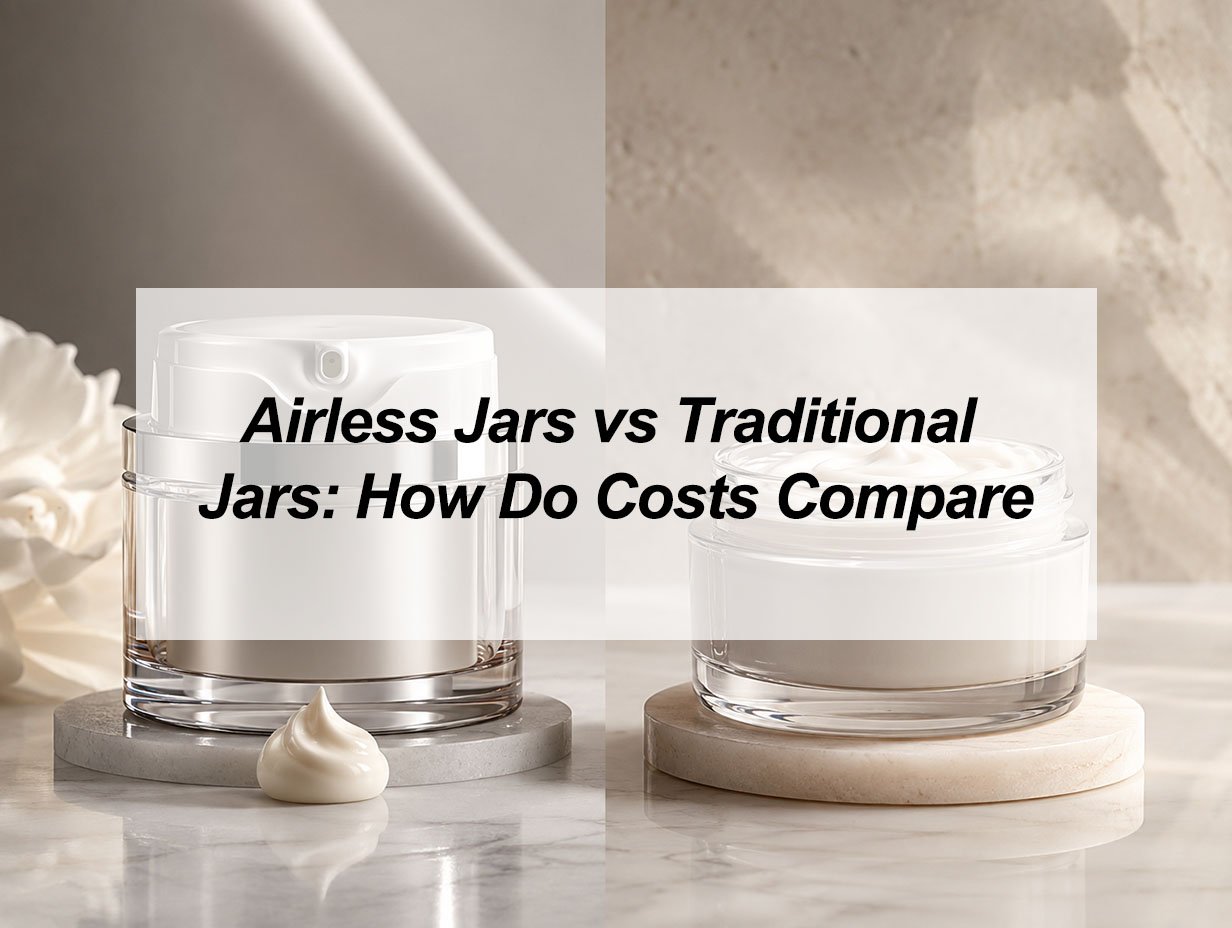
Jar cost is not only the purchase price. Formula protection, filling, hygiene, waste, testing, and brand value all change the real comparison.
Airless jars usually cost more than traditional jars because they use more complex pump or piston dispensing systems. Traditional jars are cheaper, simpler, and easier to fill. Airless jars can still be worth the higher cost when the formula is sensitive, the product is premium, and the brand needs cleaner dispensing or better dosage control.
Compare airless and traditional jars by total cost. Traditional jars are simpler and cheaper, while airless jars add protection, hygiene, controlled dispensing, and premium value.
What Drives the Cost Difference Between Airless Jars and Traditional Jars?
The biggest cost difference comes from structure. A traditional jar is simple. An airless jar is a dispensing system.
The cost difference between airless jars and traditional jars is driven by component count, mold complexity, pump or piston structure, filling method, assembly labor, quality testing, decoration, MOQ, formula compatibility, and supplier capability. Traditional jars cost less upfront, while airless jars add cost through function and protection.
1. Component Count
A traditional jar usually includes a jar body, cap, liner, seal, and sometimes a spatula or inner disc. The structure is simple. The supplier can often use stock molds. Filling is easier. Decoration is familiar.
An airless jar may include:
- outer jar;
- inner cup;
- piston or dispensing plate;
- pump surface;
- actuator;
- airless chamber;
- overcap;
- refillable inner part;
- gasket or seal.
More parts mean more cost. More parts also mean more quality-control points. Each part must fit well. If the piston is loose, the dispensing may fail. If the plate does not move smoothly, the customer may think the product is broken.
2. Mold and Tooling Cost
Traditional jars have many stock mold options. A brand can choose PP, PET, acrylic, glass, or double-wall plastic jars with lower tooling risk.
Airless jars often need more precise molds. The pump surface, piston system, inner cup, and actuator must match. Custom airless jars can also require higher tooling cost and longer sample time.
| Cost Driver | Traditional Jar | Airless Jar |
|---|---|---|
| Stock mold availability | High | Medium |
| Private mold cost | Lower to medium | Medium to high |
| Part precision | Moderate | Higher |
| Assembly steps | Fewer | More |
| Supplier options | Many | Fewer skilled suppliers |
| Sample risk | Lower | Higher |
3. Filling and Assembly
Traditional jars are easier to fill because the opening is wide. Thick creams, masks, balms, and body butters can be filled directly.
Airless jars need the correct filling method. The formula must match the pump or piston system. The supplier may need to test priming, output, residual product, and leakage. This adds time and cost.
4. Testing Cost
Traditional jars still need testing, but the test list is usually simpler. Brands should test leakage, cap torque, compatibility, drop resistance, decoration durability, and label adhesion.
Airless jars need more tests:
- pump output;
- priming;
- piston movement;
- formula viscosity;
- leakage;
- filling accuracy;
- residual product;
- cap fit;
- heat exposure;
- transport vibration;
- long-term stability.
A cost comparison should include these extra testing steps.
Are Airless Jars More Expensive Than Traditional Jars?
In most projects, yes. Airless jars are more expensive. But the higher price can make sense for the right formula and retail position.
Airless jars are usually more expensive than traditional jars because they use complex dispensing systems, more parts, tighter tolerances, and more testing. Traditional jars are usually cheaper, but airless jars can support higher product value when the brand sells active skincare, luxury creams, eye creams, or sensitive formulas.
1. Traditional Jars Are Better for Low-Cost Simplicity
Traditional jars are a strong choice when the product is stable, simple, and price-sensitive. They are also useful when the customer wants to see, scoop, or feel the texture.
Traditional jars work well for:
- body butter;
- clay masks;
- cleansing balms;
- scrub products;
- hair masks;
- thick cream masks;
- low-cost moisturizers;
- classic luxury creams.
A traditional jar can still look premium. Glass jars, acrylic jars, thick-wall PP jars, metallic caps, soft-touch coating, and hot stamping can create a strong shelf image. The cost can still be lower than an airless jar if the structure stays simple.
2. Airless Jars Are Better for Premium Function
Airless jars work better when the package must protect the formula and improve the user experience. Airless packaging is widely used for skincare and cosmetics because it can help reduce contamination and support product integrity. Market sources also note that airless systems are used for products that need cleaner dispensing and reduced product waste.
Airless jars work well for:
- anti-aging cream;
- vitamin C cream;
- retinol cream;
- peptide cream;
- eye cream;
- premium moisturizer;
- sensitive skincare;
- natural-positioned formulas;
- sunscreen creams;
- dermatology-style skincare.
3. The Price Gap Should Match the Product Value
Airless packaging should not be used just to look expensive. It should solve a real product problem.
| Product Situation | Better Cost Choice |
|---|---|
| Low-cost body butter | Traditional jar |
| Thick clay mask | Traditional jar |
| Premium eye cream | Airless jar |
| Retinol face cream | Airless jar |
| Stable basic cream | Traditional jar |
| Natural active moisturizer | Airless jar |
| Luxury cream with classic texture ritual | Traditional jar or airless jar |
| Refillable premium skincare | Airless jar with refill system |
If the formula is simple and the price point is low, a traditional jar is usually the better cost choice. If the formula is sensitive and the product can support premium pricing, an airless jar can be a better value choice.
How Do Hygiene, Formula Protection, and Product Waste Affect Real Cost?
The real cost of packaging includes what happens after the customer opens the product.
Hygiene, formula protection, and product waste affect real cost because poor packaging can increase contamination risk, reduce product consistency, create customer complaints, and leave unused formula inside the jar. Airless jars can reduce some of these risks, while traditional jars rely more on formula preservation, user habits, and clear instructions.
1. Hygiene Cost
A traditional jar exposes the product surface every time the customer opens it. The customer may also dip fingers into the formula. FDA information on cosmetic microbiological safety notes that consumer use, including dipping fingers into a product, can affect contamination risk.
This does not mean every jar is unsafe. Many jar formulas are designed with preservatives, stability testing, and safety controls. But it does mean the package creates more user-contact risk than a closed dispensing system.
2. Formula Protection Cost
Sensitive formulas can lose quality when they face air, light, moisture, heat, and repeated contact. An airless jar can help reduce routine air exposure and direct contact with the bulk formula.
Airless packaging does not replace:
- preservative systems;
- stability testing;
- compatibility testing;
- GMP control;
- safe filling;
- correct storage guidance.
But it can support the formula during normal customer use.
3. Product Waste Cost
Traditional jars can leave product in corners, under shoulders, or around the inner wall. Some users may not use all of it. Others may scoop too much.
Airless jars can help dispense a more controlled amount. Some airless market sources describe reduced waste and better product evacuation as reasons for airless packaging growth.
4. Complaint and Return Cost
Packaging problems can create hidden costs. These costs may not appear in the first quotation.
Hidden costs include:
- customer complaints;
- product returns;
- bad reviews;
- leaking during shipping;
- formula drying;
- pump failure;
- sticky or dirty jar rim;
- poor dosage control;
- product waste;
- lower repeat purchase.
| Risk Area | Traditional Jar | Airless Jar |
|---|---|---|
| Finger contact | Higher | Lower |
| Air exposure | Higher | Lower |
| Pump failure | None | Possible |
| Filling difficulty | Lower | Higher |
| Product waste | Medium | Lower if system works well |
| Customer ritual | Familiar | Modern and clean |
| Complaint risk | Hygiene and mess | Pump or priming failure |
| Best control method | Formula preservation and instructions | Testing and supplier quality |
This is why cost comparison must include user behavior. A cheaper jar can be a good choice. But it must fit the formula and routine.
What Should Brands Check Before Choosing Airless Jars or Traditional Jars?
A jar decision should start with formula needs. The package should protect the product and fit the user routine.
Before choosing airless jars or traditional jars, brands should check formula viscosity, active ingredients, preservative strategy, target price, filling method, decoration plan, MOQ, testing cost, sustainability goals, supplier skill, and customer use habits. The best package is the one that fits the formula and business model.
1. Formula Fit
The formula decides the jar. A thick balm may not work well in an airless jar. A light cream with active ingredients may benefit from airless dispensing.
Brands should check:
- Is the formula thick or light?
- Does it contain retinol, vitamin C, peptides, or botanical extracts?
- Does it contain particles, shimmer, grains, or powders?
- Does it need air or light protection?
- Can it move through an airless dispensing plate?
- Will the customer use it daily or occasionally?
2. Filling Method
Traditional jars are easier to fill. Airless jars need more technical filling control.
Brands should ask suppliers:
- Can the factory fill this airless jar?
- What filling machine is needed?
- Does the formula need vacuum filling?
- How many samples are needed before approval?
- What is the acceptable residual product level?
- What is the pump output per press?
3. Decoration and Brand Position
Traditional jars can feel classic and luxurious. Airless jars feel cleaner, more modern, and more technical.
| Brand Position | Better Jar Direction |
|---|---|
| Classic luxury skincare | Glass or acrylic traditional jar |
| Clinical active skincare | Airless jar |
| Natural skincare | Airless jar or simple recyclable jar |
| Spa product | Traditional jar |
| Eye cream | Airless jar |
| Budget cream | Traditional PP jar |
| Premium refill line | Refillable airless jar |
| Thick mask | Traditional jar |
4. Sustainability Review
Both formats can create sustainability challenges. A simple PP traditional jar may be easier to explain than a complex multi-material airless jar. But a refillable airless jar may reduce repeated full-package waste if customers actually buy refills.
Beauty packaging trend coverage notes that pumps and airless systems have historically been difficult to recycle because of mixed materials, but suppliers are moving toward mono-material airless builds as brands seek better recyclability. The EU PPWR also generally applies from August 12, 2026, and promotes reuse, refill, recycling, and prevention of unnecessary packaging.
Sustainability questions should include:
- How many materials are used?
- Can the parts be separated?
- Is the jar refillable?
- Is the refill easy to buy?
- Is PCR material available?
- Does decoration affect recycling?
- Can the supplier provide documents?
How Can Buyers Build a Practical Cost Comparison Table?
A cost table should compare full project cost, not only the jar quote.
Buyers can build a practical airless jar vs traditional jar cost comparison table by listing unit price, mold cost, MOQ, filling cost, assembly, decoration, testing, freight, defect risk, product waste, sustainability documents, and expected retail value. This makes the packaging decision more realistic.
Cost Comparison Template
| Cost Item | Traditional Jar | Airless Jar | Buyer Note |
|---|---|---|---|
| Unit price | Lower | Higher | Airless has more parts |
| Mold cost | Lower to medium | Medium to high | Stock molds reduce risk |
| MOQ | Often lower | Often higher | Custom airless may need larger orders |
| Filling cost | Lower | Higher | Airless needs correct filling method |
| Assembly | Simple | More complex | More parts need QC |
| Testing | Basic | More detailed | Pump and piston tests needed |
| Decoration | Flexible | More complex | More parts and surfaces |
| Freight | Depends on material | Depends on structure | Glass and acrylic add weight |
| Product waste | May be higher | Can be lower | System must dispense well |
| Premium value | Classic | Modern and technical | Price point matters |
| Sustainability | Simple mono-material possible | Refillable or complex | Review material structure |
| Supplier risk | Lower | Higher | Supplier skill matters |
Choose Traditional Jars When:
- the formula is stable;
- unit cost is the top priority;
- the formula is very thick;
- open access is part of the product ritual;
- filling needs to stay simple;
- stock molds are enough;
- the brand wants classic cream-jar luxury.
Choose Airless Jars When:
- the formula contains sensitive actives;
- the product is premium;
- clean dispensing is part of the brand promise;
- dosage control matters;
- product waste reduction matters;
- the brand wants a modern skincare image;
- refillable packaging supports repeat purchase.
Compare Both When:
- the product sits between mass and premium;
- the formula is moderately sensitive;
- the brand wants sustainable packaging;
- the buyer wants lower cost but better user experience;
- the supplier offers both stock traditional jars and stock airless jars.
The best procurement question is not “Which jar is cheaper?” The better question is “Which jar gives the best value after filling, testing, shipping, customer use, and repeat purchase?”
My insights: Airless Jars vs Traditional Jars: How Do Costs Compare
Airless jars cost more at first, but traditional jars can create hidden costs when formula protection, hygiene, and product waste matter.
Airless jars usually have a higher unit cost than traditional jars because they use more complex dispensing systems, tighter assembly, and more testing. Traditional jars are cheaper and easier to source, but airless jars can justify the cost for premium creams, sensitive formulas, cleaner use, controlled dosage, and stronger product value.
From Unit Cost to Real Packaging Value
A fair cost comparison should not stop at the jar price. It should compare the full packaging system. A traditional jar may be cheaper to buy, fill, and decorate. An airless jar may cost more, but it can protect the formula better and create a more premium user experience.
| Cost Area | Traditional Jar | Airless Jar |
|---|---|---|
| Unit cost | Lower | Higher |
| Structure | Simple jar, cap, liner | Jar body, pump plate, piston, actuator, cap |
| Filling | Easier | More technical |
| Formula protection | Lower during daily use | Better controlled dispensing |
| Hygiene | User may touch formula | Less direct contact with bulk formula |
| Product waste | Product may remain in corners | Can help push more product out |
| Decoration | Wide options and lower complexity | More parts to decorate and assemble |
| Premium value | Classic luxury feel | Modern skincare and active-formula value |
| Testing need | Basic leakage and compatibility | Pump, priming, output, leakage, viscosity |
| Best use | Stable creams, masks, balms | Active creams, eye creams, premium skincare |
The best decision is not “which jar is cheaper?” The better question is “which jar protects the formula, fits the price point, and supports the customer experience with the least total risk?”
Conclusion
Traditional jars usually win on upfront cost and simple filling. Airless jars win when formula protection, cleaner use, controlled dosage, and premium value justify the higher investment.