Eco-friendly cosmetic packaging needs more than green colors or natural wording. Brands need proof, documents, testing, and careful claim language.
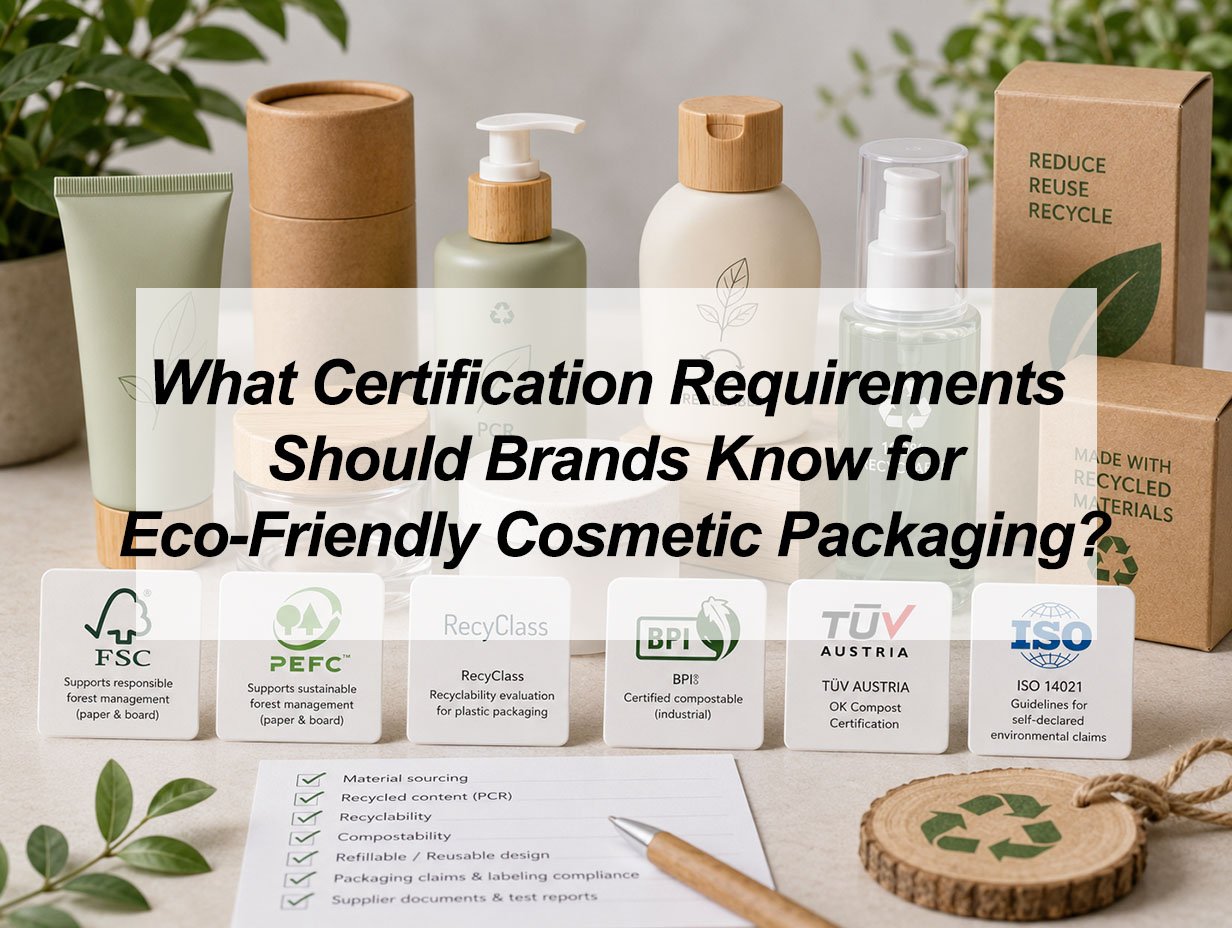
Brands should know that eco-friendly cosmetic packaging certification depends on the exact claim. FSC and PEFC support paper sourcing claims. RecyClass supports plastic recyclability review. BPI and TÜV support compostability claims. ISO 14021 guides self-declared environmental claims. Supplier documents support PCR, refillable, recyclable, and material-specific packaging proof.
Eco-friendly cosmetic packaging must connect material choice, supplier documents, certification scope, claim wording, and target market rules. A good claim should be specific, provable, and easy for buyers to understand.
What Certifications Matter for Eco-Friendly Cosmetic Packaging?
Different eco-friendly packaging claims need different certification paths. One certificate cannot prove every sustainability claim.
The main certifications and standards for eco-friendly cosmetic packaging include FSC, PEFC, RecyClass, BPI, TÜV OK compost, ISO 14021, COSMOS, and market-specific recyclability labels such as How2Recycle. Brands should choose them based on whether the packaging claim is about paper sourcing, recycling, recycled content, compostability, or cosmetic certification.
1. FSC and PEFC for Paper-Based Packaging
FSC chain-of-custody certification verifies that FSC-certified material is identified and separated from non-certified or non-controlled material as it moves through the supply chain. This matters for paper cartons, gift boxes, sleeves, paper tubes, inserts, and molded fiber packaging.
PEFC also offers chain-of-custody certification for packaging supply chains. PEFC states that manufacturers, converters, and other supply-chain actors can obtain PEFC Chain of Custody certification, which can support verified sourcing and due-diligence needs.
2. RecyClass for Plastic Recyclability
RecyClass certification evaluates whether plastic packaging is compatible with the waste management chain, including collection, sorting, recycling, and the ability of recycled material to be reused in its original application. This is useful for PET bottles, PP jars, PE tubes, mono-material packs, PCR bottles, and plastic closures.
3. BPI and TÜV for Compostability
BPI is a recognized third-party verification program for compostable products and packaging in North America. BPI states that it uses ASTM D6400 as the base standard for items going through the BPI certification process.
TÜV AUSTRIA’s OK compost INDUSTRIAL certification uses EN 13432:2000 as the reference point for its certification program. This can matter for compostable films, sample sachets, secondary packs, or special packaging parts, but brands must confirm whether the certification covers industrial composting or home composting.
4. ISO 14021 for Self-Declared Claims
ISO 14021:2026 applies to self-declared environmental claims that appear as words, symbols, graphics, packaging labels, product literature, advertising, and digital platforms. This is important when brands make claims such as recycled content, recyclable, reusable, reduced material, refillable, or similar statements.
5. COSMOS for Natural and Organic Cosmetics
COSMOS certification is mainly known for natural and organic cosmetics, but the standard also includes storage, manufacturing, and packaging requirements. Ecocert states that COSMOS certification verifies products from composition to processing and packaging.
| Certification or Standard | Best For | Main Packaging Use |
|---|---|---|
| FSC | Paper and forest-based packaging | Cartons, sleeves, paper tubes, inserts |
| PEFC | Paper and forest-based packaging | Verified paper sourcing |
| RecyClass | Plastic packaging recyclability | PET, PP, PE, PCR, mono-material packs |
| BPI | Compostable products and packaging | Industrial compostable packaging claims |
| TÜV OK compost | Industrial or home composting claims | Compostable films, packs, components |
| ISO 14021 | Self-declared environmental claims | Recyclable, recycled, reusable, reduced material |
| COSMOS | Natural and organic cosmetics | Packaging review inside cosmetic certification |
| How2Recycle | Consumer recycling instructions | U.S. and Canada recyclability communication |
The main point is simple. “Eco-friendly” is not one certificate. It is a group of possible claims, and each claim needs the right proof.
How Should Brands Verify Recyclable, Recycled, Compostable, and Paper-Based Packaging Claims?
Verification should happen before artwork approval, not after the packaging is printed.
Brands should verify eco-friendly packaging claims by checking the certificate issuer, certificate number, product scope, supplier name, validity date, material percentage, batch traceability, test standard, and market coverage. They should also confirm that the claim applies to the exact package being sold, not only to a raw material or similar product.
1. Verify Paper Claims
For FSC or PEFC paper packaging, brands should check:
- certificate number;
- chain-of-custody scope;
- certified supplier name;
- certified material category;
- validity date;
- invoice or purchase document;
- approved label use;
- whether the final converter is covered.
A paper carton cannot automatically use an FSC mark just because the paper mill is certified. The chain of custody must cover the relevant supply chain step. The converter, printer, or packaging supplier may also need certification depending on how the claim is made.
2. Verify Recyclability Claims
Recyclability claims are more complex than many brands expect. A package may be made from PET or PP, but that does not mean the final structure is recyclable everywhere. Color, labels, sleeves, pumps, caps, adhesives, coatings, and residue can all affect recycling.
The FTC says marketers should qualify recyclable claims when recycling facilities are not available to at least 60% of consumers or communities where the product is sold. The FTC also says environmental claims should be truthful and supported by evidence.
| Recyclability Factor | What to Check |
|---|---|
| Main resin | PET, PP, PE, HDPE, aluminum, glass, paper |
| Color | Clear, white, black, opaque, metallic |
| Closure | Cap, pump, sprayer, dropper, magnet |
| Label | Paper label, plastic label, full sleeve, ink |
| Decoration | Coating, metallization, hot stamping |
| Residue | Formula left inside the package |
| Local system | Target-market recycling acceptance |
| Proof | RecyClass, How2Recycle, supplier test, local review |
How2Recycle provides recyclability labels for the U.S. and Canada and requires packaging specifications to determine the proper recyclability designation. Its own 2026 guidelines also state that the How2Recycle program is not a certification program, so brands should use it as a consumer communication label rather than calling it a certification.
3. Verify Recycled-Content Claims
PCR claims need more than a supplier statement. Brands should ask for:
- PCR percentage;
- post-consumer or post-industrial source;
- batch record;
- material data sheet;
- safety suitability;
- color and odor limits;
- traceability document;
- supplier certificate.
A bottle made with 30% PCR should not be described as “100% recycled packaging.” A carton with recycled board should not imply that every part of the pack is recycled if coating, ink, window film, or insert material is different.
4. Verify Compostable Claims
Compostable packaging claims should name the composting environment. Industrial composting and home composting are not the same. BPI focuses on commercial compostability certification in North America and uses ASTM D6400 as the base standard for certification. TÜV AUSTRIA offers OK compost programs, including industrial and home compostability routes.
Compostable cosmetic packaging should be used carefully because many cosmetic products contain wet, oily, or active formulas. The package still needs product compatibility, barrier protection, shelf-life testing, and market disposal access.
What Documents Should Suppliers Provide for Sustainable Cosmetic Packaging?
A supplier should provide documents that match the packaging claim, not only a catalog page or verbal promise.
Suppliers should provide material data sheets, certificates, chain-of-custody documents, PCR traceability records, recyclability reports, compostability certificates, test reports, artwork approval files, production batch records, and quality inspection standards. These documents help brands prove claims, pass buyer review, and reduce greenwashing risk.
1. Basic Supplier Document Checklist
| Document | When It Is Needed |
|---|---|
| Material data sheet | For all packaging materials |
| FSC or PEFC certificate | For paper-based packaging claims |
| PCR certificate | For recycled-content claims |
| RecyClass report or certificate | For plastic recyclability claims |
| BPI or TÜV certificate | For compostable packaging claims |
| ISO 14021 claim file | For self-declared environmental claims |
| COSMOS packaging review | For natural or organic cosmetic certification |
| Compatibility test | For formula-contact packaging |
| Migration or safety test | When required by material or market |
| QC inspection report | Before shipment |
| Artwork approval | Before printing or labeling |
| Batch traceability | For repeat orders and claim control |
2. Check Certificate Scope
Many certificate mistakes happen because the certificate is real, but it does not cover the exact product. A supplier may show an FSC certificate for one facility, but the cosmetic carton may be made by another printer. A supplier may show a compostable resin certificate, but the final pouch with ink, adhesive, and zipper may not be certified. A supplier may show a PCR material document, but not the final bottle batch.
Brands should check:
- Does the certificate cover the final package?
- Does it cover the correct material?
- Does it cover the correct factory?
- Is the certificate still valid?
- Is the logo use approved?
- Does the claim match the percentage or class?
- Can the supplier provide invoice traceability?
3. Prepare a Claim Evidence File
A good brand should keep a claim evidence file for each eco-friendly packaging claim. This file can include certificates, supplier documents, test reports, specification sheets, artwork wording, and internal approval records.
This is important because laws and retailer checks are becoming stricter. The EU Packaging and Packaging Waste Regulation entered into force on February 11, 2025 and generally applies from August 12, 2026. It covers EU rules on packaging and packaging waste, including design and waste management.
A brand does not need to make every package certified. But when it makes a claim, it needs a clear proof trail.
How Can Brands Avoid Greenwashing When Using Eco-Friendly Packaging Claims?
Greenwashing usually starts when packaging language becomes broader than the evidence.
Brands can avoid greenwashing by using specific claim language, qualifying claims by market, avoiding vague words, keeping certificates current, checking supplier scope, testing the final package, and making sure artwork matches proof. Claims such as recyclable, compostable, biodegradable, plastic-free, refillable, and eco-friendly should be used only with clear evidence.
1. Replace Broad Claims With Specific Claims
Weak claims include:
- eco-friendly packaging;
- green packaging;
- sustainable bottle;
- recyclable everywhere;
- plastic-free;
- biodegradable;
- planet-safe;
- zero waste.
Stronger claims include:
- FSC-certified paper carton;
- bottle made with 30% PCR PET;
- mono-material PP jar designed for recyclability;
- BPI-certified commercially compostable pouch;
- refillable jar with replaceable inner cup;
- recyclable where facilities accept this material.
The FTC says eco-friendly or green claims must be truthful. It also says marketers should support compostable claims with competent and reliable scientific evidence and qualify recyclable claims when access is limited.
2. Do Not Mix Claims Without Explaining Them
A package may be FSC paperboard, but the label may be plastic. A tube may contain PCR plastic, but the cap may be virgin PP. A refillable jar may reduce repeat packaging, but the refill pod may still use plastic. A compostable outer pouch may not mean the full product is compostable.
Brands should explain the claim clearly:
| Risky Wording | Better Wording |
|---|---|
| Eco-friendly jar | Refillable PP jar with replaceable inner cup |
| Sustainable carton | FSC-certified paperboard carton |
| Green bottle | Bottle made with 30% PCR PET |
| Compostable pack | BPI-certified commercially compostable packaging |
| Recyclable tube | PE tube designed for recycling where accepted |
| Plastic-free | Paperboard carton without plastic window |
3. Review the Final Artwork
The final artwork is where many mistakes happen. A design team may add an eco icon. A marketing team may add a green slogan. A supplier may add a recycling symbol. But if the claim is not supported, the package can create risk.
Before printing, brands should check:
- every sustainability word;
- every icon;
- every recycling symbol;
- certificate logo use;
- QR code content;
- country-specific wording;
- packaging disposal instructions;
- evidence file consistency.
4. Use QR Codes Carefully
QR codes can help explain material, refill steps, recycling guidance, certificate scope, and disposal instructions. But the QR page must match the physical package. If the bottle uses PCR PET, the page should not make broad claims about the cap, pump, label, and carton unless those parts are also verified.
A QR code should support transparency, not hide unclear claims.
How Should Brands Build a Certification Plan Before Packaging Production?
A certification plan should be part of packaging development from the first supplier brief.
Brands should build a certification plan by defining the target claim, target market, packaging material, supplier certificate, testing requirement, label wording, artwork approval process, and document storage system before production. This prevents last-minute claim changes, wrong logos, missing certificates, and buyer rejection.
1. Start With the Claim
The brand should decide which claim matters most:
- responsible paper sourcing;
- recyclable packaging;
- recycled content;
- compostable packaging;
- refillable packaging;
- reduced material;
- natural or organic cosmetic certification;
- plastic recyclability;
- lower-waste secondary packaging.
Each claim leads to a different proof route.
2. Match the Claim With the Package
| Target Claim | Better Packaging Direction | Possible Proof |
|---|---|---|
| Responsible paper | FSC or PEFC carton | Chain-of-custody certificate |
| Recyclable plastic | Mono-material PET, PP, or PE | RecyClass or local review |
| Recycled content | PCR PET, PCR PP, PCR PE | PCR certificate and batch record |
| Compostable | Certified compostable film or component | BPI, TÜV, ASTM D6400, EN 13432 |
| Refillable | Durable outer plus refill system | Refill design, instructions, lifecycle logic |
| Natural or organic | COSMOS-compatible packaging | Certification body review |
| Clear recycling label | How2Recycle-style consumer label | Packaging specifications and label assignment |
3. Confirm Supplier Ability
A packaging supplier should be able to answer these questions:
- What material is used?
- What certificate supports the claim?
- What factory is covered?
- What is the certificate validity date?
- What is the PCR percentage?
- What testing has been done?
- Can the logo be printed legally?
- Can the same material be supplied for repeat orders?
- What happens if the material changes?
4. Approve the Claim Before Mass Production
A brand should approve sustainability claims before mass production, not after goods are packed. This approval should include the buyer, supplier, designer, regulatory reviewer, and marketing team.
The final review should cover:
- packaging specification;
- certificate file;
- claim wording;
- artwork file;
- logo use;
- QR code page;
- target market;
- supplier declaration;
- inspection standard.
This process may feel slower at first, but it prevents bigger problems later. Missing proof can delay a launch. Wrong claim language can damage trust. A certificate that does not cover the final package can weaken buyer confidence.
My insights: What Certification Requirements Should Brands Know for Eco-Friendly Cosmetic Packaging
Eco-friendly packaging claims can sound attractive, but weak proof can create greenwashing risk, buyer distrust, and market compliance problems.
Brands should understand certification requirements for eco-friendly cosmetic packaging by matching each claim with the right proof. FSC or PEFC supports responsible paper sourcing, RecyClass supports plastic recyclability review, BPI or TÜV supports compostability, ISO 14021 guides self-declared claims, and supplier documents support PCR or refillable claims.
From Green Claims to Real Certification Proof
Eco-friendly cosmetic packaging should not start with a broad claim. It should start with the exact packaging structure and the exact claim the brand wants to make. A paper carton, PCR bottle, refillable jar, compostable pouch, aluminum tube, and mono-material pump all need different proof.
| Claim Type | Possible Proof | What Brands Should Check |
|---|---|---|
| FSC paper | FSC Chain of Custody certificate | Certificate number, scope, supplier link |
| PEFC paper | PEFC Chain of Custody certificate | Certified material flow and supplier validity |
| Recyclable plastic | RecyClass assessment or local recyclability review | Resin, color, label, cap, pump, decoration |
| Recycled content | PCR certificate and batch record | Percentage, source, traceability, safety |
| Compostable | BPI, TÜV OK compost, ASTM D6400, EN 13432 | Industrial or home composting scope |
| Self-declared claim | ISO 14021-based evidence | Clear wording and proof file |
| Natural/organic cosmetic pack | COSMOS packaging review | Packaging material, waste, and excess packaging |
The safest rule is simple. Do not say “eco-friendly packaging” without explaining why. Say what is certified, what is tested, what percentage is used, and where the claim applies.
Conclusion
Eco-friendly cosmetic packaging needs specific proof. Brands should match each green claim with the right certificate, supplier document, test report, and market rule.