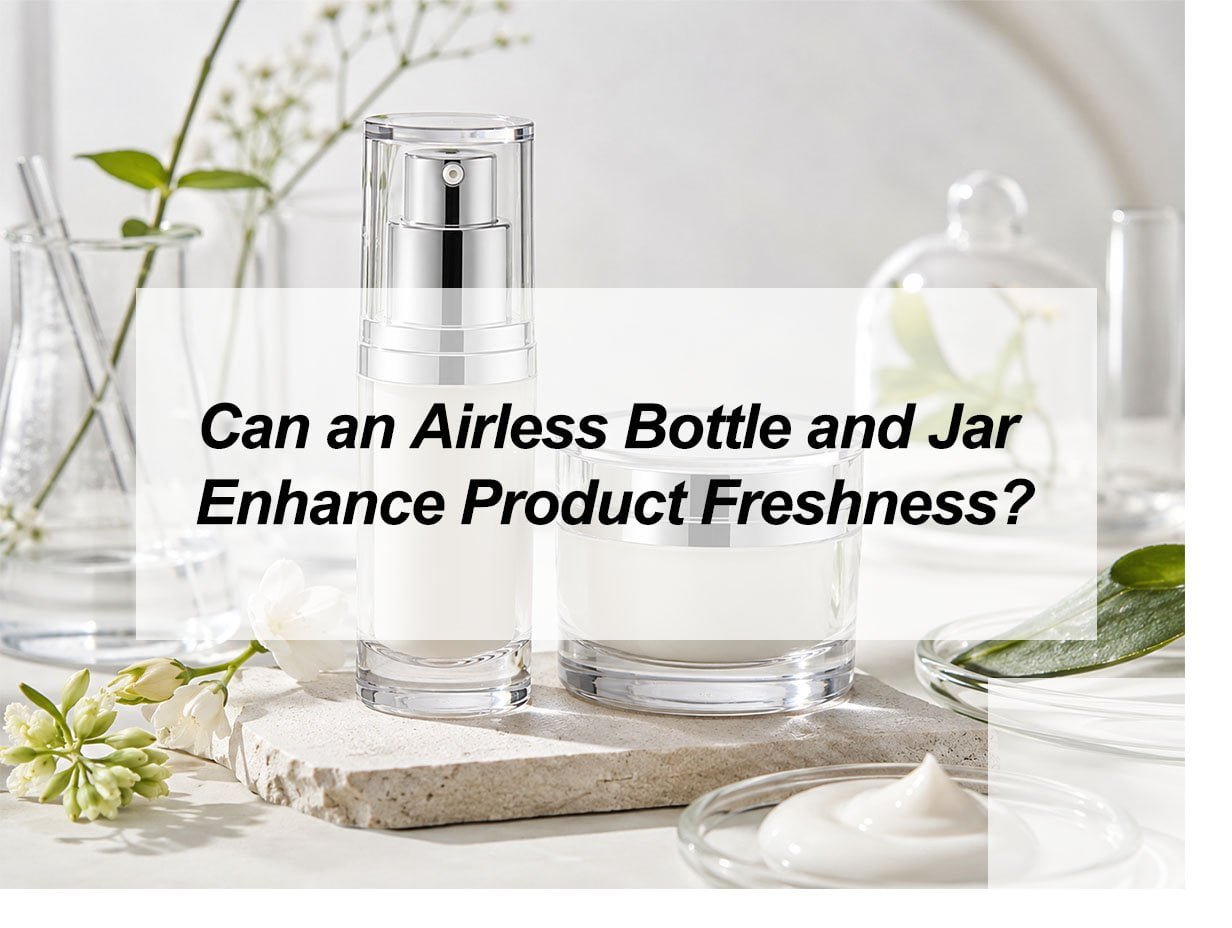
Sensitive formulas can weaken when packaging exposes them to air, fingers, and daily opening. Airless bottles and jars help reduce that risk.
Yes, an airless bottle and jar can enhance product freshness by reducing air exposure, limiting direct user contact, improving dosage control, and supporting cleaner dispensing. They are especially useful for skincare formulas with sensitive ingredients, including vitamin C, retinol, peptides, antioxidants, natural extracts, serums, lotions, creams, sunscreens, and anti-aging products.
Airless bottles and jars help protect skincare formulas by reducing air exposure, limiting finger contact, supporting cleaner dispensing, and keeping product experience more consistent.
How Do Airless Bottles and Jars Protect Cosmetic Formulas?
Many cosmetic formulas do not fail suddenly. They slowly lose freshness when air, light, heat, and repeated user contact affect the formula.
Airless bottles and jars protect cosmetic formulas by keeping the bulk product inside a more closed dispensing system. They reduce repeated air exposure, reduce direct finger contact, support controlled dosage, and help sensitive ingredients stay more stable during normal use. This makes them useful for active skincare and premium cosmetic products.
A traditional bottle often uses a dip tube pump. As product leaves the bottle, air can enter the container. A traditional jar exposes the formula every time the lid opens. Users may also touch the product directly with fingers or spatulas. That does not always mean the product will spoil, but it creates more chances for exposure.
Airless packaging changes the dispensing method. In many airless bottles, a piston rises as the product is pumped out. The formula moves upward, and less outside air enters the package. In some airless systems, a pouch or bag-in-bottle structure protects the formula while the outer bottle keeps its shape. Airless jars use a top-dispensing plate or pump surface, so the user presses down and receives a measured amount of cream without opening the full bulk formula.
Protection Benefits of Airless Packaging
| Protection Need | How Airless Packaging Helps |
|---|---|
| Oxidation control | Reduces repeated contact between formula and outside air |
| Hygiene support | Limits direct contact with the bulk formula |
| Dosage control | Dispenses a more measured amount per pump |
| Product waste reduction | Helps push more product toward the dispensing point |
| Formula consistency | Helps the product feel more stable across daily use |
| Premium experience | Creates a cleaner and more technical skincare routine |
A scientific review on cosmetic preservation notes that jars and bottles are more likely to cause microbial contamination, while closed system configurations such as airless pumps are less accessible to contamination. This is an important point for product development. Packaging cannot make a weak formula safe by itself, but it can reduce some use-phase risks.
I would use airless packaging when the formula has a clear reason to need protection. A vitamin C serum, retinol cream, peptide lotion, antioxidant moisturizer, eye cream, sunscreen lotion, or natural-positioned formula may benefit from less air exposure and cleaner dispensing. A simple rinse-off product or low-cost body lotion may not need the same packaging cost.
The key is to match the protection level with the product value.
Are Airless Bottles Better Than Traditional Jars for Product Freshness?
Traditional jars are familiar and attractive, but they are not always the best choice for freshness-sensitive formulas.
Airless bottles are often better than traditional open jars for product freshness because they reduce air exposure and direct finger contact. However, traditional jars can still work for stable creams, masks, and formulas where luxury feel, wide opening, or low viscosity stress matters more than maximum protection.
A jar has real benefits. It gives a premium look. It allows users to see and feel the cream texture. It works well for thick formulas that are hard to pump. It can be easier to fill and decorate. It also gives strong shelf presence, especially for luxury skincare.
But a jar has one weakness. It opens the formula to the outside environment. Every use can introduce air, moisture, and contact. The FDA specifically lists dipping fingers into a jar as one consumer-use factor that can affect product contamination. For formulas that rely on sensitive active ingredients, this matters.
Airless Bottle vs. Traditional Jar
| Feature | Airless Bottle | Traditional Jar |
|---|---|---|
| Freshness protection | Stronger for sensitive formulas | Lower because the product is exposed |
| User contact | Lower because product is pumped out | Higher because users may touch formula |
| Dosage | More controlled | Less controlled |
| Thick cream use | May need special pump design | Easy to scoop |
| Luxury feel | Modern and clinical | Classic and tactile |
| Cost | Usually higher | Often lower |
| Filling complexity | More technical | Simpler |
| Best use | Serums, lotions, active creams | Masks, balms, stable creams |
Airless jars sit between these two options. They keep the jar-like appearance but add pump-style dispensing. This is useful for brands that want the premium feel of a cream jar but do not want users to open the whole formula surface each time. Airless cosmetic jars are commonly described as packaging that helps protect formulas from oxidation and contamination by reducing oxygen exposure.
Still, airless is not always the automatic answer. If a formula is very thick, grainy, or contains particles, the pump may clog or dispense poorly. If the brand is very price-sensitive, the cost may be too high. If the formula is simple and stable, a standard jar may be enough. The best choice should come from formula testing, brand position, and user habit.
Which Skincare Formulas Benefit Most From Airless Packaging?
Airless packaging is most useful when the formula has high value, sensitive ingredients, or a hygiene-driven use case.
The skincare formulas that benefit most from airless packaging include vitamin C serums, retinol creams, peptide lotions, antioxidant formulas, eye creams, sunscreens, lightweight moisturizers, natural-positioned products, preservative-sensitive formulas, and premium anti-aging skincare. These products often need better protection from air exposure, contamination risk, and dosage inconsistency.
Airless packaging works especially well for liquid and semi-liquid formulas. Serums, lotions, gels, emulsions, and medium-viscosity creams can move through a pump system more easily. Very thick balms, scrub formulas, clay masks, and formulas with large particles may need a jar, tube, or special pump design instead.
Formula Fit Guide
| Formula Type | Airless Bottle Fit | Airless Jar Fit | Notes |
|---|---|---|---|
| Vitamin C serum | Strong fit | Possible | Needs oxidation control |
| Retinol cream | Good fit | Strong fit | Benefits from lower exposure |
| Peptide lotion | Strong fit | Good fit | Controlled dosage supports premium use |
| Eye cream | Good fit | Strong fit | Hygiene is important near sensitive areas |
| Sunscreen lotion | Good fit | Possible | Pump output and label space matter |
| Thick moisturizer | Possible | Strong fit | Jar format may suit viscosity better |
| Clay mask | Weak fit | Possible | Texture may not suit pump systems |
| Scrub formula | Weak fit | Weak fit | Particles can affect dispensing |
| Foundation | Good fit | Possible | Airless supports clean dispensing |
| Natural-positioned skincare | Strong fit | Good fit | Protection can support freshness story |
Airless pump bottles are often promoted for formulas with active ingredients such as vitamin C, retinol, and natural extracts because the system minimizes oxidation and contamination. Beauty packaging coverage also notes that airless packaging gives delicate formulas protection and helps reduce product waste.
I would not choose airless packaging only because it sounds premium. I would ask three questions first. Does the formula need better protection? Does the user need cleaner dispensing? Does the product price support a more technical package? If the answer is yes, airless packaging may be a strong option.
For product families, brands can also combine formats. A serum can use an airless bottle. A face cream can use an airless jar. An eye cream can use a small airless pump. A travel version can use a smaller airless bottle or tube. This creates a consistent freshness story across the full skincare line.
What Should Brands Check Before Choosing Airless Bottles or Jars?
Airless packaging looks simple to customers, but it needs careful testing before production.
Before choosing airless bottles or jars, brands should check formula viscosity, pump output, priming performance, leakage, filling method, residual product, material compatibility, decoration durability, cap fit, MOQ, lead time, recyclability, and supplier quality control. Airless packaging should be tested as a full system, not only as a container.
The first checkpoint is viscosity. If the formula is too thin, it may leak or dispense too much. If it is too thick, the pump may struggle. If the formula contains particles, shimmer, powder, or grainy texture, the airless system may clog. The supplier should test the exact formula, not only water or standard lotion.
The second checkpoint is pump performance. Airless pumps often need priming. If the pump does not start smoothly, customers may think the product is broken. Brands should test how many presses are needed before product comes out. They should also test output per pump. A serum may need a small dose. A lotion may need a larger dose. A cream may need a wide dispensing surface.
Airless Packaging Testing Checklist
| Test Area | What to Check |
|---|---|
| Formula viscosity | Can the product move smoothly through the pump? |
| Priming | How many pumps before first dispensing? |
| Output dosage | Is each dose consistent and suitable? |
| Leakage | Does the pack leak during shipping or travel? |
| Compatibility | Does the formula react with plastic, metal, gasket, or coating? |
| Residual product | How much product remains when pumping stops? |
| Filling method | Can the factory fill the airless system correctly? |
| Decoration | Does printing or coating survive handling and use? |
| Cap and actuator | Do they fit securely and feel premium? |
| Recyclability | Are materials, pumps, and components easy to explain? |
The third checkpoint is packaging structure. Some airless bottles use mixed materials, metal springs, or multi-part pumps. This may improve function, but it can complicate recycling. In 2026, beauty packaging trends are moving toward more sustainable materials, smart packaging, and clearer storytelling, so brands should ask whether their airless choice supports or weakens their sustainability message.
The fourth checkpoint is supplier ability. Airless packaging requires precision. A weak pump, poor piston fit, wrong filling method, or unstable quality control can create customer complaints. Buyers should ask for samples, material information, pump test data, MOQ, lead time, decoration limits, and shipment testing.
Airless packaging is worth the effort when the product needs it. It can protect formula freshness, improve user hygiene, support premium positioning, and reduce messy use. But it should be chosen through testing, not only by catalog photos.
Can Airless Packaging Improve Brand Value and Customer Trust?
Product freshness is not only a formula issue. It also affects how customers judge brand quality.
Airless packaging can improve brand value and customer trust by making the product feel cleaner, more precise, more protective, and more professional. When customers can pump the same dose smoothly without opening the whole formula, the product feels more controlled and reliable during daily use.
A customer may not know the technical details of oxidation or microbial risk. But they understand clean use. They understand a pump that gives the same amount each time. They understand a package that feels modern and protects the product. This is why airless bottles and jars are often used for higher-value skincare.
Brand Value Benefits
| Brand Goal | How Airless Packaging Supports It |
|---|---|
| Premium positioning | Gives a technical and skincare-focused feeling |
| Clean beauty message | Supports cleaner dispensing and less direct contact |
| Active ingredient story | Helps explain protection for sensitive formulas |
| Customer convenience | Reduces scooping and improves dosage control |
| Product consistency | Helps the product feel similar across repeated use |
| E-commerce appeal | Airless bottles and jars look modern in product images |
Airless packaging also gives sales teams a clearer story. Instead of saying only “premium bottle,” a brand can explain that the package helps protect sensitive formulas, improves hygiene, and supports controlled dispensing. This is more useful for skincare buyers because it connects packaging with product performance.
However, the claim should stay realistic. A brand should not say airless packaging guarantees freshness forever. It should say airless packaging helps reduce exposure and supports formula protection. The final product still needs preservative design, stability testing, compatibility testing, and proper storage guidance.
This honest message builds trust. Customers do not need exaggerated packaging claims. They need packaging that works.
My insights: Can an Airless Bottle and Jar Enhance Product Freshness
Sensitive skincare can lose quality when air, fingers, and repeated opening touch the formula. Airless packaging gives brands a cleaner protection system.
An airless bottle and jar can enhance product freshness by reducing air exposure, limiting repeated finger contact, improving dosage control, and protecting sensitive formulas from faster oxidation and contamination risk. It is especially useful for skincare products with actives, natural extracts, antioxidants, retinol, vitamin C, peptides, creams, serums, and lotions.
From Open Exposure to Controlled Dispensing
Airless packaging should not be seen as a magic freshness solution. It is better to see it as a controlled dispensing system. A standard jar opens the formula to air and user contact. An airless bottle or airless jar keeps the formula inside a closed system and dispenses only the needed amount.
| Freshness Factor | Traditional Jar | Airless Bottle or Jar |
|---|---|---|
| Air exposure | High during repeated opening | Lower during dispensing |
| Finger contact | Common with cream jars | Reduced through pump dispensing |
| Dosage control | Less controlled | More controlled |
| Formula protection | Depends heavily on preservatives and user habit | Supported by closed-system design |
| User experience | Familiar and luxurious | Cleaner, modern, and precise |
| Best fit | Simple creams, masks, low-risk formulas | Serums, lotions, creams, active skincare |
The best result comes from matching the airless system with the formula. A lightweight serum may fit an airless bottle. A thick face cream may fit an airless pump jar. A premium anti-aging line may use both formats in one product family. Brands should test compatibility, pump output, leakage, filling, and decoration before mass production.
Conclusion
Airless bottles and jars can enhance product freshness when they match the formula, reduce exposure, improve hygiene, and pass real filling, leakage, and compatibility tests.