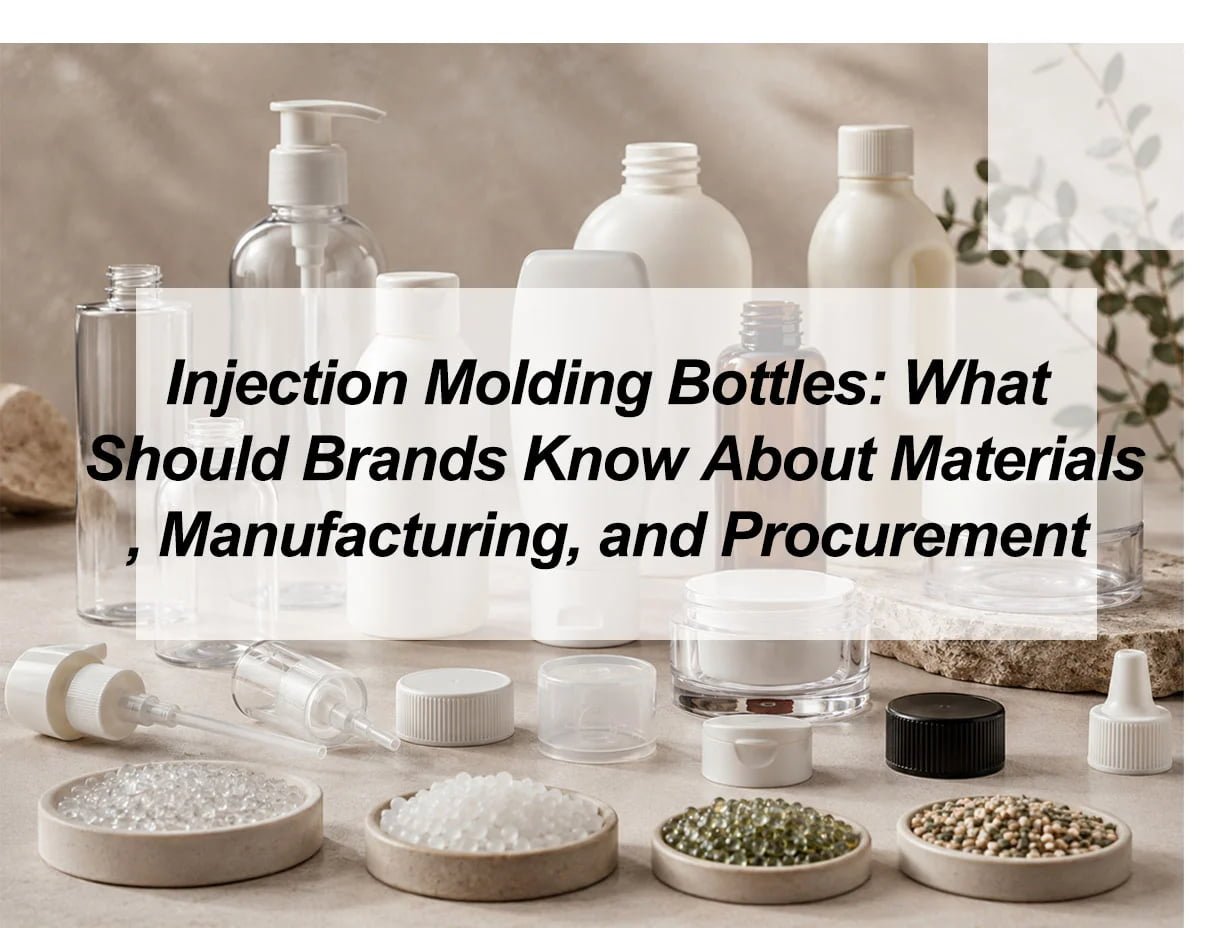
Bottle sourcing looks easy until material, mold, neck finish, decoration, and leakage problems appear. A clear manufacturing brief prevents expensive mistakes.
Injection molding bottles require brands to understand materials, manufacturing routes, mold choices, quality testing, and procurement terms. In many cases, bottles are not made by simple injection molding alone. They may use injection molded preforms, injection blow molding, injection stretch blow molding, extrusion blow molding, or injection molded components.
Bottle sourcing becomes easier when buyers distinguish injection molding, injection blow molding, injection stretch blow molding, and extrusion blow molding before requesting quotations or samples.
What Materials Are Commonly Used for Injection Molding Bottles?
A bottle material should not be chosen only by appearance. It should match the formula, process, decoration, cost, and recycling target.
Common materials for injection molding bottles and related components include PET, PP, PE, HDPE, PETG, ABS, acrylic, PCR plastic, and sometimes bio-based or recycled-content resins. PET is often used for clear bottles[^1], PE and HDPE for flexible bottles, and PP for caps, closures, jars, and pump parts.
PET is common when brands need clarity, gloss, and a clean shelf look. It is widely used for personal care, skincare, and beverage-style bottles. PET also works well with injection stretch blow molding because the preform can be molded first and then stretched and blown into the final bottle. Injection stretch blow molding can deliver accurate neck dimensions and consistent quality, which is useful for bottles that need precise caps or automated filling.
PE and HDPE are practical when brands need flexibility, impact resistance, and a familiar personal care feel. HDPE bottles are often used for lotions, shampoos, body care, household products, and opaque packaging. PE and HDPE are especially useful when the product needs a squeeze-friendly or durable bottle. PP is often used for caps, closures, pumps, jars, and components that need toughness or repeated movement. A cosmetic packaging material guide notes that PP is often injection molded for components such as lids and pumps because it is lightweight, durable, and can handle flexing in hinged caps.
Material Comparison for Bottle Projects
| Material | Common Use | Main Strength | Main Watch Point |
|---|---|---|---|
| PET | Clear bottles, toner bottles, skincare bottles | Clarity and strong shelf appearance | Compatibility with some formulas must be tested |
| HDPE | Lotion bottles, body care bottles, opaque packs | Impact resistance and durability | Less transparent than PET |
| PE | Squeeze bottles and flexible packs | Soft feel and flexibility | Shape precision can be lower |
| PP | Caps, closures, pumps, jars, parts | Toughness and repeated-use performance | Bottle clarity is limited |
| PETG | Clear premium packs and thick-wall looks | Glass-like appearance | Recycling classification can be more complex |
| ABS | Caps, decorative shells, luxury parts | Good rigidity and decoration | Less ideal for simple recycling claims |
| Acrylic | Luxury jars and outer cases | Premium transparent appearance | Can be heavy and harder to recycle |
| PCR plastic | Bottles and components with recycled content | Reduces virgin plastic use | Color, odor, and supply consistency need review |
PCR plastic and mono-material choices are becoming more important in beauty packaging[^2]. Market coverage for beauty and personal care packaging shows that plastic remains a major material category in 2026, while PCR and mono-material requirements are reshaping the packaging mix. This does not mean PCR is always the best material. It means buyers should ask better questions. What percentage of PCR is available? Is the PCR suitable for the formula? Can the supplier provide documentation? Will the color stay stable? Does the material affect odor or appearance?
Material choice should always be confirmed by testing. Cosmetic formulas may contain oils, alcohol, fragrance, acids, surfactants, pigments, or active ingredients. These can interact with resins, coatings, gaskets, and closures. A material that works for one lotion may fail for another formula.
How Are Injection Molding Bottles Manufactured?
The manufacturing process depends on whether the project needs a bottle body, a preform, or a component. The name of the process changes the whole sourcing plan.
Injection molding bottles are manufactured through several related routes. Standard injection molding makes preforms and components. Injection blow molding makes small precise bottles. Injection stretch blow molding makes strong clear PET bottles. Extrusion blow molding makes many PE and HDPE bottle bodies. Each route has different tooling, tolerance, and cost logic.
Standard injection molding starts with plastic resin pellets. The resin is heated, injected into a mold cavity, cooled, and ejected as a finished part. This process is excellent for caps, closures, jars, threaded components, pump parts, inner plugs, and preforms. It is not usually the final step for a hollow bottle body because a bottle needs an internal empty space and thin walls.
Injection blow molding starts with an injection molded preform. The preform is transferred into a blow mold, and air forms it into the final container. This process is useful when the bottle needs a precise neck finish, smooth surface, and consistent dimensions. It is often used for small bottles in cosmetics, pharmaceuticals, and lab applications.
Manufacturing Route Comparison
| Process | Best For | Strength | Procurement Watch Point |
|---|---|---|---|
| Injection molding | Caps, pumps, jars, preforms, closures | High precision and repeatability | Not ideal for final hollow bottle bodies alone |
| Injection blow molding | Small precise bottles | Accurate neck and polished surface | Higher mold/process requirements |
| Injection stretch blow molding | PET bottles, clear bottles, strong containers | Clarity, strength, and dimensional control | Better at scale, but tooling cost matters |
| Extrusion blow molding | PE and HDPE bottles, larger bottles | Flexible shapes and lower tooling cost in many cases | Neck finish may be less precise |
| Two-step preform blowing | High-volume PET bottles | Efficient for large production | Preform design and blowing conditions must match |
Injection stretch blow molding is especially important for PET bottles. It can produce clear and strong containers with accurate dimensions. It also supports high-volume production, but the equipment and tooling cost can be higher than simpler blow molding processes. A 2025 overview of injection stretch blow molding notes that it supports high-volume output and precise neck and thread dimensions, while also requiring higher upfront investment and process control.
Extrusion blow molding is different. It extrudes a hot tube of plastic called a parison, closes a mold around it, and blows air into it. This process is common for PE and HDPE bottles. It can be a good choice for shampoo bottles, lotion bottles, body care bottles, and larger cosmetic packaging. It may allow more shape flexibility and lower tooling cost in some cases, but the neck finish and wall thickness control may differ from injection blow molding.
For procurement, the most important point is simple: do not ask suppliers only for “injection molding bottles.” Ask which process they will use. A good supplier should be able to explain why the process fits the bottle, material, capacity, closure, and decoration plan.
What Is the Difference Between Injection Molding, Injection Blow Molding, and Extrusion Blow Molding?
These process names sound similar, but they create different bottle results. The wrong process can create wrong samples and poor quotation accuracy.
Injection molding makes precise parts and preforms. Injection blow molding makes small, accurate hollow bottles from injection molded preforms. Injection stretch blow molding stretches PET preforms for stronger and clearer bottles. Extrusion blow molding makes many PE and HDPE bottles by blowing an extruded plastic parison inside a mold.
A buyer should understand the process difference before asking for pricing. Injection molding is best when the shape is solid, open, or component-based. Caps, pump buttons, overcaps, collars, jars, and preforms are good examples. The mold can create detailed threads, smooth surfaces, logos, ribs, hinges, and tight tolerances. This is why injection molding is common across cosmetic packaging components.
Injection blow molding is more suitable when a small bottle needs a precise neck finish. It starts with a molded preform, so the neck and thread can be controlled accurately. The bottle body is then blown into shape. This can be useful for small cosmetic bottles, travel-size bottles, pharmaceutical-style bottles, and high-quality containers that need neat appearance and reliable closure fit.
Process Decision Table
| Buyer Requirement | Better Process Direction |
|---|---|
| Need a cap, pump part, jar, or closure | Injection molding |
| Need a small precise cosmetic bottle | Injection blow molding |
| Need a clear PET bottle with strong body | Injection stretch blow molding |
| Need an HDPE lotion or shampoo bottle | Extrusion blow molding |
| Need very accurate neck finish | IBM or ISBM |
| Need low-cost flexible bottle body | EBM may be suitable |
| Need luxury thick-wall component | Injection molding or PETG/acrylic molding |
| Need high-volume PET bottle production | ISBM is often suitable |
The material also guides the process. PET is strongly linked with injection stretch blow molding when clarity and strength matter. HDPE and PE are strongly linked with extrusion blow molding for many lotion and personal care bottles. PP is widely used for injection molded parts but may also appear in certain bottle and closure applications. A cosmetic packaging guide from APC Packaging describes PP as a lightweight and durable thermoplastic often used for lids, pumps, and hinged caps.
Procurement risk increases when the process is unclear. A supplier may quote a stock bottle made by extrusion blow molding when the buyer expects a precise injection blow molded bottle. Another supplier may quote a private mold when the buyer expects a public mold. One supplier may offer PET, while another offers PETG or HDPE. The samples may all look similar in photos, but they will differ in clarity, squeeze feel, surface finish, neck precision, recyclability, and cost.
A clear RFQ should therefore include both the product goal and the manufacturing expectation. If the buyer does not know the right process, the RFQ should ask the supplier to recommend the process and explain the reason. This is much better than forcing the wrong process name into the brief.
What Should Buyers Check Before Procuring Injection Molding Bottles?
Procurement should not end at unit price. A cheaper bottle can become more expensive if it fails filling, shipping, decoration, or customer use.
Before procuring injection molding bottles, buyers should check material, manufacturing process, mold ownership, capacity, neck finish, closure fit, tolerance, decoration method, MOQ, lead time, sample plan, compatibility testing, leakage testing, supplier documentation, and quality inspection standards. A clear RFQ reduces confusion and delays.
The first procurement step is to define the bottle and closure together. A bottle without a closure is not a finished package. Neck finish, thread, gasket, pump size, cap torque, liner, and sealing surface all affect leakage. If the bottle uses a pump, the dip tube length, pump output, actuator style, and collar match must be confirmed. If the bottle uses a flip cap, the hinge strength and sealing plug need testing.
Procurement Checklist
| Procurement Item | What to Ask |
|---|---|
| Material | What resin is used? Is it virgin, PCR, or mixed? |
| Process | Is it injection molding, IBM, ISBM, or EBM? |
| Mold | Is it a public mold, private mold, or modified mold? |
| Capacity | What is the nominal fill and brimful capacity? |
| Neck finish | What thread, pump neck, or cap standard is used? |
| Closure fit | Has leakage testing been done with the chosen cap or pump? |
| Tolerance | What are the dimensional tolerances for neck, weight, and height? |
| Decoration | Which methods work on this material and shape? |
| MOQ | What MOQ applies for plain, colored, and decorated bottles? |
| Lead time | What is the sample time and mass production time? |
| Testing | What tests are included before shipment? |
| Documentation | Can the supplier provide material and QC documents? |
The second step is to test real samples. Buyers should not approve only based on photos or 3D mockups. They should test the bottle with the real formula if possible. The team should check leakage, drop resistance, pump output, cap torque, label adhesion, printing rub resistance, heat exposure, and shipping vibration. If the product contains oils, fragrance, alcohol, or active ingredients, compatibility testing becomes even more important.
The third step is to review labeling and market requirements. In the U.S., the FDA says cosmetic labeling must be truthful and not misleading, and it provides an overview of cosmetic labeling requirements with emphasis on information that affects labeling. The eCFR also states that cosmetic packages must bear a net quantity declaration. This means the bottle shape must leave enough label space for identity, net contents, ingredients, warnings, directions, batch details, and responsible party information where required.
The fourth step is sustainability review. The EU Packaging and Packaging Waste Regulation entered into force on February 11, 2025, and generally applies from August 12, 2026. It pushes packaging toward waste reduction, reuse, recycling, and better packaging management. Buyers should ask whether the bottle uses a clear resin, colored resin, label, sleeve, pump, or mixed-material closure. Resin Identification Codes are covered by ASTM D7611, which was created to identify plastic resin types in manufactured articles. A resin code does not automatically mean the package is recyclable everywhere, but it helps identify the material family for sorting and documentation.
How Can Brands Build a Better RFQ for Injection Molding Bottles?
A good RFQ saves time because it tells suppliers exactly what they need to quote, sample, and test.
Brands can build a better RFQ by specifying bottle capacity, material, process, color, mold type, neck finish, closure, decoration, order quantity, target market, testing requirements, packaging method, and certificate needs. The RFQ should also ask suppliers to explain risks, alternatives, tooling cost, and lead time.
A weak RFQ says, “Please quote a 100 ml plastic bottle.” A strong RFQ says, “Please quote a 100 ml PET bottle made by ISBM, clear body, 24/410 neck, matching white flip cap, two-color silk screen printing, 10,000 pieces, cosmetic lotion use, leakage test required, export carton packaging, and sample lead time needed.” The second version helps the supplier respond faster and more accurately.
Supplier-Ready RFQ Template
| RFQ Field | Example Input |
|---|---|
| Product type | Cosmetic lotion bottle |
| Capacity | 100 ml nominal fill, confirm brimful volume |
| Material | PET, HDPE, PP, or PCR option |
| Process | Supplier to confirm IBM, ISBM, or EBM |
| Color | Transparent, white, custom Pantone, or frosted |
| Neck finish | 24/410, 20/410, pump neck, or custom |
| Closure | Flip cap, screw cap, pump, sprayer, disc top |
| Decoration | Label, silk screen, hot stamping, matte coating |
| Quantity | 10,000 / 50,000 / 100,000 pieces |
| Market | U.S., EU, Middle East, Southeast Asia, or other |
| Testing | Leakage, drop, compatibility, torque, print adhesion |
| Documents | Material data, QC report, PCR certificate if needed |
| Packing | Export carton, inner bag, pallet, carton mark |
| Timeline | Sample date and mass production date |
The RFQ should also ask about mold ownership. A public mold is cheaper and faster, but competitors may use the same shape. A private mold gives brand uniqueness, but it needs tooling cost and longer development time. A modified stock mold can sit between the two. It may save time while giving some customization, but not every supplier can modify existing molds safely.
Brands should also ask about decoration limits. A bottle may support silk screen printing on a flat panel but not on a curved shoulder. A metallic coating may look premium but may affect recycling claims. A full shrink sleeve may create strong shelf impact but may create sorting problems for some recycling systems. A label may be cheaper but can peel if the product is oily or used in wet environments.
Finally, buyers should compare total procurement risk, not only price. A reliable supplier should communicate clearly, give realistic lead times, provide stable samples, explain tolerances, and support quality inspection. A low quote with vague material information can create problems later. A slightly higher quote with better mold control, testing, and documentation can be safer for long-term business.
My insights: Injection Molding Bottles: What Should Brands Know About Materials, Manufacturing, and Procurement
Many buyers ask for injection molding bottles, but the real process may involve injection molded preforms, injection blow molding, or extrusion blow molding.
Injection molding bottles require clear decisions on material, process, mold, tolerance, decoration, testing, and supplier capability. Brands should understand whether they need injection molded preforms, injection blow molded bottles, extrusion blow molded bottles, or injection molded components before procurement. This avoids wrong quotations, weak samples, and production delays.
From a Simple Bottle Request to a Supplier-Ready Procurement Brief
Injection molding bottle procurement should not start with only shape and capacity. I would first define the manufacturing route, then choose the resin, mold type, closure system, decoration method, and testing plan. This is important because a PET cosmetic bottle, an HDPE lotion bottle, a PP jar, and a pump component may all use different molding logic.
| Decision Area | What Buyers Should Define | Why It Matters |
|---|---|---|
| Bottle process | IBM, ISBM, EBM, or injection molded component | The process affects shape, accuracy, and cost |
| Material | PET, PP, PE, HDPE, PETG, PCR | Resin affects clarity, flexibility, resistance, and recycling |
| Mold type | Public mold, modified mold, private mold | Mold choice affects cost, uniqueness, and lead time |
| Neck finish | Thread, snap fit, pump neck, cap match | Neck accuracy affects leakage and assembly |
| Decoration | Label, silk screen, hot stamping, coating | Surface and shape affect print quality |
| Testing | Leakage, drop, torque, compatibility, filling | Testing reduces launch and shipment risk |
| Procurement terms | MOQ, lead time, sample plan, QC standard | Clear terms reduce supplier misunderstanding |
The best bottle decision is not only about unit price. A low-cost bottle can become expensive if it leaks, cracks, looks inconsistent, or does not match the closure. A more suitable bottle can reduce sample rounds, improve filling performance, and make sourcing more stable.
Conclusion
Injection molding bottle procurement works best when buyers define the material, process, mold, closure, testing, and supplier terms before sampling or mass production.