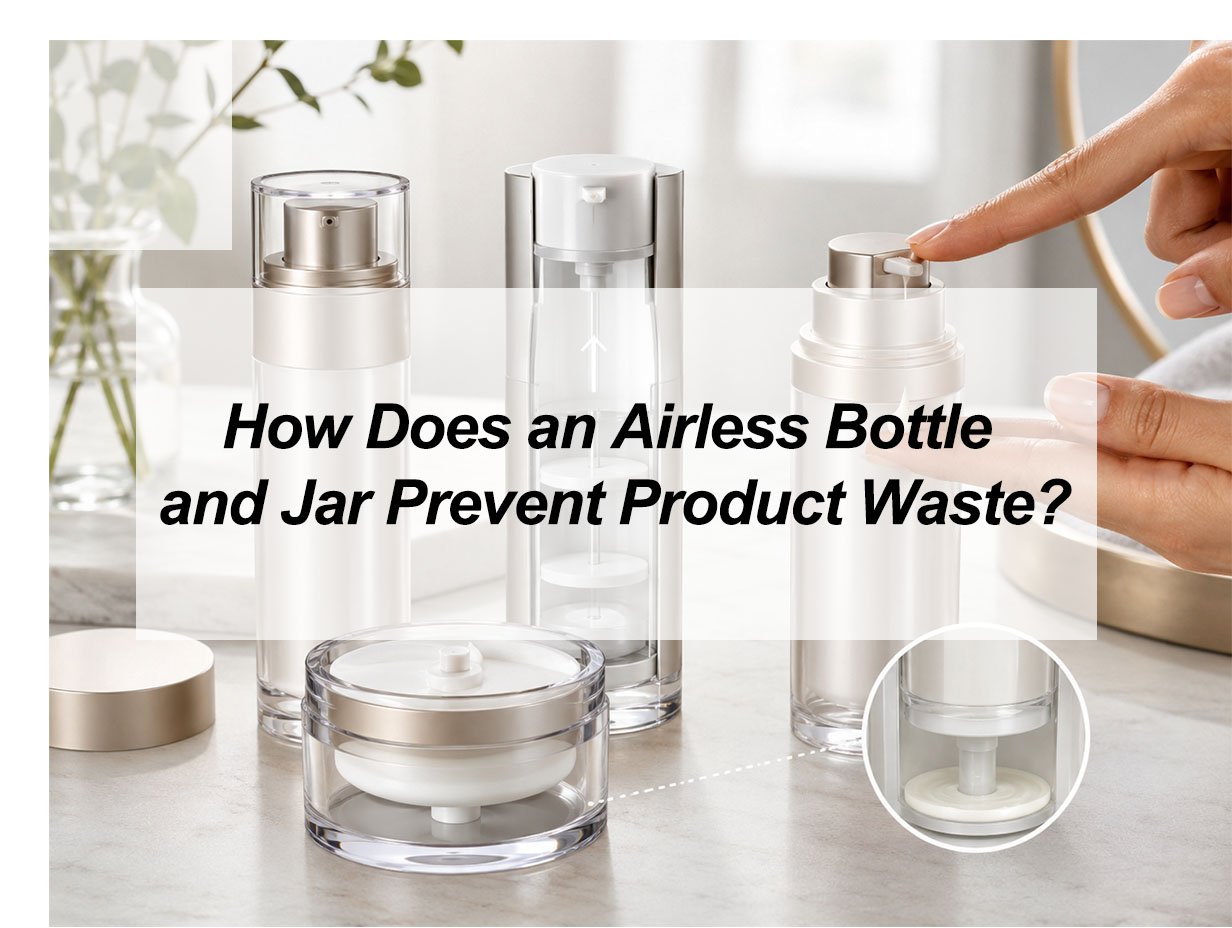
A skincare formula can be expensive to develop. But if the package leaves product behind, the customer pays for cream they cannot use.
An airless bottle and jar prevent product waste by pushing the formula upward, reducing trapped residue, limiting air exposure, lowering contamination risk, and giving a controlled dose with each press. They are especially useful for creams, lotions, serums, sunscreens, foundations, masks, and active skincare products that need cleaner and more complete dispensing.
Airless packaging does not solve every sustainability problem. It can use more components than a simple bottle or jar. But it can reduce wasted formula, improve product protection, and support a cleaner customer experience. For skincare brands, this matters because product waste is not only annoying. It is also a cost, quality, and trust problem.
What Is the Difference Between an Airless Bottle and an Airless Jar?
An airless bottle and an airless jar both reduce product waste, but they are designed for different product textures and usage habits.
An airless bottle is usually used for lotions, serums, sunscreens, foundations, and medium-viscosity formulas. An airless jar is usually used for creams, balms, masks, moisturizers, and thicker formulas. Both systems reduce product waste by moving the formula toward the dispensing point instead of leaving it trapped inside the package.
Airless bottles work well for pumpable formulas
An airless bottle usually uses a piston or bag-in-bottle structure. When the user presses the pump, the product moves upward. The system does not depend on a long dip tube like a traditional pump bottle. This helps the package dispense more consistently from first use to last use.
Airless bottles are useful for products that need a controlled dose. A serum may need a small amount. A sunscreen may need a larger amount. A foundation may need smooth dispensing without drying or clogging. The right pump output matters because too much output creates waste, while too little output creates frustration.
Airless jars work well for thicker formulas
An airless jar is designed for products that may not flow well through a narrow dip tube. Many creams and balms are too thick for basic pump bottles. A regular jar lets users scoop product directly, but that can expose the formula to fingers, air, dust, and bathroom moisture.
An airless jar helps by keeping the formula inside a protected chamber. The user presses the top surface or actuator, and a measured amount comes out. This can make thick skincare feel cleaner and easier to use.
| Feature | Airless Bottle | Airless Jar |
|---|---|---|
| Best formula type | Lotion, serum, sunscreen, foundation | Cream, balm, mask, moisturizer |
| Main waste problem solved | Product left below dip tube or around bottle walls | Product left on jar walls or exposed during scooping |
| User action | Press pump | Press top or dispensing surface |
| Hygiene benefit | Less air and hand contact | Less finger dipping than open jar |
| Best buying check | Pump output and formula viscosity | Plate movement, sealing, and cream release |
I would choose an airless bottle for flowing formulas. I would choose an airless jar for thicker formulas that need a premium and hygienic application style.
How Does Airless Packaging Reduce Leftover Product?
The biggest waste-saving value of airless packaging is better evacuation. That means more product comes out before the package is thrown away.
Airless packaging reduces leftover product by using a piston, pouch, or vacuum-style system that pushes the formula toward the dispenser. This design can help users access about 95–98% of the product in many airless formats, while traditional tubes, bottles, and pumps may leave more residue depending on formula thickness and package geometry.
Why traditional packaging leaves residue
Traditional pump bottles often use a dip tube. The dip tube pulls product from the bottom of the bottle. But if the product is thick, sticky, or low in the bottle, the tube may not collect everything. Some formula can stay around the bottle shoulder, corners, walls, and base.
Tubes can also leave product behind. Users may squeeze the tube, roll it, or cut it open. But thick creams can still remain near seams, shoulders, and caps. Regular jars can empty well if users scrape them carefully, but that depends on behavior. Many users throw away jars before cleaning every wall.
Why airless systems perform better
Airless packaging moves the product toward the dispensing point. In many piston systems, the base rises as product is used. In bag-in-bottle systems, the inner bag collapses as product comes out. This reduces dead space inside the package.
A 2025 study on cosmetic packaging emptiability found strong differences between formats. For hair wax and gel, the lowest residue values came from an airless pump dispenser at 0.59% and jars between 0.62% and 2.98%; higher residue values appeared in tubes, pump dispensers, and one bottle.
| Waste Factor | Traditional Bottle / Tube / Jar | Airless Bottle / Jar |
|---|---|---|
| Dead space | More likely near bottom, shoulder, or tube seam | Lower when piston or pouch moves correctly |
| Thick formula residue | Often higher | Usually lower with matched pump or jar system |
| User effort | Shaking, squeezing, scraping, cutting | Pressing and dispensing |
| Product access | Less complete | More complete |
| Waste control | Depends heavily on user behavior | More controlled by package structure |
This is why airless packaging is valuable for high-cost skincare. A small amount of residue may not matter much for a low-cost cleanser. But it matters for retinol cream, vitamin C serum, sunscreen, eye cream, foundation, and luxury moisturizer.
How Does an Airless Bottle Prevent Waste in Lotions, Serums, and Sunscreens?
An airless bottle prevents waste by keeping the formula moving toward the pump and giving a more controlled dose.
An airless bottle prevents waste in lotions, serums, and sunscreens by reducing trapped product, improving dosage control, and protecting the formula from repeated air exposure. It is especially useful for medium-viscosity products that can become difficult to dispense in traditional pump bottles as the bottle empties.
Controlled dispensing reduces overuse
Product waste is not only what remains inside the package. It is also what comes out in the wrong amount. A traditional squeeze bottle can release too much product if the user presses hard. A pump with poor output can also create waste if it dispenses too much per press.
Airless bottles can be designed with specific pump outputs. A facial serum may use a small output. A body lotion may use a larger output. A sunscreen may need enough output to support proper application, but not so much that users waste it.
| Product Type | Why Airless Bottle Helps |
|---|---|
| Serum | Controlled small dose and less air exposure |
| Lotion | Better evacuation and smoother daily use |
| Sunscreen | Cleaner dispensing and less product trapped inside |
| Foundation | More consistent flow and less drying at opening |
| Eye cream | Small controlled dose and cleaner use |
| Active skincare | Better protection from repeated air contact |
Formula protection also prevents waste
If a formula oxidizes, dries, changes smell, separates, or feels contaminated, the customer may stop using it before the package is empty. Airless systems reduce air intake compared with many traditional dispensing systems. Supplier guides commonly describe airless pump bottles as useful for protecting sensitive formulations, improving evacuation, and creating a cleaner user experience.
This matters for formulas with vitamin C, retinol, peptides, botanical extracts, natural oils, fragrance, and low-preservative positioning. Airless packaging is not a replacement for proper formulation and preservative testing. But it can support a more stable use environment.
How Does an Airless Jar Prevent Waste in Creams and Balms?
Airless jars help reduce waste by changing how customers use thick products. They do not need to scoop from an open container.
An airless jar prevents waste in creams and balms by dispensing a controlled amount from a protected chamber. It reduces scraping, finger dipping, repeated air exposure, and product left on inner walls. This makes it useful for moisturizers, masks, thick creams, balms, and premium skincare formulas.
Thick formulas need a different package
Many creams do not work well in standard pump bottles. They may be too thick. They may clog. They may leave product around the bottom or shoulders of the container. A regular jar solves the flow problem, but it creates another issue: the user must touch or scoop the formula.
An airless jar gives a middle path. It keeps the wide, premium feel of a jar but adds a dispensing function. The user presses the top, and the product comes out in a controlled amount. This can reduce over-scooping and make the product feel more hygienic.
Less contamination can reduce early disposal
Cosmetic products can become harmful if contaminated with harmful microorganisms, including pathogenic bacteria and fungi, according to the FDA. A review on cosmetic preservation also notes that jars and bottles are more likely to cause microbial contamination, while closed systems such as airless pumps are less accessible to contamination.
| Regular Cream Jar Problem | Airless Jar Advantage |
|---|---|
| Fingers touch the formula | Product is dispensed without scooping |
| Air enters each time the jar opens | Formula stays in a more protected chamber |
| User may take too much | Pressing action can control dose |
| Cream sticks to walls | Moving platform can improve evacuation |
| Shared use feels less clean | Dispenser feels more hygienic |
I would choose an airless jar when the brand wants a premium cream format but wants to reduce the hygiene concerns of open jars.
Does Airless Packaging Reduce Environmental Waste Too?
Airless packaging can reduce environmental waste when it lowers formula residue and supports better product use. But the package structure must also be checked.
Airless packaging can reduce environmental waste when it lowers product residue, prevents early disposal, and supports complete use. But the final impact depends on plastic weight, material type, recyclability, refillability, PCR content, and whether the airless system uses mixed components that are hard to recycle.
Product waste has environmental value
The product inside the package carries its own environmental impact. It uses raw materials, water, energy, manufacturing, filling, shipping, and storage. If 10% or 20% of the formula remains unused, that waste matters.
A 2023 life cycle assessment compared cosmetic packaging systems with a general dip-tube pump, an airless pump, and a bag-in-bottle format. The study found the airless pump packaging system had less environmental burden than the other two systems across all assessed life cycle impact categories, while packaging material production and lotion residue were major contributors.
Packaging material still matters
Airless systems can be more complex than simple bottles or jars. Some contain multiple plastic types, metal springs, thick walls, or decorative coatings. This can make recycling harder. A good airless package should be judged by both product evacuation and package design.
| Sustainability Factor | Good Airless Design |
|---|---|
| Product evacuation | Low residue after normal use |
| Bottle or jar weight | Lightweight where possible |
| Material choice | PP, PET, PCR plastic, or compatible material family |
| Pump structure | Metal-free or easier-to-separate where possible |
| Refill option | Refillable outer jar or bottle when practical |
| Decoration | Simple printing, compatible labels, fewer coatings |
| Testing | Real formula evacuation and transport testing |
So I would avoid a broad claim like “airless packaging is always eco-friendly.” A better claim is more specific: “This airless bottle improves product evacuation,” “This airless jar reduces direct hand contact,” or “This refillable airless system reduces repeat packaging material.”
How Should Brands Choose Between Airless Bottles and Airless Jars?
Brands should choose based on formula viscosity, user behavior, product value, and waste risk.
Choose an airless bottle for pumpable formulas such as serums, lotions, sunscreens, and foundations. Choose an airless jar for thicker creams, masks, balms, and moisturizers. In both cases, test product evacuation, formula compatibility, pump output, leakage, sealing, decoration, and refill potential before bulk production.
Buyer decision table
| Product Need | Better Choice | Why |
|---|---|---|
| Thin serum | Airless bottle | Small controlled dose |
| Medium lotion | Airless bottle | Smooth pump dispensing |
| Sunscreen | Airless bottle | Cleaner application and controlled output |
| Thick face cream | Airless jar | Better for dense texture |
| Balm or mask | Airless jar | Easier dispensing than narrow pump |
| Luxury moisturizer | Airless jar | Premium feel with cleaner use |
| Foundation | Airless bottle or jar | Depends on viscosity and use style |
| Refillable skincare | Airless bottle or jar | Depends on refill structure |
Testing should happen before ordering
A sample can look good and still fail with the real formula. I would test these points before mass production:
| Test Item | Why It Matters |
|---|---|
| Evacuation rate | Shows how much product remains unused |
| Pump output | Controls dosage and user experience |
| Formula compatibility | Prevents swelling, cracking, odor, or leakage |
| Viscosity match | Avoids clogging or poor dispensing |
| Drop test | Protects shipping quality |
| Heat and cold test | Checks stability during transport |
| Decoration test | Protects branding and shelf appearance |
| Refill test | Confirms whether reuse is realistic |
Airless packaging works best when the supplier understands both packaging engineering and cosmetic formula behavior. A weak pump, poor piston fit, or wrong actuator can turn a good airless concept into a bad customer experience.
My insights: How Does an Airless Bottle and Jar Prevent Product Waste
Many skincare products are wasted before the customer finishes them. The problem is not always the formula. Sometimes, it is the package.
An airless bottle and jar prevent product waste by improving product evacuation, reducing leftover residue, limiting air exposure, lowering contamination risk, and giving users controlled dispensing. Well-designed airless systems often help users access about 95–98% of the formula, while some traditional pumps, tubes, and bottles can leave much more product behind depending on formula viscosity and package design.
Product Waste Starts With Poor Emptiability
When I compare airless packaging with traditional cosmetic packaging, I do not only look at the bottle or jar shape. I check how much product remains inside after normal use. This is called emptiability. A 2025 study on cosmetic packaging found that product residue depends strongly on both the package type and the product formula; in hand cream examples, jars and airless pump dispensers retained less than 1% residue, while some pump dispensers retained up to 26%.
| Packaging Type | Waste Problem | How Airless Helps |
|---|---|---|
| Traditional pump bottle | Dip tube may not reach all product | Piston or pouch pushes formula upward |
| Regular cream jar | Users may leave product on walls or expose it often | Airless jar dispenses from a protected chamber |
| Squeeze tube | Thick formula may stay near seams and shoulders | Airless system improves evacuation |
| Open jar | More hand contact and air exposure | Airless jar reduces direct access to bulk formula |
| Airless bottle or jar | Higher cost and more structure | Better dispensing, cleaner use, less residue |
Airless Packaging Reduces Waste in Several Ways
Airless bottles often use a piston, pouch, or bag-in-bottle mechanism. As the pump is pressed, the product moves upward without needing a dip tube. This helps the formula dispense more evenly and reduces product trapped at the bottom or corners.
Airless jars work in a similar waste-prevention direction, but they are designed for creams, balms, moisturizers, masks, and thicker formulas. Instead of asking users to scoop product from an open jar, an airless jar usually pushes product through a dispensing surface. This keeps the experience cleaner and helps users take a more controlled amount each time.
So I would not describe airless packaging as only a premium design. I would describe it as a functional waste-control system. It is most useful when the formula is thick, expensive, sensitive to air, or used in small daily doses.
Conclusion
An airless bottle and jar prevent product waste by improving evacuation, controlling dosage, reducing exposure, and keeping formulas cleaner until the final use.