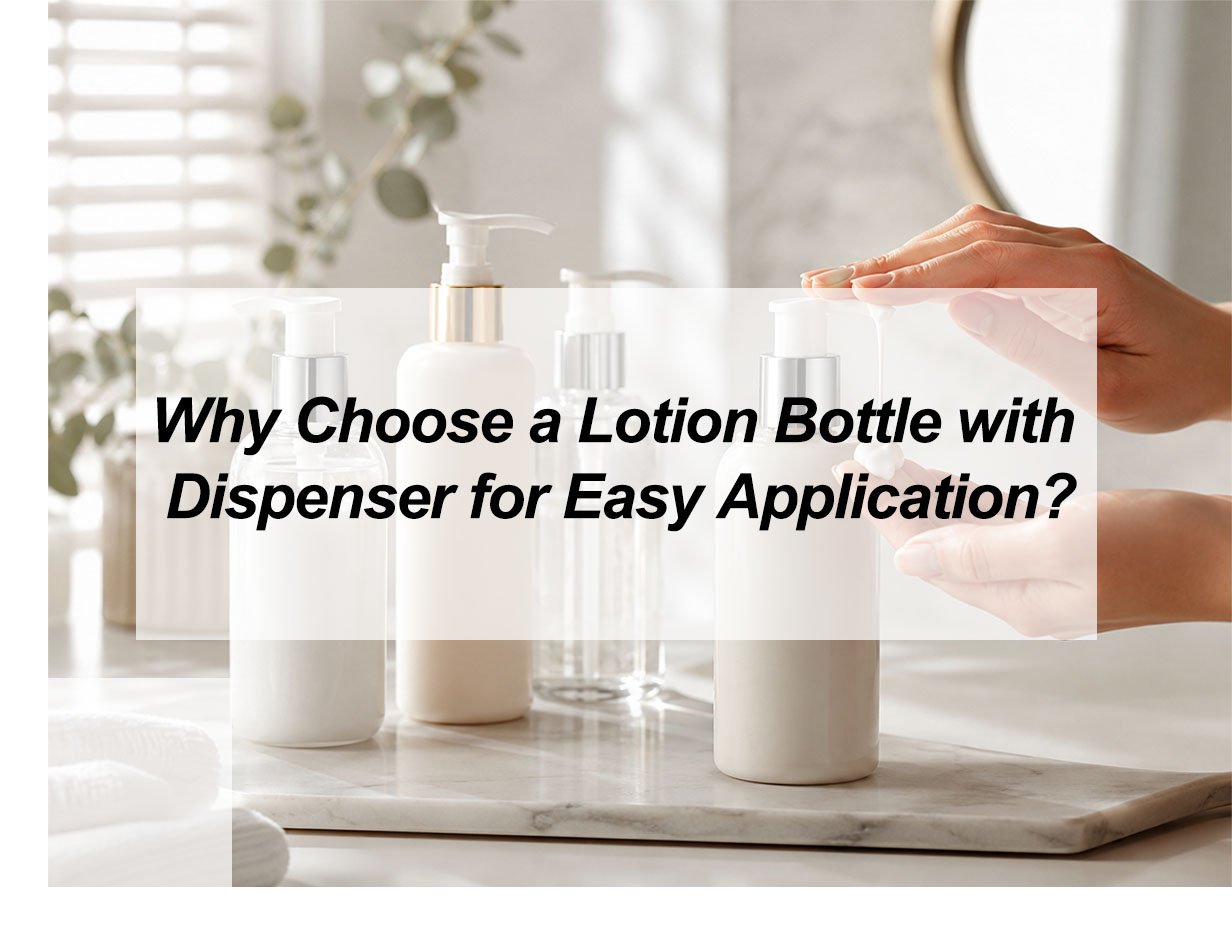
A good lotion formula can still feel annoying if the bottle is messy. The wrong package can waste product, slow use, and reduce repeat sales.
Choose a lotion bottle with dispenser because it makes application cleaner, faster, and easier to control. A dispenser gives a more measured dose, reduces spills, limits direct hand contact, and improves the daily user experience. It works best for lotions, moisturizers, cleansers, sunscreens, body creams, and hand care products.
Packaging is not only a container. It is part of the product experience. When a customer presses a pump and gets the right amount, the product feels easier to use. When the pump clogs, leaks, or gives too much product, the formula may feel worse than it really is. That is why lotion bottle dispenser design matters for both skincare brands and packaging buyers.
What Is a Lotion Bottle with Dispenser Used For?
A lotion bottle with dispenser is used for products that need clean, controlled, repeat dispensing. It is one of the most practical packaging formats in daily skincare.
A lotion bottle with dispenser is used to package and dispense lotions, moisturizers, body creams, cleansers, sunscreens, hand sanitizers, hair care products, and other liquid or semi-thick formulas. It helps users apply the product without pouring, squeezing too hard, or touching the formula inside the bottle.
The dispenser turns packaging into a usage tool
A basic bottle only stores the formula. A dispenser controls how the formula comes out. This small difference can change how customers feel about the product.
For example, a body lotion in a wide-mouth jar may feel rich, but it may also feel less clean for shared use. A squeeze bottle may be simple, but users may squeeze out too much product. A lotion pump bottle gives a more controlled result because each press can release a set or semi-controlled amount of product. Packaging suppliers often describe lotion pumps as useful for controlled dispensing, hygiene, convenience, and improved user experience.
| Product Type | Why a Dispenser Helps |
|---|---|
| Body lotion | Makes daily application faster and cleaner |
| Hand cream | Supports frequent use without opening a cap |
| Facial cleanser | Gives controlled amount for washing |
| Sunscreen | Helps users apply without messy pouring |
| Moisturizer | Reduces overuse and keeps the bottle clean |
| Hair lotion | Helps dispense thicker liquid evenly |
| Salon-size skincare | Makes shared use more convenient |
I would choose a dispenser when the product is used often, has a medium or thick texture, and needs a clean application routine. I would be more careful with very thin liquids because the pump may splash. I would also test very thick creams because the pump output must match the formula viscosity.
Is a Lotion Pump Bottle Better Than a Squeeze Bottle?
A lotion pump bottle is often better for control and cleanliness. A squeeze bottle is often better for low cost and simple filling.
A lotion pump bottle is better than a squeeze bottle when the brand wants cleaner use, controlled dosage, less mess, and a more premium user experience. A squeeze bottle may still be better for low-cost products, travel sizes, very simple formulas, or products that need full bottle squeezability.
The choice depends on product position
A squeeze bottle is simple. It has fewer parts. It can be lighter and cheaper. It works well for shower products, travel packs, basic lotions, and products where customers expect fast use.
A dispenser bottle feels more controlled. It also supports better countertop use. The customer can press the pump with one hand. This is useful in bathrooms, salons, spas, hotels, clinics, and home skincare routines. Pump dispenser bottles are often promoted as mess-free because a single press helps reduce spills and over-pouring.
| Comparison Point | Squeeze Bottle | Lotion Bottle with Dispenser |
|---|---|---|
| Cost | Usually lower | Usually higher |
| Components | Simple cap and bottle | Bottle, pump, actuator, dip tube, cap or lock |
| Dosage control | Less stable | More stable |
| Mess control | Depends on user pressure | Better for daily use |
| Hygiene | Cap must be opened often | Less direct product contact |
| Premium feel | Basic to medium | Medium to premium |
| Best use | Simple lotions and shower products | Daily skincare, body care, salon products |
The best choice is not always the most expensive one. If the formula is basic and the customer expects a budget product, a squeeze bottle may be enough. But if the brand wants a better daily-use experience, a lotion bottle with dispenser usually feels more professional.
How Does a Lotion Dispenser Improve Product Hygiene?
A dispenser improves hygiene by reducing direct contact between hands and the product inside the bottle. This matters more for products used many times.
A lotion dispenser improves hygiene because users do not need to dip fingers into the formula or open the full container each time. The bottle stays more closed between uses, which helps reduce exposure to hands, dust, bathroom moisture, and outside contamination.
Hygiene is part of product quality
Skincare packaging should protect the formula before and after purchase. The FDA states that cosmetic products can become harmful if contaminated with harmful microorganisms. FDA GMP guidance also says primary packaging materials should be stored and handled in ways that prevent mix-up, microbial contamination, chemical contamination, and decomposition from poor environmental exposure.
This does not mean a pump bottle makes a product sterile. It does not. But it can reduce repeated direct contact compared with open jars. This is especially important for shared products, family-size packs, professional products, and formulas used after washing hands or during skincare routines.
| Hygiene Factor | Open Jar | Squeeze Bottle | Lotion Pump Bottle |
|---|---|---|---|
| Finger contact | High | Low | Low |
| Air exposure | Higher when opened | Medium | Lower |
| Bathroom moisture exposure | Higher | Medium | Lower |
| Shared-use convenience | Lower | Medium | Higher |
| Formula protection | Depends on preservative and closure | Medium | Better for repeat use |
For buyers, hygiene is also a selling point. Customers may not know the technical details of packaging. But they understand a clean pump. They understand one-hand use. They understand not needing to scoop cream from a jar.
Does a Dispenser Help Reduce Product Waste?
A dispenser can help reduce product waste by controlling the amount used each time. But the pump must be matched to the formula.
A dispenser helps reduce product waste when it gives a controlled amount and prevents users from pouring or squeezing out too much product. The benefit is strongest for lotions, moisturizers, cleansers, sunscreens, and other products where customers need a repeatable dose.
Waste reduction comes from better control
A squeeze bottle can release too much product when the bottle is full, soft, or held upside down. A jar can lead to over-scooping. A pump gives a more predictable experience. Some packaging suppliers describe lotion pumps as useful because each press helps control dispensing and avoid unnecessary waste.
But pump design matters. A pump with too large an output can still waste product. A pump with too small an output can annoy customers. A pump that cannot handle thicker lotion may clog or fail.
| Product | Suggested Dispenser Logic |
|---|---|
| Face lotion | Smaller output for controlled application |
| Body lotion | Medium output for faster use |
| Hand lotion | Small to medium output |
| Cleanser | Controlled output with good pump recovery |
| Sunscreen | Enough output for proper use |
| Thick cream | Test high-viscosity pump or airless option |
A lotion bottle with dispenser should be tested with the real formula, not only water. Viscosity, oil level, fragrance, particles, and temperature can all affect pump performance.
Which Dispenser Type Is Best for Lotion Bottles?
The best dispenser depends on the formula, bottle size, product position, and use case. A standard lotion pump is not the only option.
The best dispenser for a lotion bottle may be a standard lotion pump, lockable pump, treatment pump, airless pump, foaming pump, or disc-top dispenser. For most lotions and moisturizers, a lockable lotion pump is practical because it supports controlled application, shipping safety, and daily convenience.
Common dispenser choices
A standard lotion pump works for many body lotions, hand lotions, and moisturizers. A lockable pump is better for e-commerce, travel, and retail shipping because the actuator can be locked to reduce accidental leakage. A treatment pump is better for facial skincare because it usually gives a smaller and more refined output. An airless pump is better for sensitive formulas, active skincare, and products that need better evacuation or lower air exposure. Airless pump packaging is often used because it can protect sensitive formulations, improve product evacuation, and support controlled dispensing.
| Dispenser Type | Best For | Main Advantage |
|---|---|---|
| Standard lotion pump | Body lotion, hand lotion | Easy and familiar |
| Lockable pump | E-commerce and travel packs | Helps reduce leakage |
| Treatment pump | Facial lotion and serum | Smaller controlled dose |
| Airless pump | Active skincare, premium lotion | Better formula protection |
| Foaming pump | Foam cleanser | Creates foam without aerosol |
| Disc-top cap | Simple lotions | Lower cost than pump |
I would choose the dispenser by asking one simple question: how should the customer use this product every day? If the answer is “quickly, cleanly, and with one hand,” a pump or dispenser bottle is usually a strong choice.
How Should Brands Choose a Lotion Bottle with Dispenser?
Brands should choose a lotion bottle with dispenser by testing the formula, pump output, material, neck size, leakage resistance, decoration, and user experience.
To choose the right lotion bottle with dispenser, check formula viscosity, pump output, bottle material, dip tube length, closure size, locking function, compatibility, MOQ, decoration method, leakage testing, and shipping performance. The best bottle should dispense smoothly from the first use to the last use.
A practical buyer checklist
| Check Item | Why It Matters |
|---|---|
| Formula viscosity | Thick lotions need the right pump strength |
| Pump output | Controls how much product comes out |
| Bottle material | PET, HDPE, PP, PCR plastic, or glass affect cost and image |
| Neck size | Pump and bottle must match |
| Dip tube length | Affects product pick-up near the bottom |
| Locking function | Reduces leakage during shipping |
| Compatibility test | Prevents swelling, cracking, or odor |
| Decoration | Labeling, printing, hot stamping, and coating affect shelf look |
| MOQ and lead time | Protects launch planning |
| Recyclability | Matters for eco skincare packaging claims |
The bottle material also matters. PET gives good clarity. HDPE gives strong chemical resistance and a soft practical look. PP works well for some components and closures. PCR plastic can reduce virgin plastic demand. Glass can feel premium but adds weight and breakage risk.
A good supplier should not only send a nice sample. The supplier should explain pump output, material options, test requirements, and production limits. This is important because a lotion dispenser is a functional part, not just a decorative part.
Are Lotion Bottles with Dispensers Good for Eco Skincare Packaging?
They can be good for eco skincare packaging, but only when the full design supports lower waste, better recycling, or reuse.
A lotion bottle with dispenser can support eco skincare packaging when it uses PCR plastic, refillable design, recyclable bottle material, mono-material thinking, lighter bottle weight, or a pump that can be removed before recycling. The package should avoid oversized bodies, unnecessary coatings, and hard-to-separate mixed materials.
Sustainability depends on the whole package
A pump adds function, but it also adds components. Many pumps use mixed plastic and sometimes metal springs. This can make recycling more difficult than a simple cap. So an eco lotion dispenser should be judged by the full structure, not only by the bottle material.
| Eco Design Choice | Why It Helps |
|---|---|
| PCR PET or PCR HDPE bottle | Reduces virgin plastic demand |
| Refillable lotion bottle | Reduces repeat primary packaging |
| Removable pump | Helps improve end-of-life sorting |
| Lightweight bottle | Uses less material |
| Simple label and ink | Reduces recycling problems |
| Mono-material direction | Makes recycling claims clearer |
| Larger refill format | Reduces packaging per use |
A dispenser bottle can still be a smart eco choice if it prevents product waste, improves dosage, and supports refill behavior. But buyers should be careful with broad claims like “100% sustainable.” A stronger claim is more specific: “PCR bottle,” “refillable system,” “recyclable PET bottle,” or “removable pump.”
My insights: Why Choose a Lotion Bottle with Dispenser for Easy Application
Many skincare products fail at the last step: daily use. A formula may be good, but poor dispensing can make it messy, wasteful, or inconvenient.
A lotion bottle with dispenser is a strong choice for easy application because it gives controlled dosage, cleaner use, less mess, better hygiene, and a smoother customer experience. It is especially useful for lotions, moisturizers, body creams, cleansers, sunscreens, hand care, and other medium-viscosity skincare products used every day.
Easy Application Starts With Controlled Dispensing
A dispenser helps users press once and get a more consistent amount of product. This is different from a squeeze bottle, where the amount depends on hand pressure, bottle softness, product thickness, and opening size. Pump dispenser packaging is often used in skincare because it supports mess-free daily use and helps control how much product comes out with each press.
| Packaging Type | Application Experience | Main Risk |
|---|---|---|
| Open jar | Easy to scoop | More hand contact |
| Squeeze bottle | Simple and low-cost | Harder to control dosage |
| Flip-top bottle | Good for basic products | Can spill if too much comes out |
| Lotion bottle with dispenser | Clean and controlled | Pump must match formula viscosity |
| Airless pump bottle | More protective and premium | Higher cost and testing needs |
Dispensers Also Support Hygiene and Brand Trust
A lotion bottle with dispenser reduces the need to dip fingers into the product. This can help limit direct contact with the formula, which is important because the FDA notes that cosmetics can become harmful if contaminated with microorganisms such as bacteria or fungi.
The bottle also stays more closed between uses. This helps protect the product from repeated exposure to hands, dust, and bathroom moisture. For buyers, this makes dispenser bottles suitable for family-size lotions, salon products, hotel amenities, hand creams, body care, and skincare products that customers use many times each week.
Conclusion
A lotion bottle with dispenser makes application easier because it gives cleaner use, better dosage control, stronger hygiene, and a smoother daily experience.