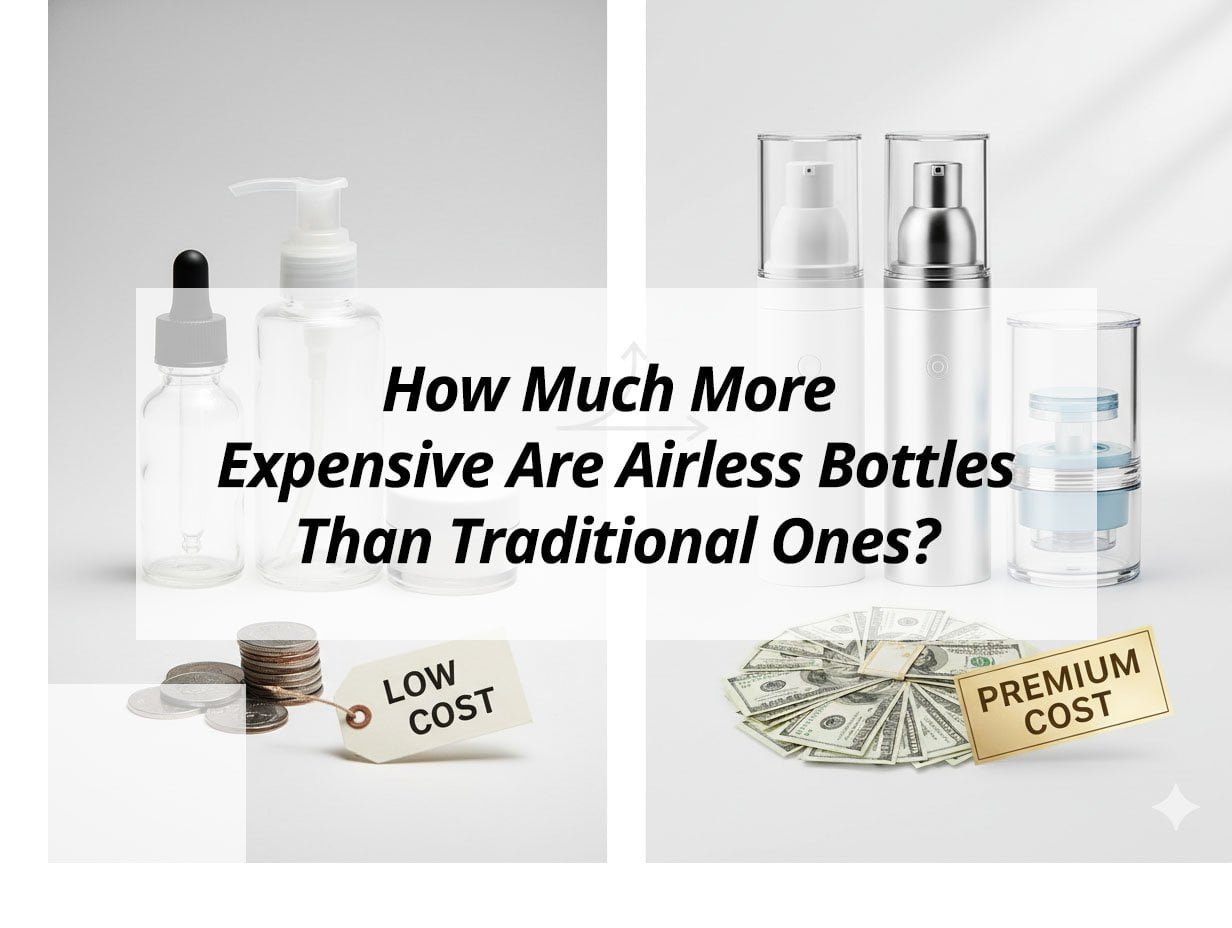
Plastic waste in cosmetic packaging is easy to blame but hard to measure. Many brands switch to airless bottles, then realize the answer is not simple.
Airless bottles usually save more product waste than plastic packaging waste. A well-designed airless bottle can reduce leftover formula from about 10–25% in some traditional bottles to about 1–5%. For packaging plastic, the saving may be small unless the bottle is refillable, lightweight, recyclable, mono-material, or made with PCR plastic.
The real answer depends on what we mean by “plastic waste.” If we mean the plastic bottle itself, airless packaging does not always use less plastic. Some airless bottles are more complex than standard pump bottles. But if we include wasted product, failed dispensing, leakage, contamination, and early disposal, airless bottles can reduce total waste in a more practical way.
Do Airless Bottles Really Reduce Plastic Waste?
Many brands hear “airless” and think it means “less plastic.” That is not always true. Airless packaging is a dispensing system first, and a sustainability tool second.
Airless bottles reduce plastic waste only when the design supports lower material use, reuse, recycling, or refill. A standard airless bottle may not use less plastic than a traditional pump bottle. But it can reduce waste by helping consumers use more of the formula before throwing the package away.
An airless bottle works with a piston, pouch, or bottle-in-bottle system. The product moves upward as the pump is pressed. No long dip tube is needed. Less air enters the package. This helps the product dispense more evenly and reduces the amount left at the bottom.
A 2025 study on cosmetic packaging emptiability found that packaging type strongly affects product residue. In some product categories, airless pump dispensers and jars had the lowest residue, while standard pump dispensers could retain much higher residue depending on product and design. The study reported pump dispenser residues up to 26% in some cases, while airless pump dispensers retained less than 1% for some hand cream products.
The key difference
| Waste Type | Traditional Bottle | Airless Bottle | Realistic Saving |
|---|---|---|---|
| Plastic body waste | Can be simple and light | Can be heavier or more complex | Not always lower |
| Formula residue | Often higher with thick creams and lotions | Usually lower when the system is well matched | Often meaningful |
| Contamination risk | Higher because air can enter | Lower because the formula is sealed | Helps avoid early disposal |
| Recycling | Depends on material and pump | Depends on mono-material or separable design | Case by case |
| Reuse/refill | Less common | Possible with refillable airless systems | Can reduce packaging impact |
So I would not say, “Airless bottles save 30% plastic waste” as a general rule. That would be too broad. I would say this instead: airless bottles can reduce usable product waste by about 5–23 percentage points, but plastic packaging waste savings depend on the structure.
How Much Product Waste Can Airless Bottles Save?
The biggest measurable benefit of airless bottles is product evacuation. This matters because cosmetic formulas are part of the product’s total environmental cost.
A well-designed airless bottle may allow users to access about 95–99% of the formula, while some traditional pumps, bottles, and tubes may leave much more product behind. In practical terms, a 50 ml skincare bottle may save around 2.5–11.5 ml of formula waste compared with a poorly emptied traditional pack.
Several packaging suppliers describe airless systems as having high evacuation rates, often around 95–98%. One airless packaging guide states that 95–98% evacuation means less product is discarded compared with jars or standard pumps. Another packaging FAQ explains that airless bottles use a piston or bag-in-bottle mechanism to create a vacuum effect and support complete evacuation.
The scientific study gives a more careful view. It found large differences by product type. For body lotion, airless pump dispensers retained about 0.29–1.18% residue, while bottles had a much wider range, from 2.84% to 23.29%. For face cream, some airless pump dispensers retained less than 1%, but one sample retained 3.3%. For serum, results varied widely because formula viscosity and system design changed performance.
Simple 50 ml example
| Packaging Type | Possible Residue | Product Left Behind in 50 ml |
|---|---|---|
| Good airless bottle | 1–5% | 0.5–2.5 ml |
| Traditional pump bottle | 10–25% | 5–12.5 ml |
| Possible saving | 5–23 percentage points | 2.5–11.5 ml |
This is why airless bottles are useful for skincare creams, serums, lotions, sunscreens, foundations, and active formulas. The more expensive or sensitive the formula is, the more important this saving becomes.
Do Airless Bottles Use Less Plastic Than Traditional Pump Bottles?
This is where many sustainability claims become weak. A bottle can reduce product waste and still use more plastic in the package.
Airless bottles may use the same amount of plastic, less plastic, or more plastic than traditional bottles. The result depends on wall thickness, pump design, refillability, PCR content, decoration, cap structure, and whether the bottle is mono-material.
Traditional pump bottles are often simple. They may use a PET or PP bottle, a pump, a dip tube, and a cap. Some are lightweight. But many traditional pumps contain mixed materials, including metal springs. These parts can make recycling more difficult.
Airless bottles are also different from each other. Some use double-wall structures. Some use pistons. Some use inner bags. Some use heavy caps. These designs may increase material use. But newer airless systems are trying to solve this problem.
Aptar’s Future Airless PET, for example, combines a mono-material PE dispensing pump with a PET bottle-in-bottle structure. Aptar says the bottle-in-bottle can be entirely made of rPET, and the metal-free pump can contain up to 52% PCR. The same page says the package was reviewed by RecyClass for recyclability.
What actually lowers plastic impact?
| Design Choice | Does It Reduce Plastic Waste? | Why |
|---|---|---|
| Lighter bottle body | Yes | Less plastic per unit |
| PCR plastic | Yes, partly | Reduces virgin plastic demand |
| Mono-material design | Yes, if recycled | Makes recycling easier |
| Metal-free pump | Often yes | Improves recyclability |
| Refillable airless system | Yes, if consumers refill | Reduces repeat primary packaging |
| Thick double-wall design | Not always | May increase plastic weight |
| Heavy decorative cap | Not always | Adds material without function |
So the honest answer is this: airless bottles save plastic waste only when the package is designed for that goal. If the airless system is heavy, mixed-material, and non-refillable, the plastic saving may be zero.
Are Refillable Airless Bottles Better for Plastic Waste?
Refillable airless bottles can reduce plastic waste, but only when people actually buy and use the refills. A refill system that sits unsold does not reduce waste.
Refillable airless bottles can reduce packaging waste when the durable outer bottle is reused many times and the refill uses less material than a full replacement bottle. But the refill must be convenient, affordable, clean, and easy to replace.
Refillable beauty is becoming more important, but it is not a magic fix. A recent Vogue Business article explains that refillable beauty works better when it is convenient and tied to products people buy repeatedly. It also notes that refill packaging must truly reduce plastic use, or it can become another sustainability halo.
For airless packaging, refill design is more complicated than a simple jar refill. The refill may need to stay sealed. It may need to protect the formula from air. It may need to keep the pump clean. This can add cost and engineering work.
Refillable airless makes sense when:
- The product has high repeat purchase.
- The outer bottle is durable and attractive.
- The refill contains less plastic than a new full bottle.
- The refill is cheaper than the full pack.
- The consumer can replace it without mess.
- The supplier can prove leakage and compatibility performance.
For skincare brands, refillable airless packaging can be strong for moisturizers, serums, sunscreens, body lotions, and professional treatment products. It is weaker when the product is low-cost, rarely repurchased, or hard to refill cleanly.
How Should Brands Calculate the Real Waste Saving?
A brand should not rely on one broad claim. It should calculate the waste saving by comparing bottle weight, residue rate, and refill behavior.
To calculate the real saving, compare the traditional bottle and airless bottle by total plastic weight, product residue percentage, number of refills, PCR content, recyclability, and defect rate. The best result comes from a full packaging comparison, not a simple “airless versus traditional” label.
Here is a simple formula:
Total waste impact = packaging plastic weight + product residue + damaged goods + refill performance + recycling outcome
A brand can start with these numbers:
| Metric | Traditional Bottle | Airless Bottle |
|---|---|---|
| Empty package weight | ___ g | ___ g |
| Product residue after use | ___ % | ___ % |
| Virgin plastic content | ___ % | ___ % |
| PCR plastic content | ___ % | ___ % |
| Refill cycles | 0 | ___ |
| Defect or leakage rate | ___ % | ___ % |
| Recyclability | Low / Medium / High | Low / Medium / High |
If a traditional bottle weighs 18 g and an airless bottle weighs 25 g, the airless pack uses more plastic at the start. But if the traditional bottle wastes 10 ml of an expensive lotion and the airless bottle wastes only 1 ml, the total resource saving may still favor airless packaging.
If the airless bottle is refillable, the calculation changes again. The first purchase may use more material. But the second, third, and fourth purchases may use less packaging if the refill is lightweight.
When Are Airless Bottles Worth It?
Airless bottles are not necessary for every cosmetic product. A simple cleanser or basic lotion may not need airless packaging.
Airless bottles are most worth it for formulas that are expensive, sensitive, thick, active, or easy to contaminate. They are less necessary for low-cost products, simple rinse-off formulas, or products that already empty well in flexible packaging.
Airless packaging is especially useful for:
| Product Type | Why Airless Helps |
|---|---|
| Vitamin C serum | Reduces air exposure |
| Retinol cream | Helps protect active ingredients |
| Sunscreen | Supports controlled dispensing |
| Foundation | Helps with thicker formula evacuation |
| Eye cream | Reduces contamination risk |
| Luxury moisturizer | Reduces expensive formula waste |
| Professional skincare | Improves hygiene and dosing |
Airless packaging also supports a premium user experience. The pump feels clean. The dose is more controlled. The consumer does not need to shake, cut, or scrape the package.
But the supplier must match the pump to the formula. The MDPI study found that serum performance can vary widely because viscosity and system construction affect emptying results. Some airless serum samples performed very well, while others retained much more product.
That means testing is not optional. Brands should test product evacuation, leakage, pump output, drop resistance, compatibility, decoration, and transport stability before placing bulk orders.
My insights: How Much Plastic Waste Do Airless Bottles Save Compared to Traditional Ones
Many buyers expect airless bottles to cut plastic waste directly. But the real saving often comes from using more product, not from using less bottle material.
Airless bottles usually save more product waste than packaging plastic waste. A well-designed airless system can reduce leftover formula from about 10–25% in traditional pump or squeeze bottles to around 1–5%. For a 50 ml skincare product, this may save about 2.5–11.5 ml of wasted formula.
The Real Saving Comes From Product Evacuation
When I compare airless bottles with traditional cosmetic bottles, I do not only look at the empty bottle weight. I also check how much formula the customer can actually use. This matters because the product inside the bottle also carries material cost, production cost, transport cost, and environmental impact.
Traditional pump bottles often leave product at the bottom, around the shoulder, or inside the dip tube area. This problem becomes more obvious with thick creams, lotions, sunscreens, foundations, and high-viscosity skincare formulas. Consumers may shake the bottle, press the pump many times, or throw the package away before the product is fully used.
Airless bottles solve part of this problem through a piston, pouch, or vacuum-style dispensing system. The formula moves upward as the pump is pressed, so less product stays trapped inside the container. This can reduce product residue and make the user experience cleaner.
| Comparison Point | Traditional Pump or Squeeze Bottle | Airless Bottle |
|---|---|---|
| Leftover formula | Often around 10–25% | Often around 1–5% |
| Waste-saving strength | Lower product evacuation | Higher product evacuation |
| Plastic bottle weight | May be lighter | May be heavier or similar |
| Best sustainability use | Simple low-cost formulas | Thick, active, or premium formulas |
| Real plastic impact | Depends on material and pump | Depends on PCR, refill, and recyclability |
Plastic Waste Savings Depend on the Bottle Design
Airless bottles do not automatically reduce plastic packaging waste. Some airless bottles use more components than traditional bottles. They may include an inner piston, double-wall structure, pump system, cap, and decoration parts. If the design is heavy, mixed-material, and difficult to recycle, the plastic waste saving may be limited.
The plastic impact becomes better when the airless bottle uses a lightweight body, mono-material structure, PCR plastic, refillable design, or recyclable pump system. A refillable airless bottle can reduce repeat packaging waste if the refill pack uses less material than a new full-size bottle. A mono-material airless bottle can also make recycling easier when local recycling systems accept the material.
So I would describe the saving in a careful way. Airless bottles can save about 2.5–11.5 ml of product waste per 50 ml bottle in many cosmetic cases. But the actual plastic packaging saving must be calculated by comparing bottle weight, material type, PCR content, refill cycles, recyclability, and pump structure.
Conclusion
Airless bottles can save about 5–23 percentage points of product waste, but they do not automatically save plastic packaging waste. The best option is lightweight, refillable, recyclable, mono-material, or PCR-based airless packaging.