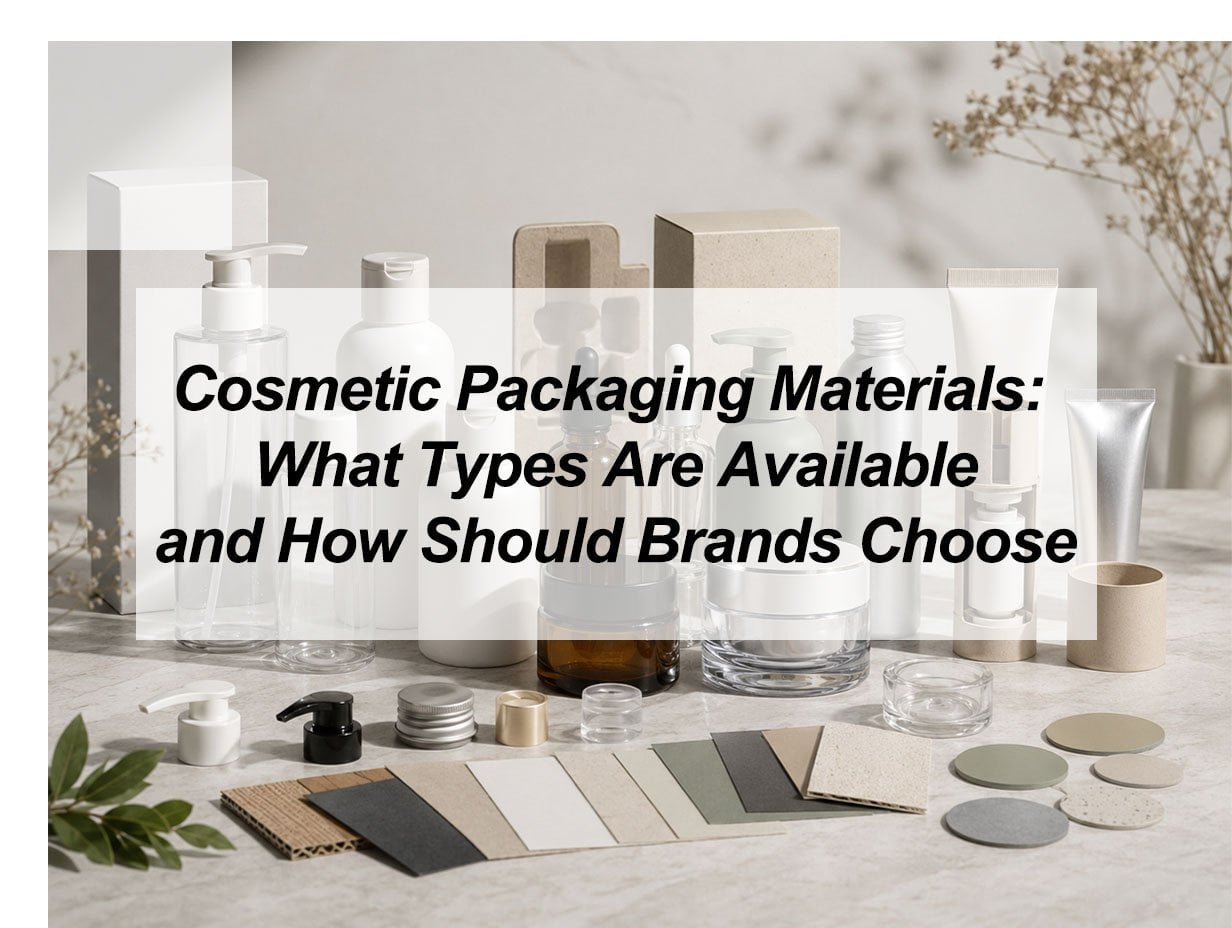
Cosmetic packaging looks simple from the outside. But one wrong material choice can affect product safety, cost, decoration, recycling, and customer trust.
Cosmetic packaging materials include PET, PP, PE, HDPE, acrylic, glass, aluminum, paperboard, PCR plastic, and refillable structures. Brands should choose them by matching the formula, product format, barrier needs, decoration plan, sustainability target, cost level, label space, shipping method, and end-user experience.
Cosmetic packaging materials must protect formulas, support use, fit branding, allow clear labeling, and meet growing rules for recyclability, recycled content, waste reduction, and safety documentation.
What Are the Main Types of Cosmetic Packaging Materials?
Material choice starts with knowing the basic options. Each material has a different use, strength, weakness, and brand feeling.
The main types of cosmetic packaging materials are plastic, glass, aluminum, paperboard, PCR plastic, acrylic, bamboo, and refillable or mono-material structures. PET, PP, PE, and HDPE are common plastic options, while glass and aluminum are often used for premium, protective, or reusable cosmetic packaging.
Plastic remains widely used because it is light, flexible, moldable, and cost-efficient. PET is often used for clear bottles when brands want to show the product color. HDPE and PE are useful for opaque bottles, tubes, and products that need impact resistance. PP is common for caps, closures, jars, compacts, and components that need repeated movement. Packaging suppliers often group PET, PP, PE, HDPE, PCR, glass, aluminum, and bamboo as common cosmetic packaging material options.
Common Cosmetic Packaging Materials
| Material | Common Uses | Main Strength | Main Watch Point |
|---|---|---|---|
| PET | Clear bottles, toner bottles, lotion bottles | Clear, light, good shelf look | Compatibility must be checked |
| PE / HDPE | Tubes, body lotion bottles, opaque bottles | Durable, flexible, impact-resistant | Less premium than glass |
| PP | Caps, jars, closures, compacts, pumps | Tough and good for repeated use | Surface decoration needs testing |
| Acrylic | Luxury jars, outer cases, makeup packs | Premium glass-like look | Recycling can be harder |
| Glass | Serums, fragrance, luxury skincare | Premium feel and strong barrier | Heavy and fragile |
| Aluminum | Tubes, bottles, caps, refillable packs | Premium and recyclable image | Dents and coating issues |
| Paperboard | Cartons, gift boxes, secondary packs | Printable and lightweight | Weak for wet formulas |
| PCR plastic | Bottles, jars, tubes, caps | Reduces virgin plastic use | Color, odor, and supply may vary |
A material list alone does not solve the decision. A brand still needs to match the material with the product. A cream jar may use PP, PET, glass, or acrylic. A serum bottle may use glass, PET, or an airless plastic system. A lipstick tube may use ABS, PP, aluminum, or mixed components. A compact case may use ABS, PP, metal pans, magnets, and mirrors. Each structure changes recycling, cost, weight, and decoration.
I would not choose a material only because it is popular. I would choose it because it fits the product. A lightweight PET bottle may be right for toner. A PE tube may be right for hand cream. A glass jar may be right for a premium cream. An aluminum tube may be right for a modern skincare line. A PCR bottle may be right when the brand wants to reduce virgin plastic use and can accept natural color variation.
How Do Brands Choose the Right Material for Cosmetic Packaging?
A good material decision starts with the formula, not the visual mood board. The package must protect the product before it sells the product.
Brands should choose cosmetic packaging materials by checking formula compatibility, product viscosity, barrier needs, dispensing method, decoration surface, sustainability target, cost, MOQ, shipping risk, label space, and supplier capability. The best material is the one that protects the formula, fits the brand, and works in production.
Formula compatibility is the first checkpoint. Cosmetic formulas can include oils, alcohol, fragrance, pigments, powders, acids, actives, preservatives, and surfactants. These ingredients can interact with packaging materials, coatings, gaskets, pumps, or labels. Cosmetic packaging testing services often evaluate plastic, glass, metal, and other substrates for interaction, migration, stability, and compatibility with cosmetic formulas.
Material Selection Checklist
| Question | Why It Matters |
|---|---|
| Is the formula watery, oily, thick, or powder-based? | Viscosity affects bottle, tube, jar, and pump choice |
| Does the formula contain alcohol, acids, or fragrance? | Some materials may swell, crack, or absorb odor |
| Does the formula need light or air protection? | Opaque, glass, aluminum, or airless options may help |
| Will the user squeeze, pump, twist, dip, or spray? | Usage method decides material stress |
| Does the brand need a premium look? | Glass, aluminum, acrylic, or thick-wall packs may fit |
| Does the brand need lower shipping weight? | Plastic and paperboard may help |
| Does the market require strong label information? | The package must leave enough readable space |
| Does the brand need recyclability or PCR content? | Component count and material family matter |
The second checkpoint is product format. A bottle and a tube do not behave the same way. A tube needs flexibility and seal strength. A pump bottle needs a rigid body and compatible actuator system. A jar needs wall strength and cap fit. A compact needs hinge strength, pan fit, mirror fit, and closure stability. A lipstick tube needs twist control and smooth assembly. These details matter before decoration starts.
The third checkpoint is the customer experience. A luxury serum may need glass because weight and clarity support the price point. A body lotion may need HDPE because the pack must survive bathroom use and shipping. A travel sunscreen may need PE tube packaging because it must squeeze easily and fit in a bag. A refillable skincare product may need a durable outer shell and replaceable inner part.
The fourth checkpoint is sourcing. A material may look perfect, but the supplier must support stable molds, decoration, MOQ, lead time, certificates, and quality control. A weak supplier can turn a good material into a late shipment or inconsistent product. I would always compare the material choice with real manufacturing conditions.
Which Cosmetic Packaging Material Is Best for Skincare, Makeup, and Personal Care?
There is no single best material for every cosmetic product. The best choice depends on product category and use behavior.
For skincare, PET, PP, glass, airless plastic, and aluminum are common choices. For makeup, PP, ABS, acrylic, aluminum, glass, and paperboard are often used. For personal care, PE, HDPE, PET, and refill pouches can work well because they support larger volumes, durability, and cost control.
Skincare packaging often needs strong compatibility and a clean application experience. Toners and light lotions can use PET or HDPE bottles. Serums can use glass bottles, PET bottles, or airless pumps. Creams can use PP jars, glass jars, acrylic jars, or airless jars. Products with sensitive formulas may need opaque or airless packaging.
Category-Based Material Guide
| Product Category | Common Packaging Materials | Practical Reason |
|---|---|---|
| Facial toner | PET, HDPE, glass | Clear display or durable daily use |
| Serum | Glass, PET, airless plastic | Premium look and controlled dispensing |
| Cream | PP, PET, acrylic, glass | Jar strength and brand positioning |
| Lotion | HDPE, PET, PP pump | Larger volume and easy dispensing |
| Lipstick | ABS, PP, aluminum | Structure, twist function, decoration |
| Compact powder | ABS, PP, metal pan, paperboard | Hinge, pan fit, and display value |
| Mascara | PP, PETG, aluminum parts | Wiper fit and brush control |
| Body wash | PET, HDPE, refill pouch | Larger capacity and bathroom durability |
Makeup packaging is more structural than many people expect. A compact case is not only a plastic shell. It may include a hinge, mirror, magnet, metal pan, label, and outer carton. A mascara pack needs a bottle, cap, rod, brush, and wiper. A lipstick needs a base, cup, inner mechanism, cap, and decoration. This is why material choice affects assembly, function, and defect rate.
Personal care packaging often needs durability and cost control. Body wash, shampoo, lotion, and hand cream usually need larger sizes. PE, HDPE, and PET are practical because they are light and strong. Paperboard may be used for secondary packaging, but it usually cannot replace primary packaging for wet products unless it uses special barriers or coatings.
Luxury products often use glass, acrylic, aluminum, and heavier plastic components. These materials can support a premium feel, but they also raise questions about shipping weight, breakage, recyclability, and component separation. A heavy jar may look attractive, but it may not fit a brand that wants lower shipping impact. A thick acrylic jar may look premium, but it may not support a simple recycling story.
How Can Brands Balance Cost, Sustainability, Compatibility, and Design?
Many packaging mistakes happen because brands choose one priority too early. A better choice balances several priorities at the same time.
Brands can balance cost, sustainability, compatibility, and design by using a material decision matrix. The matrix should compare formula safety, barrier needs, user experience, decoration quality, MOQ, unit cost, shipping weight, recyclability, PCR options, component count, and regulatory label space before sampling.
Sustainability is now a major packaging driver, but it must be specific. Mono-material plastic packaging can improve recyclability because bottles, closures, and components stay in the same material family. European packaging research also points to RecyClass and SPICE guidelines as useful references for designing recyclable cosmetic plastic packaging with materials such as PET, PP, and PE.
Material Decision Matrix
| Priority | Low-Risk Choice | Higher-Risk Choice | What to Confirm |
|---|---|---|---|
| Formula compatibility | Tested PET, PP, HDPE, glass | Unknown recycled or coated material | Stability and migration testing |
| Premium look | Glass, aluminum, acrylic | Thin low-cost plastic | Breakage, denting, decoration |
| Cost control | PE, PP, PET stock molds | Custom thick-wall molds | MOQ and tooling |
| Recyclability | Mono-material PET, PP, PE | Mixed pumps, magnets, mirrors, coatings | Sorting and local acceptance |
| Lightweighting | PET, PP, PE, paperboard | Heavy glass or thick acrylic | Shipping and protection |
| Refill potential | Durable outer plus simple refill | Complex refill with many parts | Repeat use and material savings |
| Label space | Wide bottle or carton | Tiny compact or slim tube | Required information layout |
Cost should not be judged only by unit price. A cheaper material can become expensive if it causes leakage, cracking, poor decoration, or product returns. A more expensive material can be worth it if it improves formula protection, shelf appeal, or repeat purchase. Brands should compare total cost, not only packaging cost. Total cost includes sampling, mold, decoration, assembly, shipping, storage, defects, and redesign risk.
Sustainability should also be judged with care. PCR plastic can reduce virgin plastic use, but it may have color limits, odor risk, and supply variation. Aluminum can be recyclable and premium, but primary aluminum production can be energy-intensive, so the best result depends on reuse, recycling, and sourcing. Refillable systems can reduce repeated packaging only when customers actually use the refills. Recent beauty refill discussions show that convenience, affordability, product loyalty, and real material reduction decide whether refill systems work.
Design must also serve function. A beautiful coating may reduce recyclability. A metallic sleeve may block sorting. A thick label may peel in the bathroom. A soft-touch finish may scratch during shipping. A paperboard carton may look sustainable but become wasteful if it is oversized. A practical design review should ask: Can the product survive use? Can the customer understand it? Can the supplier produce it consistently? Can the market dispose of it properly?
What Should Brands Test Before Confirming Cosmetic Packaging Materials?
A material should not be confirmed only from a catalog image. Brands need testing before they approve mass production.
Before confirming cosmetic packaging materials, brands should test formula compatibility, leakage, drop resistance, pump output, cap torque, label adhesion, decoration durability, color stability, odor transfer, heat resistance, shipping strength, and recyclability claims. Testing reduces risk before molds, large orders, and launch timelines are locked.
Testing should start with the formula inside the actual package. A material may look stable when empty, but the formula can change its behavior. Oils can soften some materials. Fragrance can be absorbed. Pigments can stain. Alcohol can stress-crack some plastics. Thick creams can clog pumps. Powders can scratch inner surfaces or affect closure fit. Chemical resistance charts can help teams understand risk, but real formula-pack testing is still necessary.
Pre-Production Testing Checklist
| Test Area | What to Check |
|---|---|
| Compatibility | Color change, odor change, swelling, cracking, migration |
| Leakage | Cap seal, pump seal, tube seal, travel movement |
| Dispensing | Pump output, spray pattern, squeeze force, stick movement |
| Decoration | Rub resistance, scratch resistance, water and oil exposure |
| Drop test | Breakage, cracking, cap separation, pump damage |
| Heat test | Shape change, leakage, label lifting, formula change |
| Shipping test | Carton strength, inner protection, vibration risk |
| Label review | Ingredients, warnings, directions, batch, responsible party |
| Sustainability claim | PCR documentation, recyclability evidence, component count |
Label review should happen early. The FDA says cosmetic labeling requirements affect what appears on cosmetic packaging, and brands should not treat the label as an afterthought. The EU market also requires cosmetic products to follow its cosmetic product regulation framework. This means a small jar, slim tube, or compact may need extra planning for readable information, multi-language needs, inserts, cartons, or digital support.
Brands should also request supplier documentation. A supplier may need to provide material data, PCR certificate, compatibility guidance, decoration limits, production tolerances, and quality-control standards. This is especially important when using PCR, aluminum with inner coating, refillable systems, or mixed-material components.
I would approve a packaging material only after the team reviews design, formula, production, and market needs together. A material that satisfies only the design team may fail in filling. A material that satisfies only the purchasing team may weaken the brand. A material that satisfies only the sustainability team may fail in customer use. A good package must work across all of these areas.
My insights: Cosmetic Packaging Materials: What Types Are Available and How Should Brands Choose
Choosing the wrong cosmetic packaging material can damage formula stability, increase cost, weaken brand image, and create sourcing problems.
Cosmetic packaging materials include PET, PP, PE, HDPE, acrylic, glass, aluminum, paperboard, PCR plastic, and refillable structures. Brands should choose materials by checking formula compatibility, barrier needs, product viscosity, decoration method, sustainability goals, cost, label space, shipping risk, and the customer experience.
From Material Lists to Real Packaging Decisions
Cosmetic packaging material selection should not start with appearance only. I would start with the formula, then compare the package structure, market position, sustainability target, and production needs. A luxury serum, a body lotion, a lipstick, a cream jar, and a sunscreen tube all need different material logic.
| Decision Area | What Brands Should Check | Why It Matters |
|---|---|---|
| Formula fit | Oils, alcohol, acids, pigments, fragrance, viscosity | The wrong material can react with the formula |
| Product format | Bottle, tube, jar, compact, stick, pump, carton | The format decides the material choices |
| Barrier needs | Air, light, moisture, heat, odor, leakage | Some formulas need stronger protection |
| Decoration | Label, silk screen, hot stamping, coating, metallization | Decoration must match the material surface |
| Sustainability | PCR, mono-material, refillable, recyclable | Buyers need clearer material responsibility |
| Cost and MOQ | Mold cost, decoration cost, weight, supplier ability | Material choice affects total project cost |
| Compliance | Label space, material safety, documentation | Packaging must support market requirements |
The best choice is usually a balance. PET may be clear and light, but it may not fit every active formula. Glass may feel premium, but it can raise freight cost and breakage risk. Aluminum may look modern, but it may need inner coating. PCR plastic may support sustainability, but color and supply can be less stable. A good material decision should protect the product, fit the brand, support the user, and reduce avoidable risk before production.
Conclusion
Cosmetic packaging materials should be chosen through formula fit, function, design, cost, sustainability, and compliance, not by appearance alone.