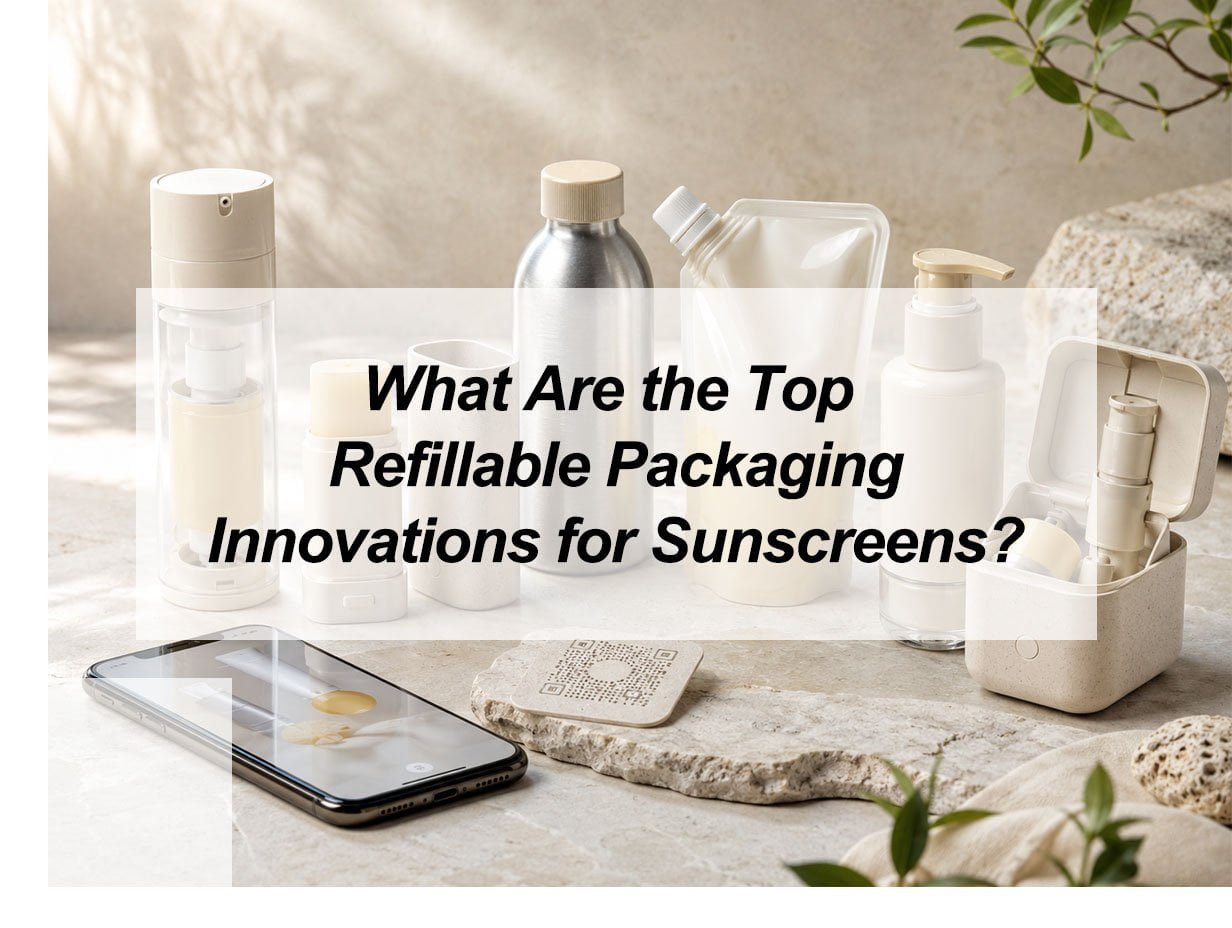
Refillable sunscreen packaging can reduce waste, but poor design creates mess, leakage, and low repeat use. The best systems make refilling feel easy.
The top refillable packaging innovations for sunscreens are refillable airless bottles, replaceable stick cartridges, aluminum reusable bottles, lightweight refill pouches, mono-material pump systems, smart QR refill labels, and modular outer cases. These innovations help brands reduce repeated packaging while keeping SPF formulas protected, clean, portable, and easy to understand.
I see refillable sunscreen packaging becoming more important because sun care is changing. Sunscreen is no longer only a beach product. It is becoming part of daily skincare, sports routines, travel kits, kids care, and outdoor lifestyles. This means packaging must support repeat use, clearer instructions, and better convenience.
In 2026 beauty packaging, refillable packs continue to grow in popularity, while online shopping, sustainable packaging, and premium airless dispensers remain important packaging themes. Refillable beauty is also getting more attention, but industry coverage shows that convenience and affordability are still major barriers to real adoption.
For sunscreen, refillable packaging is more complex than many other cosmetic categories. SPF products need formula protection, stable dispensing, clear label space, and good hygiene. In the U.S., sunscreen products that make water-resistance claims must support those claims through required testing, and labels must state whether the product remains effective for 40 or 80 minutes in water. In the EU, sunscreen products also use UVA labeling guidance and protection communication that affects packaging design and label space.
This is why refillable sunscreen packaging should not be treated as a simple eco upgrade. It must be designed as a full packaging system.
What Are the Best Refillable Packaging Formats for Sunscreens?
Many brands want refillable sunscreen packaging, but the format must match the formula first. A refill idea is weak if the sunscreen cannot dispense cleanly.
The best refillable sunscreen packaging formats are refillable airless bottles, reusable aluminum bottles, refill pouches, replaceable stick cartridges, modular pump bottles, and refillable sunscreen tubes. Each format fits a different SPF use case, so brands should compare formula type, product viscosity, hygiene, portability, label space, and refill behavior before choosing.
Sunscreen formulas are not all the same. A daily facial SPF lotion is different from a thick mineral sunscreen. A clear gel sunscreen is different from a tinted SPF cream. A kids sunscreen stick is different from a family-size body lotion. The package must match the formula before it matches the brand story.
Refillable Sunscreen Format Comparison
| Format | Best For | Why It Works | What to Check |
|---|---|---|---|
| Refillable airless bottle | Facial SPF, skincare SPF | Controlled dosing and cleaner use | Pump compatibility and refill design |
| Aluminum reusable bottle | Premium body SPF, outdoor SPF | Durable and recyclable image | Denting, cost, and decoration |
| Refill pouch | Family sunscreen, body sunscreen | Lower repeat rigid packaging | Pouring, leakage, and recycling |
| Stick cartridge | Kids SPF, sport SPF, face touch-up | Easy replacement and portable use | Stability and cartridge fit |
| Modular pump bottle | Lotion SPF, daily body SPF | Familiar use with refill potential | Mixed pump materials |
| Refillable tube | Travel SPF, daily SPF | Lightweight and common format | Refill opening and sealing |
The refillable airless bottle is one of the most useful options for facial sunscreen. It gives a skincare feeling, controls dosage, and keeps fingers away from the formula. Mono-material and all-plastic airless systems are also appearing in beauty packaging because they can support refillability and simpler recycling design compared with more complex mixed-material packs.
Aluminum refillable bottles are also important. Aluminum became a strong beauty packaging material because it can support a premium look and a plastic-reduction story. Beauty packaging trend coverage for 2026 notes that aluminum has gained attention as refillable models grow and brands look for plastic-free alternatives. For sunscreen, aluminum can work well for premium body SPF or outdoor-positioned sun care, but brands must test denting, coating, formula compatibility, and cap performance.
Refill pouches are useful when the goal is to reduce repeated rigid packaging. But they are not perfect. If the pouch is hard to pour, leaks during travel, or feels cheap, users may not repeat the refill. A pouch can save material only when the customer actually uses it and when the pouch design does not create another hard-to-recycle problem.
How Can Refillable Sunscreen Packaging Stay Hygienic and Leak-Proof?
A refillable sunscreen pack can look sustainable, but it will fail if it leaks in a bag or feels unsafe to refill.
Refillable sunscreen packaging can stay hygienic and leak-proof by using controlled refill openings, replaceable inner cartridges, airless pumps, tight closure systems, tamper-evident details, clear cleaning instructions, and formula-compatible materials. Brands should test the package with real sunscreen viscosity, heat exposure, travel movement, and repeated opening cycles.
Hygiene is one of the biggest issues for refillable SPF packaging. Sunscreen is often used outdoors, near water, on sand, in heat, and with wet hands. A customer may apply it at the beach, in a car, at a playground, or after exercise. The refill system needs to handle real life.
Hygiene and Leakage Checklist
| Checkpoint | Why It Matters |
|---|---|
| Refill opening | A narrow or guided opening reduces mess |
| Closure seal | Strong sealing prevents bag leakage |
| Airless system | Less direct contact can improve clean use |
| Inner cartridge | Replacing the inner part can reduce contamination |
| Heat testing | Sunscreen may sit in a hot car or beach bag |
| Drop testing | Outdoor products need stronger durability |
| Cleaning guidance | Users need simple care steps |
| Tamper evidence | Refills should feel safe and new |
Airless systems are useful because they can separate the formula from frequent finger contact. They can also create a premium dispensing experience. But an airless system must be carefully developed if it is refillable. The refill action should not expose the formula too much, break the pump seal, or create trapped product waste.
Cartridge systems solve some hygiene concerns. Instead of pouring product into an old container, the user replaces the inner pod, stick, or cartridge. This can work well for sunscreen sticks, compact SPF products, and premium skincare-style SPF. The outer case can stay beautiful and durable, while the inner unit remains clean and fresh.
Leak-proof design is also essential. Sunscreen is often carried in handbags, beach bags, school bags, and luggage. A refillable cap must survive repeated opening and closing. Flip caps, screw caps, pumps, and twist mechanisms should be tested with filled product, not only with water. Sunscreen viscosity, oils, powders, and emulsions can behave differently from simple test liquids.
Brands should also think about refill instructions. A QR code can show a short refill video, cleaning steps, recycling guidance, and storage advice. This keeps the label clean while giving the user more help. Smart packaging can add value when it gives useful product-specific information instead of sending the user to a general homepage.
Are Refill Pouches, Cartridges, and Airless Systems Really Better for SPF Packaging?
Refillable packaging is not automatically sustainable. It only helps when the full system reduces waste and works in real user behavior.
Refill pouches, cartridges, and airless systems can be better for SPF packaging when they reduce repeated rigid packaging, protect the formula, keep refilling simple, and encourage repeat purchase. They are not better when they add too many mixed materials, create messy use, cost too much, or fail to make customers buy refills.
This is the reality check. A refillable sunscreen system can look great in a campaign, but the environmental benefit depends on how many times the outer pack is reused and how much material the refill uses. Beauty industry analysis has warned that refill systems can fail when they are expensive, inconvenient, poorly adopted, or built around products customers do not repurchase often.
Refill System Trade-Off Table
| Refill System | Strong Point | Weak Point | Best Use |
|---|---|---|---|
| Pouch refill | Lower repeated rigid packaging | Can be messy or hard to recycle | Family and body SPF |
| Inner cartridge | Cleaner and easy to replace | More precise tooling needed | Sticks, compacts, premium SPF |
| Airless refill | Clean dosing and premium feel | More complex structure | Facial SPF and skincare SPF |
| Aluminum bottle refill | Durable outer pack | Higher cost and denting risk | Premium sun care |
| Modular pump refill | Familiar use | Pump may use mixed materials | Daily lotion SPF |
A pouch refill can be useful for body sunscreen because customers may use larger volumes. But the pouch should be easy to pour and seal. It should also show clear instructions. If the customer spills product during refill, the system feels wasteful and annoying. If the pouch cannot be recycled in the target market, the brand must be careful with its claims.
A cartridge system can feel more premium and controlled. It is easier for the user because they remove one part and insert another. This works well for sunscreen sticks, compact SPF, and skincare-like SPF. The trade-off is that the cartridge needs accurate fit, stable locking, and clear material planning.
An airless refill system can be the strongest format for premium facial sunscreens. It supports controlled dosage and a clean beauty routine. It also matches the skin care positioning of modern daily SPF. The challenge is cost and complexity. A refillable airless system should not add so many parts that it loses the benefit of refillability.
The best answer is not one format. The best answer depends on use. A daily facial SPF may need a refillable airless bottle. A sport sunscreen may need a refillable stick cartridge. A family body sunscreen may need a durable bottle plus pouch refill. A premium mineral sunscreen may need an aluminum bottle or modular pump system. The innovation is the match between format and habit.
What Should Brands Check Before Launching Refillable Sunscreen Packaging?
A refillable sunscreen launch needs more than a beautiful mockup. It needs testing, sourcing control, and a clear repeat-use plan.
Before launching refillable sunscreen packaging, brands should check formula compatibility, SPF label space, refill convenience, leakage, hygiene, material claims, recycling limits, supplier capability, MOQ, decoration durability, and customer adoption. A refillable system should be tested as a real product routine, not only as a packaging concept.
The first check is formula compatibility. Sunscreen formulas can contain oils, filters, powders, emulsifiers, fragrances, and pigments. These materials can interact with packaging over time. A pack that works for lotion may not work for mineral sunscreen. A pump that works for serum may clog with a thicker SPF cream. A pouch that works for body wash may not work for high-viscosity sunscreen.
Pre-Launch Testing Checklist
| Area | What to Test |
|---|---|
| Formula compatibility | Material stability, odor change, color change, leakage |
| Dispensing | Pump output, tube squeeze, stick glide, refill flow |
| Label space | SPF value, directions, warnings, water-resistance information |
| Refill steps | Opening, pouring, inserting, sealing, cleaning |
| Durability | Drop test, heat test, travel test, repeated use |
| Decoration | Printing rub resistance, water exposure, oil resistance |
| Sustainability claim | Material data, refill weight, recyclability proof |
| Supplier ability | Mold, MOQ, lead time, certificates, sample control |
Sunscreen label space is also important. In the U.S., sunscreen labels must follow specific rules around SPF, broad-spectrum statements, directions, and water-resistance claims. Water-resistant sunscreen labels need to state whether protection is retained for 40 or 80 minutes after water exposure. In the EU, sunscreen packaging also needs clear UVA communication when the product meets the recommended UVA protection level. A refillable format cannot ignore these needs just because it is smaller or more decorative.
Brands should also check whether the refill system has a real reason to exist. Refillable beauty often works better for products with strong loyalty and repeat purchase behavior. Sunscreen can fit this because many people use SPF daily, but the system must make repeat buying easy. Refills should be available in the same sales channels. The refill price should make sense. The instructions should be simple. The outer pack should feel worth keeping.
A launch team should compare the full system cost. A refillable package may cost more at the start, but it can support loyalty if the outer pack is strong and the refill is priced well. It can also improve brand image if the material and refill logic are honest. But if the system is too expensive or inconvenient, customers may not use it again.
How Can Smart Packaging Improve Refillable Sunscreen Systems?
Refillable packaging needs clear instructions. Smart packaging can explain the system without crowding the physical label.
Smart packaging can improve refillable sunscreen systems by adding QR codes, NFC tags, refill videos, product authentication, recycling instructions, batch details, and reorder links. This helps brands keep the physical pack clean while giving customers the practical information they need to refill, reuse, recycle, and apply SPF correctly.
A refillable sunscreen package has more information to explain than a normal package. It must explain the product, the SPF level, the application routine, the refill process, the material story, and the disposal method. There is limited space on a small tube, bottle, stick, or cartridge. A QR code or NFC label can extend the package into a digital guide.
Smart Packaging Uses for Refillable SPF
| Smart Feature | How It Helps |
|---|---|
| QR refill guide | Shows refill steps with simple visuals |
| NFC authentication | Helps confirm product identity |
| Reorder link | Makes refill purchase easier |
| Recycling guide | Explains how to separate or dispose of parts |
| Usage education | Shows how much SPF to apply and when to reapply |
| Batch information | Supports traceability and trust |
| Loyalty page | Rewards repeat refill purchases |
This is useful for global brands. A small sunscreen pack may be sold in several markets with different languages and label needs. Digital content can help explain extra information without making the pack look crowded. It can also support e-commerce because the same digital page can connect the product page, packaging instructions, and reorder flow.
Smart packaging should stay simple. A QR code should not lead to a generic brand homepage. It should open a specific page for that sunscreen product. The page should show refill instructions, product use, storage advice, material details, and refill purchase options. If the product uses a cartridge, the page can show which cartridge fits. If the product uses a pouch, the page can show how to pour without mess. If the pack uses a pump, the page can show how to clean and reuse the outer part.
For B2B sunscreen packaging development, this matters because packaging is not only physical anymore. The pack is part of a larger customer journey. A refillable sunscreen bottle can become a product, instruction system, authenticity tool, recycling guide, and repeat-purchase channel at the same time.
My insights: What Are the Top Refillable Packaging Innovations for Sunscreens
Refillable sunscreen packaging sounds simple, but many systems fail when refilling feels messy, costly, or hard to repeat.
The top refillable packaging innovations for sunscreens include refillable airless bottles, replaceable stick cartridges, aluminum reusable bottles, lightweight refill pouches, mono-material pump systems, smart QR refill guidance, and modular outer cases. These options help brands reduce repeated packaging waste while protecting SPF formulas, label clarity, hygiene, and user convenience.
From One-Time SPF Packs to Refillable Sun Care Systems
A good refillable sunscreen package should not only look sustainable. It should work as a full repeat-use system. I would compare each option by formula fit, refill method, hygiene, leakage control, material reduction, label space, and user habit.
| Innovation | Best Use Case | Main Benefit | Main Risk |
|---|---|---|---|
| Refillable airless bottle | Facial SPF, premium SPF lotion | Cleaner dosing and formula protection | More complex structure |
| Stick refill cartridge | Sport SPF, kids SPF, touch-up SPF | Easy replacement and portable use | Smaller fill size |
| Aluminum reusable bottle | Premium sun care, body SPF | Durable and recyclable feel | Dents and cost need review |
| Refill pouch | Family sunscreen, body lotion SPF | Lower repeated rigid packaging | Messy refill risk |
| Mono-material pump | Lotion or gel sunscreen | Easier recycling direction | Pump performance must be tested |
| QR refill guide | Global SPF lines | More information without label crowding | Must provide useful content |
| Modular outer case | Luxury SPF, refill-first brands | Strong repeat-purchase identity | Needs real consumer loyalty |
The best innovation is not only the pack. It is the system behind the pack. A refillable sunscreen must be easy to buy again, easy to open, easy to refill, clean to use, safe for the formula, and clear on the shelf. If the refill feels like extra work, the customer may return to normal packaging.
Conclusion
Refillable sunscreen packaging works best when innovation supports real daily use, clean refilling, formula protection, clear labeling, and repeat purchase instead of only looking sustainable.