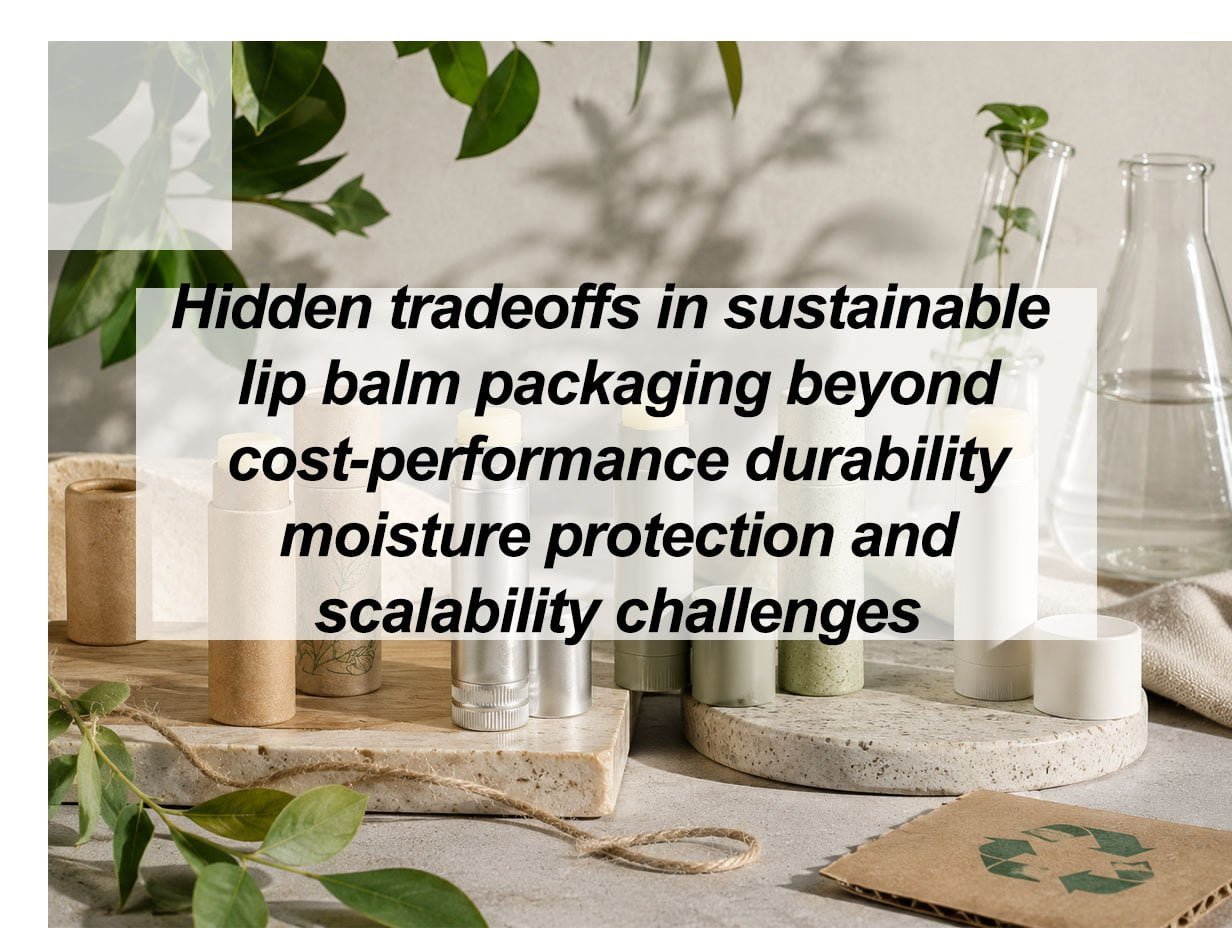
Sustainable lip balm packaging sounds simple. A brand replaces plastic, tells a greener story, and wins customer trust. But the real problems often appear after production starts.
The hidden tradeoffs in sustainable lip balm packaging go beyond cost. Brands must test performance, durability, moisture protection, formula compatibility, user experience, recyclability claims, and scalability. Paper, aluminum, PCR plastic, compostable materials, and refillable systems can all work, but each option creates different risks during filling, shipping, storage, use, and disposal. Sustainable packaging materials often need to balance environmental goals with durability, barrier protection, handling requirements, and recovery systems.
I often see brands focus on the visible part of sustainable packaging first. They ask whether the tube looks eco-friendly. They ask whether the unit price is acceptable. They ask whether the customer will like the story. These questions matter, but they are not enough. A lip balm package must also protect oils, waxes, fragrances, active ingredients, and the user experience. If the tube warps, absorbs oil, cracks, leaks, or feels difficult to use, the sustainable message becomes weaker.
What Are the Disadvantages of Sustainable Lip Balm Packaging?
A sustainable package can reduce plastic use, but it can also introduce new performance risks if the material is not matched to the balm formula.
The disadvantages of sustainable lip balm packaging include weaker moisture resistance, lower oil barrier performance, more complex filling requirements, possible durability issues, higher minimum order pressure, and unclear end-of-life claims. Paper tubes, compostable formats, PCR plastic, aluminum, and refill systems each solve one problem while creating another. Paper packaging can face waterproofing and airtight sealing limits, especially when products need moisture protection or stable barrier performance.
Sustainability Does Not Remove the Basic Job of Packaging
A lip balm package has a simple job on the surface. It holds the product. But in real production, the job is much bigger. It must protect the formula from air, heat, moisture, dirt, and handling damage. It must work with hot filling. It must survive shipping pressure. It must open and close cleanly. It must let the customer apply the product without mess.
This is where sustainable formats become more complicated. Paperboard tubes can reduce plastic, but untreated paper naturally has weaker resistance to oil and moisture. Suppliers often add wax liners, greaseproof liners, PLA coatings, or barrier layers to improve protection. These layers may improve function, but they can also make recycling or composting claims more complex. Some suppliers describe waxed or greaseproof liners as oil- and moisture-resistant, but the brand still needs to test them with the real lip balm formula.
| Packaging option | Main benefit | Hidden tradeoff |
|---|---|---|
| Paper tube | Plastic reduction and natural look | Oil absorption, moisture damage, push-up friction |
| Aluminum tin | Strong barrier and recyclability | Heavier feel, denting, different application habit |
| PCR plastic tube | Uses recycled content | Material quality and color consistency can vary |
| Compostable tube | Strong eco story | Composting access and coating claims need proof |
| Refillable format | Less primary packaging over time | Consumer repeat use and refill waste can be hard to control |
The Real Risk Is Product Failure
Cost is easy to calculate. Product failure is harder. If a paper tube absorbs oil, the outside may stain. If the inner disc sticks, the customer cannot push the balm up smoothly. If the package softens in a humid warehouse, it may look cheap. If the tube lacks barrier strength, the balm may lose fragrance, texture, or stability.
So I treat sustainable lip balm packaging as a performance system, not just a material choice. The tube, liner, formula, filling temperature, storage condition, label, carton, and shipping route all work together. If one part fails, the whole sustainable story suffers.
Are Paper Lip Balm Tubes Durable Enough for Daily Use?
Paper lip balm tubes can work well, but they need the right structure, liner, coating, and formula testing.
Paper lip balm tubes can be durable enough for daily use when they have proper wall thickness, a stable push-up mechanism, oil-resistant lining, and moisture protection. The risk is not paper itself. The risk is using paper without enough barrier design, filling control, and real-use testing. Cardboard tubes are often described as more prone to wear and moisture damage than metal or plastic options, especially for oily or soft balms.
Durability Has More Than One Meaning
When a buyer asks whether paper tubes are durable, the answer should not be only yes or no. Durability has several layers. The tube must resist crushing during transport. The sidewall must stay firm when the user holds it. The cap must fit well after many openings. The bottom disc must move without slipping backward. The surface must resist scuffing, oil marks, and moisture stains.
Paper packaging can perform better than many people expect, especially when it uses multi-layer paperboard and an inner barrier. But paper still reacts to water and oil differently from plastic or aluminum. This means a paper tube that works well in a dry room may behave differently in a humid bathroom, a hot car, or a long ocean shipment.
Test Conditions Matter
| Test area | Why it matters | Simple check |
|---|---|---|
| Drop resistance | Protects package during handling | Drop filled tubes from table height |
| Compression | Protects during carton stacking | Test stacked cartons under weight |
| Cap fit | Keeps product clean | Open and close samples repeatedly |
| Push-up movement | Affects daily user experience | Test cold, room-temperature, and warm samples |
| Surface staining | Protects brand image | Store filled tubes for several weeks |
Paper Needs Formula Matching
A hard balm with a balanced wax structure may work well in a paper tube. A softer balm with more liquid oils may create more risk. A formula with volatile fragrance, high oil migration, or strong colorants may need more careful barrier testing. Some paper tube suppliers specifically mention oil sticking problems when the tube lacks a proper oil-resistant lining or when filling temperatures are too high.
I would not approve a paper lip balm tube based only on an empty sample. Empty samples can feel firm and clean. The real test starts after filling. The balm should sit in the tube during heat, cold, humidity, transit vibration, and repeated consumer handling. A sustainable tube should still look acceptable when the customer is halfway through the product.
How Does Moisture Protection Affect Sustainable Lip Balm Packaging?
Moisture protection affects both the package and the formula. It can decide whether a sustainable tube feels premium or fragile.
Moisture protection is critical because lip balm packaging must resist humidity from storage, shipping, bathrooms, handbags, and warm climates. Paper and plant-based materials often need liners or coatings to protect against moisture and oil. Without enough barrier protection, packaging can soften, stain, deform, or weaken. Sustainable packaging guidance often lists resistance to moisture, heat, and environmental factors as a key performance challenge.
Lip Balm Is Small but Demanding
Lip balm looks like a simple solid product, but it is demanding for packaging. It contains waxes, butters, oils, flavors, fragrances, pigments, and sometimes SPF ingredients. These ingredients can migrate, soften, separate, or react with weak barriers. A tube may also face temperature changes during filling and shipping.
Moisture protection matters in two directions. First, the package must stop outside humidity from weakening the material. Second, the package must stop oils and fragrance inside the balm from damaging the tube. This is why a sustainable package needs both external and internal protection.
Barrier Layers Create a New Tradeoff
A liner can solve one problem and create another. A wax paper liner can help resist oil. A PLA coating can protect the surface. A greaseproof liner can improve product contact performance. But once coatings are added, end-of-life communication becomes more important. The package may still be compostable under certain conditions, or it may need industrial composting, or it may not fit normal paper recycling.
| Barrier choice | Performance value | Sustainability question |
|---|---|---|
| Wax liner | Helps resist oil migration | Is it accepted in composting or recycling? |
| Greaseproof paper | Reduces oil absorption | What treatment was used? |
| PLA coating | Adds moisture protection | Is industrial composting available? |
| Plastic liner | Stronger barrier | Does it reduce recyclability? |
| Aluminum layer | Strong protection | Does it create multi-material complexity? |
Moisture Protection Should Be Proven, Not Assumed
I would test moisture protection with filled tubes, not only material sheets. The test should include high-humidity storage, warm storage, cold storage, and normal bathroom-like exposure. The package should be checked for swelling, odor change, staining, cap looseness, disc sticking, and label damage.
A sustainable claim can bring attention, but moisture failure can damage repeat purchase. In lip balm, the product lives in pockets, bags, bathrooms, cars, and travel kits. That daily environment is much less controlled than a design presentation. A package must survive the real life of the buyer.
Can Sustainable Lip Balm Packaging Scale for Wholesale Production?
A material can look perfect in a small sample run but become risky when the brand needs thousands or millions of units.
Sustainable lip balm packaging can scale only when material supply, production tolerance, filling speed, decoration quality, lead time, and logistics are stable. Many sustainable materials face limits in consistent quality, available volume, coating control, and supplier capacity. Scalability is not only about making more units. It is about making the same unit again and again. McKinsey notes that sustainable materials may not always be available in consistent quality or in the volumes required by packaging purchasers.
Scaling Exposes Hidden Weaknesses
Small-batch sustainable packaging often looks attractive. The samples may have a nice kraft texture, a clean label, and a strong eco message. But wholesale production is different. A brand needs repeatable dimensions, stable color, low defect rate, predictable delivery, and compatibility with filling equipment.
Paper tubes can have tolerance variation. The inner diameter may affect how the balm releases. The cap tightness may change between batches. The bottom disc may move differently if humidity changes the paper. PCR plastic can have color variation because recycled feedstock may not be as consistent as virgin resin. Aluminum can scale well in some formats, but tooling, decoration, and dent prevention need attention.
Scalability Checklist
| Scaling factor | What can go wrong | What to confirm before bulk order |
|---|---|---|
| Raw material supply | Batch variation or shortage | Supplier capacity and backup sources |
| Tube dimensions | Filling line jams or loose caps | Tolerance reports and pre-production samples |
| Barrier consistency | Oil staining or moisture damage | Coating specification and migration test |
| Decoration | Logo color shifts or surface scratches | Print samples after final coating |
| Shipping | Crushing or humidity damage | Carton design and transit testing |
| End-of-life claim | Greenwashing risk | Clear claim support and disposal guidance |
Scale Also Includes Disposal
Scalability does not stop at the factory. It also includes whether the package can enter a real recovery system. Small-format beauty packaging is often difficult to recycle, and refill systems also need frequent enough reuse to create environmental savings. The Sustainable Packaging Coalition notes that beauty’s small-format packaging has proven challenging for recyclability, and refill pods or inserts can also create disposal issues if they are not recyclable.
This matters for lip balm because the package is small. A tiny tube may be missed in sorting systems. A paper tube with residue may not behave like clean paperboard. A refill cartridge may reduce the outer package but still create a new waste stream. So I would not call a format scalable only because a factory can produce it. I would ask whether the whole system can scale, from sourcing to filling to disposal.
My insights: What Are the Hidden Tradeoffs in Sustainable Lip Balm Packaging Beyond Cost
The deepest tradeoff is not between cheap and expensive. It is between environmental intent and real product performance.
The hidden tradeoffs in sustainable lip balm packaging beyond cost are performance reliability, durability under daily use, moisture and oil barrier strength, formula compatibility, production consistency, customer convenience, and scalable recovery. A package is truly better only when it protects the balm, supports the brand claim, survives logistics, and fits a realistic end-of-life path. Industry reviews of sustainable packaging often emphasize that every material has sustainability and performance tradeoffs, so brands should evaluate best-use categories instead of assuming one material is always better.
The Fifth Insight: Sustainable Packaging Must Protect the Product First
This is the key insight that should answer the H1. Sustainable lip balm packaging fails when it is judged only by material image or unit cost. A kraft paper tube may look greener than plastic, but if it absorbs oil, sticks during use, or collapses in humidity, it is not a strong choice. Aluminum may offer better barrier protection, but it can be heavier and more energy-intensive to produce. PCR plastic may keep familiar tube performance, but recycled material quality and supply can vary. Refill systems may reduce waste, but only if customers actually refill often enough.
Compare the Tradeoffs Before Choosing
| Decision area | What the brand wants | Hidden tradeoff to test |
|---|---|---|
| Performance | Smooth application and stable balm | Tube friction, oil migration, formula softening |
| Durability | Clean look through full product life | Scuffing, denting, crushing, cap looseness |
| Moisture protection | Stable package in humid conditions | Swelling, staining, odor, coating failure |
| Scalability | Reliable wholesale supply | Batch variation, MOQ, lead time, supplier limits |
| Sustainability claim | Clear eco story | Composting access, recycling acceptance, residue issues |
| User experience | Easy daily use | Push-up control, portability, hygiene, mess |
A Practical Selection Framework
I would start with the formula, not the package. A firm wax balm can tolerate different packaging options than a soft oil-rich balm. A tinted balm needs more attention to staining. An SPF balm may need stronger protection from air, light, and heat. A fragrance-heavy balm may need better barrier control.
Then I would test the package under real conditions. I would fill samples at production temperature. I would store them in heat and humidity. I would ship them in cartons. I would open and close them many times. I would ask users to carry them for several weeks. I would check not only whether the packaging survives, but whether it still feels clean, premium, and easy to use.
The best sustainable lip balm packaging is not always the most natural-looking option. It is the option that creates the lowest total risk across product protection, customer trust, production stability, and end-of-life reality. For some brands, that may be a well-lined paper tube. For others, it may be aluminum, PCR plastic, a mono-material tube, or a refill system. The correct choice depends on the product promise and the supply chain behind it.
Conclusion
Sustainable lip balm packaging must do more than look eco-friendly. It must protect the balm, survive real use, scale reliably, and support honest disposal claims.