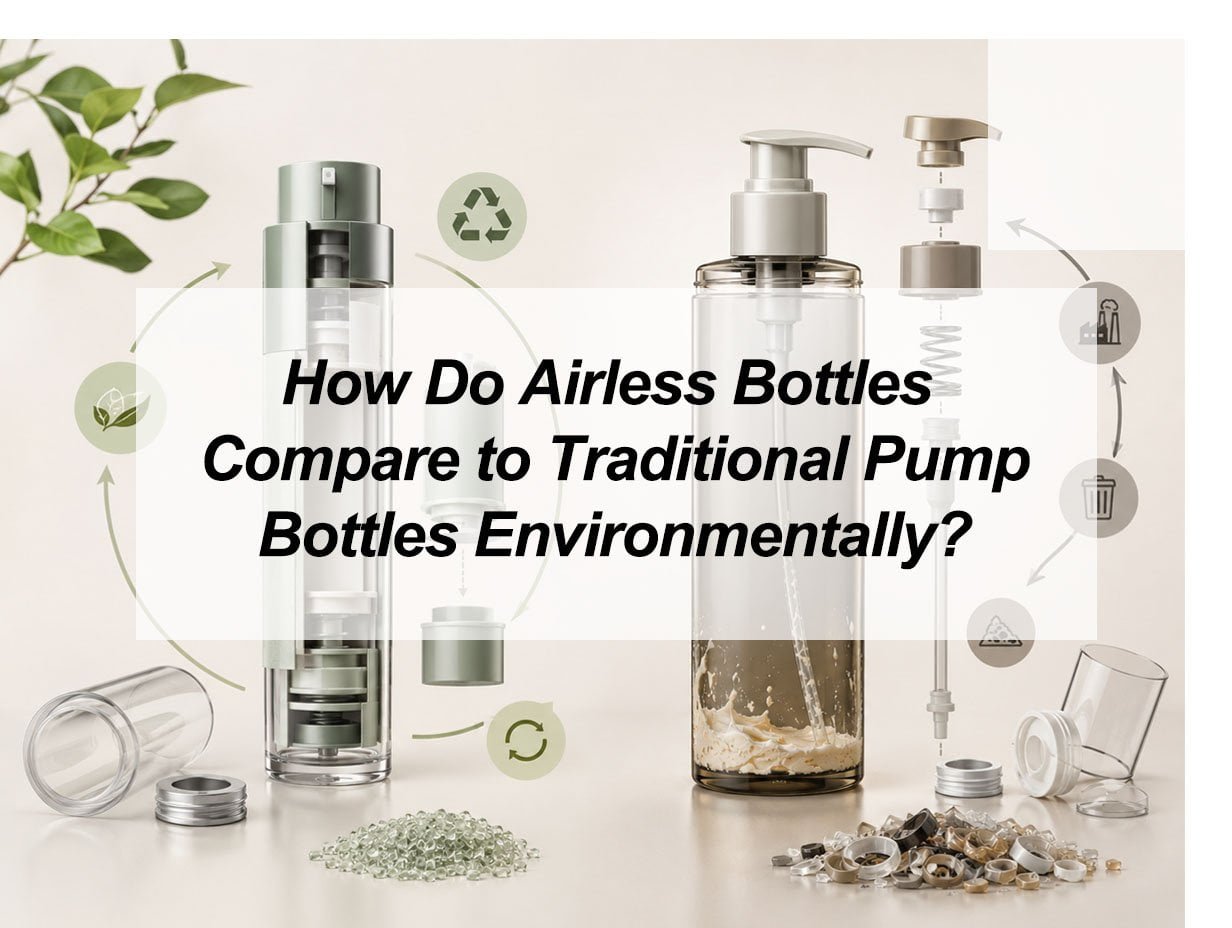
A package can look sustainable but still waste product, block recycling, or use too much material. The real answer is not always visible from the outside.
Airless bottles often compare better environmentally when they reduce product residue, protect sensitive formulas, and use recyclable or refillable structures. Traditional pump bottles may use simpler parts and lower material weight, but they can leave more product behind and may still be difficult to recycle because pumps often include mixed components. A 2023 life cycle assessment of cosmetic dispensing systems found that an airless pump system had less environmental burden than a general dip-tube pump and a bag-in-bottle format across all studied impact categories, while packaging material production and product residue were major contributors.
I do not compare airless bottles and traditional pump bottles by price or appearance alone. I compare them as systems. A bottle system includes the plastic body, pump, actuator, spring, dip tube, piston, label, refill option, decoration, product residue, and end-of-life route. If I only ask which package uses less plastic, I may miss the bigger picture. If I only ask which package protects the formula better, I may also miss the recycling problem.
What Is the Difference Between Airless Bottles and Traditional Pump Bottles?
The difference is not only the pump head. The difference is how the product moves, how much air enters, and how much product is left behind.
A traditional pump bottle usually uses a dip tube to pull product from the bottom of the bottle. An airless bottle usually uses a vacuum or piston system to push product upward without letting much air enter. This difference affects product protection, residue, material complexity, and recyclability.
Airless Bottles Protect the Formula More Closely
An airless bottle is designed to reduce contact between the formula and outside air. This matters for skincare products with active ingredients, natural oils, antioxidants, or formulas that can oxidize. When the package protects the formula better, the brand may reduce product spoilage, returns, and wasted product. That can improve environmental performance, because the product inside often has its own material, energy, water, and production footprint.
A traditional pump bottle is simpler in one way. It usually has a bottle, pump, actuator, dip tube, and closure system. It can work well for lotions, cleansers, haircare, and many stable formulas. But it often allows more air exchange over time, and the dip tube may not remove all product from the bottom or sides.
| Comparison point | Airless bottle | Traditional pump bottle |
|---|---|---|
| Dispensing method | Vacuum or piston movement | Dip tube pulls product upward |
| Formula exposure | Lower air exposure | More air can enter over time |
| Product residue | Often lower | Often higher, depending on viscosity |
| Material complexity | Can be higher | Can be simpler, but pump may still be mixed-material |
| Recycling potential | Stronger if mono-material or refillable | Stronger if pump and bottle are designed for recycling |
The Environmental Answer Depends on the Whole System
An airless bottle may use more parts than a basic bottle. That can increase material demand. But if it reduces product waste, protects a high-impact formula, and is designed with recyclable materials, it can still perform better overall. The 2023 LCA is useful because it counted both packaging materials and the facial cream residue left behind, not only the empty packaging weight.
This is why I avoid a simple answer like “airless is greener” or “traditional pumps are greener.” The better question is: which system creates the lowest total burden for this exact formula, market, filling process, and disposal path?
Are Airless Pump Bottles Recyclable?
Airless pump bottles can be recyclable, but not every airless bottle should be called recyclable.
Airless pump bottles are more recyclable when they use mono-material plastic, avoid metal springs, reduce mixed parts, and fit real collection and sorting systems. Multi-material airless bottles can be harder to recycle, especially when the pump, piston, spring, label, and bottle body are not compatible. The Association of Plastic Recyclers says a package is recyclable only when its design is recycling-compatible, consumers have access to collection, the package is accepted in the recycling stream, and there are markets for the recycled resin.
Recyclability Is Not Just a Symbol
Many brands focus on the recycling symbol. I think that is too simple. A package may carry a plastic code and still fail in real recovery systems. The APR also notes that every design feature of a package should be assessed, including base resin, color, size, closures, and dispensers. It also says recyclability should not depend on consumers removing closures, washing packages, or taking extra steps beyond normal use.
This matters for both airless bottles and traditional pump bottles. A traditional pump bottle may look easier to recycle because the bottle body is simple. But the pump may include a metal spring, several plastic types, and a dip tube. If the consumer does not separate the pump, the full package may be less recycling-friendly.
Mono-Material Airless Designs Change the Comparison
Newer airless designs try to solve this problem with all-plastic or mono-material structures. A PP airless bottle, for example, can be designed so the body and mechanism are more compatible with the same recycling stream. This does not make every design automatically recyclable in every country. But it moves the package closer to real recyclability.
| Design choice | Environmental advantage | Risk to check |
|---|---|---|
| Mono-material airless bottle | Easier material compatibility | Local recycling access may still vary |
| Metal-free pump | Less separation difficulty | Pump performance must stay reliable |
| PCR plastic body | Reduces virgin plastic demand | Color and strength consistency need testing |
| Refillable airless system | Reuses outer package | Consumer refill behavior must be strong |
| Traditional pump with removable pump | Simpler bottle recovery | Consumers may not remove the pump |
The Ellen MacArthur Foundation reported that cosmetics signatories have worked on reducing or eliminating items such as PETG, undetectable carbon black, pumps, and triggers to improve recyclability. This shows that pump systems are a known recyclability challenge in beauty packaging. The issue is not only airless bottles. It is dispenser design in general.
Do Airless Bottles Reduce Product Waste Better Than Traditional Pumps?
Product waste is one of the strongest environmental arguments for airless packaging.
Airless bottles often reduce product waste better than traditional pump bottles because the piston or vacuum system can push more formula toward the dispenser. Traditional dip-tube pumps may leave product at the bottom, on the walls, or around corners, especially when the formula is thick.
The Product Inside Also Has an Environmental Footprint
Many packaging comparisons focus on the empty bottle. That is easy to weigh. But the product inside also matters. A serum, cream, lotion, or sunscreen may require water, oils, emulsifiers, active ingredients, heating, mixing, testing, labor, and shipping. If 5% to 15% of the product remains trapped in the package, the environmental loss is not only plastic. It is also wasted formula.
The 2023 LCA included both packaging material and facial cream residue in the environmental assessment. It found that packaging material production was the largest contributor for all studied formats, followed by lotion residue. That finding is important because it supports a more complete view. A package that uses slightly more material may still perform better if it greatly reduces product residue.
Residue Depends on Formula Viscosity
The waste difference is not the same for every product. A thin toner may leave less residue in a traditional pump. A thick cream, sunscreen, primer, or lotion may leave much more. A product with a high retail price or high environmental ingredient footprint may benefit more from airless dispensing.
| Formula type | Traditional pump risk | Airless bottle advantage |
|---|---|---|
| Thin lotion | Moderate residue | Cleaner dosing and better protection |
| Thick cream | Higher residue | More complete evacuation |
| Serum with actives | Oxidation and residue risk | Better air control and precise use |
| Sunscreen | Formula stability matters | Better protection and controlled dosing |
| Clean beauty formula | Preservative and oxidation concerns | Lower air exposure can help stability |
I would not choose airless packaging only because it sounds advanced. I would test real fill weight, evacuation rate, product stability, and consumer use. If the airless bottle removes more product and keeps the formula stable longer, it can reduce waste in a way that a simple material-weight comparison may miss.
Are Traditional Pump Bottles More Environmentally Friendly?
Traditional pump bottles can be more environmentally friendly in some cases, but only when the design is simple, lightweight, recyclable, and suitable for the formula.
Traditional pump bottles may be environmentally better when they use less material, work with stable low-viscosity formulas, avoid unnecessary decoration, and use recyclable bottle materials. But they can perform worse when they leave too much product behind, include mixed-material pumps, or fail to protect sensitive formulas.
Traditional Pumps Can Be Efficient for the Right Product
A traditional pump bottle still has a place in sustainable cosmetic packaging. It can be lightweight. It can use common plastics such as PET, HDPE, or PP. It can be easy to fill. It can run well on high-speed production lines. It can also be easier for customers to understand.
For rinse-off products, body lotion, simple moisturizer, or formulas with strong stability, a traditional pump bottle may be enough. If the product is easy to dispense and does not leave much residue, the environmental benefit of airless packaging may become smaller.
The Pump Is the Problem Area
The bottle body may be recyclable, but the pump is often the weak point. Pumps can include several materials, including different plastics and sometimes metal springs. This makes the whole unit harder to process. APR guidance says package recyclability depends on design, access, acceptance, and end markets, not only on material identity.
| When traditional pumps may work better | When airless may work better |
|---|---|
| Stable formulas | Sensitive formulas |
| Low-viscosity products | Thick creams or lotions |
| High-volume basic products | High-value skincare |
| Lightweight bottle design | Products with high residue risk |
| Simple recycling-compatible pump | Mono-material or refillable airless system |
I would choose a traditional pump when it gives enough protection with less material and strong recyclability. I would choose airless when product preservation, controlled dosing, and lower residue create a clear environmental benefit. The more sensitive and valuable the formula is, the stronger the case for airless packaging becomes.
My insights: How Do Airless Bottles Compare to Traditional Pump Bottles Environmentally
This is the main decision point. The better option is the one that reduces total environmental burden, not the one that looks greener.
Airless bottles compare favorably to traditional pump bottles when they reduce product waste, extend formula stability, support precise dosing, and use recyclable, refillable, or mono-material designs. Traditional pump bottles compare favorably when they are lighter, simpler, recycling-compatible, and used for stable formulas that do not leave much residue.
The Fifth Insight: Airless Is Better Only When Performance Offsets Complexity
The most important insight is simple. Airless bottles are not automatically greener. Traditional pump bottles are not automatically worse. Airless packaging can win environmentally when its performance benefits are strong enough to offset its added structure.
If an airless bottle protects a sensitive formula from oxidation, reduces leftover product, and uses a mono-material or refillable design, it can have a strong environmental case. If it uses mixed materials, heavy decoration, non-recyclable parts, and no refill option, the case becomes weaker.
Traditional pump bottles can also be improved. Brands can reduce bottle weight, avoid dark colors that are hard to sort, use PCR content, choose compatible labels, and design pumps for recycling. The APR Design Hub frames circular plastic packaging as packaging designed to be compatible with recycling systems, reduce contamination, and support post-consumer resin use.
A Practical Comparison Table
| Environmental factor | Airless bottle | Traditional pump bottle |
|---|---|---|
| Product protection | Usually stronger | Usually weaker |
| Product residue | Often lower | Often higher for thick formulas |
| Material weight | Often higher | Often lower |
| Mechanism complexity | Higher | Medium |
| Recycling challenge | Depends on mono-material design | Pump can still be difficult |
| Refill potential | Strong in newer systems | Possible, but less common |
| Best use case | Sensitive skincare and high-value formulas | Stable lotions and high-volume products |
The Best Choice Needs a Life Cycle View
A life cycle view is important because packaging sustainability is not one factor. It includes material production, manufacturing, filling, shipping, product use, residue, collection, recycling, and end-of-life. The 2023 LCA is a useful reminder because the airless pump system performed best in that study, but the result was based on a specific facial cream case and a specific set of system boundaries.
So I would use airless bottles when the formula needs protection and the bottle design supports recovery. I would use traditional pump bottles when the formula is stable and the package can stay light, simple, and recycling-compatible. The best environmental answer is not a packaging trend. It is a tested match between formula, function, material, and disposal reality.
Conclusion
Airless bottles can be environmentally stronger than traditional pump bottles, but only when reduced product waste and better formula protection outweigh added material and recycling complexity.