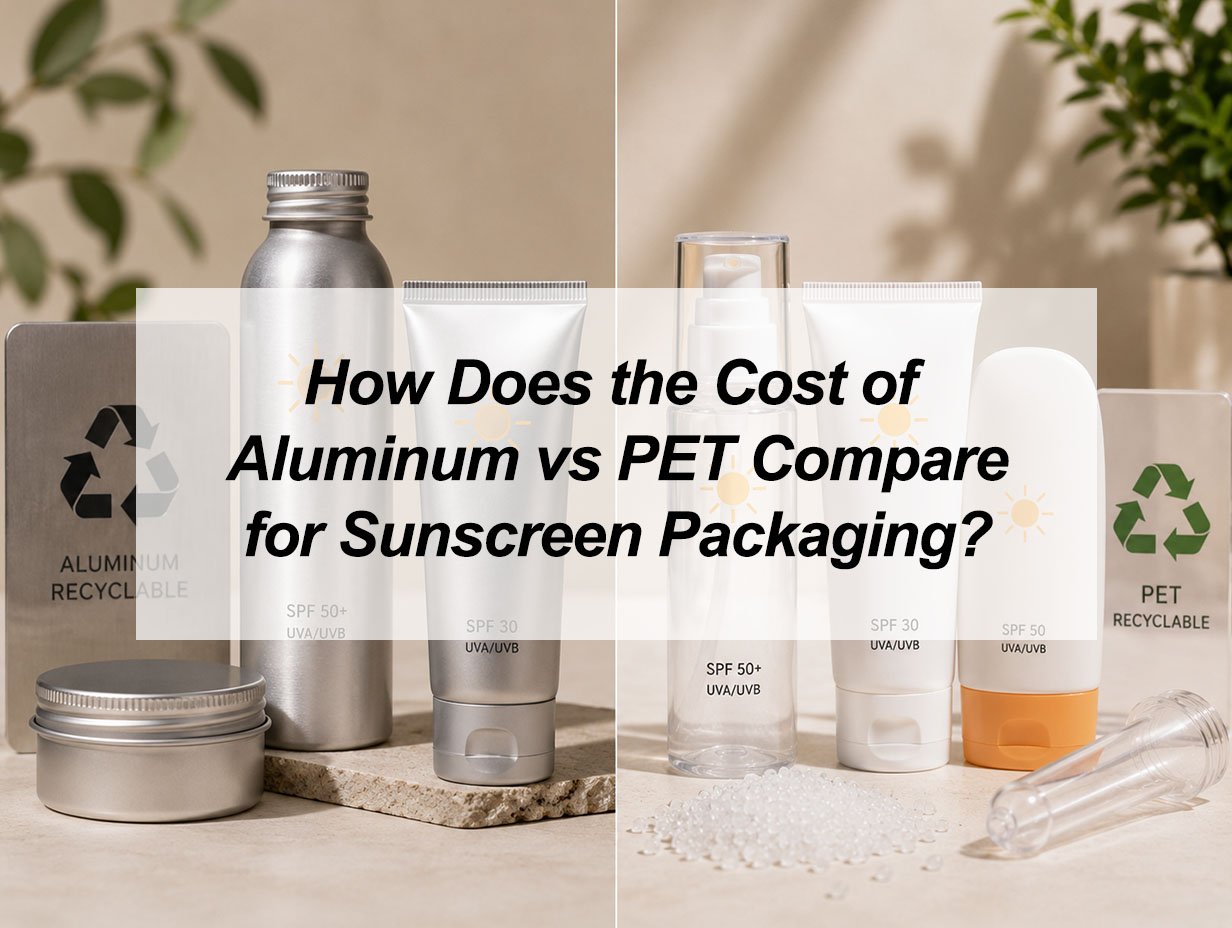
Sunscreen packaging cost is not just the bottle price. Material, molding, decoration, shipping, protection, and recycling all change the final decision.
Aluminum sunscreen packaging usually has a higher upfront cost than PET, while PET is usually cheaper, lighter, and easier to scale. Aluminum can still be worth choosing for premium sunscreen because it offers stronger shelf differentiation, better light-blocking perception, and a stronger recycling or refill story when the full system is designed well.
Sunscreen brands should compare PET and aluminum by total cost. PET is usually cheaper and lighter, while aluminum adds premium value, light protection, and sustainability appeal.
What Drives the Cost Difference Between Aluminum and PET Sunscreen Packaging?
The cost difference starts with raw material, but it does not end there. The real cost comes from the full packaging system.
The cost difference between aluminum and PET sunscreen packaging is driven by raw material price, bottle weight, production process, mold cost, decoration method, inner coating, closure choice, MOQ, freight, damage risk, recycling story, and brand positioning. PET often wins on scale cost, while aluminum often wins on premium value.
1. Raw Material Cost
PET usually has a lower raw material cost than aluminum. It is also widely used in bottle production, which helps suppliers offer more stock molds and common neck finishes. This makes PET easier for many sunscreen brands to source quickly.
Aluminum usually starts from a higher material base. It may also need extra processing, inner coating, shaping, printing, and surface protection. In the U.S., aluminum costs have also faced pressure from tariffs and low stocks, with Reuters reporting record-high costs for U.S. consumers in early 2026 after import tariff increases and supply tightness.
2. Production and Tooling Cost
PET bottles can be made through processes such as injection stretch blow molding, extrusion blow molding, or other bottle-forming routes depending on the bottle type. Many suppliers already have stock molds for sunscreen, lotion, toner, and personal care bottles.
Aluminum bottles may need more specialized tooling and forming. They may also need internal coating if the formula should not touch bare metal. This coating can add cost, testing time, and quality-control steps.
| Cost Driver | PET | Aluminum |
|---|---|---|
| Raw material base | Lower in most cases | Higher in most cases |
| Stock mold availability | High | Lower or more specialized |
| Inner coating | Usually not needed | Often needed |
| Decoration cost | Flexible and familiar | Can be higher depending on finish |
| MOQ flexibility | Often better | Often higher for custom projects |
| Sampling speed | Usually faster | Can be slower |
3. Decoration Cost
PET can use labels, silk screen printing, hot stamping, matte coating, color masterbatch, or shrink sleeves. It gives brands many low-to-mid-cost decoration paths.
Aluminum can look premium with printing, anodizing, brushing, matte coating, or metallic effects. But these finishes may increase cost. They also need scratch, dent, and adhesion testing.
4. Shipping and Handling Cost
PET is very light. That helps reduce freight pressure, especially for export orders and large-volume sunscreen lines.
Aluminum is also lighter than glass, but it is usually heavier than PET for similar sunscreen bottle formats. It can also dent during shipping or daily use. Brands should check carton protection, scratch resistance, and handling marks before choosing aluminum for mass retail.
Is Aluminum or PET Cheaper for Sunscreen Bottles?
For most sunscreen bottle projects, PET is cheaper. But cheaper does not always mean better.
PET is usually cheaper than aluminum for sunscreen bottles because it has lower material cost, lighter weight, broader supplier availability, and more stock mold options. Aluminum usually costs more, but it can justify the increase when the product needs premium positioning, plastic reduction, stronger light protection, or refillable packaging value.
1. PET Is Usually Better for Mass-Market Cost
PET works well when the brand needs:
- lower unit price;
- lighter shipping weight;
- clear or colored bottle options;
- common pump or cap necks;
- fast sourcing;
- large-volume production;
- flexible decoration.
PET is useful for daily sunscreen lotions, family SPF, body sunscreen, travel-size bottles, and mass retail products. It can also work for clinical sunscreen if the brand wants a clean, clear, or opaque bottle design.
2. Aluminum Is Usually Better for Premium Value
Aluminum works well when the brand needs:
- premium shelf image;
- plastic-reduction story;
- reusable or refillable positioning;
- stronger light-blocking appearance;
- outdoor or luxury sun care identity;
- metal texture;
- higher retail price support.
Aluminum can help sunscreen packaging feel more durable and more special. But the brand must be able to explain the value. If the consumer only sees a higher price without a clear benefit, aluminum may weaken price competitiveness.
3. Simple Cost Direction
| Project Type | Better Cost Choice | Reason |
|---|---|---|
| Entry-level SPF lotion | PET | Lower unit cost and lighter shipping |
| Family sunscreen | PET | Larger volume needs cost control |
| Travel sunscreen mini | PET or aluminum | PET is cheaper; aluminum adds premium story |
| Premium mineral sunscreen | Aluminum | Stronger barrier and eco-positioning |
| Daily facial SPF | PET or aluminum | Depends on price point and formula protection |
| Refillable sunscreen | Aluminum or durable PET | Depends on refill system and repeat use |
| Luxury SPF line | Aluminum | Stronger premium signal |
PET is the practical choice when price matters most. Aluminum is the strategic choice when packaging helps the brand sell at a higher value.
How Do Sustainability and Recycling Change the Real Cost Comparison?
Sustainability changes the cost comparison because it adds material proof, recycling claims, refill systems, and end-of-life planning.
Sustainability can make aluminum more attractive because aluminum has a strong recycling story and high material value. PET can still be cost-effective and sustainable when it uses rPET, mono-material design, clear recycling guidance, and compatible labels or caps. The real comparison depends on the full packaging structure and local recycling systems.
1. Aluminum Sustainability Cost
Aluminum can be recycled repeatedly, and it has strong scrap value. This gives it a strong sustainability story. But new aluminum can be energy-intensive. Beauty packaging coverage has noted that aluminum can be attractive for recyclability, but a new aluminum bottle may carry a higher global-warming impact than a new PET bottle in some comparisons.
This means aluminum is strongest when:
- recycled aluminum content is used;
- the bottle is reused or refilled;
- the packaging replaces more wasteful formats;
- local recycling systems accept it;
- the brand explains disposal clearly.
2. PET Sustainability Cost
PET is lightweight and widely used. It can reduce transport cost and is recyclable in many systems. But PET recycling depends on collection, sorting, color, labels, caps, contamination, and local infrastructure.
PET becomes stronger when:
- rPET content is used;
- the bottle is clear or lightly colored;
- the label does not block sorting;
- the cap and pump are chosen carefully;
- the brand avoids unnecessary mixed materials;
- the package gives clear recycling instructions.
3. Regulation Adds Future Cost
The EU Packaging and Packaging Waste Regulation entered into force on February 11, 2025 and will generally apply from August 12, 2026. It pushes packaging toward waste reduction, recyclability, reuse, refill, and clearer packaging management.
This matters for both aluminum and PET. Future packaging cost may include:
- recyclability review;
- supplier documentation;
- material certificates;
- recycled-content planning;
- label changes;
- packaging reduction work;
- refill or reuse system planning.
| Sustainability Area | PET Cost Impact | Aluminum Cost Impact |
|---|---|---|
| Recycled content | rPET may cost more or vary by supply | Recycled aluminum content may affect sourcing |
| Recyclability | Stronger with clear mono-material design | Strong if coating and closures are managed |
| Transport footprint | Usually lower due to light weight | Higher than PET in many bottle formats |
| Refill potential | Possible with durable PET | Stronger premium refill story |
| Consumer perception | Can be seen as plastic unless explained | Often seen as more sustainable |
| Documentation | rPET certificates may be needed | Recycled content and coating proof may be needed |
Sustainability does not automatically make aluminum cheaper or PET worse. It changes the decision from unit price to long-term value.
What Should Brands Check Before Choosing Aluminum or PET Sunscreen Packaging?
A good material decision should start with the formula, then move to cost, decoration, testing, and market position.
Before choosing aluminum or PET sunscreen packaging, brands should check formula compatibility, UV protection, inner coating, bottle weight, neck finish, closure fit, decoration durability, MOQ, tooling, freight, recycling claims, label space, and total landed cost. The best material should protect the formula and support the brand’s price strategy.
1. Formula Compatibility
Sunscreen formulas may contain UV filters, oils, fragrance, alcohol, powders, pigments, and mineral particles. These ingredients can interact with plastic, coating, pumps, labels, or metal surfaces.
Brands should test:
- formula stability;
- odor change;
- color change;
- leakage;
- coating reaction;
- pump output;
- cap seal;
- long-term storage;
- heat exposure.
Aluminum may need an inner coating. PET may need UV-blocking color or additives. Neither material should be approved without compatibility testing.
2. UV and Light Protection
Sunscreen packaging should protect the formula during storage and use. Aluminum blocks light well because it is opaque. PET can be clear, tinted, opaque, or UV-treated depending on the design.
| Protection Need | PET | Aluminum |
|---|---|---|
| Clear product visibility | Strong | Not suitable |
| Light blocking | Needs color, additive, or label | Naturally strong |
| Heat feel | Can be lighter in hand | Metal may feel warmer or colder |
| Formula protection | Good with correct design | Strong barrier image with coating |
| Shelf display | Flexible | Premium and distinctive |
3. Closure and Pump Fit
The bottle material is only one part of the package. The closure often creates the real use experience.
Brands should check:
- flip cap fit;
- screw cap torque;
- pump compatibility;
- spray actuator fit;
- gasket material;
- leakage during travel;
- dip tube length;
- refill opening;
- child or family use needs.
PET bottles often have many standard neck options. Aluminum bottles may need more careful closure matching and sealing tests.
4. Decoration Durability
Sunscreen products are used with wet hands, oily skin, beach bags, heat, and outdoor conditions. Decoration must survive this environment.
Testing should include:
- scratch test;
- rub test;
- oil exposure;
- sunscreen contact;
- water exposure;
- heat aging;
- carton friction;
- label adhesion.
A premium aluminum bottle with scratched decoration can lose value quickly. A PET bottle with a peeling label can look cheap. Decoration should be tested as seriously as the bottle body.
How Should Brands Build a Practical Cost Comparison Table?
A cost table should compare full project cost, not only the bottle quote.
Brands should build a practical aluminum vs PET cost comparison table by listing material cost, tooling, unit price, decoration, closure, compatibility testing, freight, damage rate, sustainability documentation, MOQ, lead time, and expected retail value. This gives a clearer view of the real packaging decision.
Cost Comparison Template
| Cost Item | PET Bottle | Aluminum Bottle | Notes |
|---|---|---|---|
| Raw material | Lower | Higher | PET resin generally starts cheaper |
| Bottle forming | Lower to medium | Medium to high | Depends on process and supplier |
| Stock mold | Easier to find | Less common | PET often offers more choices |
| Private mold | Possible | Possible | Aluminum may need more specialized tooling |
| Decoration | Flexible | Premium but can cost more | Depends on finish |
| Closure | Many standard options | Needs careful fit | Sealing is critical |
| Compatibility testing | Required | Required | Aluminum may need coating review |
| Shipping | Lower | Higher than PET | Weight and carton protection matter |
| Damage risk | Low dent risk | Dent and scratch risk | Packaging protection matters |
| Sustainability proof | rPET and recyclability data | Recycled aluminum and coating data | Claims need documents |
| Brand value | Practical and scalable | Premium and distinctive | Retail price matters |
Small Decision Points
Choose PET when:
- the product is price-sensitive;
- the order volume is large;
- the brand needs lower freight cost;
- fast sourcing matters;
- stock molds are preferred;
- the sunscreen is mass-market or family-use;
- the brand wants clear or translucent packaging.
Choose aluminum when:
- the product is premium;
- the brand wants a plastic-reduction story;
- the formula needs strong light-blocking perception;
- the pack may be reused or refilled;
- shelf differentiation matters;
- the retail price can support higher packaging cost;
- the brand wants a more durable outdoor image.
Compare total value when:
- the product sits between mass and premium;
- the brand sells online and needs strong visuals;
- sustainability claims are important;
- the target market has strict packaging rules;
- the supplier offers both PET and aluminum options.
The best comparison is not “Which material is cheaper?” The better question is, “Which material gives the right cost, protection, image, and repeat-purchase value for this sunscreen line?”
My insights: How Does the Cost of Aluminum vs PET Compare for Sunscreen Packaging
Choosing sunscreen packaging by unit price alone can create hidden costs in decoration, shipping, product protection, and brand positioning.
Aluminum sunscreen packaging usually costs more upfront than PET, while PET is usually cheaper, lighter, and easier to scale. However, aluminum can add premium value, stronger light protection, and a better recycling story. Brands should compare total cost, not only bottle price, before choosing either material.
From Unit Price to Total Packaging Cost
A fair cost comparison should include more than raw material. PET may win on low unit cost and shipping weight. Aluminum may win on premium value, light blocking, and long-term brand perception. The better choice depends on product price, sunscreen formula, target market, MOQ, decoration, sustainability story, and customer use.
| Cost Area | PET Sunscreen Packaging | Aluminum Sunscreen Packaging |
|---|---|---|
| Raw material | Usually lower | Usually higher |
| Bottle weight | Very light | Light, but usually heavier than PET at similar capacity |
| Tooling | Many stock molds available | May need more specialized tooling |
| Decoration | Labels, printing, sleeves, color masterbatch | Printing, coating, anodizing, labels |
| Formula protection | Good, but UV protection may need color or additives | Strong light-blocking image |
| Shipping | Lower freight pressure | Higher freight than PET in many cases |
| Damage risk | Shatterproof, dent-free | Can dent or scratch |
| Sustainability story | Stronger with rPET and mono-material design | Stronger recycling and reuse story |
| Brand positioning | Mass, clinical, family, daily use | Premium, eco-positioned, refillable, outdoor |
The main lesson is simple. PET is usually the safer cost choice for mass sunscreen. Aluminum is usually a stronger value choice for premium sunscreen when the brand can use the material story to support a higher price.
Conclusion
PET usually wins on cost, weight, and scale. Aluminum wins when premium value, light protection, refill potential, and sustainability perception justify the higher packaging investment.