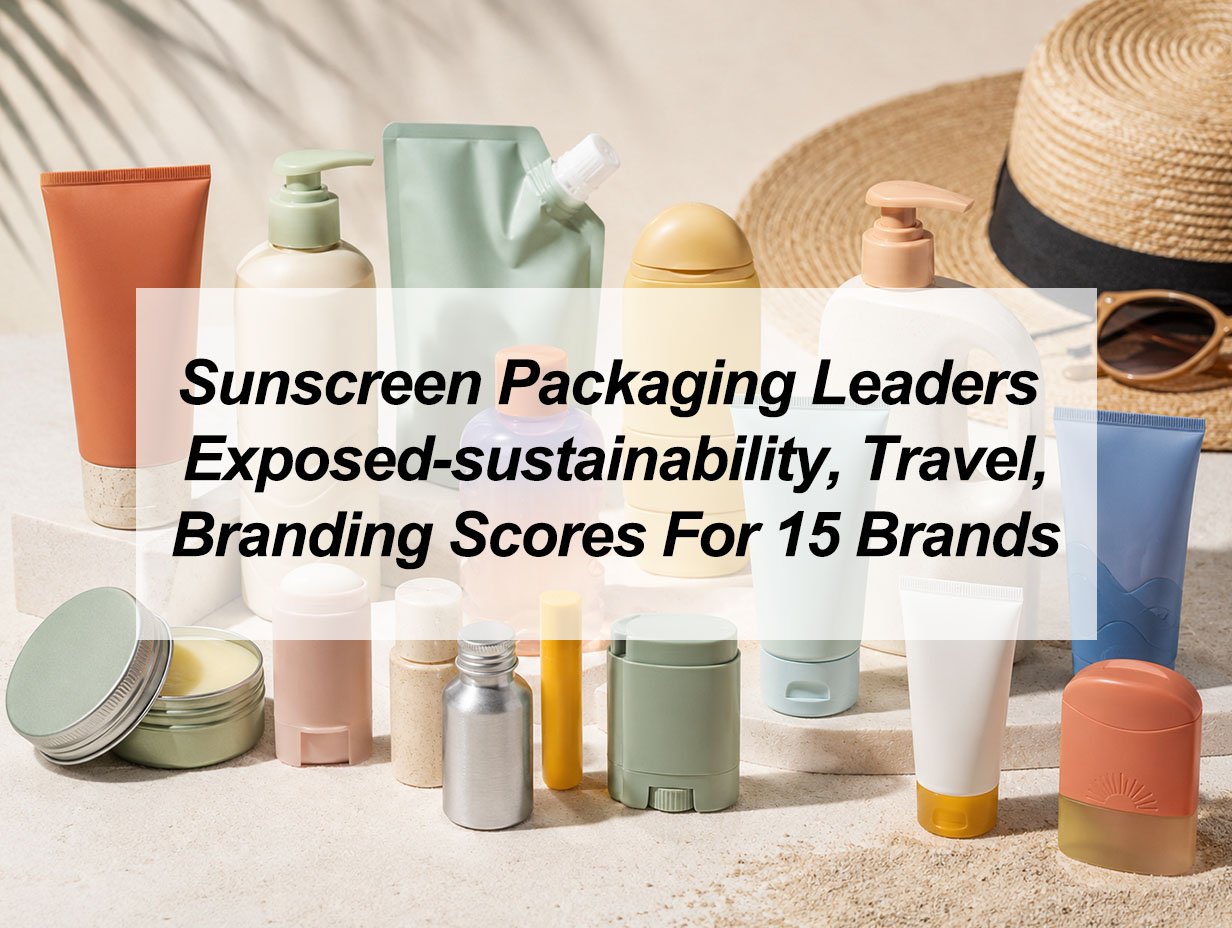
Sunscreen packaging is getting more competitive. A strong pack must look good, travel well, and explain sustainability without confusing the buyer.
The sunscreen packaging leaders across 15 brands are the brands that show clear strengths in sustainability, travel convenience, and branding. Raw Elements leads with aluminum tins, COOLA with sugarcane resin and recyclable cartons, Supergoop! with PCR boxes and refill pouches, Sun Bum with travel visibility, Vacation with nostalgic branding, and Blue Lizard with UV-sensitive packaging.
Sunscreen packaging now needs to balance sustainability, travel use, SPF label clarity, and brand recognition. A good package should protect the formula, fit daily routines, stand out online, and make disposal or refill choices easier.
Which Sunscreen Brands Score Highest for Sustainable Packaging?
Sustainable sunscreen packaging should be judged by actual material choices, not by green color, beach language, or broad eco claims.
The sunscreen brands that score highest for sustainable packaging are the brands with clearer public packaging signals, such as aluminum tins, PCR plastic, sugarcane resin tubes, recyclable cartons, reduced boxes, refill pouches, or lower-plastic formats. Raw Elements, COOLA, Supergoop!, Badger, and La Roche-Posay show some of the strongest public sustainability packaging signals.
Editorial Sustainability Scores for 15 Brands
| Brand | Sustainability Score /10 | Packaging Signal |
|---|---|---|
| Raw Elements | 9.0 | Reusable or recyclable aluminum tins, PCR materials, bio-based tube claims |
| COOLA | 8.5 | Sugarcane resin tubes, recyclable packaging, FSC/PCR paper claims |
| Supergoop! | 8.0 | 100% PCR paper boxes, recyclable boxes, refill pouch for PLAY Pump |
| Badger | 7.5 | Sunscreen tubes with 50% PCR and 50% new plastic |
| La Roche-Posay | 7.0 | Plastic-reduction work and eco-conscious paper-based tube direction |
| Shiseido | 6.5 | Corporate PCR PET goals and secondary packaging improvement |
| Blue Lizard | 6.0 | Differentiated smart cap, but less visible sustainability depth |
| Sun Bum | 5.5 | Strong travel and lifestyle range, but less packaging sustainability detail found |
| Neutrogena | 5.0 | Strong mass accessibility, less visible packaging sustainability leadership |
| CeraVe | 5.0 | Clinical clarity, less visible sunscreen-specific packaging sustainability story |
| EltaMD | 5.0 | Dermatology trust, limited public packaging innovation story |
| Hawaiian Tropic | 4.5 | Strong visual branding, weaker public packaging sustainability signal |
| Vacation | 4.5 | Excellent branding, weaker visible sustainability packaging signal |
| Thinksport | 4.5 | Product values are strong, packaging sustainability signal is less visible |
| Black Girl Sunscreen | 4.5 | Strong audience positioning, limited public packaging sustainability signal |
Raw Elements scores high because it publicly highlights recyclable or reusable aluminum tins, PCR resins, recyclable materials, compostable paperboard, bio-based materials, and a Face + Body sunscreen tube made with 65% PCR material. It also offers plastic-free aluminum tins for SPF products.
COOLA also scores strongly because its packaging updates include more post-consumer recycled material in tubes, box removal where possible, 100% recyclable boxes where needed, FSC-certified post-consumer-recycled paper, soy ink, and water-based coating. COOLA also describes sugarcane resin tubes and recyclable tube guidance on product and FAQ pages.
Supergoop! performs well because it states that its product boxes are recyclable, made in the U.S. from 100% post-consumer recycled paper, and printed with environmentally friendly inks. It also promotes a PLAY Pump Refill pouch, which improves the brand’s refill signal.
Badger has a practical and clear PCR signal. Its sustainability page says all Badger sunscreen tubes are made with 50% post-consumer regrind plastic and 50% new plastic. This is not plastic-free, but it is specific and easier to evaluate than a vague sustainability claim.
La Roche-Posay shows a more technical sustainability direction through packaging reduction and alternative material work. Its Anthelios Eco-Conscious Hydrating Lotion SPF50+ uses a carton-integrated tube designed to reduce virgin plastic by 45%, with paper sourced in the EU and certified FSC or PEFC.
Small Packaging Lessons
- Aluminum tins can create a strong sustainability story, but texture and application experience still matter.
- PCR tubes are easier to scale than plastic-free packs, but brands need material documentation.
- Refill pouches can reduce repeated rigid packaging, but the refill process must be easy.
- Paper-based tubes can reduce plastic, but they still need barrier layers and formula compatibility review.
- Recyclable claims should be local and specific because recycling acceptance changes by market.
Which Sunscreen Packaging Formats Are Most Travel-Friendly?
Travel-friendly sunscreen packaging needs to be small, portable, leak-resistant, easy to reapply, and clear enough for airline and daily-use routines.
The most travel-friendly sunscreen packaging formats are sticks, mini tubes, small bottles, compact tins, travel sets, and lotion containers at or below 3.4 oz or 100 ml for carry-on use. Sun Bum, Shiseido, Supergoop!, Neutrogena, Vacation, and Raw Elements show useful travel packaging signals.
Editorial Travel Scores for 15 Brands
| Brand | Travel Score /10 | Travel Packaging Signal |
|---|---|---|
| Sun Bum | 9.0 | Broad travel-size sunscreen collection and recognizable beach packaging |
| Shiseido | 8.5 | Travel-size sunscreen bundles and clear stick formats |
| Supergoop! | 8.0 | Many daily SPF formats, minis, pump, stick, and refill options |
| Neutrogena | 8.0 | Travel-size Ultra Sheer lotion and mass retail access |
| Vacation | 7.5 | Strong vacation positioning, portable products, QR packaging story |
| Raw Elements | 7.5 | Travel-size SPF 30 and compact tins |
| Blue Lizard | 7.0 | Stick and tube formats with smart cap behavior cue |
| COOLA | 7.0 | Tubes, sticks, and lightweight lifestyle formats |
| CeraVe | 6.5 | Dermatology-style daily SPF formats |
| La Roche-Posay | 6.5 | Clinical tubes and compact daily-use formats |
| EltaMD | 6.5 | Dermatology-friendly daily face SPF formats |
| Hawaiian Tropic | 6.0 | Recognizable bottles and sprays, but larger formats are less carry-on friendly |
| Badger | 6.0 | Tubes and mineral formats; heavier natural-positioned use feel |
| Thinksport | 6.0 | Outdoor and sport positioning, but less packaging variety signal |
| Black Girl Sunscreen | 5.5 | Strong daily-use identity, fewer travel packaging signals found |
TSA travel rules matter because liquids, aerosols, gels, creams, and pastes in carry-on baggage are generally limited to containers of 3.4 ounces or 100 milliliters or less. This makes travel-size sunscreen packaging more than a nice add-on. It can decide whether the product fits a customer’s trip.
Sun Bum scores high because it has a dedicated travel-size sunscreen collection and communicates travel-size sun care clearly. Its product pages also show travel-size versions, including 1.75 oz spray formats.
Shiseido scores high because its sunscreen pages include travel-ready active sun protection bundles and compact stick formats. Sticks are useful because they fit bags, support reapplication, and reduce spill risk compared with lotions.
Neutrogena performs well on travel because its Ultra Sheer Dry-Touch sunscreen is available in travel-size SPF formats. This is a practical advantage for mass buyers because availability matters as much as packaging design.
Raw Elements has a travel-size SPF 30 format and aluminum tin options. This gives it a different travel profile: less focused on polished convenience, more focused on compact lower-waste use.
Travel Packaging Lessons
- SPF sticks are strong for handbags, kids, sports, and reapplication.
- Mini tubes are simple, familiar, and airline-friendly.
- Aluminum tins can travel well, but the formula texture must be easy to use.
- Aerosols may feel convenient, but travel and recycling can be more complex.
- Travel sets can drive trial, but extra packaging should be controlled.
How Does Branding Affect Sunscreen Packaging Leadership?
Sunscreen packaging branding must make protection feel easy, memorable, and emotionally clear before the customer reads every claim.
Branding affects sunscreen packaging leadership by shaping shelf recognition, color memory, product trust, lifestyle connection, and e-commerce performance. Vacation, Sun Bum, Supergoop!, Blue Lizard, Shiseido, La Roche-Posay, and Black Girl Sunscreen show strong branding signals, but they do it in very different ways.
Editorial Branding Scores for 15 Brands
| Brand | Branding Score /10 | Branding Signal |
|---|---|---|
| Vacation | 9.5 | Nostalgic leisure identity and high emotional recall |
| Sun Bum | 9.0 | Strong yellow beach identity and casual lifestyle packaging |
| Supergoop! | 8.5 | Modern daily-SPF positioning and clean product family system |
| Blue Lizard | 8.0 | Smart Cap technology connects packaging with sun behavior |
| Shiseido | 8.0 | Premium skincare-style sun care identity |
| La Roche-Posay | 8.0 | Dermatology trust and clinical label hierarchy |
| Black Girl Sunscreen | 7.5 | Clear audience positioning and inclusive brand name |
| Neutrogena | 7.5 | Mass trust and clear SPF communication |
| COOLA | 7.5 | Organic lifestyle skincare identity |
| Hawaiian Tropic | 7.5 | Tropical, sensory, vacation-style shelf memory |
| EltaMD | 7.0 | Dermatology-focused professional identity |
| CeraVe | 7.0 | Clinical and dermatologist-backed visual language |
| Raw Elements | 6.5 | Natural and low-waste identity, less polished mass shelf impact |
| Badger | 6.5 | Family-friendly natural packaging identity |
| Thinksport | 6.0 | Sport and outdoor function identity |
Vacation leads in branding because its packaging and product world are built around nostalgia, leisure, scent, and humor. The brand says its sunscreen packaging includes QR-code access to Poolsuite FM and other leisure-enhancing amenities, which turns packaging into a brand experience rather than only a container.
Sun Bum scores high because its yellow packaging, beach language, monkey icon, and travel-size sun care sets create fast recognition. The brand is easy to spot in bags, retail shelves, and beach content.
Blue Lizard is interesting because its packaging becomes a behavior cue. The brand says its lotion tubes feature Smart Cap technology, where the cap changes color in harmful UV light. This is a strong example of packaging adding function to branding.
La Roche-Posay and Shiseido use a different branding path. They do not rely on playful beach cues. They use clinical trust, skincare credibility, premium structure, and clean label hierarchy. Shiseido also supports travel and premium format storytelling through stick and travel-ready sunscreen bundles.
Branding Lessons for Packaging Buyers
- A strong color system can make sunscreen easier to find and remember.
- A smart cap or QR code can make packaging interactive.
- Clinical packaging should prioritize trust, clarity, and label hierarchy.
- Nostalgic packaging can make SPF feel emotional and fun.
- Inclusive branding can create strong audience connection when the product and pack support the promise.
What Can Cosmetic Packaging Buyers Learn From 15 Sunscreen Brands?
The 15-brand scorecard shows that sunscreen packaging leadership is not one simple ranking. Each brand teaches a different packaging lesson.
Cosmetic packaging buyers can learn that strong sunscreen packaging should balance sustainability proof, travel convenience, branding clarity, label space, formula protection, and production practicality. The best packaging choice depends on the product’s formula, target user, retail channel, market rules, and price point.
Combined Editorial Scorecard
| Brand | Sustainability /10 | Travel /10 | Branding /10 | Average | Packaging Takeaway |
|---|---|---|---|---|---|
| Supergoop! | 8.0 | 8.0 | 8.5 | 8.2 | Strong all-around daily SPF packaging system |
| COOLA | 8.5 | 7.0 | 7.5 | 7.7 | Good sustainability proof with lifestyle skincare feel |
| Raw Elements | 9.0 | 7.5 | 6.5 | 7.7 | Low-waste leadership, less mainstream polish |
| Sun Bum | 5.5 | 9.0 | 9.0 | 7.8 | Travel and branding leader, sustainability less visible |
| Shiseido | 6.5 | 8.5 | 8.0 | 7.7 | Premium travel and skincare positioning |
| Blue Lizard | 6.0 | 7.0 | 8.0 | 7.0 | Smart packaging cue creates strong differentiation |
| La Roche-Posay | 7.0 | 6.5 | 8.0 | 7.2 | Clinical trust plus material-reduction innovation |
| Badger | 7.5 | 6.0 | 6.5 | 6.7 | Clear PCR signal and natural identity |
| Vacation | 4.5 | 7.5 | 9.5 | 7.2 | Branding leader with weak sustainability visibility |
| Neutrogena | 5.0 | 8.0 | 7.5 | 6.8 | Mass travel practicality and SPF clarity |
| CeraVe | 5.0 | 6.5 | 7.0 | 6.2 | Clinical trust, simple packaging system |
| EltaMD | 5.0 | 6.5 | 7.0 | 6.2 | Dermatology trust over packaging novelty |
| Hawaiian Tropic | 4.5 | 6.0 | 7.5 | 6.0 | Strong sensory branding, weaker packaging proof |
| Thinksport | 4.5 | 6.0 | 6.0 | 5.5 | Outdoor position, less visible packaging innovation |
| Black Girl Sunscreen | 4.5 | 5.5 | 7.5 | 5.8 | Strong audience identity, less packaging innovation signal |
This scorecard is useful because it separates design from proof. A brand can have great packaging style and still lack public packaging sustainability detail. A brand can have strong low-waste packaging and still feel less convenient for fast daily use. A brand can be very travel-friendly but use more small plastic packaging.
Buyer Lessons
1. Do not chase one packaging trend.
A refill pouch, aluminum tin, PCR tube, travel stick, paper-based tube, or smart cap can all be useful. None of them is perfect for every sunscreen.
2. Match format with formula.
A thick mineral sunscreen may fit a tin or tube. A facial SPF may fit a slim tube, airless pump, or stick. A body sunscreen may need a larger bottle, pouch refill, or spray.
3. Keep label space clear.
In the U.S., sunscreen labels must support claims such as SPF, broad spectrum, and water resistance where applicable. Water-resistant products must state whether protection is retained for 40 or 80 minutes during swimming or sweating.
4. Make travel useful, not wasteful.
Travel-size packs are convenient, but too many mini packs can increase packaging waste. A better strategy may combine minis, sticks, refillable travel bottles, or concentrated formats.
5. Treat branding as packaging function.
Packaging must help customers choose quickly. SPF value, skin type, water resistance, face or body use, and texture cues should be easy to read.
How Should a New Sunscreen Brand Build Its Own Scorecard?
A new sunscreen brand should not copy one leader. It should build a scorecard that fits its own formula, customer, market, and sourcing plan.
A new sunscreen brand should build its packaging scorecard by scoring sustainability, travel use, branding clarity, label space, formula protection, cost, MOQ, production risk, and recycling reality. This helps the team choose packaging that looks strong, works in real life, and can be sourced reliably.
Practical Sunscreen Packaging Scorecard
| Score Area | 1–3 Points | 4–7 Points | 8–10 Points |
|---|---|---|---|
| Sustainability | Vague eco claim | PCR or recyclable component | Clear material proof, refill, mono-material, reduced waste |
| Travel | Large or leak-prone | Some mini options | Sticks, minis, strong seals, 100 ml or under |
| Branding | Crowded or generic | Clear SPF and brand color | High shelf memory and strong product hierarchy |
| Label space | Text is cramped | Basic claims fit | SPF, directions, warnings, and claims are easy to read |
| Formula fit | Format chosen by style only | Basic compatibility review | Tested with real formula and use conditions |
| Production risk | Unknown mold or closure | Supplier sample tested | Clear mold, MOQ, testing, QC, and documentation |
A new brand should also decide its main packaging promise. If the promise is sustainability, the brand needs material proof. If the promise is travel, the package must be compact, clean, and leak-resistant. If the promise is dermatology trust, the label must be clear and serious. If the promise is lifestyle fun, the color, shape, and brand world must feel memorable.
The best packaging brief should include:
- product type;
- SPF level and claims;
- face or body use;
- formula viscosity;
- target capacity;
- travel requirement;
- material preference;
- cap or pump type;
- decoration method;
- label space;
- sustainability target;
- MOQ and budget;
- testing requirements.
This makes supplier communication faster. It also prevents a common problem: choosing a beautiful mockup that fails in material, closure, labeling, or filling.
My insights: Which Sunscreen Packaging Leaders Stand Out Across Sustainability, Travel, and Branding Scores for 15 Brands
Sunscreen packaging can look fun, clinical, natural, or premium, but strong packaging must also travel well and prove sustainability clearly.
The sunscreen packaging leaders across 15 brands are the brands that balance sustainability, travel convenience, and branding clarity. Raw Elements, COOLA, Supergoop!, Sun Bum, Vacation, Shiseido, Blue Lizard, Badger, and La Roche-Posay each show different strengths, from aluminum tins and PCR tubes to travel sets, sticks, smart caps, refill pouches, and memorable visual identity.
From Brand Claims to Packaging Scorecards
This scorecard is an editorial packaging analysis, not an official ranking. I would score each brand by visible packaging signals, public sustainability claims, travel-size usefulness, and branding strength. A brand can score high in sustainability but lower in travel. Another brand can score high in branding but weaker in packaging proof.
| Score Area | What I Checked | Why It Matters |
|---|---|---|
| Sustainability | PCR, recyclable packs, aluminum, refill, reduced boxes | Buyers need proof, not vague claims |
| Travel | Sticks, minis, 100 ml or under, leak control, portability | Sunscreen is often used outdoors and on trips |
| Branding | Color memory, SPF hierarchy, packaging story, shelf impact | Packaging must sell before the formula is tried |
| Label clarity | SPF, broad spectrum, water resistance, directions | Sunscreen is a regulated product in many markets |
| Practical risk | Leakage, refill difficulty, mixed materials, hard recycling | Strong packaging must survive real use |
The main lesson is simple. The best sunscreen packaging is not one universal format. A travel stick, aluminum tin, refill pouch, PCR tube, smart cap bottle, and nostalgic spray all solve different problems. Brands should choose the format that fits the formula, customer routine, market rules, and packaging story.
Conclusion
Sunscreen packaging leaders win in different ways. The strongest brands balance sustainability proof, travel convenience, branding clarity, label space, and real production practicality.