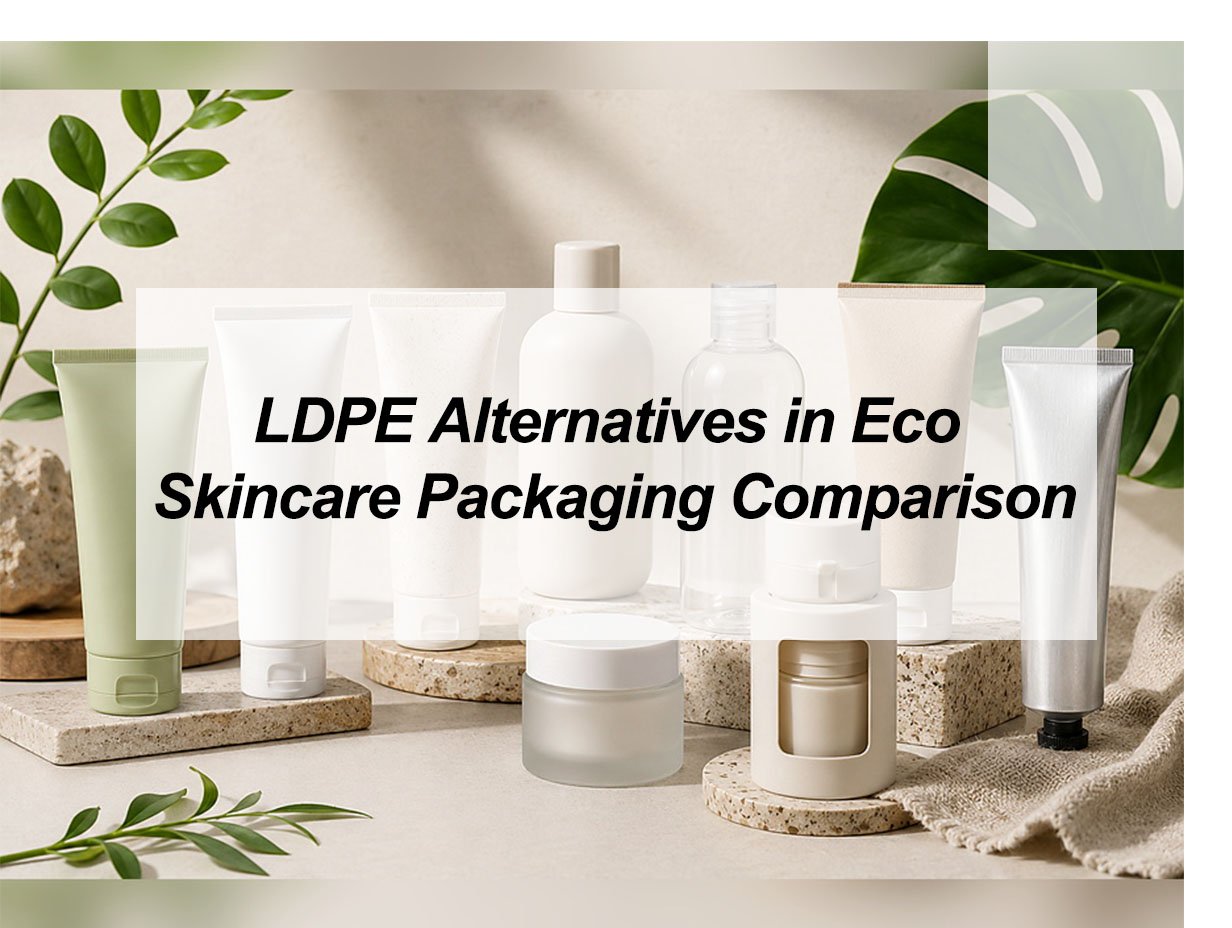
Choosing an LDPE alternative sounds easy. But the wrong material can raise costs, weaken formula protection, or create a sustainability claim that does not survive real recycling.
The best LDPE alternatives for eco skincare packaging include PCR LDPE, mono-material PE, HDPE, PP, PET, bio-based PE, paper-based tubes, aluminum, glass, and refillable systems. PCR LDPE is usually the lowest-risk switch for soft skincare tubes, while mono-material PE or PP can improve recyclability. Paper, aluminum, and glass can work well, but they need careful testing.
LDPE is common because it is soft, flexible, squeezable, chemically resistant, and easy to process. That is why skincare brands use it for tubes, sachets, sample packs, flexible pouches, and some closures. But buyers now ask for lower virgin plastic use, better recycling design, and clearer material claims. The EU Packaging and Packaging Waste Regulation is also pushing packaging toward recycled content, recyclability, clearer labels, reuse, refill, and packaging minimization.
What Makes LDPE Hard to Replace in Skincare Packaging?
LDPE looks simple, but it solves many skincare packaging problems at the same time. A replacement must protect the formula and still feel good in the customer’s hand.
LDPE is hard to replace because it gives skincare packaging flexibility, squeeze recovery, sealing performance, chemical resistance, and low-cost production. Many eco alternatives can reduce virgin plastic or improve recyclability, but they may create new problems in barrier protection, decoration, filling, shipping, or user experience.
Why LDPE is still widely used
LDPE works well for soft tubes and flexible packaging because it bends without cracking. This matters for cleansers, creams, lotions, sunscreens, masks, hand creams, and travel-size skincare. A rigid material may look sustainable on paper, but it may not fit the way consumers use the product.
The main issue is not LDPE itself. The bigger issue is the full package design. A tube may combine LDPE, EVOH barrier, adhesive, ink, foil, cap, shoulder, and label. When too many materials are mixed, recycling becomes harder. The Association of Plastic Recyclers says PE flexible mono-material film is preferred when the structure is more than 90% PE by weight, while lower PE content or non-PE layers may create recycling challenges and need testing.
| LDPE Strength | Why Brands Like It | Replacement Challenge |
|---|---|---|
| Soft touch | Easy to squeeze | Rigid materials may feel less convenient |
| Low cost | Good for mass production | Eco materials may raise unit cost |
| Sealability | Works for tubes and pouches | Some alternatives need new sealing systems |
| Chemical resistance | Fits many skincare formulas | Paper and some bio-materials may need liners |
| Light weight | Lower shipping burden | Glass and thick aluminum may add weight |
For this reason, I would not replace LDPE only because a customer asks for “plastic-free.” I would first ask what the product needs. A water-based lotion, oil balm, vitamin C cream, sunscreen, and clay mask all need different packaging protection.
Is PCR LDPE the Easiest Eco Alternative?
Many brands want a fast sustainable upgrade without changing the whole packaging structure. PCR LDPE is often the simplest starting point.
PCR LDPE is usually the easiest alternative to virgin LDPE because it keeps similar flexibility while reducing demand for virgin fossil plastic. It works best when the supplier can provide stable recycled content, clean material documentation, color control, odor control, and batch consistency.
Why PCR LDPE is practical
PCR LDPE means post-consumer recycled LDPE. It does not remove plastic from the package. Instead, it replaces part of the virgin plastic with recycled plastic. This is useful when a skincare brand wants to keep a soft tube, pouch, or flexible pack but improve the material story.
PCR LDPE is not perfect. It can have color variation. It may be harder to use for clear or white premium packaging. It can also create odor or surface issues if the recycled stream is not well controlled. For beauty packaging, this matters because customers notice color, gloss, smoothness, and smell quickly.
| Option | Best Use | Main Benefit | Main Risk |
|---|---|---|---|
| Virgin LDPE | Standard tubes and pouches | Stable quality and low cost | Uses fossil-based virgin plastic |
| PCR LDPE | Tubes, flexible packs, some closures | Lower virgin plastic demand | Color and supply consistency |
| PCR + virgin blend | Premium eco tube | Balance between quality and sustainability | Lower recycled content claim |
| High-PCR LDPE | Strong sustainability claim | Bigger virgin plastic reduction | More testing needed |
PCR LDPE is not always the best final answer, but it is often the most realistic first move. It lets a brand keep familiar filling equipment, soft feel, and tube performance. It also supports the direction of regulations that encourage recycled content in plastic packaging. The European Commission states that plastic packaging must be made partly from recycled content with increasing targets for 2030 and 2040.
Are Mono-Material PE, HDPE, PP, and PET Better Than LDPE?
Mono-material design is one of the strongest directions in eco skincare packaging. But the full component system matters.
Mono-material PE, HDPE, PP, and PET can be better than traditional LDPE structures when they make recycling easier and reduce mixed-material complexity. The best option depends on whether the package is a tube, bottle, jar, cap, pump, pouch, or refill pack.
How to compare mono-material options
Mono-material does not mean every package is automatically recyclable everywhere. It means the package is designed mainly from one material family, which can help sorting and recycling. RecyClass says design-for-recycling guidelines help determine whether product features are compatible with a specific recycling stream.
For LDPE replacement, PE-family mono-material packaging is often the safest direction because LDPE, LLDPE, MDPE, and HDPE are chemically related. APR guidance treats all PE film grades, including LDPE and HDPE, as preferred in PE flexible mono-material film when the design meets PE-content expectations.
| Material | Best Skincare Use | Sustainability Value | Watch Out For |
|---|---|---|---|
| Mono-material PE | Tubes, pouches, refill packs | Better fit with PE recycling streams | Barrier layer must be checked |
| HDPE | Bottles, caps, jars | Strong, recyclable, good PCR supply | Less soft than LDPE |
| PP | Caps, jars, sticks, airless parts | Good heat resistance and durability | Recycling access varies by market |
| PET | Bottles, some jars | Clear look, strong recycling stream | Not ideal for squeeze tubes |
| LDPE / LLDPE blend | Soft flexible tubes | Keeps squeeze feel | May still need recycling design checks |
For skincare tubes, I would usually compare PCR LDPE, mono-material PE, and bio-based PE first. For bottles, I would compare HDPE, PP, and PET. For jars, I would compare PP, PET, glass, and refillable systems. The best material is not the one with the best sustainability story. It is the one that protects the formula and has a real end-of-life path.
Are Paper-Based Tubes a Real LDPE Alternative?
Paper-based tubes are attractive because they visibly reduce plastic. But they are not pure paper packaging in most skincare applications.
Paper-based tubes can reduce plastic content in skincare packaging, but they usually still need an inner plastic layer or barrier coating to protect the formula. They work better for some creams, lotions, and cleansers than for very sensitive, oily, or high-moisture formulas.
Why paper is not always simple
Paper packaging has a strong customer appeal. It looks natural. It feels lighter. It can help a brand communicate lower plastic use. L’Oréal and Albéa announced a paper-based cosmetic tube project designed to replace part of the plastic in cosmetic tubes.
But paper has limits. Cosmetic formulas often need protection from moisture, oxygen, oil, fragrance, and contamination. A scientific review on cosmetic packaging notes that paper packaging has inherent limitations because it is not waterproof and can be difficult for products that need moisture protection or airtight sealing.
| Paper-Based Tube Factor | Advantage | Risk |
|---|---|---|
| Plastic reduction | Uses less plastic than full plastic tube | Still may need plastic liner |
| Brand image | Strong eco look | Can invite greenwashing questions |
| Printing | Natural, soft visual style | Premium decoration may be limited |
| Barrier | Enough for some formulas | Weak for moisture-sensitive products |
| Recycling | Depends on structure | Mixed paper-plastic may be hard to recycle |
I would use paper-based tubes for formulas that can pass compatibility and stability tests. I would avoid them for products that need strong oxygen, moisture, or oil barrier unless the supplier has proven test data.
Is Bio-Based PE Better Than LDPE?
Bio-based PE is useful because it can behave like normal PE while reducing fossil feedstock dependence.
Bio-based PE can be a strong LDPE alternative when the brand wants plant-based plastic without changing the packaging function too much. It can offer similar performance to conventional polyethylene, but buyers still need to check land-use claims, certification, cost, availability, and recyclability in the target market.
Why bio-based PE is a drop-in option
Bio-based PE is often made from renewable feedstocks such as sugarcane. Braskem describes its I’m green™ bio-based PE as a plant-based plastic solution, and its portfolio document states that bio-based polyethylene can be recycled in the same way as conventional polyethylene.
This makes bio-based PE different from many compostable plastics. It is not chosen because it disappears in nature. It is chosen because it reduces fossil-based raw material use while keeping PE-like performance.
| Material | Main Claim | Packaging Fit | Key Question |
|---|---|---|---|
| Virgin LDPE | Standard performance | Tubes and flexible packs | Can virgin plastic be reduced? |
| PCR LDPE | Recycled content | Tubes and flexible packs | Is PCR supply stable? |
| Bio-based PE | Renewable feedstock | Tubes, bottles, caps | Is the claim certified? |
| Compostable plastic | End-of-life claim | Limited skincare use | Is industrial composting available? |
I would be careful with “biodegradable” claims in skincare packaging. Many cosmetic packages are contaminated with residue, coatings, inks, pumps, and caps. If the end-of-life system is not available, the claim may confuse buyers and consumers.
Are Aluminum and Glass Better Than LDPE?
Aluminum and glass can be excellent in the right category. But they are not automatic upgrades.
Aluminum and glass can replace LDPE in some skincare formats, especially tubes, jars, bottles, and premium refill systems. Aluminum offers good barrier protection and recyclability, while glass offers premium feel and material stability. But both can increase weight, cost, breakage risk, or energy impact.
When aluminum works
Aluminum tubes can work for creams, ointments, masks, and some active formulas because aluminum blocks light, air, and moisture well. Some suppliers promote aluminum cosmetic tubes as recyclable and protective. But aluminum can dent, and some formulas may need inner coatings. The brand also needs to check whether customers in the target market actually recycle aluminum.
When glass works
Glass works well for premium skincare jars, droppers, essences, and refillable outer packs. It feels high-end and does not absorb fragrance or oils like some plastics may. But glass is heavy and breakable. This can increase shipping emissions, carton strength, and damage risk.
| Material | Best Use | Main Benefit | Main Risk |
|---|---|---|---|
| Aluminum tube | Cream, mask, ointment | Strong barrier and recyclable image | Denting and coating needs |
| Glass bottle | Serum, oil, essence | Premium feel and stability | Heavy and fragile |
| Glass jar | Cream and balm | Refillable premium option | Higher shipping cost |
| LDPE tube | Soft cream and lotion | Lightweight and squeezable | Virgin plastic concern |
A good comparison should include transport weight and damage rate. A lighter plastic tube with PCR content may sometimes perform better than a heavy glass package shipped across long distances. That is why I prefer lifecycle thinking instead of one-material thinking.
Are Refillable Systems the Best LDPE Alternative?
Refill systems can reduce repeat packaging waste. But they work only when customers actually use them.
Refillable skincare packaging can be a better alternative to single-use LDPE packaging when the refill uses less material and the outer pack is reused many times. The refill must be easy to buy, easy to replace, hygienic, and cheaper than buying the full package again.
Why refill is behavior-dependent
Refillable beauty is gaining attention again. Vogue reported that L’Oréal’s refillable product sales grew 34% between 2024 and 2025, but it also noted that refill success depends on convenience, price, product format, and real material reduction.
For skincare, refill systems can work well for creams, lotions, cleansers, and high-repeat products. They are harder for formulas that need strong hygiene control or sealed airless protection. Oil-based creams and sensitive formulas may need sealed refill pods rather than simple refill pouches.
| Refill Type | Good For | Sustainability Condition |
|---|---|---|
| Refill pouch | Cleanser, lotion, shampoo-style skincare | Must use much less material |
| Inner cup refill | Cream jar | Outer jar must be reused many times |
| Cartridge refill | Airless skincare | Must protect formula hygiene |
| Bulk refill | Professional or salon use | Needs controlled filling process |
A refill pack is not always better than LDPE. If the refill is a small multilayer sachet that cannot be recycled, the benefit may be weak. But if the refill is mono-material, lightweight, and used many times, it can reduce packaging intensity.
Which LDPE Alternative Should a Skincare Brand Choose?
The best choice depends on product type, brand position, cost target, and market regulation.
For most skincare brands, the best LDPE alternative is not one material. It is a decision path. Use PCR LDPE when you need a low-risk tube upgrade. Use mono-material PE when recycling design is the priority. Use HDPE, PP, or PET for bottles and jars. Use paper, aluminum, glass, or refill systems only after formula and logistics testing.
Practical buyer decision table
| Product Format | Best First Alternatives | Why |
|---|---|---|
| Soft skincare tube | PCR LDPE, mono-material PE, bio-based PE | Keeps squeeze feel and tube function |
| Lotion bottle | HDPE, PET, PP, PCR plastic | Better rigid bottle options |
| Cream jar | PP, PET, glass, refillable jar | Good structure and decoration options |
| Sample pack | Mono-material PE, refill trial size | Reduces complex sachet issues |
| Premium serum | Glass, PET, airless PP/PET | Better formula and brand fit |
| Cleanser refill | Mono-material PE pouch | Lightweight repeat-use option |
| Active cream | Aluminum, airless, refill pod | Stronger barrier and hygiene control |
My preferred order is simple. First, reduce unnecessary material. Then choose recycled or renewable content. Then simplify the material structure. Then test recyclability. Then test formula compatibility. After that, check cost, MOQ, lead time, decoration, and customer use.
My insights: LDPE Alternatives in Eco Skincare Packaging Comparison
Many brands want to replace LDPE because it is plastic. But a poor replacement can create more problems than the original material.
LDPE alternatives in eco skincare packaging should be compared by recyclability, barrier performance, formula compatibility, PCR availability, refill potential, decoration limits, cost, and local recycling access. PCR LDPE is often the safest low-risk upgrade, while mono-material PE, HDPE, PP, PET, paper-based tubes, aluminum, glass, bio-based PE, and refill systems each have different trade-offs.
The Best Alternative Depends on the Packaging Function
When I compare LDPE alternatives, I do not start with the material name. I start with the product format. A skincare tube needs softness and squeeze recovery. A lotion bottle needs strength and pump compatibility. A cream jar needs sealing and decoration stability. A refill pouch needs low material use and good barrier protection.
LDPE is popular because it is flexible, light, easy to seal, and suitable for many skincare formulas. So the replacement material must do more than look sustainable. It must protect the formula, pass filling tests, survive shipping, and feel right in the customer’s hand.
| LDPE Alternative | Best Use Case | Main Benefit | Main Trade-Off |
|---|---|---|---|
| PCR LDPE | Soft tubes and flexible packs | Keeps LDPE function while reducing virgin plastic | Color and supply may vary |
| Mono-material PE | Tubes, pouches, refill packs | Easier recycling design | Barrier layer needs testing |
| HDPE | Bottles and caps | Strong, recyclable, good PCR supply | Less soft than LDPE |
| PP | Jars, caps, sticks, airless parts | Durable and heat-resistant | Recycling access varies |
| PET | Bottles and clear packs | Good clarity and recycling stream | Not ideal for squeeze tubes |
| Paper-based tube | Creams and lotions | Reduces visible plastic use | Usually needs inner barrier |
| Aluminum | Tubes and premium packs | Strong barrier and recyclable image | Can dent and may need coating |
| Glass | Jars, droppers, premium skincare | High-end look and good formula stability | Heavy and breakable |
| Bio-based PE | Tubes, bottles, caps | Reduces fossil-based plastic use | Still needs recycling path |
| Refill system | Repeat-purchase skincare | Reduces repeat packaging waste | Only works if customers refill |
PCR LDPE Is Often the Lowest-Risk First Step
PCR LDPE is usually the easiest upgrade when a brand wants to keep the same tube feel. It does not require a full packaging redesign in many cases. It can reduce virgin plastic use while keeping softness, squeezability, and familiar production behavior.
But PCR LDPE is not perfect. The supplier must control odor, color, surface quality, and batch stability. This is important for skincare brands because packaging appearance affects trust. A cream tube with unstable color may look cheap, even if the material is more sustainable.
Other Alternatives Need Deeper Testing
Mono-material PE, HDPE, PP, and PET can improve recycling clarity when the full package is designed correctly. But the cap, label, ink, barrier layer, shoulder, and pump must also match the recycling goal. A package is not truly easy to recycle just because one part uses a recyclable resin.
Paper-based tubes, aluminum, glass, and bio-based PE can reduce the use of virgin fossil plastic. But they also bring new questions. Paper may need a plastic liner. Aluminum may dent. Glass may increase shipping weight. Bio-based PE still needs a clear recycling route. Refillable systems can reduce waste, but only when the refill is easy, clean, affordable, and used many times.
So I would not call one material the best LDPE alternative for every skincare brand. I would choose the material based on product formula, packaging format, target market, cost, MOQ, decoration needs, and real end-of-life options.
Conclusion
LDPE alternatives should be chosen by performance, not trend. PCR LDPE and mono-material PE are often the safest first steps, while paper, aluminum, glass, bio-based PE, and refill systems need deeper testing.