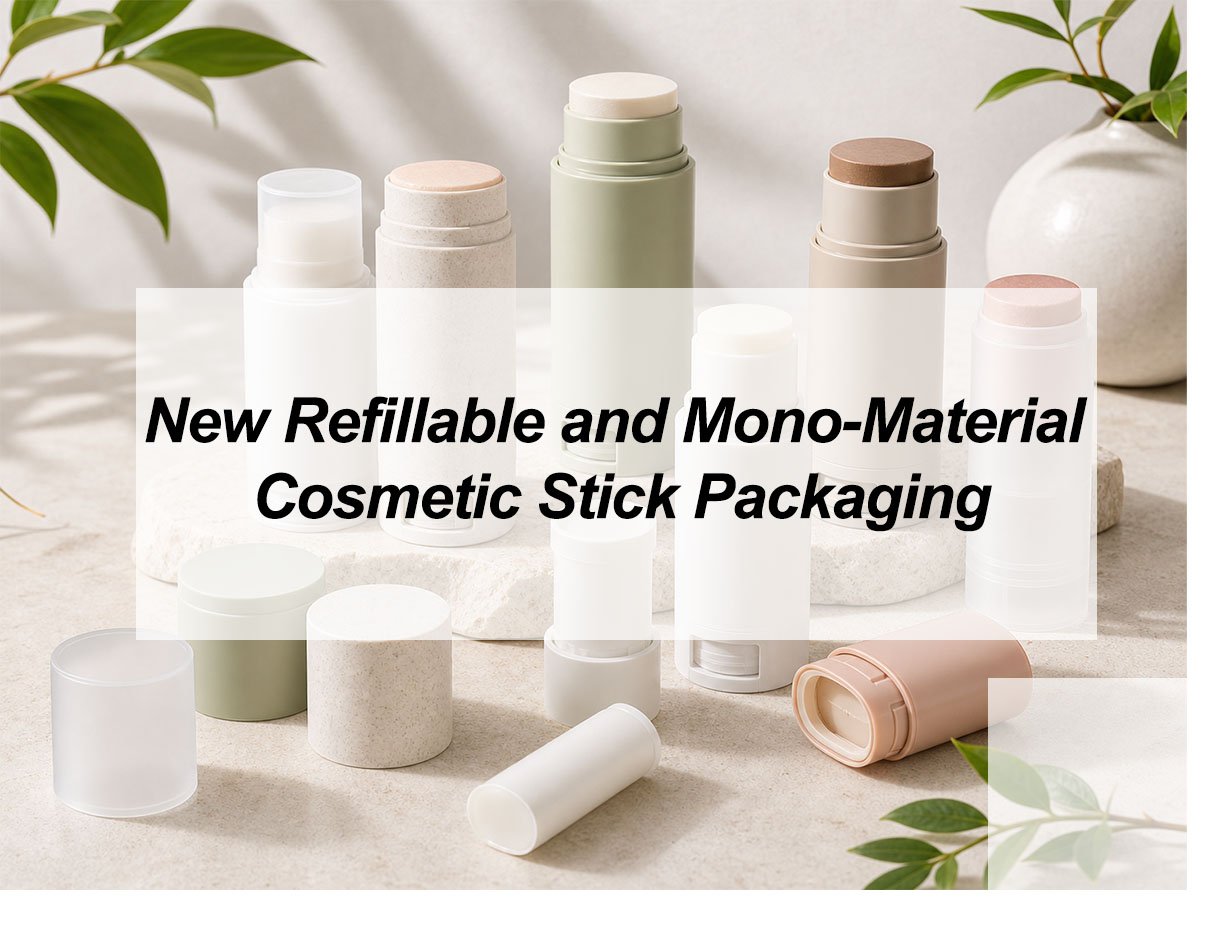
Cosmetic stick packaging is changing fast. Many brands want refillable and recyclable sticks, but not every “eco stick” is ready for real production.
New refillable and mono-material cosmetic stick packaging uses PP or PET single-material designs, PCR plastic, snap-on refills, cartridge systems, and smoother twist-up mechanisms. It works best for deodorant, sunscreen, solid skincare, balm, foundation, blush, contour, and highlighter when the package protects the formula, supports clean refilling, and reduces repeat packaging waste.
The stick format is becoming more useful because beauty brands want products that are portable, clean, and easy to apply. A stick can reduce mess. It can also support waterless or low-water formulas. But the packaging still has to perform. A refillable stick that breaks, leaks, jams, or feels cheap will not create a better customer experience.
What Is Refillable and Mono-Material Cosmetic Stick Packaging?
A cosmetic stick may look simple from the outside. But the inside mechanism decides whether the package is practical, refillable, and recyclable.
Refillable and mono-material cosmetic stick packaging is a stick container designed for repeated use, with a replaceable cartridge or refill cup and a body made mainly from one material family such as PP or PET. The goal is to reduce mixed materials, improve recyclability, and lower repeat packaging waste.
Why mono-material matters
Mono-material packaging means the main components are made from the same material family. For stick packaging, PP is common because it can work for caps, bases, screw mechanisms, and cartridges. PET can also be used in some stick formats, especially when brands want clarity or a different visual style.
The benefit is simple. Mixed-material packaging is harder to recycle. A stick that uses PP, ABS, POM, metal springs, labels, magnets, and decorative coatings may look premium, but it can be harder to sort and process. A mono-material PP stick gives the brand a cleaner recycling story when the local recycling system accepts the format.
Quadpack’s ShapeUp Stick shows this direction clearly. It is a 12.5ml refillable and recyclable stick for high-viscosity skincare and makeup formulas. The supplier says the entire pack is mono-material PP, with PCR PP used in the cap and base.
| Component | Traditional Stick Risk | Mono-Material Direction |
|---|---|---|
| Cap | May use ABS, SAN, or heavy decoration | PP or PET cap |
| Base | May use mixed plastic | PP or PET base |
| Mechanism | May include POM or metal | POM-free or same-family design |
| Cartridge | May not be refillable | Refillable PP cartridge |
| Decoration | May block recycling | Lighter printing or compatible finish |
For B2B buyers, this means the conversation should not stop at “Is it recyclable?” The better question is: What is each component made from, and can the whole pack be processed in the target market?
Why Are Refillable Cosmetic Sticks Becoming Popular?
Refillable sticks match several beauty trends at the same time. They support solid formulas, portable use, lower mess, and repeat purchase.
Refillable cosmetic sticks are becoming popular because they fit products that customers use often, including deodorant, sunscreen, balm, foundation, and solid skincare. They also allow brands to keep a durable outer case while replacing only the inner cartridge or product cup.
The format fits daily-use products
A refill system works best when the product is used often. A deodorant stick or sunscreen stick may be repurchased faster than a special glitter makeup product. A balm or moisturizer stick can also work if the texture and application feel good.
Refillable beauty is growing, but it still needs better consumer behavior. Vogue reported in June 2026 that L’Oréal’s refillable product sales grew 34% between 2024 and 2025, but the same report also explains that refills must be convenient, desirable, and clearly worth the effort.
This is important for cosmetic sticks. A refillable stick should not feel like a difficult packaging system. It should feel like a simple upgrade.
| Product Type | Refillable Stick Fit | Reason |
|---|---|---|
| Deodorant | Strong | High repeat use |
| Sunscreen stick | Strong | Portable and seasonal repeat use |
| Body balm | Strong | High product volume |
| Foundation stick | Medium to strong | Good if shade loyalty is high |
| Blush / contour | Medium | Refill cycle may be slower |
| Highlighter | Medium | More emotional than repeat-driven |
| Solid perfume | Medium | Good for premium design |
| Treatment balm | Strong | Daily-use potential |
WWP Beauty’s refillable body stick is positioned for solid antiperspirants, lotions, perfumes, color cosmetics, sunblock, and more. The supplier lists the material as PP and highlights a mono-material cartridge, which shows how refill and mono-material design are being combined in one product direction.
Which Material Is Best for Mono-Material Cosmetic Stick Packaging?
There is no single best material for every stick. But PP is usually the most practical starting point.
PP is often the best material for mono-material cosmetic stick packaging because it supports durable caps, bases, twist-up parts, and refill cartridges. PET can work for some premium or clear designs. PCR PP or PCR PET can reduce virgin plastic use, but buyers must check color, strength, odor, and formula compatibility.
PP is the current practical choice
PP has a good balance of strength, flexibility, heat resistance, and cosmetic packaging use. It can support many stick mechanisms. It can also work for deodorant sticks, balm sticks, sunscreen sticks, and makeup sticks.
The EU Packaging and Packaging Waste Regulation also pushes packaging design toward more recycled content, recyclability by 2030, clearer labels, lighter packaging, and reuse or refill options where possible. This does not mean every PP stick is automatically compliant, but it does mean buyers should design with recyclability and refillability in mind from the start.
| Material | Best Use | Advantage | Risk |
|---|---|---|---|
| PP | Most stick formats | Strong, practical, common for mechanisms | Recycling access varies by market |
| PCR PP | Eco stick bodies and caps | Reduces virgin plastic demand | Color and surface stability need testing |
| PET | Clear or premium sticks | Good clarity and strong visual value | Mechanism design may be harder |
| PCR PET | Premium recycled-content design | Strong sustainability story | May affect clarity and color |
| Paper-based stick | Natural brand image | Reduces visible plastic | Barrier and durability limits |
| Aluminum | Premium durable case | Strong reusable feel | Higher cost and denting risk |
I would choose PP for most refillable stick projects. I would choose PET only when the design needs clarity or a specific premium look. I would choose paper or aluminum only after deeper testing because stick mechanisms need stable movement, strong sealing, and good hand feel.
How Should Brands Test Refillable Stick Packaging Before Mass Production?
A refillable stick has more failure points than a simple stick. Testing should happen before the mold or bulk order is approved.
Brands should test refillable stick packaging by checking formula compatibility, twist-up smoothness, refill locking strength, cap tightness, drop resistance, filling method, heat stability, decoration durability, and consumer refill experience. A good refillable stick must work after repeated use, not only during the first sample review.
The real risk is not only material
A mono-material stick can still fail if the product is too soft, too oily, too brittle, or too sensitive to heat. A sunscreen stick may need strong stability under warm conditions. A deodorant stick may need smooth lift and even application. A makeup stick needs controlled glide, no sweating, and no cracking.
Filling method also matters. Quadpack’s Linea PP Panstick supports both top and bottom filling, which is useful because different formulas and production lines may need different filling processes.
| Test Item | What to Check | Why It Matters |
|---|---|---|
| Formula compatibility | Oil, wax, fragrance, active ingredients | Prevents swelling, cracking, or odor |
| Twist-up mechanism | Smooth movement and no jamming | Protects user experience |
| Refill lock | Cartridge stays in place | Prevents return complaints |
| Cap fit | Airtightness and torque | Protects formula freshness |
| Drop test | Cap, base, and cartridge strength | Reduces shipping damage |
| Heat test | Melting, sweating, deformation | Important for sticks and balms |
| Decoration test | Ink, hot stamp, coating adhesion | Protects shelf appearance |
| Refill test | Ease of replacing cartridge | Decides whether consumers refill |
I would also test the pack after several refill cycles. Many samples look good once. The question is whether the package still feels strong after the second, third, and fourth refill.
Are Refillable Cosmetic Sticks Actually Sustainable?
They can be sustainable, but only when the refill system really reduces material use and customers actually refill.
Refillable cosmetic sticks are sustainable when the outer case is reused many times and the refill cartridge uses less material than a full new stick. If the refill is expensive, difficult to use, unavailable, or made from hard-to-recycle mixed materials, the sustainability benefit becomes weak.
Refill must reduce real packaging intensity
A refillable stick should be measured by repeat use. The first unit may use more material because it includes a durable outer shell. The refill should use less material than a full replacement pack. If the refill is almost the same weight as a full package, the benefit is small.
Vogue’s refillable beauty report warns that refill packaging can become another sustainability halo if the refill is still plastic, sold in small quantities, or made with hard-to-recycle materials.
| Refill System Question | Good Answer |
|---|---|
| Is the refill cheaper than the full pack? | Yes, clearly cheaper |
| Is the refill easy to install? | Yes, no tools and no mess |
| Is the refill hygienic? | Yes, sealed before use |
| Does the refill use less packaging? | Yes, meaningfully less material |
| Is the refill mono-material? | Ideally yes |
| Can the customer buy refills easily? | Yes, online and retail availability |
| Does the outer case last? | Yes, multiple refill cycles |
For stick packaging, I prefer a refill cartridge that is simple, stable, and easy to understand. A customer should not need instructions that feel technical. The refill should click in smoothly and feel safe.
What Should Buyers Ask Suppliers Before Choosing a New Stick Package?
A supplier’s sample may look attractive, but buyers need production details before ordering.
Buyers should ask suppliers about material composition, PCR percentage, refill structure, filling method, MOQ, mold cost, lead time, decoration options, compatibility tests, defect handling, and recycling claims. The best supplier can explain both the benefits and the limits of the stick design.
Supplier questions I would ask first
| Question | Why It Matters |
|---|---|
| Is the whole stick mono-material or only the cartridge? | Avoids unclear recycling claims |
| What material is used for the mechanism? | Mechanism parts can create mixed-material issues |
| Can the pack include PCR? | Reduces virgin plastic use |
| What PCR percentage is stable in mass production? | Prevents sample-to-bulk mismatch |
| Is the refill cartridge sealed? | Protects hygiene and formula stability |
| Does it support top filling or bottom filling? | Affects factory production |
| What is the MOQ for stock and custom colors? | Affects launch budget |
| Can the package pass heat and drop tests? | Protects shipment and retail quality |
| Which decoration methods are compatible? | Affects design and recyclability |
| Can the supplier support refill sales later? | Refill system needs long-term supply |
I would be careful with very complex decoration. Heavy metallization, thick coatings, mixed labels, or soft-touch finishes can make a mono-material story weaker. A simple PP stick with smart color, clean printing, and good hand feel may be better than a luxury-looking stick that is hard to recycle.
Which Products Are Best for New Refillable and Mono-Material Sticks?
The best products are solid, repeat-use, and easy to refill without mess.
New refillable and mono-material cosmetic stick packaging works best for deodorant, sunscreen sticks, moisturizer sticks, body balms, foundation sticks, blush, contour, highlighter, solid perfume, and treatment balms. It is less suitable for formulas that melt easily, leak oil, require strong airless protection, or sell in very low repeat volumes.
Product fit table
| Product | Fit Level | Main Packaging Need |
|---|---|---|
| Deodorant stick | High | Large capacity, smooth twist, refill economy |
| Sunscreen stick | High | Heat stability and strong cap seal |
| Moisturizer stick | High | Airtightness and clean glide |
| Body balm | High | Larger size and strong mechanism |
| Foundation stick | Medium to high | Shade loyalty and formula stability |
| Blush stick | Medium | Premium feel and smooth application |
| Contour stick | Medium | Precise shape and good decoration |
| Highlighter stick | Medium | Formula control and shine stability |
| Solid perfume | Medium | Fragrance compatibility |
| Lip balm | Medium | Low unit size may reduce refill benefit |
The best opportunity is not only packaging replacement. It is product redesign. A brand can move some liquid or cream products into stick form, reduce leakage, improve portability, and create a refillable system from the beginning.
My insights: New Refillable and Mono-Material Cosmetic Stick Packaging
Many cosmetic stick packs look sustainable at first glance. But the real test starts with the refill system, the material structure, and the formula fit.
New refillable and mono-material cosmetic stick packaging is moving toward PP or PET single-material structures, PCR content, cartridge refills, smoother twist-up mechanisms, and designs for makeup, deodorant, sunscreen, balm, and solid skincare. The best options reduce repeat packaging waste while keeping filling, sealing, decoration, and user experience stable.
The Strongest Direction Is Refillable Mono-Material PP
Refillable cosmetic stick packaging is becoming more practical because stick products are growing across beauty and personal care. Brands now use sticks for foundation, blush, highlighter, contour, deodorant, sunscreen, moisturizer, solid perfume, body balm, and treatment products. This makes stick packaging a useful format for reducing liquid leakage, simplifying application, and creating a travel-friendly product.
Mono-material PP is one of the most common directions because it can support twist-up mechanisms, caps, bases, and cartridges in one resin family. Quadpack’s 2026 Linea PP Panstick is a good example. It is a refillable 10g makeup stick made of PP, with an option to include PCR content, and it supports both top and bottom filling. The supplier also highlights a snap-on refill system and a POM-free mechanism.
| Packaging Direction | Main Benefit | Main Buying Check |
|---|---|---|
| Mono-material PP stick | Easier recycling design | Check full component material |
| PCR PP stick | Reduces virgin plastic use | Check color and batch stability |
| Refillable cartridge | Reduces repeat pack waste | Check refill locking and hygiene |
| PET mono-material stick | Clearer premium look | Check formula and mechanism fit |
| Custom shaped stick | Strong brand identity | Check mold cost and filling risk |
Refill Only Works When It Is Easy to Use
A refillable stick is not automatically sustainable. It must be refilled many times. The refill must be cheaper, easy to install, clean, and available after the first purchase. Vogue’s 2026 refillable beauty report notes that convenience and affordability remain key issues, and refill programs only work when they actually reduce plastic and do not create another hard-to-recycle refill format.
For buyers, the best new refillable and mono-material cosmetic stick packaging should be tested through formula compatibility, torque control, cap tightness, filling method, cartridge strength, decoration durability, leakage resistance, and real refill behavior.
Conclusion
New refillable and mono-material cosmetic stick packaging is strongest when PP or PET design, PCR content, refill usability, formula stability, and real recycling access work together.