Luxury cosmetic packaging used to rely on weight, gloss, and decoration. That is no longer enough. The next stage will ask for beauty with proof.
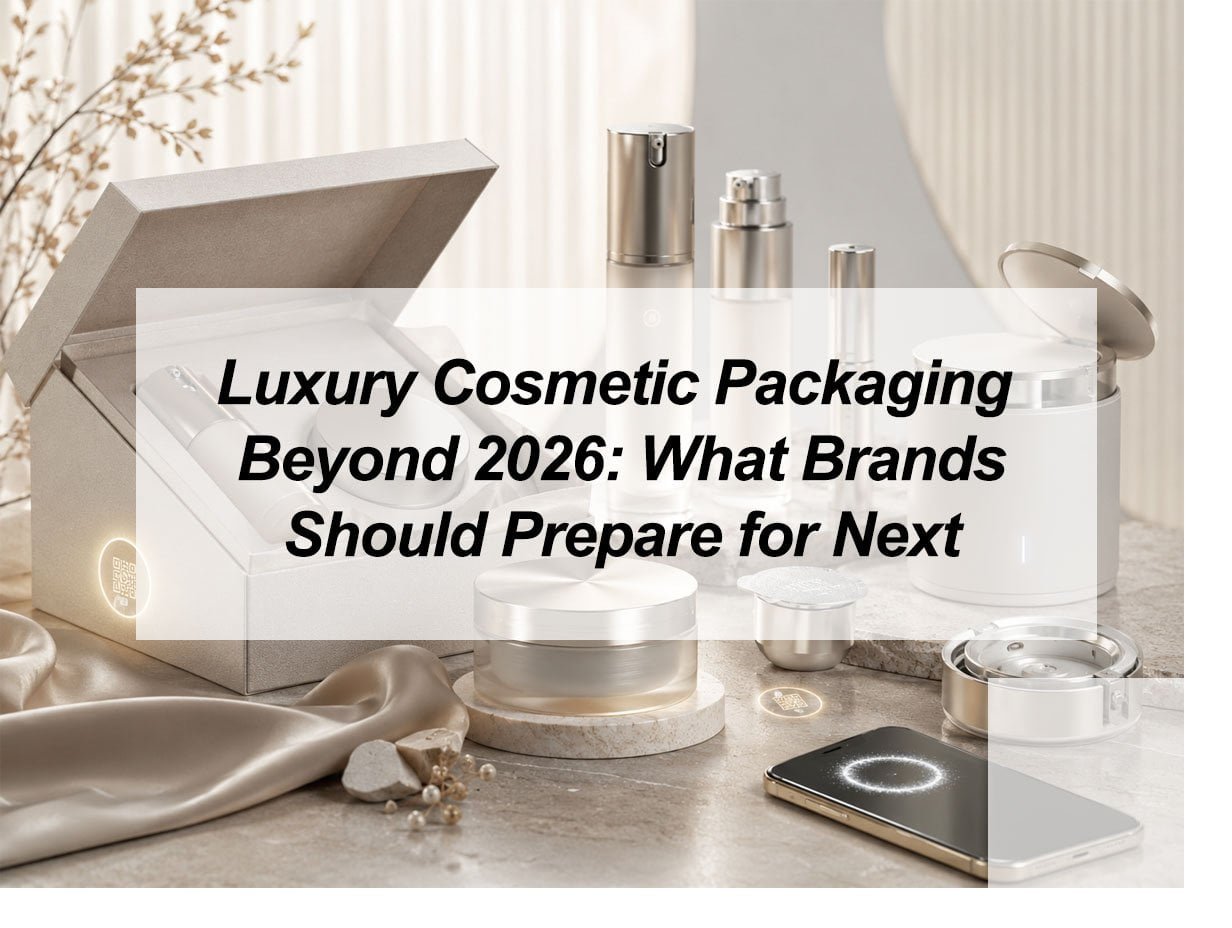
Luxury cosmetic packaging beyond 2026 should prepare for sustainable materials, refillable systems, smart labels, sensory unboxing, lightweight premium structures, and stricter compliance needs. Brands should move from decorative packaging to packaging systems that support trust, repeat purchase, product protection, digital engagement, and responsible growth.
Luxury cosmetic packaging beyond 2026 must stay beautiful, but it also needs smarter materials, refill systems, clear information, and stronger proof of responsibility.
What Will Define Luxury Cosmetic Packaging After 2026?
Luxury packaging after 2026 will not be defined by weight alone. It will be defined by how well beauty, function, responsibility, and experience work together.
After 2026, luxury cosmetic packaging will be defined by responsible material choices, refined sensory design, refill readiness, smart product information, strong e-commerce presentation, and clear compliance planning. Brands should prepare packaging that feels premium in the hand, works well in daily use, and supports a more circular beauty market.
The first change is the meaning of premium. For many years, a heavy glass jar or thick acrylic component created an instant luxury feeling. The customer could hold it and feel value. That logic still works, but it is no longer complete. A heavy package can also suggest waste, high shipping cost, and poor material efficiency. A future luxury package should feel valuable without looking careless.
The New Luxury Signals
| Old Luxury Signal | New Luxury Signal Beyond 2026 |
|---|---|
| Heavy jar | Balanced weight with lower material waste |
| Glossy decoration | Refined texture and meaningful finish |
| Thick outer box | Right-sized carton with strong unboxing |
| Mixed materials | Easier separation or mono-material design |
| Static label | Digital information through QR or NFC |
| One-time package | Refillable, reusable, or collectible structure |
Luxury will also become more sensory. A package can create value through a soft-touch surface, a clean click, a smooth magnetic closure, a precise pump, or a sculptural cap. These details are smaller than a thick box, but they can feel more modern. They also work better in e-commerce and social media because people now judge packaging through videos, product pages, and unboxing clips before they see it in person.
Brands should also prepare for “quiet proof.” This means the package should not shout every claim. It should show quality through structure, fit, finish, and information. A smart QR code can give product origin, refill instructions, recycling guidance, formula education, or authentication. A clear material choice can support a sustainability message without using vague green language. A refill system can create loyalty if it feels simple and beautiful.
The most important point is that packaging teams should stop thinking in single units. They should think in systems. A luxury cream jar is not only a jar. It is an outer case, refill pod, carton, label, QR code, logistics unit, display object, and after-use item. Future luxury will come from how these parts work together.
How Should Luxury Beauty Brands Prepare for Sustainable Packaging Rules?
Sustainability is no longer only a marketing theme. It is becoming a design, sourcing, and compliance requirement.
Luxury beauty brands should prepare for sustainable packaging rules by reducing unnecessary packaging, improving recyclability, using clearer material structures, testing refill options, planning physical and digital labels, and collecting supplier documentation early. Packaging teams should treat compliance as part of luxury design, not as a final technical check.
The EU PPWR is a strong signal for global beauty brands because it sets packaging requirements across the life cycle, including production, use, waste management, reuse, refill, recycling, and labeling. It also supports digital information in some cases where small packaging has limited space. For cosmetics, this matters because luxury packs are often small, decorated, and made from several materials.
Preparation Checklist for Luxury Brands
| Area | What to Prepare |
|---|---|
| Material map | List each component and material clearly |
| Recyclability review | Check if the pack can be sorted and recycled |
| Refill plan | Decide if the product can support repeat refills |
| Label space | Leave room for material, reuse, and sorting information |
| Digital label | Use QR or NFC for extra product and recycling details |
| Supplier proof | Collect certificates, PCR data, and test documents |
| Packaging reduction | Remove empty space and unnecessary layers |
Luxury brands should be careful with complex packaging. A beautiful cap may use metal, plastic, magnets, coatings, and decoration. A compact may include a mirror, pan, hinge, magnet, and label. A skincare pump may include multiple plastic grades and metal parts. These designs can feel premium, but they may become harder to recycle or explain.
This does not mean luxury brands must use plain packaging. It means they need more discipline. They can design beauty with fewer material conflicts. They can choose better refill structures. They can use high-quality mono-material components where possible. They can use aluminum or glass only when the full life cycle makes sense. They can replace extra printed inserts with digital instructions. They can make the outer carton right-sized while keeping a strong opening experience.
A brand that prepares early can avoid rushed changes later. The packaging brief should include sustainability requirements from the start. The supplier discussion should include recyclability, PCR options, decoration limits, and separation logic. The design review should include label space and sorting information. The final luxury effect should come from good design, not from unnecessary packaging volume.
Why Will Refillable Luxury Packaging Need More Than a Beautiful Outer Case?
Refillable luxury packaging sounds attractive. But it only works when customers actually use the refill again.
Refillable luxury packaging will need more than a beautiful outer case because real adoption depends on convenience, product loyalty, price benefit, hygiene, easy replacement, refill availability, and emotional value. A refill system should make repeat purchase feel natural, not like extra work for the customer.
The refillable beauty conversation has become more realistic. Industry coverage in 2026 points out that refills can succeed, but they are not automatically sustainable or profitable. Some refill systems fail because they are expensive, inconvenient, hard to find, or not tied to products customers love enough to repurchase. Stronger examples usually focus on hero products, customer education, better availability, and clear savings.
What Makes a Refill System Work?
| Refill Factor | Weak Approach | Strong Approach |
|---|---|---|
| Product choice | Refillable for every SKU | Refillable for best-selling repeat products |
| Customer habit | Customer must search for refill | Refill is easy to buy and replace |
| Price logic | Refill costs almost the same as full pack | Refill gives a clear value reason |
| Outer case | Beautiful but heavy and wasteful | Durable, desirable, and long-lasting |
| Inner refill | Difficult to insert | Clean, fast, and intuitive |
| Communication | “Eco-friendly” claim only | Clear material and waste-reduction explanation |
For luxury cosmetics, the outer case can become a long-term object. This is a strong opportunity. A beautiful lipstick case, compact, fragrance bottle, cream jar, or serum bottle can become part of the customer’s routine. But the refill must match the same level of ease. If the refill leaks, feels cheap, looks confusing, or costs too much, the system loses trust.
Brands should also prepare different refill models. A lipstick may use a replaceable bullet. A compact may use a pan refill. A skincare jar may use an inner pod. A fragrance bottle may use a refill bottle or refill station. A shampoo or body product may use a pouch. Each model has different benefits and risks.
The future of refillable luxury will not be one standard solution. It will be product-specific. A high-loyalty product can support refills better than a trend product. A daily skincare item may work better than an occasional color cosmetic. A premium fragrance may support refill culture if the bottle feels collectible. The key is simple: the refill must protect the luxury feeling while making repeat use easier.
How Can Smart Packaging Add Value to Luxury Cosmetic Products?
Smart packaging should not be used only to look modern. It should solve real luxury brand problems.
Smart packaging can add value to luxury cosmetic products by supporting authentication, product storytelling, refill instructions, recycling guidance, ingredient education, loyalty programs, and personalized after-sale experiences. QR codes, NFC, RFID, and digital product pages can turn packaging into a long-term brand touchpoint after purchase.
Luxury beauty has always used storytelling. The difference is that the physical package has limited space. A small serum bottle cannot explain sourcing, clinical testing, refill logic, recycling steps, usage routine, batch information, and brand story at the same time. Smart packaging extends the package without making the design crowded.
Smart Packaging Use Cases
| Smart Feature | Luxury Value |
|---|---|
| QR code | Easy access to routine, refill, and recycling information |
| NFC tag | Premium digital experience and authentication |
| RFID | Supply chain tracking and inventory control |
| Digital product passport | Origin, material, and compliance information |
| AR layer | Immersive product story or application guide |
| Loyalty link | Repeat purchase and refill reminders |
Smart packaging can also help fight counterfeits. This matters in luxury cosmetics because packaging is often copied. A scannable identity layer can help customers verify authenticity. It can also support distributors, retailers, and after-sale service. For global markets, smart packaging can help brands share different language information without printing everything on a small pack.
But smart packaging must be useful. A QR code that only opens a homepage is weak. A better system opens a product-specific page. It can show how to replace a refill, how to recycle the cap, how to check batch authenticity, how to use the product, and how to reorder the correct refill. This gives the customer a reason to scan.
Smart packaging also supports premium personalization. A brand can use variable data printing, member-only content, customized instructions, or refill reminders. The package becomes less static. It becomes part of the relationship between brand and customer. That is valuable for luxury because luxury is not only the first purchase. It is also memory, service, trust, and repeat desire.
What Should Brands Prepare Operationally Before Packaging Changes Become Urgent?
A future-ready packaging strategy is not only a design task. It is also a sourcing, testing, documentation, and launch-planning task.
Brands should prepare operationally by building a packaging material database, auditing suppliers, testing refill structures, reviewing decoration limits, planning digital labels, checking market rules, and using mockups before sampling. This makes luxury packaging development faster, safer, and less reactive when new market expectations or rules appear.
Luxury packaging projects often involve many people. Marketing wants beauty. Product development wants formula protection. Purchasing wants stable cost. Compliance wants correct labels. Sales wants strong visual impact. Suppliers need clear technical details. If these teams work separately, the final package becomes slow and risky.
Operational Preparation Table
| Preparation Area | What Brands Should Do |
|---|---|
| Supplier audit | Check material options, certificates, testing ability, and lead time |
| Material database | Record PCR, glass, aluminum, PP, PET, ABS, refill parts, and coatings |
| Mockup workflow | Test shape, label, color, and e-commerce image before sampling |
| Refill testing | Check leakage, hygiene, replacement ease, and customer handling |
| Decoration review | Confirm if coating, printing, foil, or labels affect recycling |
| Compliance review | Check market-specific packaging and label requirements early |
| Cost model | Compare premium feel with material use, logistics, and MOQ |
Mockups are very useful at this stage. A brand can test whether a luxury cream jar still looks premium after lightweighting. It can compare a refill pod with a full jar. It can test whether a QR code disrupts the front label. It can see whether a product page thumbnail still communicates luxury when the package is simplified.
Brands should also prepare for less waste in sampling. Instead of ordering many physical samples with unclear direction, they can create a tighter shortlist. Digital mockups, 3D views, material boards, and supplier specification sheets can reduce confusion before tooling or sampling begins. This is practical because luxury packaging often needs longer lead times, more decoration tests, and more approval rounds.
Beyond 2026, speed will matter. Brands that wait until rules or customer expectations force change may need rushed redesigns. Brands that prepare now can build better systems. They can keep luxury while improving recyclability, refillability, transparency, and production control. That is the real advantage.
My insights: Luxury Cosmetic Packaging Beyond 2026: What Brands Should Prepare for Next
Luxury packaging is changing fast. Brands that only prepare beautiful boxes may miss the next real shift in premium beauty.
Beyond 2026, luxury cosmetic packaging should prepare for responsible materials, refill systems, smart labels, sensory unboxing, lighter premium structures, and clearer compliance planning. The next luxury standard will not be only about weight, shine, or decoration. It will be about trust, usefulness, repeat value, and emotional experience.
From Decorative Luxury to Responsible Luxury
Luxury cosmetic packaging after 2026 will need to feel premium and prove its value at the same time. A brand can still use elegant shapes, rich textures, magnetic closures, metal details, sculptural caps, and beautiful cartons. But these features will need stronger reasons behind them.
| Future Luxury Focus | What Brands Should Prepare | Why It Matters |
|---|---|---|
| Sustainable materials | PCR, aluminum, mono-material, lightweight glass | Premium packaging must reduce waste pressure |
| Refill systems | Cartridges, pods, pouches, replaceable inner packs | Repeat purchases need convenience and loyalty |
| Smart packaging | QR, NFC, RFID, digital product pages | Luxury storytelling can continue after purchase |
| Sensory design | Texture, sound, opening feel, weight balance | Unboxing must feel memorable and shareable |
| Compliance planning | Material labels, recyclability, reuse information | Packaging rules are becoming stricter |
| E-commerce appeal | Clear thumbnails, strong mockups, social visuals | Luxury now needs to perform online |
The biggest shift is that luxury packaging can no longer hide behind decoration. A heavy jar may look premium, but it may create cost and waste concerns. A refillable case may look sustainable, but it may fail if customers do not buy refills. A smart label may look modern, but it must give useful information. Brands should prepare packaging systems, not just packaging designs.
Conclusion
Luxury cosmetic packaging beyond 2026 should prepare for smarter materials, refill systems, sensory design, digital value, and clearer compliance without losing emotional appeal.